
Four AI Agents Died 605 Times in Minecraft. Then They Killed the Ender Dragon.
A DeepMind experiment put four Gemini agents in a blocky world with no human-written code and one goal: learn teamwork the hard way.
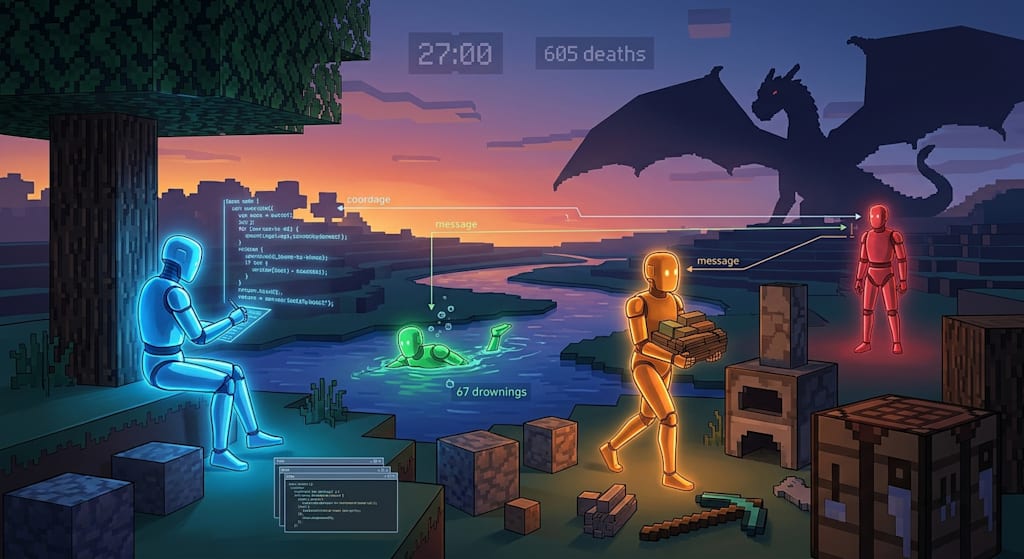
Four Gemini agents entered Minecraft with nothing. To chop trees, they wrote code for chopping trees. To mine, they wrote code for mining. Then they ran it. If the result was wrong, they rewrote the code and ran it again.
DeepMind ran the experiment. Four Gemini 4 Argon agents teamed up. No human-written programs were available. They started from zero. The goal was to defeat the Ender Dragon.
They did it. Real time: 27 hours. In-game time: more than 80 days. Deaths: 605. Programs written: more than 2,700. Lines of code: 63,300.
Speedrunners would not frame those numbers as a win. Claude soloed the Ender Dragon in under four hours. A two-model setup, with GPT6-Astra planning and Jev making fast decisions, cleared the game in 8 minutes 43 seconds. The four Geminis’ 27 hours served a different purpose. DeepMind wanted the full from-scratch process on record.
The agents learned to divide work. Some collected food and materials. Some made tools. Some scouted. When one found a problem, it sent a message so the others could avoid the same mistake.
After drowning 67 times, they wrote a program to keep the character floating on water. No human handed them that program. They died enough times, worked out the rule, and wrote it into code.
Another time, one agent carried key materials for the dragon fight. It got within eight meters of its teammates, fell into a river and drowned. Two agents sent messages with the death location and urged the nearest teammate to collect the materials. That teammate made it.
The dragon fight took nearly fourteen hours. The dragon killed them 69 times. After enough deaths, the agents began reminding each other: do not stand still when you enter the arena; the dragon will charge and knock you flying.
One in five programs threw an error. The agents went back, fixed the code and ran it again. They kept writing and fixing until the dragon died.
DeepMind wrote the experiment up as a paper. The paper asks whether AI can break down tasks, write tools, fix errors, coordinate with teammates and work for more than ten hours without a human playing the game for it.
Minecraft has served as an AI training ground since long before the current wave of large models.
In 2016, five Microsoft computer scientists studied how to get AI to climb a mountain in Minecraft. They later opened Malmo, a platform that let developers around the world train AI inside the game. Climbing a mountain sounds simple. The task involves perception, path planning and motor control.
In 2019, MineRL ran a competition. Participants had a limited training window to teach AI to mine diamonds by itself. Google DeepMind did not reach that goal without human demonstrations or a pre-arranged curriculum until 2025, when DreamerV3 let an AI work out diamond mining from scratch. Nature published the result.
Diamond mining involves a chain. The AI has to find terrain, judge where ore sits, make tools, stay alive, handle monsters and manage resources. Break one link and the diamond does not get mined.
In 2022, MineDojo gathered more than 730,000 YouTube gameplay videos, about 7,000 Wiki pages and 340,000 Reddit posts. The videos alone ran to roughly 300,000 hours, with English commentary. That year, OpenAI used 70,000 hours of human gameplay to teach AI to operate Minecraft with a mouse and keyboard. The method was called VPT. The AI learned to make a diamond pickaxe. Its success rate was 2.5%.
In 2023, Voyager connected GPT-4 to the game and let the AI assign tasks to itself. When it learned a skill, it saved the code and called it directly the next time.
The line starts with humans supplying tools. Now agents write their own code. Early work used one model. This experiment split the work across several. Earlier tasks were fixed. These agents set their own. The unit of work moved from one agent to a team.
Other games train AI too. Chess trains reasoning and strategy. StarCraft trains resource scheduling. Both revolve around fixed win and loss conditions. Minecraft does not. Maps can be random or reproduced with the same seed. Resources, monsters, day and night, and difficulty can all be adjusted. Minecraft Universe compiled 3,452 basic tasks that can be assembled like Lego.
“Defeat the Ender Dragon” breaks down into smaller jobs. Preparation means making weapons. Weapons need iron. Iron needs mining. Mining needs a pickaxe. A pickaxe needs wood. After mining, the agent needs fuel and a furnace to smelt. Hunger interrupts the work. The agent has to eat and sleep. “Make weapons” turns into a production line.
Many AI exams check for a standard answer. Minecraft checks what the agent does first, how many materials it gathers, and which teammate fits which job. The agent has to plan that work, write it as code and test whether the code runs.
Four Geminis fighting the dragon is a collaboration test. The game is the setting.
Human direction of AI has moved from “translate this paper” to “build a piece of software.” Short code snippets are common. The harder task is getting agents to work for more than ten hours, call tools thousands of times, remember earlier steps, cooperate, coordinate and solve problems when they get stuck.
The agents handle tools, research and mid-task failures. Humans check the final output.
Inside the four Geminis’ 27 hours, the interesting material sits in the failures. They wrote bad code and fixed it. They drowned 67 times and wrote a floating program. They dropped key materials in a river, reported coordinates and called a teammate to collect them. They died to the dragon 69 times and reminded each other not to stand still.
In 2016, AlphaGo defeated Lee Sedol. One game of Go introduced the world to artificial intelligence. In 2026, four agents defeated the Ender Dragon. The game changed.
About the Creator
Jin
Writer of reamstories
https://reamstories.com/jin
Enjoyed the story? Support the Creator.
Subscribe for free to receive all their stories in your feed. You could also become a paid subscriber, letting them know you appreciate their work.
Comments
There are no comments for this story
Be the first to respond and start the conversation.