
Fire Sprinklers Market Set to Surpass US$ 21 Billion by 2033 as Global Focus on Building Safety Intensifies
Rising Urbanization, Strict Fire Safety Regulations, and Smart Fire Protection Technologies Are Transforming the Global Fire Sprinklers Industry

Fire safety has become one of the most important priorities in modern infrastructure development. As cities continue to expand, commercial complexes grow larger, and industrial facilities become more sophisticated, the need for advanced fire protection systems has never been greater. Among these systems, fire sprinklers remain one of the most effective and widely adopted solutions for minimizing fire-related damages and protecting lives.
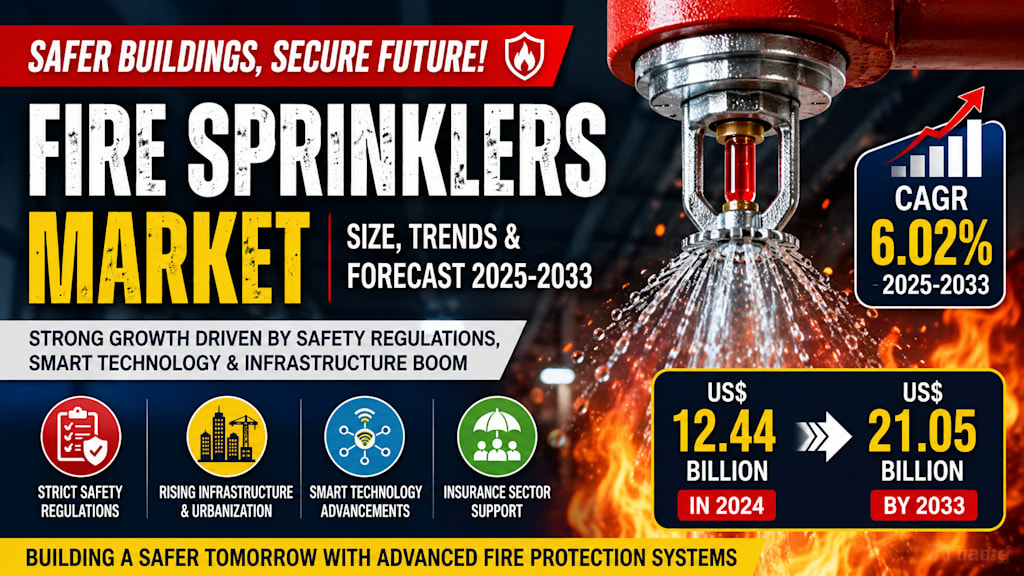
According to Renub Research, the global Fire Sprinklers Market is projected to grow from US$ 12.44 billion in 2024 to US$ 21.05 billion by 2033, expanding at a CAGR of 6.02% between 2025 and 2033. The market's steady growth reflects increasing awareness regarding fire safety, evolving building regulations, technological advancements, and growing investments in commercial and residential infrastructure worldwide.
Why Fire Sprinkler Systems Are More Important Than Ever
Fire incidents continue to cause significant human and economic losses globally. Modern fire sprinkler systems provide a proactive approach to fire suppression by automatically detecting and controlling fires before they spread extensively.
Unlike manual firefighting methods, sprinkler systems activate rapidly when high temperatures are detected, reducing damage to property and minimizing threats to occupants. This capability has made them a critical component of contemporary fire protection strategies.
Governments, businesses, and property owners increasingly recognize that investing in fire suppression systems is not merely a regulatory requirement but also a long-term risk management strategy.
Rapid Urbanization Is Creating New Opportunities
One of the most influential factors driving the fire sprinklers market is global urbanization. According to United Nations estimates, nearly 68% of the global population is expected to live in urban areas by 2050.
As cities expand, demand for residential complexes, office buildings, shopping centers, airports, hospitals, schools, warehouses, and manufacturing facilities continues to rise. These structures require comprehensive fire safety systems to meet building codes and protect occupants.
Urban environments naturally present higher fire risks because of population density and increased concentration of valuable assets. Consequently, governments and developers are integrating advanced fire protection systems into construction projects from the earliest design stages.
The ongoing construction boom across emerging economies in Asia-Pacific, the Middle East, and Latin America is expected to generate substantial demand for fire sprinkler installations over the coming decade.
Strict Fire Safety Regulations Continue to Drive Market Growth
Government regulations remain one of the strongest catalysts behind market expansion.
Many countries have established comprehensive fire safety standards that require sprinkler installations in commercial buildings, industrial facilities, educational institutions, healthcare facilities, and increasingly in residential structures.
In the United States, standards developed by the National Fire Protection Association (NFPA), particularly NFPA 13, have become critical benchmarks for fire sprinkler system design and implementation.
Failure to comply with fire safety regulations can result in legal penalties, increased insurance costs, and heightened liability risks. As a result, building owners and developers increasingly prioritize compliance through investment in advanced fire protection technologies.
Regulatory frameworks continue to evolve as authorities seek to improve public safety, creating new opportunities for manufacturers and service providers operating within the fire sprinkler industry.
Insurance Companies Are Encouraging Adoption
The insurance industry plays a major role in promoting fire sprinkler installations.
Insurance providers often offer premium discounts to properties equipped with certified fire suppression systems. These incentives make fire sprinkler investments financially attractive for property owners while reducing insurers' exposure to fire-related claims.
In high-risk environments such as manufacturing plants, warehouses, data centers, and large commercial facilities, sprinkler systems are often viewed as essential risk mitigation measures.
Furthermore, insurers frequently collaborate with regulatory agencies and safety organizations to develop best practices for fire prevention and loss reduction. Their influence continues to support broader adoption of fire sprinkler systems across multiple sectors.
Technological Innovations Are Transforming Fire Protection
The fire sprinkler industry is experiencing significant technological advancements that are improving performance, efficiency, and reliability.
Modern systems increasingly incorporate smart sensors, Internet of Things (IoT) capabilities, real-time monitoring, and automated control functions. These innovations enable faster detection of fire hazards and more precise system responses.
Smart sprinkler systems can communicate directly with building management platforms, allowing facility managers to monitor system status remotely and receive immediate alerts regarding potential issues.
Advanced technologies also help reduce false alarms, optimize water usage, and improve maintenance planning, resulting in greater operational efficiency.
As smart buildings become more common worldwide, intelligent fire protection systems are expected to become a standard component of integrated building management solutions.
Commercial Sector Remains a Key Revenue Generator
Commercial buildings represent one of the largest application segments within the fire sprinklers market.
Office towers, shopping malls, hotels, hospitals, educational institutions, and entertainment venues all require robust fire safety systems to protect large numbers of occupants.
Increasing investments in commercial real estate development, particularly in emerging economies, continue to generate strong demand for sprinkler installations.
Additionally, businesses increasingly view fire safety as part of their broader environmental, social, and governance (ESG) commitments. Ensuring occupant safety and business continuity has become a strategic priority for organizations across industries.
Industrial Facilities Depend on Reliable Fire Suppression
Industrial facilities often face elevated fire risks due to the presence of combustible materials, heavy machinery, chemicals, and complex manufacturing processes.
Fire sprinkler systems provide a critical layer of protection in factories, warehouses, logistics centers, and energy facilities.
The growth of e-commerce has further accelerated demand for fire protection systems in large distribution centers and fulfillment warehouses. These facilities store substantial inventories that require effective protection against fire-related losses.
As industrial automation continues to advance, safeguarding critical infrastructure through reliable fire suppression technologies remains an essential requirement.
Residential Adoption Is Increasing Worldwide
Historically, fire sprinkler systems were most commonly associated with commercial and industrial properties. However, residential adoption is growing rapidly.
Governments and fire safety authorities increasingly advocate for sprinkler installations in apartment buildings, residential towers, and large housing developments.
Growing awareness among homeowners regarding fire risks and property protection is also contributing to increased demand.
Residential fire sprinkler systems provide an additional layer of safety that can significantly reduce fatalities and property damage during emergencies. As awareness continues to grow, residential installations are expected to become an increasingly important market segment.
Challenges Facing the Fire Sprinklers Industry
Despite its strong growth outlook, the fire sprinklers market faces several challenges.
High Installation Costs
Initial installation expenses remain a major concern, particularly for small businesses and residential property owners.
Costs can vary significantly depending on building size, system complexity, labor requirements, and integration needs. Retrofitting older buildings often presents additional challenges and expenses.
Beyond installation, ongoing inspection, testing, maintenance, and repair costs can create long-term financial commitments that discourage some property owners from investing in sprinkler systems.
Regulatory Complexity
Fire safety regulations differ considerably across countries and regions.
Manufacturers and service providers must navigate diverse compliance requirements, certification standards, and installation guidelines. This complexity increases operational costs and can delay project implementation.
For companies seeking international expansion, adapting products and services to local regulations often requires significant resources and expertise.
Regional Market Insights
United States
The United States remains one of the most mature and influential fire sprinkler markets globally.
Strong regulatory frameworks, advanced construction standards, widespread awareness of fire safety, and insurance incentives support continued market growth.
Technological innovation also remains a major driver. Smart sprinkler systems and integrated fire protection solutions are gaining popularity across commercial and industrial applications.
The country's extensive infrastructure modernization efforts and focus on building safety continue to create new growth opportunities.
United Kingdom
The United Kingdom is witnessing growing demand for fire sprinkler systems following increased scrutiny of building safety regulations.
Government initiatives promoting automatic fire suppression systems in residential and commercial buildings have accelerated adoption.
Retrofit projects designed to improve fire safety compliance in older structures are also contributing to market expansion.
India
India's fire sprinkler market is experiencing significant growth due to rapid urbanization, infrastructure development, and increasing awareness of fire safety.
The construction of high-rise residential towers, commercial complexes, shopping malls, and industrial facilities is driving demand for advanced fire protection systems.
Additionally, rising concerns regarding fire incidents caused by electrical faults and short circuits have strengthened regulatory enforcement and encouraged broader adoption of sprinkler technologies.
United Arab Emirates
The UAE continues to emerge as an important market for fire sprinkler systems.
Large-scale construction projects, smart city initiatives, and strict safety regulations are creating strong demand for advanced fire protection solutions.
High-rise buildings, luxury residential developments, commercial complexes, and industrial facilities increasingly rely on sophisticated sprinkler systems to meet safety standards and protect valuable assets.
Ten Recent Developments Shaping the Fire Sprinklers Industry
1. Plumis Expands into the United States
In September 2024, Plumis partnered with Ferguson to introduce its Automist fire suppression technology to the U.S. market.
2. AGF Manufacturing Launches PURGENVENT™ Model 7940 BLE
In April 2025, AGF introduced an advanced air vent assembly designed to improve wet sprinkler system performance.
3. BAFSA Introduces Online Fire Sprinkler Training Program
The British Automatic Fire Sprinkler Association launched a CPD-recognized educational platform for industry professionals.
4. Honeywell Enhances Smart Building Fire Safety Solutions
Honeywell continues integrating AI-powered monitoring capabilities into building safety systems.
5. Johnson Controls Expands Connected Fire Protection Portfolio
The company has strengthened its focus on intelligent fire suppression and remote monitoring technologies.
6. Minimax Advances Industrial Fire Protection Systems
Minimax continues developing specialized fire suppression solutions for high-risk industrial environments.
7. Bosch Expands IoT-Based Safety Technologies
Bosch is investing in connected building technologies that improve fire detection and response capabilities.
8. Hochiki Strengthens Global Fire Detection Integration
The company is enhancing compatibility between fire detection and sprinkler control systems.
9. API Group Increases Fire Protection Service Investments
API Group continues expanding inspection, maintenance, and compliance services worldwide.
10. Smart Sprinkler Adoption Accelerates Globally
Multiple manufacturers are incorporating cloud connectivity, predictive maintenance, and real-time monitoring into next-generation sprinkler systems.
The Future of Fire Sprinklers Is Smart, Connected, and Essential
The future of the fire sprinkler market appears exceptionally promising. Growing urbanization, stricter regulations, expanding infrastructure projects, and increasing awareness regarding fire safety will continue driving demand worldwide.
The integration of smart technologies, IoT connectivity, predictive analytics, and automated monitoring capabilities will further enhance system effectiveness while reducing operational costs.
As governments, businesses, and homeowners place greater emphasis on protecting lives and property, fire sprinkler systems will remain at the center of modern fire safety strategies.
Final Thoughts
Fire safety is no longer viewed solely as a regulatory obligation—it has become a critical investment in resilience, risk management, and public protection. With the global Fire Sprinklers Market projected to reach US$ 21.05 billion by 2033, the industry is entering a period of sustained expansion and technological transformation.
Organizations that embrace innovative fire protection technologies while maintaining compliance with evolving safety standards will be best positioned to benefit from this growing market. As urban development accelerates and smart buildings become more prevalent, fire sprinkler systems will continue serving as one of the most reliable defenses against fire-related disasters.
About the Creator
Enjoyed the story? Support the Creator.
Subscribe for free to receive all their stories in your feed.
Comments
There are no comments for this story
Be the first to respond and start the conversation.