
Fintech App Development Cost: 2026 Pricing Guide
See the real fintech app development cost for 2026. From MVP budgets to hidden fees, we break down what you will actually pay to launch your financial app.


Building a money app right now feels like trying to fix a plane while flying. You want a piece of that $400 billion market revenue everyone talks about. But figuring out the actual fintech app development cost can make your head spin.
I remember my first attempt at a wallet app back in the day. We thought fifty grand would cover it. We were wrong. Dead wrong. By the time we handled security and bank links, we had burned through double that amount.
Most people give you vague ranges. I hate that. You need hard numbers to plan a business. In 2026, the price of entry has shifted because of AI and new regulations. Let us look at what you are really facing.
Counting Coins Before You Write Code
Setting a budget requires knowing your endgame. A simple budgeting tool costs less than a full crypto exchange. It sounds obvious, but many founders try to build a Swiss Army knife on a butter knife budget.
Minimum Viable Product vs Full Scale Builds
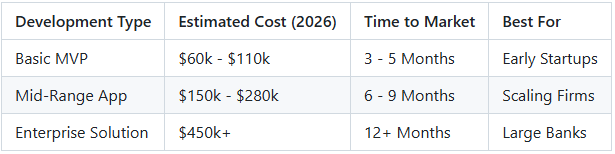
Starting small is usually the smartest move you can make. An MVP focuses on one core problem for your users. For a basic fintech app in 2026, expect to shell out between $60,000 and $110,000.
Building a full-scale platform is a different beast entirely. You are looking at $200,000 to $500,000 for something complex. These apps include multi-currency support and advanced AI spending predictions. Most successful founders I know start with the MVP to test the waters first.
Why Your Location Changes Everything Fast
Where your developers sit matters more than almost anything else. Hiring a team in San Francisco or London will drain your bank account faster than a hole in a bucket.
Stick with me.
High-end regions charge $150 to $250 per hour. If you look at fintech app development services New York, you will find top-tier talent who understand US banking laws. Check out fintech app development services New York if you need someone who knows the local regulatory hurdles inside out.
Choosing a team in Eastern Europe or India can drop those hourly rates to $40 or $80. I reckon a hybrid model works best for most. Keep your strategy close and your heavy coding offshore to save some serious cash.
Breakdown of Fintech App Development Cost
Every dollar you spend goes into specific buckets. You cannot just throw money at a screen and hope an app appears. It takes a mix of art and very boring math.
Design and User Experience Expenses Today
Fintech apps must look tidy and feel intuitive. People are skittish about their money. If the interface looks like a scam from 2005, they will delete it in seconds.
Expect to spend $15,000 to $25,000 on design alone. This covers user journeys, wireframes, and high-fidelity prototypes. A lush design helps build trust, which is the only currency that really matters in finance.
Back-End Security and Compliance Fees
This is the part that keeps me up at night. Security is not a feature; it is the foundation. You need encryption, multi-factor authentication, and secure cloud storage.
"Banking is no longer somewhere you go, it’s something you do." — Chris Skinner, Author and Fintech Expert, The Finanser.
Compliance with KYC and AML laws adds another layer of cost. You might spend $30,000 just on the back-end architecture to ensure you stay out of legal trouble. It is expensive, but cheaper than a fine from the feds.
Comparing Development Paths for Your Budget
The route you take determines the final bill. No two projects follow the same path. Some folks want custom builds, while others use pre-made blocks to get moving.
Hidden Expenses That Sneak Up on You
The initial build price is just the tip of the iceberg. I have seen great projects die because they forgot about the recurring bills. It is like buying a boat; the purchase is the easy part.
Here is the kicker.
API Integration and Third-Party Subscriptions
Your app needs to talk to banks and credit bureaus. Services like Plaid or Stripe are not free. They charge per transaction or per user.
Integrating these APIs can cost $10,000 in dev time. Then you have the monthly fees. If you have 10,000 users, those API calls start adding up to thousands of dollars every month.
Ongoing Maintenance and Server Costs
Software rots if you do not touch it. Operating systems update, and libraries get old. You should budget 20% of your initial build cost for yearly maintenance.
If your app cost $200,000 to build, prepare to spend $40,000 every year just to keep the lights on. This includes server hosting, bug fixes, and small security patches. I know it sounds steep, but a broken app is a dead app.
"Generative AI is shifting fintech costs from front-end to data infrastructure. Spend on data is the new spend on UI." — Lex Sokolin (@lexsokolin), Fintech Analyst.
Smart Ways to Save Without Cutting Corners
You do not need to be a billionaire to launch a successful app. You just need to be canny with your resources. I have learned a few tricks over the years to keep costs down.
Choosing the Right Tech Stack for 2026
React Native and Flutter are still king for cross-platform builds. Instead of hiring two teams for iOS and Android, you hire one. This can save you nearly 40% on labor costs.
Using serverless architecture also helps. You only pay for the computing power you actually use. It is a braw way to handle spikes in traffic without paying for idle servers all night.
Outsourcing vs In-House Team Realities
Building an in-house team is hella expensive. You have salaries, benefits, and office space to cover. For a startup, that is usually a mistake.
Real talk.
Outsourcing to a dedicated agency gives you access to senior talent without the long-term overhead. You can scale the team up or down based on your current needs. Just make sure you find a partner who communicates well and does not go dark for weeks.
Future Outlook and Market Data for 2027
Looking ahead, the market shows no signs of slowing down. Analysts project the fintech space will reach nearly $480 billion by 2028. This growth means more competition and higher user expectations.
Right now, AI integration is becoming a standard requirement rather than a luxury. By 2027, I expect the baseline cost for a competitive app to rise as users demand hyper-personalized financial advice. What this means for you is simple: build with scalability in mind today or pay double to rewrite your code tomorrow.
Common Questions About Fintech Project Pricing
Q: How much does it cost to build a banking app like Chime?
A: Building a full neo-bank requires significant investment. You are looking at $300,000 to $600,000 for the initial launch. This covers the app, complex ledger systems, and heavy regulatory compliance modules.
Q: Can I build a fintech app for under $50,000?
A: It is possible but very difficult. You would likely need to use no-code tools or very basic white-label solutions. These often lack the security and custom feel needed to win over users in 2026.
Q: Why is fintech development more expensive than social media apps?
A: The main reason is security and regulation. Money apps require intense encryption and audits that social platforms do not. One small bug in a financial app can lead to massive legal liabilities and lost user funds.
Q: How long does it take to get a price estimate?
A: Most agencies can give you a rough ballpark in a few days. However, a detailed quote requires a full discovery phase. This usually takes two weeks and involves mapping out every single feature and integration point.
Conclusion
Building your vision takes time and a fair bit of cash. But if you plan right, the fintech app development cost is an investment that can pay off massively. Just do not skimp on the security, mate. It is not worth the risk. Actually, scratch that. It is never worth the risk when people's life savings are on the line.
Keep your head down and your code clean. You will be alright. Tara a bit!
About the Creator
Enjoyed the story? Support the Creator.
Subscribe for free to receive all their stories in your feed.
Comments
There are no comments for this story
Be the first to respond and start the conversation.