
Figma's Blurring The Line Between Design And Code And It's About Time
A design tool that lets you write actual code, generate animations without leaving the app, and have AI build plugins for you. The designer-engineer handoff is basically collapsing.


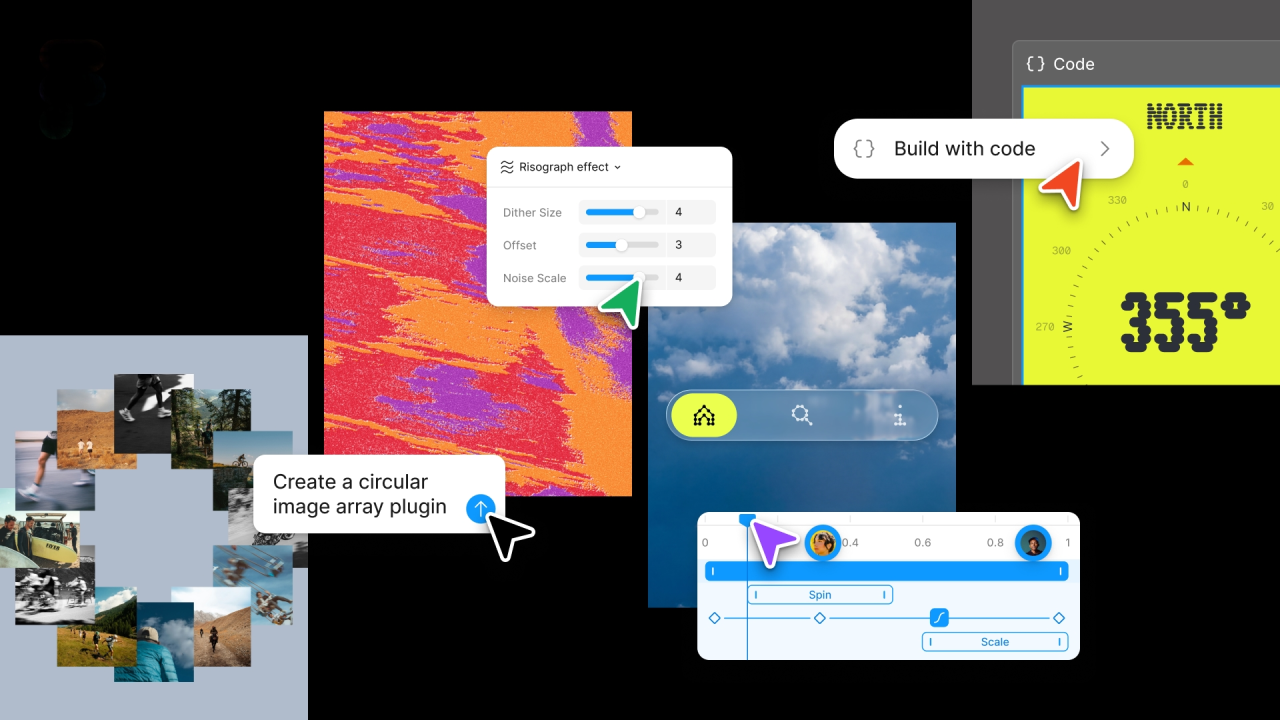
Figma added a bunch of features on Wednesday, and on the surface, they sound incremental: code layers, animation support, more AI tools. But they're actually addressing a real friction point that's existed for years, the awkward moment when a designer finishes something and has to hand it off to an engineer who has to reinterpret everything.
What Figma's doing is basically saying: why do those have to be separate processes at all?
The Designer-Engineer Handoff Is Still Broken
You've probably seen this if you've worked on product teams. Designer finishes a beautiful mockup in Figma. Hand it off to the engineer. The engineer opens it, sees the layers, the animations, the interactions, and realizes: none of this code exists yet. They have to rebuild everything from scratch, and usually in a different way than the designer intended.
Figma's been trying to fix this for a while. Last year, they added integrations with Claude Code and OpenAI's Codex so you could generate code from designs. They launched Figma Make for AI-powered prototyping. All of it was moving in one direction: closer to actual code.
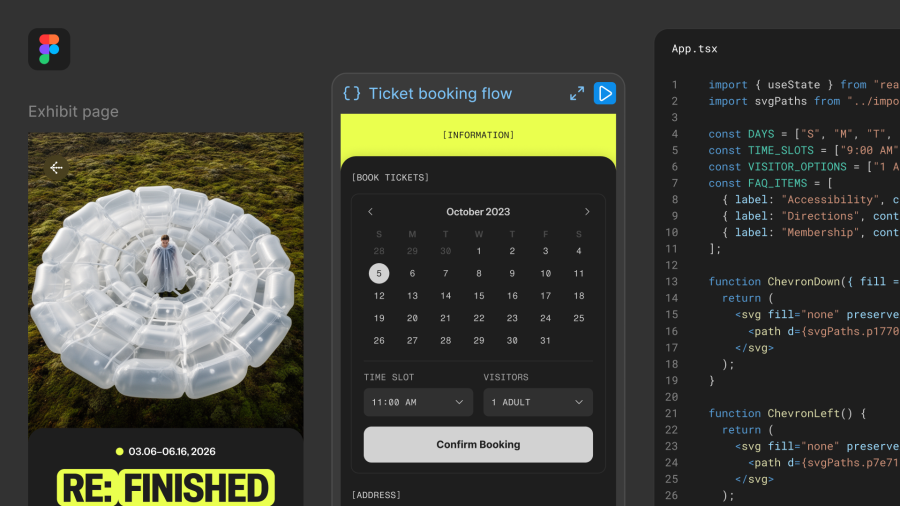
This update goes further. Code layers let you import code directly into Figma. Clone a repository. Extract the actual code flows and turn them into design layers. Work on real code inside a collaborative canvas instead of inside some separate IDE.
What Actually Changed
Code layers are the headline, but the deeper move is that Figma is collapsing the distinction between "design artifact" and "thing you're actually shipping."
Previously, you designed something. Your designer made it look good. Your engineer implemented it. If the implementation didn't match the design, that was just... how it worked. The design was aspirational. The code was reality.
Now you can have both in the same place. An engineer can look at the design, work on the actual code in Figma alongside the designer, and they're looking at the same thing the whole time. The code layers exist on the collaborative canvas, which means everyone sees what's happening in real-time.
Figma's CPO Yuhki Yamashita framed it as: "We think the multiplayer canvas is really powerful because this is an environment where you don't really care about the quality of the code. If you're rapidly exploring or need to explore new directions, you can do that in this spatial way."
Translation: stop treating the handoff as a formal gate. Make it collaborative and iterative.
Animations Finally Don't Require A Separate Tool
Previously, designers had to create animations in After Effects or some other tool, then export them as code that Figma could understand. Which is stupid. You're making something, exporting it, importing it, hoping it works correctly.
Now Figma supports animations, transitions, and 3D transforms natively. You design the animation in Figma. It works. The engineer doesn't have to reverse-engineer what you meant.
And you can use AI to generate the animations. Write a prompt like "fade in on scroll," and the AI creates it. You can also use AI to generate shader effects and fill the visual stuff that's tedious to build by hand.
The AI Piece Is Getting Smarter
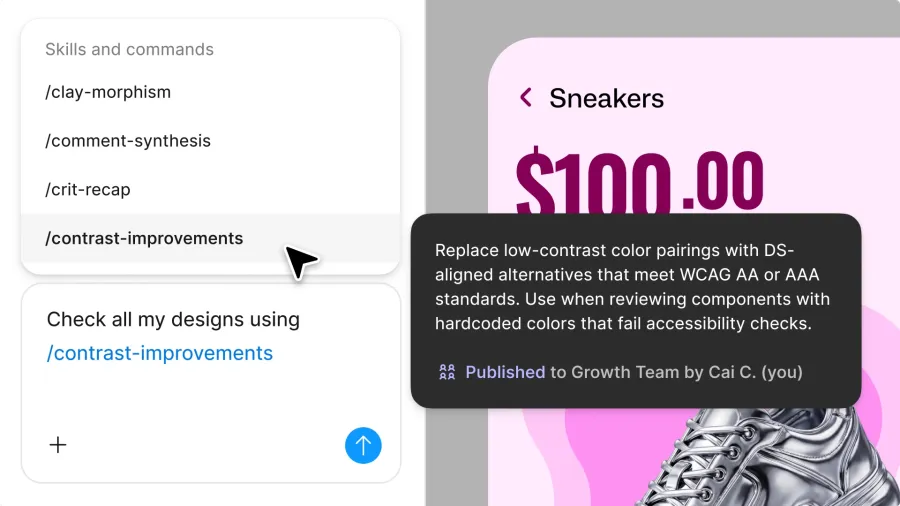
Figma's AI assistant now has more capabilities. You can write text prompts to create "repeatable skills" that the AI can use. You can connect it to external tools, such as Notion, Excel, GitHub, and Granola, so it has context about what you're trying to build.
They acquired Weavy last year (a tool for running design workflows through different AI models and comparing outputs), and they're integrating it so you can generate Weavy workflows directly in Figma. Eventually, you'll be able to create custom plugins using prompts instead of having to code them manually.
This is the direction design tools are moving: the tool becomes an intermediary between human intent and generated assets. You describe what you want. The AI builds it. You iterate.
Why This Matters Beyond Feature Parity
The real story is that Figma's trying to own the entire product development cycle. Not just design. Design plus code plus prototyping plus asset generation. All in one place.
That's valuable because it reduces context switching. Right now, you're in Figma, then you're in VS Code, then you're in your AI code generator, then you're back in Figma. Each switch costs cognitive load. If everything lives in Figma, the cost of coordination drops.
It also means designers can do more without waiting for engineers. Need a quick prototype with animations? Build it in Figma without coding. Want to explore a bunch of directions with different shader effects? Use AI to generate them and compare.
The Engineering Angle
This is also trying to make engineers less hostile to design-heavy processes. Engineers historically see Figma as "the thing designers use to make my job harder by designing something I can't actually build." Now Figma's saying: you can work in here too. You can write code. You can see what the designer is thinking in real-time. You can collaborate instead of handing off.
That changes the dynamic. If engineers can work in Figma alongside designers, they're not waiting for perfect design specs. They're iterating. They're catching problems early. They're building with the designer rather than against them.
The Bigger Picture
Figma's essentially trying to become a full-stack design-to-code platform. Not just the canvas where designers work. The entire flow from idea to shipped product. That's ambitious because it requires handling design, code, AI generation, plugin architecture, and external integrations, all at the same level of quality.
But if they pull it off, they've basically made all the other tools in that workflow optional. You design in Figma. You code in Figma. You prototype in Figma. You generate assets with AI in Figma. Everything's in one place.
The Catch
This only works if teams actually use it that way. Plenty of engineering teams have their own workflows, their own tools, their own preferences. Getting them to work inside Figma is a social problem, not a technical one.
Figma is betting that if the tool is good enough and the workflow is smooth enough, teams will adopt it because it's more efficient than the alternative. That's probably true for well-functioning teams. It's definitely not true for teams that are already deeply invested in their current setup.
Figma's moving from "design tool" to "product development platform." Code layers, animations, AI-powered asset generation, plugin creation, it's all pointing in one direction: you should be able to go from idea to shipped product without leaving Figma.
That's not revolutionary technology. It's just reducing friction. But friction is expensive. Every handoff costs time. Every context switch costs clarity. Every tool switch costs coordination.
If Figma eliminates those, that's actually valuable. Whether teams will actually use it that way is a different question. But at least the tool's trying to solve the real problem instead of just adding more features.
About the Creator
Mark Lim
Hi I am mark an automotive student and a car, tech and food enthusiast ! Im gonna try and post daily & hope you enjoy what I write and do share my page with people you know. I would gladly appreciate it! Cheers
Enjoyed the story? Support the Creator.
Subscribe for free to receive all their stories in your feed.
Comments
There are no comments for this story
Be the first to respond and start the conversation.