
EV Charging Station Market Set to Reach US$161.1 Billion by 2034 as Global Electric Mobility Accelerates
Government investments, technological breakthroughs, and rising EV adoption are transforming charging infrastructure into one of the world's fastest-growing industries.

The global transition toward cleaner transportation is no longer a distant vision—it is happening now. Electric vehicles (EVs) are becoming increasingly common on roads worldwide, driven by environmental concerns, rising fuel costs, and supportive government policies. Yet behind every electric vehicle lies an essential piece of infrastructure that often receives less attention: the charging station.
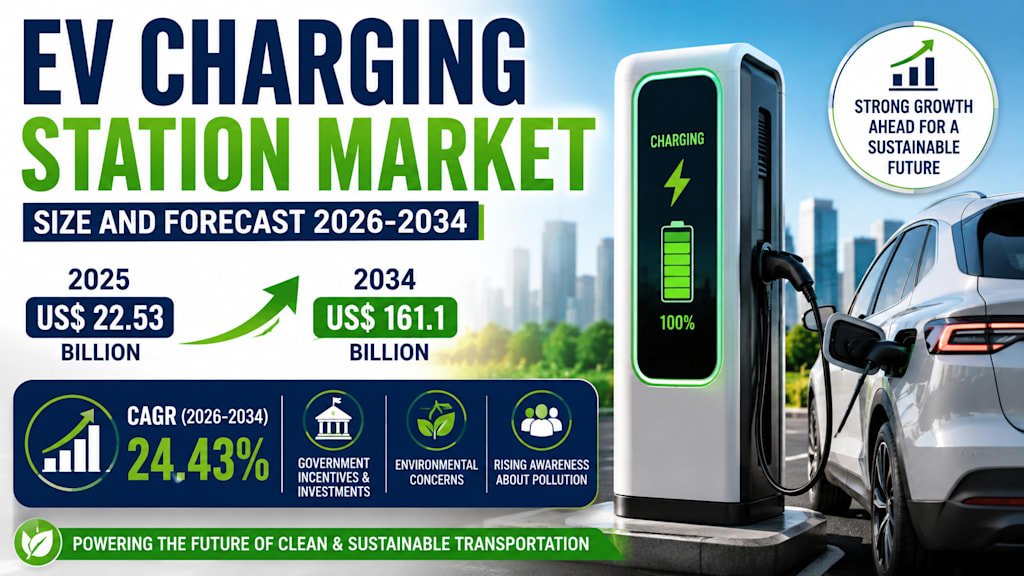
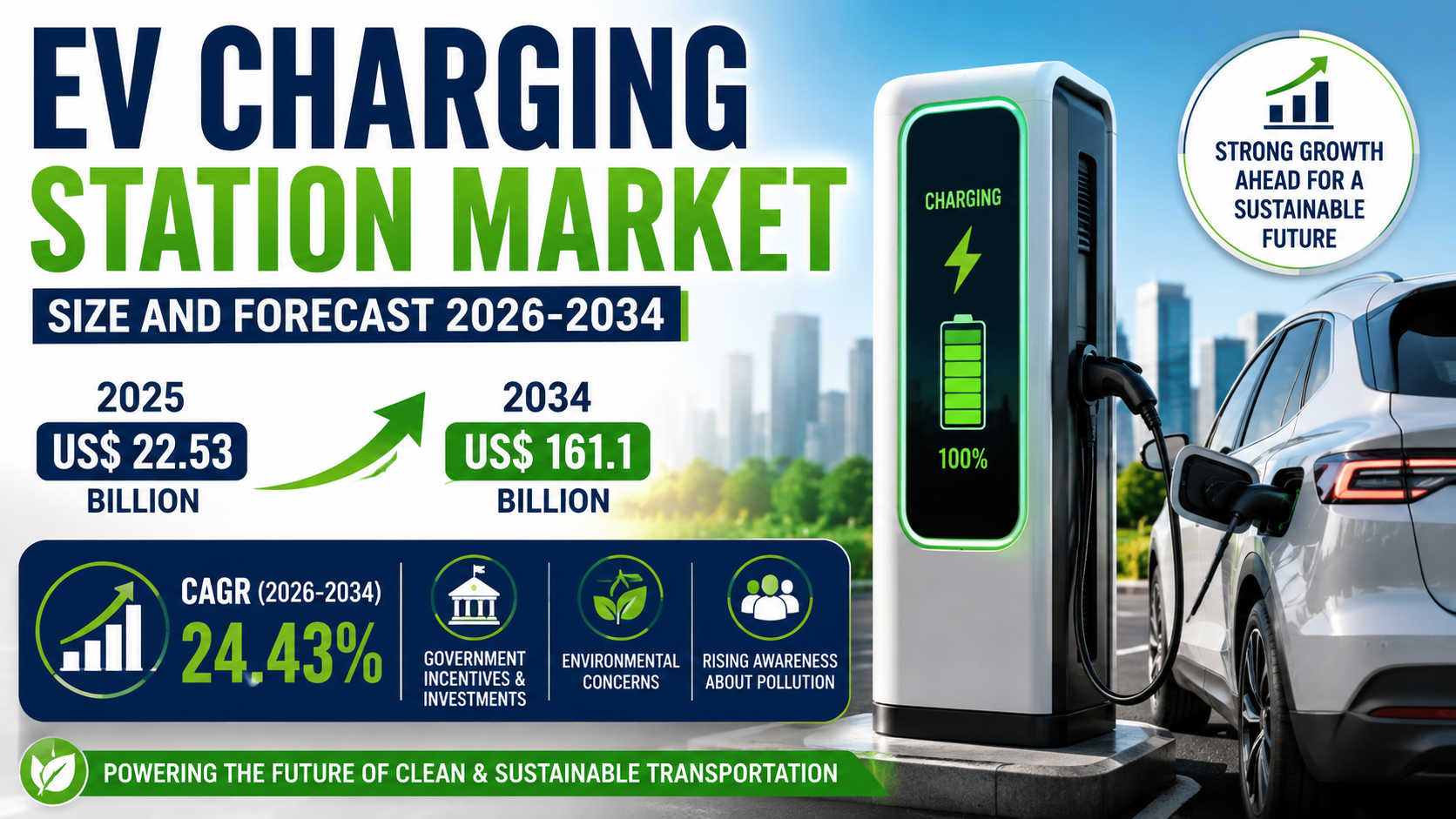
As electric mobility continues to gain momentum, charging networks are expanding rapidly to meet growing demand. According to Renub Research, the global EV Charging Station Market is expected to grow from US$22.53 billion in 2025 to an impressive US$161.1 billion by 2034, registering a compound annual growth rate (CAGR) of 24.43% between 2026 and 2034. These figures highlight not only the growing popularity of electric vehicles but also the critical importance of building a robust charging ecosystem capable of supporting future transportation needs.
Why EV Charging Infrastructure Matters
Electric vehicles cannot achieve mass adoption without convenient, reliable, and accessible charging infrastructure. While consumers may be attracted by lower operating costs, environmental benefits, and advanced vehicle technologies, their purchasing decisions often depend on one key question: "Where will I charge my vehicle?"
EV charging stations provide the answer.
These stations supply electricity to battery-electric vehicles, plug-in hybrid vehicles, electric buses, and increasingly, electric two-wheelers. Depending on charging speed and technology, stations are typically categorized into Level 1, Level 2, and DC fast charging systems.
The growing network of charging stations is making electric transportation more practical for everyday users. Whether installed in homes, workplaces, shopping centers, parking lots, or highways, charging stations are becoming an essential part of modern infrastructure.
As governments pursue carbon reduction goals and consumers seek cleaner transportation alternatives, charging networks are emerging as the backbone of the global electric mobility revolution.
The Surge in Electric Vehicle Adoption
One of the strongest forces driving the EV charging station market is the explosive growth of electric vehicle sales worldwide.
Electric vehicles have moved beyond the early-adopter stage and entered mainstream markets. Consumers are increasingly choosing EVs because of lower fuel costs, reduced emissions, government incentives, and advancements in battery technology.
Global electric vehicle sales exceeded 17 million units in 2024, accounting for approximately 20% of all vehicle sales worldwide. China alone contributed around 11 million EV sales, reinforcing its leadership position in the global electric vehicle market.
As more electric vehicles enter the roads, demand for charging infrastructure rises proportionally. Every new EV owner requires access to dependable charging solutions, creating substantial opportunities for charging station operators, equipment manufacturers, energy providers, and technology developers.
This relationship between EV adoption and charging infrastructure creates a powerful cycle of growth. More vehicles encourage more charging stations, while more charging stations make electric vehicles increasingly attractive to consumers.
Government Policies Are Fueling Growth
Public policy has become a major catalyst for charging infrastructure development.
Governments around the world recognize that transportation accounts for a significant portion of greenhouse gas emissions. To meet climate targets and improve air quality, many nations are actively encouraging electric vehicle adoption through subsidies, tax incentives, grants, and infrastructure investments.
Countries across North America, Europe, and Asia-Pacific are allocating billions of dollars toward expanding charging networks. In many regions, governments have also announced timelines to phase out gasoline and diesel-powered vehicles, creating long-term certainty for investors and infrastructure developers.
Public-private partnerships have become especially important in accelerating deployment. Government support reduces financial barriers while private companies contribute innovation, operational expertise, and capital investment.
These collaborative efforts are helping establish charging networks in urban centers, suburban communities, transportation corridors, and rural regions that previously lacked adequate infrastructure.
As climate commitments become more ambitious, government-backed charging initiatives are expected to remain a central growth driver throughout the next decade.
Technology Is Revolutionizing Charging Experiences
Rapid technological advancement is reshaping the charging station industry.
In the early years of electric mobility, lengthy charging times represented a major obstacle for consumers. Today, innovations in charging technology are dramatically reducing wait times while improving convenience and efficiency.
DC fast charging systems can now replenish vehicle batteries significantly faster than traditional charging methods. Some advanced charging solutions allow vehicles to recover substantial battery capacity within minutes rather than hours.
Ultra-fast charging technology continues to push performance boundaries. Companies worldwide are investing heavily in next-generation charging platforms capable of delivering greater power outputs and shorter charging sessions.
Smart charging systems are also transforming energy management. These solutions optimize electricity consumption based on grid demand, pricing conditions, and renewable energy availability. Such capabilities improve operational efficiency while reducing strain on electrical networks.
Meanwhile, mobile applications are enhancing the customer experience by helping drivers locate available charging stations, monitor charging progress, reserve charging slots, and process payments seamlessly.
The integration of renewable energy sources such as solar and wind power further strengthens the environmental benefits of EV charging infrastructure. Combined with battery storage systems and smart-grid technologies, charging stations are evolving into sophisticated energy hubs rather than simple power outlets.
Fast Charging Emerges as a Key Market Segment
Among various charging technologies, fast charging stations are gaining particular attention.
Fast charging solutions use direct current (DC) technology to deliver large amounts of electrical energy directly to vehicle batteries. This significantly reduces charging times and makes electric vehicles more practical for long-distance travel and commercial operations.
Highway corridors, retail centers, transportation hubs, and urban charging locations are increasingly adopting fast charging systems to meet consumer expectations for speed and convenience.
For fleet operators, rideshare companies, delivery services, and logistics providers, minimizing vehicle downtime is essential. Fast charging stations provide a practical solution that helps maintain operational efficiency while supporting electrification goals.
As battery technologies continue to improve and charging speeds increase, fast charging infrastructure is expected to become a cornerstone of the global EV ecosystem.
The Continued Importance of AC Charging
Despite the excitement surrounding fast charging, AC charging stations remain highly relevant.
AC charging is particularly common in residential settings, workplaces, apartment complexes, and parking garages. Although charging speeds are slower than DC fast charging, AC systems are generally more affordable and easier to install.
For many EV owners, overnight charging at home satisfies daily transportation needs. This makes AC charging an economical and practical solution for routine vehicle use.
Governments and real estate developers are increasingly encouraging residential charging installations to support broader EV adoption. Smart charging capabilities also allow users to charge vehicles during off-peak electricity periods, helping reduce energy costs.
As urban populations continue to grow and electric vehicle ownership expands, AC charging infrastructure will remain an essential component of the overall charging landscape.
Portable Charging Solutions Gain Popularity
Another emerging trend within the industry is the growth of portable EV charging stations.
Portable charging devices provide flexibility and convenience for electric vehicle owners who may not always have access to traditional charging infrastructure. These lightweight systems can often connect to standard electrical outlets, offering a practical backup solution during travel or emergencies.
The demand for portable charging options is increasing among both individual consumers and commercial fleet operators. Drivers traveling through remote areas particularly value the reassurance that portable chargers provide.
Advancements in safety features, charging efficiency, and portability are making these products increasingly attractive. As EV ownership continues to expand globally, portable charging technologies are expected to play a growing role in supporting mobility and reducing range-related concerns.
Connected Charging Networks and Smart Cities
The rise of digitalization is creating new opportunities within the charging station industry.
Connected charging stations utilize cloud-based platforms, Internet of Things (IoT) technologies, and mobile applications to enable remote monitoring and management.
These systems provide significant benefits for both users and operators. Drivers can locate available charging stations, schedule charging sessions, monitor energy usage, and make digital payments. Operators gain access to valuable data that supports maintenance planning, performance optimization, and energy management.
Connected charging infrastructure also aligns closely with smart city initiatives. As cities become increasingly digitized, charging networks can integrate with broader energy systems, public transportation networks, and sustainability programs.
The combination of connectivity, automation, and data analytics is helping transform charging infrastructure into a more intelligent and efficient ecosystem.
Challenges That Still Need Attention
Despite strong growth prospects, the EV charging station market faces several challenges.
One of the most significant barriers remains the high cost of infrastructure deployment. Installing charging stations requires substantial investment in equipment, electrical upgrades, site preparation, and ongoing maintenance.
Fast charging systems, in particular, demand advanced technologies and robust electrical connections that can significantly increase project costs.
Another challenge is uneven infrastructure distribution. While major cities and developed markets have seen rapid expansion, many regions still lack adequate charging coverage.
This infrastructure gap contributes to "range anxiety"—the fear that an electric vehicle may run out of battery power before reaching a charging station. Range anxiety continues to influence consumer purchasing decisions and remains a key obstacle to broader EV adoption.
Compatibility concerns, charging wait times, and power grid limitations also require ongoing attention from industry stakeholders.
Addressing these challenges will require coordinated efforts among governments, utilities, technology providers, automakers, and charging network operators.
Regional Markets Show Strong Momentum
The United States is witnessing substantial investment in charging infrastructure, supported by both government initiatives and private-sector participation. Highway corridors, workplaces, apartment complexes, and urban centers are seeing significant deployment of both Level 2 and DC fast charging systems.
The United Kingdom continues expanding its charging network as it moves toward phasing out traditional combustion-engine vehicles. Public and private organizations are collaborating to install charging stations across residential, commercial, and transportation locations.
India represents one of the most promising emerging markets. Government programs, private investments, and increasing adoption of electric two-wheelers, three-wheelers, and public transportation vehicles are driving infrastructure development throughout the country.
Saudi Arabia is also investing in charging infrastructure as part of broader sustainability and economic diversification initiatives. Smart city development and strategic partnerships are supporting the gradual expansion of EV charging networks across the kingdom.
These regional developments demonstrate that EV charging infrastructure growth is truly global, creating opportunities across both developed and emerging economies.
Final Thoughts
The EV charging station market sits at the center of one of the most significant transportation transformations in modern history.
As electric vehicles continue replacing traditional combustion-engine vehicles, charging infrastructure will become as essential to mobility as gas stations have been for decades. The combination of government support, technological innovation, environmental awareness, and rising consumer demand is creating unprecedented growth opportunities across the industry.
With the market projected to expand from US$22.53 billion in 2025 to US$161.1 billion by 2034, the future of EV charging infrastructure appears exceptionally bright. While challenges such as infrastructure costs and range anxiety remain, continued investment and innovation are steadily addressing these barriers.
The coming decade will likely determine how quickly the world transitions toward sustainable transportation. If current trends continue, EV charging stations will not simply support that transition—they will help define it.
About the Creator
Enjoyed the story? Support the Creator.
Subscribe for free to receive all their stories in your feed.
Comments
There are no comments for this story
Be the first to respond and start the conversation.