
Europe Stationery and Supplies Market Set for Steady Growth as Schools, Offices, and Eco Trends Drive Demand Through 2034
From Classrooms to Corporate Desks, Europe’s Stationery Industry Reinvents Itself in a Digital Era

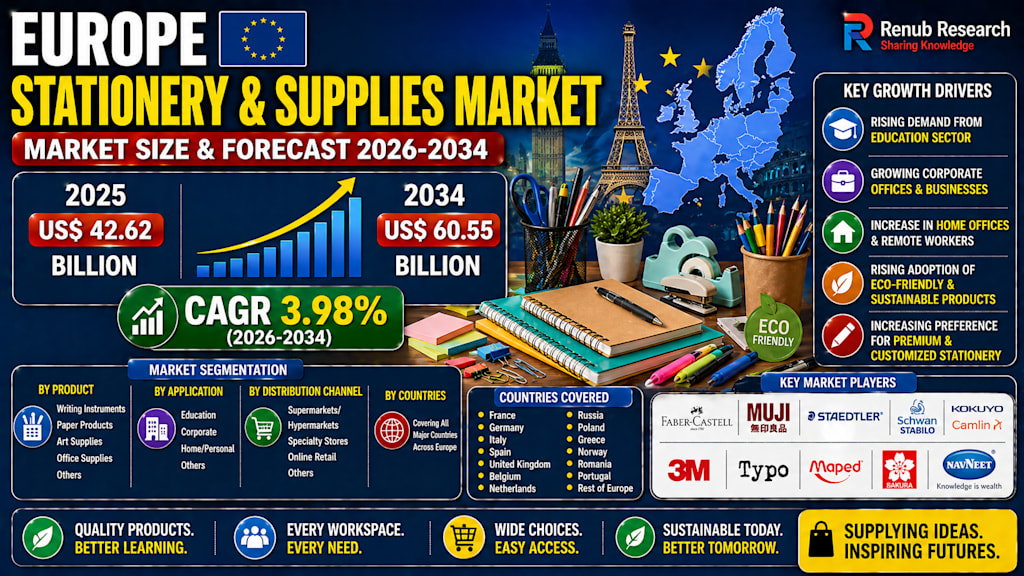
Europe may be living in a digital-first age, but the demand for notebooks, pens, printer paper, planners, and creative supplies remains surprisingly resilient. According to new industry insights from Renub Research, the Europe Stationery and Supplies Market is forecast to rise from US$ 42.62 Billion in 2025 to US$ 60.55 Billion by 2034, expanding at a CAGR of 3.98% from 2026 to 2034.
While many assumed technology would eliminate the need for physical stationery, the European market tells a different story. Schools still require learning materials, companies continue using office essentials, and households increasingly purchase planners, art kits, and home-office supplies. Add to that Europe’s growing love for sustainable and premium paper products, and the industry is entering a new phase of smart, profitable evolution.
Why Stationery Still Matters in a Screen-Dominated World
Stationery and supplies cover a broad product range—paper goods, notebooks, writing tools, folders, envelopes, markers, printers, inks, art materials, planners, and desk organization tools.
These items remain essential because many daily tasks still benefit from physical interaction. Students learn handwriting and note-taking. Businesses use printed documentation, presentations, and branded stationery. Individuals rely on planners, journals, and creative tools for productivity and wellness.
Instead of disappearing, stationery is adapting. Today’s consumers seek products that combine usefulness, aesthetics, and sustainability.
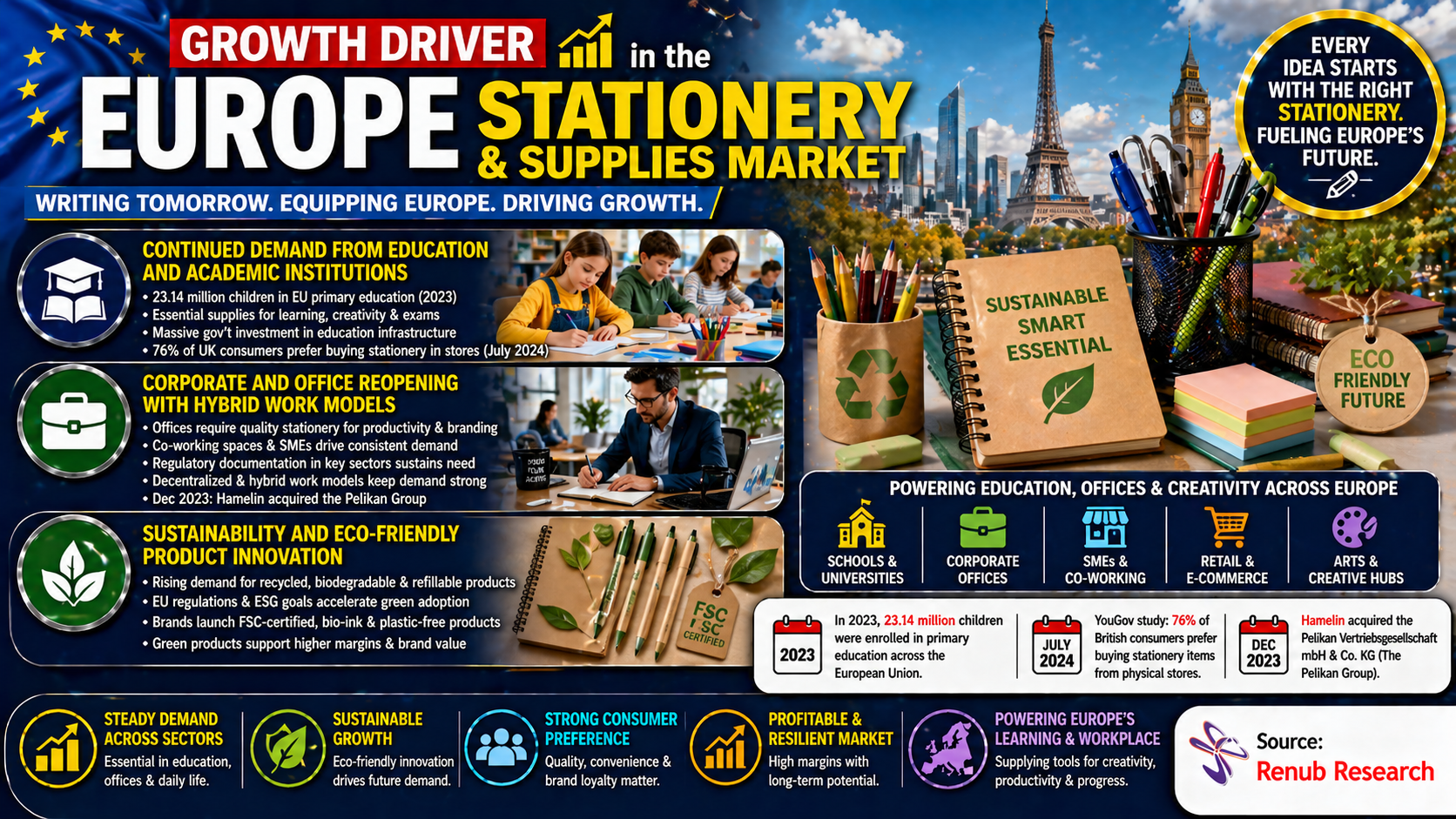
Growth Driver #1: Europe’s Education Sector Keeps Demand Strong
One of the strongest pillars supporting the stationery market is education. Europe has millions of students enrolled in schools, colleges, and universities, creating recurring demand for notebooks, pens, paper, exam sheets, and classroom supplies.
Renub Research notes that in 2023, primary education enrollment in the European Union reached approximately 23.14 million children, highlighting the scale of opportunity for suppliers.
Even as tablets and laptops enter classrooms, handwritten learning remains highly valued—especially in early education. Teachers continue recommending writing by hand for memory retention, spelling development, and concentration.
Back-to-school seasons remain some of the most profitable retail periods across Europe, generating strong annual sales for brands and retailers.
Growth Driver #2: Hybrid Work Has Created a New Office Supply Economy
Remote work was expected to reduce office stationery demand permanently. Instead, hybrid work has created two separate demand centers: the corporate office and the home office.
Professionals now buy:
- Premium notebooks
- Desk organizers
- Printer paper
- Pens and markers
- Diaries and planners
- Filing products
Businesses are also investing in branded stationery to maintain professional identity during client meetings and internal events.
Small and medium enterprises across Europe continue to rely on physical documentation, especially in finance, healthcare, manufacturing, and legal sectors. This ongoing need ensures office stationery remains commercially relevant.
Growth Driver #3: Sustainability Is Reshaping Consumer Choices
Perhaps the biggest transformation in the market is sustainability.
European consumers increasingly prefer:
- Recycled paper notebooks
- FSC-certified products
- Refillable pens
- Plastic-free packaging
- Biodegradable office items
- Reusable organizers
For many buyers, stationery is no longer just functional—it reflects values.
Schools, governments, and corporations with ESG goals are choosing greener procurement strategies. That creates pricing power for manufacturers offering environmentally responsible products.
Premium eco-friendly stationery is now becoming one of the industry’s fastest-growing categories.
Challenge #1: Digitalization Continues to Pressure Traditional Products
Despite its resilience, the industry faces real disruption.
Cloud storage, tablets, collaboration apps, e-signatures, and digital note-taking tools have reduced demand for some traditional paper products. Many companies aim for paperless operations to lower costs and improve sustainability.
Universities increasingly share digital materials. Corporate teams use project management software instead of printed planners. Students type notes on laptops.
This means low-innovation commodity paper products may struggle unless brands differentiate through quality, design, or sustainability.
Challenge #2: Raw Material Costs and Margin Pressure
Paper pulp, plastics, packaging, transport, and energy costs remain volatile across Europe. Since consumers and businesses are price-sensitive, companies cannot always pass on higher costs easily.
This creates pressure on manufacturers, wholesalers, and retailers.
Winning companies will likely focus on:
- Efficient sourcing
- Inventory control
- Smart packaging
- Product premiumization
- Direct-to-consumer online sales
- Sustainable differentiation
Paper Products Still Dominate the Market
Notebooks, copier paper, diaries, sticky notes, and folders remain the foundation of the European stationery market.
Demand remains particularly strong in:
- Schools
- Government offices
- Legal sectors
- Healthcare administration
- Home organization markets
While volumes may shift gradually, premium paper categories continue to grow. Consumers increasingly want thicker paper, elegant design, recycled materials, and durable binding.
This means the future of paper products may be smaller in volume—but stronger in value.
Art & Craft Supplies Are Quietly Booming
Another bright segment is art and craft products.
Across Europe, hobbies, creativity, mindfulness, and DIY culture are boosting demand for:
- Sketchbooks
- Paints
- Brushes
- Craft kits
- Colored markers
- Calligraphy tools
- Kids’ creative sets
Many consumers now see art as relaxation, therapy, or side-business potential. Parents also buy craft products for child development and screen-free activities.
This category often delivers higher margins than commodity stationery.
Offline Stores Still Hold Strong Power
Even in the age of e-commerce, physical stores remain highly relevant.
Consumers still prefer to inspect pens, paper texture, art supplies, and office products in person before purchasing. Schools and businesses also value immediate availability through nearby stores.
Popular offline channels include:
- Stationery shops
- Bookstores
- Supermarkets
- Office supply chains
- Hypermarkets
That said, online channels are growing rapidly, especially for repeat purchases, bulk buying, and premium niche products.
Germany Leads the Regional Market
Germany remains one of Europe’s most important stationery markets due to:
- Strong education infrastructure
- Large corporate sector
- Industrial documentation needs
- Preference for quality products
- High sustainability awareness
German buyers often prioritize performance, precision, and environmentally responsible products—creating strong opportunities for premium brands.
United Kingdom Balances Creativity and Hybrid Work
United Kingdom has a diverse stationery market driven by students, freelancers, remote workers, and younger consumers.
The country has seen rising demand for:
- Home-office supplies
- Themed notebooks
- Branded planners
- Eco-friendly products
- Online stationery subscriptions
The UK also has one of Europe’s strongest e-commerce ecosystems for stationery retail.
France Blends Writing Culture with Design Appeal
France continues to support premium stationery thanks to its appreciation for writing, aesthetics, and creative culture.
Elegant notebooks, fountain pens, art materials, and designer desk accessories remain popular. French consumers often value appearance as much as function, helping premium brands thrive.
Russia Remains Volume Driven
Russia continues to generate demand through schools, government institutions, and practical office needs.
Affordable notebooks, pens, folders, and paper goods dominate purchasing behavior, while children’s creative supplies are gradually expanding.
Key Companies Shaping the Industry
Major brands active across Europe include:
- Faber-Castell
- MUJI
- Staedtler
- Schwan Stabilo
- 3M
- Maped
These players compete through innovation, design, distribution reach, and sustainability commitments.
Final Thoughts
The Europe stationery and supplies market proves that digital transformation does not eliminate physical products—it reshapes them.
Consumers still need tools to learn, organize, create, and communicate. Businesses still require branded materials and documentation. Students still benefit from writing by hand. Artists and hobbyists still seek tangible creative tools.
As sustainability, hybrid work, and premiumization continue to rise, the sector is moving from basic commodity sales to value-driven growth.
According to Renub Research, reaching US$ 60.55 Billion by 2034 signals that stationery in Europe is far from obsolete—it is simply evolving into something smarter, greener, and more profitable.
About the Creator
Enjoyed the story? Support the Creator.
Subscribe for free to receive all their stories in your feed.
Comments
There are no comments for this story
Be the first to respond and start the conversation.