
Europe Smart Lock Market to Surpass US$ 3 Billion by 2033 as Smart Home Adoption Accelerates Across the Region
Rising Security Awareness, Smart Home Integration, and Digital Access Technologies Fuel Rapid Market Expansion

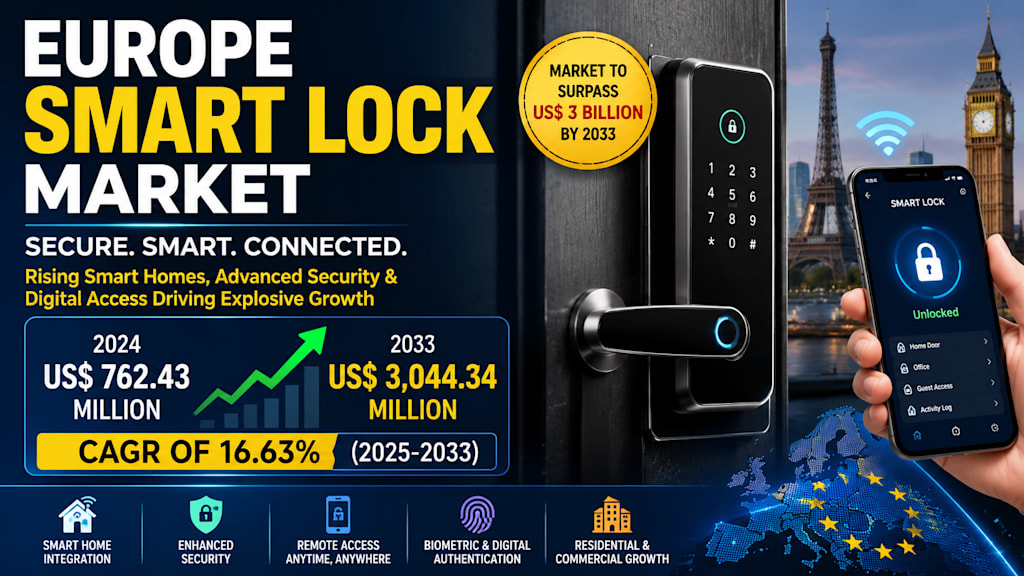
The Europe Smart Lock Market is entering a transformative growth phase as consumers, businesses, and governments increasingly embrace digital security solutions. According to Renub Research, the Europe Smart Lock Market is projected to grow from US$ 762.43 million in 2024 to US$ 3,044.34 million by 2033, expanding at an impressive CAGR of 16.63% during 2025–2033. The market’s strong growth trajectory reflects the rapid adoption of smart homes, rising concerns about property security, and ongoing technological advancements in access control systems.
Smart locks have evolved far beyond simple electronic locking mechanisms. Modern smart locks now integrate seamlessly with smartphones, voice assistants, security cameras, and home automation systems, allowing users to remotely control access to their properties. As digital lifestyles become increasingly common throughout Europe, smart locks are becoming an essential component of connected living environments.
Smart Locks Redefining Modern Security Standards
Traditional mechanical locks are gradually being replaced by intelligent locking systems that offer superior convenience and security. Smart locks enable homeowners and businesses to lock or unlock doors using smartphones, biometric authentication, digital codes, key cards, or cloud-based access management platforms.
The growing popularity of remote monitoring and access control is changing how Europeans manage security. Users can now receive real-time notifications whenever a door is opened, grant temporary access to guests or service providers, and monitor activity logs from anywhere in the world.
As concerns about burglary prevention and property protection continue to increase, smart locks are gaining traction among both residential and commercial users seeking advanced security solutions without sacrificing convenience.
Market Size Reflects Strong Growth Potential
Europe's smart lock industry is witnessing remarkable momentum due to the convergence of technological innovation and changing consumer preferences. According to Renub Research, the market is expected to increase nearly fourfold over the forecast period, highlighting significant opportunities for manufacturers, software developers, and smart home ecosystem providers.
Several macroeconomic and technological factors are contributing to this expansion:
Increasing smartphone penetration
Growth of connected home ecosystems
Rising urbanization rates
Higher disposable incomes
Strong government support for digital infrastructure
Expanding smart building projects
Growing awareness of home security technologies
These factors collectively create a favorable environment for widespread smart lock adoption across Europe.
Smart Home Automation Driving Demand
One of the strongest catalysts for market growth is the rapid adoption of smart home automation systems.
European consumers are increasingly investing in connected devices that offer convenience, energy efficiency, and enhanced security. Smart locks fit naturally into this ecosystem by integrating with devices such as smart doorbells, surveillance cameras, lighting systems, and voice-controlled assistants.
Users appreciate the ability to manage their homes remotely through centralized mobile applications. Whether unlocking doors for family members, checking security status while traveling, or creating temporary digital access credentials, smart locks provide flexibility that traditional locking systems cannot match.
As smart homes become mainstream across Europe, smart lock installations are expected to accelerate significantly.
Technological Innovation Strengthening Market Growth
Technology continues to be a major force behind the smart lock industry's evolution.
Manufacturers are introducing advanced features such as:
Fingerprint recognition
Facial authentication
AI-powered access management
Mobile app integration
Cloud-based monitoring
Bluetooth connectivity
Wi-Fi-enabled remote control
Voice assistant compatibility
Biometric authentication, in particular, is becoming increasingly popular because it offers a high level of security while eliminating the need for physical keys.
Improved wireless communication technologies are also enhancing user experience by providing seamless connectivity and real-time access management.
As innovation continues, smart locks are expected to become more secure, reliable, and user-friendly, further encouraging adoption among consumers and businesses alike.
Construction Boom Creating New Opportunities
The expansion of residential and commercial construction activities throughout Europe is creating additional demand for smart locking systems.
Modern residential developments increasingly incorporate smart technologies as standard features rather than luxury upgrades. Builders and developers recognize that connected security systems add significant value to properties and appeal to technology-oriented buyers.
Similarly, commercial buildings are adopting smart access control systems to improve operational efficiency and security management.
Hotels, office complexes, co-working spaces, healthcare facilities, and educational institutions are increasingly investing in digital locking solutions that streamline access control while reducing administrative costs associated with traditional key management.
The integration of smart locks into new construction projects is expected to remain a major growth driver over the coming decade.
Hospitality Industry Embracing Digital Access
The hospitality sector represents one of the fastest-growing application areas for smart locks.
Hotels and vacation rental operators are leveraging smart lock technologies to enhance guest experiences while improving operational efficiency.
Digital access systems enable:
Contactless check-in and check-out
Mobile key access
Temporary guest credentials
Enhanced security monitoring
Reduced staffing requirements
These benefits became particularly valuable following the pandemic, as consumers increasingly favored contactless interactions.
Hospitality operators across Europe continue to modernize their properties through smart lock deployments, contributing significantly to market growth.
Cybersecurity Remains a Key Challenge
Despite strong growth prospects, cybersecurity concerns remain a major obstacle for the industry.
Because smart locks rely on wireless communication protocols such as Wi-Fi and Bluetooth, they can become potential targets for cyberattacks if adequate security measures are not implemented.
Potential risks include:
Unauthorized access attempts
Signal interception
Software vulnerabilities
Data breaches
Mobile application exploitation
Consumers are increasingly aware of these risks and often evaluate cybersecurity features before purchasing smart security devices.
Manufacturers must therefore invest heavily in encryption technologies, secure firmware updates, and advanced authentication protocols to maintain customer trust and support long-term market growth.
Integration Issues Continue to Affect Adoption
Another challenge facing the market is interoperability.
Smart locks must often function within broader smart home ecosystems that include products from multiple manufacturers. Compatibility issues between platforms can create frustration for users and complicate installation processes.
Many European buildings, particularly older properties, were not originally designed to support connected technologies. Retrofitting such structures can involve additional costs and technical complexity.
The development of industry-wide standards and improved interoperability will be essential for accelerating market penetration in the years ahead.
Germany Leads Innovation and Adoption
Germany remains one of Europe's most influential smart lock markets.
The country's strong emphasis on innovation, engineering excellence, and digital transformation has created favorable conditions for smart security technologies.
German consumers are increasingly investing in connected homes and intelligent security solutions. The nation's expanding smart city initiatives and infrastructure modernization programs are also supporting greater deployment of digital access systems.
Growing awareness of energy-efficient and sustainable technologies further complements smart lock adoption, positioning Germany as a major contributor to regional market growth.
United Kingdom Market Expanding Rapidly
The United Kingdom is witnessing substantial growth in smart lock adoption across both residential and commercial sectors.
Government support for smart city development and digital infrastructure modernization is encouraging investment in connected technologies.
Consumers increasingly value convenience, security, and remote accessibility, making smart locks an attractive alternative to traditional locking systems.
Recent innovations in retrofit smart locks have made installation easier and more affordable, enabling homeowners to upgrade existing doors without extensive modifications. This accessibility is expected to further accelerate market expansion across the UK.
France Experiencing Strong Smart Home Growth
France's smart lock market is benefiting from rising consumer interest in technology-enabled living environments.
Urbanization, increasing apartment occupancy, and growing adoption of smart home ecosystems are encouraging consumers to invest in digital security solutions.
French homeowners appreciate features such as:
Remote access control
Voice assistant integration
Biometric authentication
Multi-user management
The country's hospitality and rental sectors are also adopting smart locks to improve operational efficiency and enhance customer experiences.
Spain Moving Toward Connected Security
Spain continues to emerge as an attractive market for smart lock providers.
Government initiatives promoting digital innovation, combined with increasing awareness of security technologies, are driving market adoption.
Spanish consumers increasingly seek solutions that combine convenience with advanced security capabilities. Retrofit smart locks are particularly appealing because they can be installed easily without major structural changes.
As digital transformation accelerates across Spain, demand for smart access control solutions is expected to rise steadily.
Competitive Landscape Intensifying
Competition within the European smart lock industry continues to intensify as established security companies and technology innovators compete for market share.
Leading companies focus on:
Product innovation
Biometric authentication technologies
Smart home ecosystem integration
Cloud-based management platforms
Strategic partnerships
Geographic expansion
Major industry participants include:
Allegion plc
Assa Abloy
Dormakaba Holding AG
Samsung
Panasonic Corporation
Zhejiang Dahua Technology Co. Ltd.
Spectrum Brands Holdings, Inc.
Avent
These companies continue investing in research and development to deliver next-generation security solutions that meet evolving consumer expectations.
10 Recent Developments from Leading Smart Lock Companies
1. Allegion Expands Connected Security Portfolio
Allegion continues enhancing its smart lock ecosystem with advanced Wi-Fi-enabled residential and commercial access solutions.
2. Assa Abloy Strengthens Digital Access Platforms
The company expanded cloud-based access management capabilities across multiple European markets.
3. Dormakaba Advances Smart Building Integration
Dormakaba introduced enhanced smart access solutions designed for large commercial infrastructures.
4. Samsung Improves Biometric Authentication Features
Samsung expanded fingerprint and mobile-based access technologies across smart security products.
5. Panasonic Focuses on IoT Connectivity
Panasonic strengthened integration between smart locks and connected home ecosystems.
6. Dahua Enhances Security Intelligence
Dahua incorporated advanced surveillance integration capabilities within access control platforms.
7. Spectrum Brands Expands Residential Offerings
The company introduced user-friendly smart lock solutions targeting mainstream homeowners.
8. Smart Lock Vendors Increase AI Adoption
Several manufacturers have integrated AI-powered monitoring and security analytics into access management systems.
9. Cloud-Based Access Control Gains Momentum
Leading brands continue investing in cloud infrastructure to enable remote security management.
10. Hospitality-Focused Solutions Continue Expanding
Manufacturers are introducing specialized smart lock systems tailored for hotels and short-term rental properties.
Final Thoughts
The Europe Smart Lock Market is entering a period of sustained expansion fueled by digital transformation, rising security concerns, and growing adoption of smart home technologies. With the market projected to climb from US$ 762.43 million in 2024 to US$ 3,044.34 million by 2033, opportunities remain substantial across residential, commercial, hospitality, and infrastructure sectors.
As technological innovation continues to improve functionality, convenience, and security, smart locks are poised to become a standard feature of modern living throughout Europe. Companies that successfully address cybersecurity concerns, interoperability challenges, and evolving consumer expectations will be best positioned to capitalize on this rapidly growing market.
About the Creator
Enjoyed the story? Support the Creator.
Subscribe for free to receive all their stories in your feed.
Comments
There are no comments for this story
Be the first to respond and start the conversation.