
Europe Smart Lighting Market Booms as Energy Efficiency and Smart Cities Transform Urban Infrastructure
IoT integration, sustainability regulations, and rising smart home adoption are driving Europe’s smart lighting industry toward US$ 18 billion by 2034.

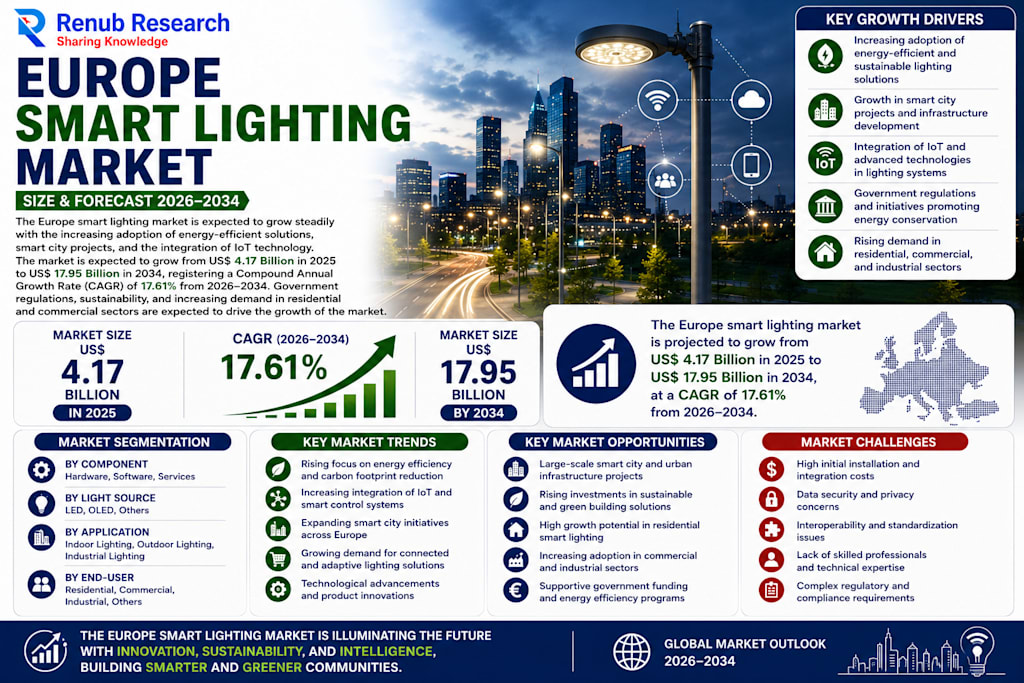
Europe Smart Lighting Market Enters a High-Growth Phase
The Europe smart lighting market is undergoing rapid transformation as governments, businesses, and households increasingly adopt intelligent lighting solutions designed to improve energy efficiency, sustainability, and user convenience. The combination of smart cities, connected technologies, and strict environmental regulations is reshaping the region’s lighting infrastructure at an unprecedented pace.
According to Renub Research, the Europe smart lighting market is projected to grow from US$ 4.17 billion in 2025 to US$ 17.95 billion by 2034, expanding at a remarkable compound annual growth rate (CAGR) of 17.61% from 2026 to 2034. Growing adoption of Internet of Things (IoT) technologies, government sustainability targets, and increasing demand from residential and commercial sectors are among the major drivers accelerating market growth.
Smart lighting refers to advanced lighting systems that use connected technologies such as sensors, wireless communication, software controls, and automation platforms to optimize lighting performance. These systems allow users to remotely control brightness, color temperature, scheduling, and energy consumption through mobile apps, voice assistants, or centralized building management systems.
As Europe continues prioritizing carbon reduction and digital transformation, smart lighting is emerging as one of the region’s most important infrastructure technologies.
Energy Efficiency Regulations Are Driving Adoption
One of the strongest growth drivers behind Europe’s smart lighting market is the region’s strict energy efficiency regulations and ambitious climate goals. European governments are actively encouraging the adoption of low-energy technologies to reduce electricity consumption and lower carbon emissions.
Smart lighting systems support these objectives by optimizing lighting usage through features such as automated dimming, occupancy sensing, motion detection, and daylight harvesting. These technologies significantly reduce unnecessary electricity consumption while improving operational efficiency.
The report highlights the European Union’s Green Deal and Ecodesign Directive, both of which aim to achieve carbon neutrality by 2050. These policies are accelerating the transition toward energy-efficient smart lighting solutions across residential, commercial, and public infrastructure sectors.
Government-backed projects are already demonstrating measurable results. For example, pilot smart lighting projects in cities such as Amsterdam and Munich reportedly reduced energy consumption by up to 15%.
The growing integration of smart lighting with IoT and 5G technologies is also improving real-time control and connectivity across urban environments.
Smart City Projects Are Expanding Across Europe
The rapid expansion of smart city initiatives is another major factor fueling demand for smart lighting solutions across Europe. Cities are increasingly investing in intelligent infrastructure to improve public safety, optimize energy management, and enhance operational efficiency.
Smart lighting plays a central role in modern smart city ecosystems because it allows municipalities to remotely monitor, automate, and optimize street lighting and public infrastructure. Integrated sensors and data analytics further help reduce maintenance costs while improving urban management.
The report notes that the EU Horizon Mission “Climate-Neutral and Smart Cities by 2030” is investing more than 98 million euros in supporting over 100 European cities as they transition toward climate neutrality. These cities are expected to become innovation hubs demonstrating advanced sustainable infrastructure technologies, including smart lighting systems.
As urban populations continue growing and municipalities pursue digital transformation strategies, smart lighting adoption is expected to expand significantly throughout Europe.
Smart Home Adoption Continues Accelerating
The increasing popularity of smart home ecosystems is also driving rapid growth in Europe’s residential smart lighting market. Consumers are increasingly adopting connected home technologies that offer convenience, automation, personalization, and long-term energy savings.
Smart lighting systems allow homeowners to remotely control lighting through mobile applications, automate schedules, adjust ambiance settings, and integrate lighting with voice assistants such as Amazon Alexa and Google Assistant.
Europe’s strong broadband penetration and widespread adoption of connected devices are accelerating residential market growth. Renovation and retrofitting activities in older residential properties are also creating major opportunities for smart lighting upgrades.
The report highlights Honeywell International’s multi-year contract to implement IoT-enabled LED smart lighting systems at Frankfurt Airport. The project demonstrates how advanced lighting systems are improving operational efficiency and passenger experience across major European infrastructure projects.
Commercial Buildings Are Embracing Intelligent Lighting
Commercial offices, shopping centers, hotels, educational institutions, and industrial facilities are increasingly adopting smart lighting systems to reduce operational costs and improve energy efficiency. Businesses are under growing pressure to meet sustainability targets while optimizing employee comfort and workplace productivity.
Smart lighting systems in commercial buildings can automatically adjust brightness levels based on occupancy and daylight conditions, reducing energy waste while creating more comfortable environments. Retail stores are also using dynamic lighting systems to improve customer experiences and product presentation.
As organizations continue investing in smart building technologies and digital infrastructure, commercial demand for intelligent lighting systems is expected to remain strong.
High Initial Costs Remain a Key Challenge
Despite strong growth potential, the Europe smart lighting market still faces several important challenges. One of the biggest barriers is the high initial installation and integration cost associated with smart lighting systems.
Smart lighting solutions require advanced hardware, sensors, wireless communication modules, software platforms, and system integration services, making them more expensive than traditional lighting systems. Small businesses, households, and municipalities with limited budgets may hesitate to invest due to long payback periods.
Retrofitting older buildings can also be expensive because of compatibility issues and infrastructure limitations. Although long-term energy savings often offset these costs, initial affordability remains a concern for many potential buyers.
Cybersecurity and Interoperability Concerns Persist
Another challenge affecting the market is interoperability between different smart lighting platforms and communication technologies. The use of proprietary systems and inconsistent standards can create compatibility problems that complicate large-scale deployments.
Cybersecurity is also becoming increasingly important as smart lighting systems connect to cloud platforms and public networks. Concerns regarding data privacy, unauthorized access, and network vulnerability are especially relevant in commercial and public infrastructure environments.
Manufacturers and software providers are therefore investing heavily in cybersecurity solutions and open-standard integration frameworks to strengthen customer confidence.
Software Solutions Are Becoming Increasingly Important
The Europe smart lighting software market is expanding rapidly because software platforms are essential for controlling, monitoring, and optimizing intelligent lighting systems. Advanced software allows users to manage lighting schedules, occupancy detection, brightness levels, and energy analytics through centralized dashboards or mobile applications.
Cloud-based software solutions are particularly attractive because they offer scalability, remote accessibility, and simplified maintenance. Artificial intelligence and predictive maintenance technologies are also becoming increasingly integrated into smart lighting management systems.
As real-time monitoring and data-driven building management become more important, software is expected to remain one of the fastest-growing segments within the market.
Wireless Smart Lighting Gains Momentum
Wireless smart lighting systems are becoming increasingly popular because they are easier and less expensive to install compared to traditional wired systems. Wireless solutions are particularly valuable for retrofitting projects and existing infrastructure upgrades.
These systems support remote control, automation, and seamless integration with smart home ecosystems without requiring extensive rewiring. Europe’s advanced digital infrastructure and widespread connected-device usage are helping accelerate wireless lighting adoption across residential and commercial markets.
Smart LED Lamps Continue Dominating the Market
Smart LED lamps remain one of the largest segments within Europe’s smart lighting market because of their low energy consumption, long lifespan, and compatibility with connected technologies. Smart LEDs offer features such as dimming, color adjustment, scheduling, and remote control while significantly reducing electricity usage.
Government programs promoting LED adoption and sustainability are further supporting demand for smart LED products across households and businesses.
France Leads Public Infrastructure Adoption
France has emerged as one of Europe’s leading smart lighting markets due to its strong focus on sustainability, urban modernization, and public infrastructure efficiency. Smart lighting systems are increasingly being installed across government buildings, public streets, and transportation infrastructure to reduce operating costs and improve energy management.
The report highlights Itron’s partnership with Cielis to continue managing nearly 200,000 smart streetlights in Paris, reflecting the scale of France’s investment in intelligent urban infrastructure.
United Kingdom Market Benefits from Smart Home Growth
The United Kingdom smart lighting market is driven heavily by consumer interest in smart home automation and advanced digital infrastructure. Residential adoption is especially strong as consumers seek energy-efficient and voice-controlled lighting systems.
Commercial and public sectors are also investing in smart lighting to support sustainability goals and operational efficiency. Retrofitting projects in older buildings represent a particularly important growth area within the UK market.
Germany and Netherlands Focus on Smart Infrastructure
Germany’s smart lighting market benefits from strong industrial modernization, strict energy regulations, and widespread adoption of sustainable technologies. Municipalities and businesses are increasingly integrating smart lighting into infrastructure modernization projects.
The Netherlands continues leading in smart city innovation and intelligent urban infrastructure. Strong digital connectivity and sustainability-focused policies are helping accelerate smart lighting deployment across public and commercial environments.
Competitive Landscape
The Europe smart lighting market includes major companies such as Philips Lighting, Honeywell International, Wipro Limited, Acuity Brands, Eaton Corporation, Legrand, General Electric, Cree Inc., and OSRAM Licht AG.
Competition is increasingly centered around energy efficiency, software integration, wireless technologies, cybersecurity, and smart city partnerships. Companies investing in AI-enabled analytics, IoT connectivity, and cloud-based lighting management systems are expected to shape the future of the industry.
Final Thoughts
The Europe smart lighting market is rapidly evolving as sustainability goals, digital infrastructure, and smart city initiatives transform the region’s approach to energy management and urban development. Intelligent lighting systems are no longer viewed simply as lighting solutions—they are becoming essential components of connected infrastructure ecosystems.
With the market projected to grow from US$ 4.17 billion in 2025 to US$ 17.95 billion by 2034, the future of Europe’s smart lighting industry appears exceptionally promising. Companies that successfully combine energy efficiency, smart connectivity, cybersecurity, and user-friendly innovation will likely lead the next generation of intelligent infrastructure across Europe.
About the Creator
Enjoyed the story? Support the Creator.
Subscribe for free to receive all their stories in your feed.
Comments
There are no comments for this story
Be the first to respond and start the conversation.