
Europe’s Push Toward Safer Security: Why the Non-Lethal Weapons Market Is Expanding Rapidly
From crowd-control technologies to AI-assisted defense systems, Europe is reshaping modern security strategies with non-lethal weapon innovation.

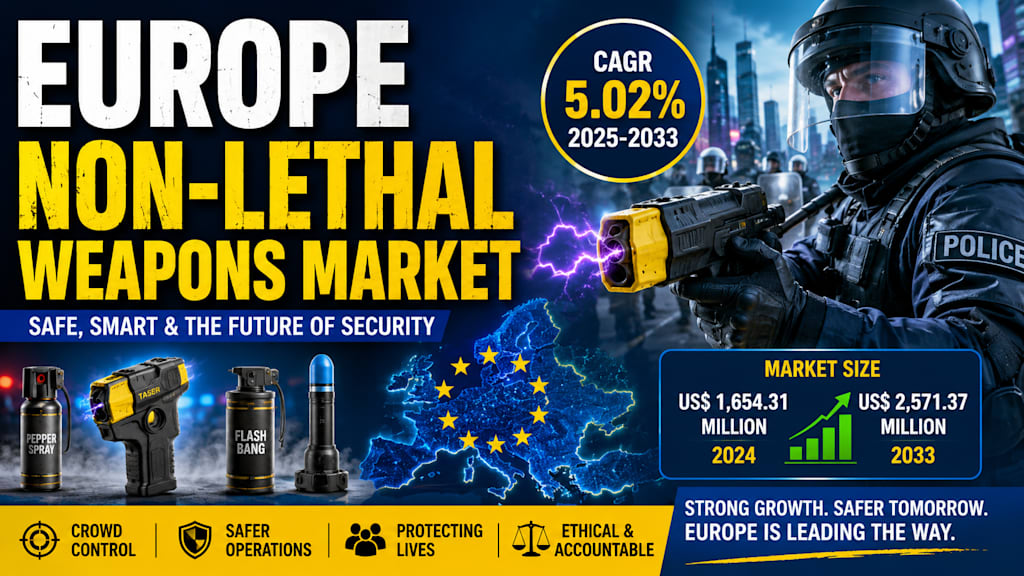
The European security landscape is changing rapidly. Governments across the continent are facing increasing pressure to maintain public order while also protecting human rights and minimizing casualties during security operations. As a result, non-lethal weapons are emerging as one of the fastest-growing segments within the defense and public safety industry.
According to Renub Research, the Europe Non-Lethal Weapons Market is projected to grow from US$ 1,654.31 million in 2024 to US$ 2,571.37 million by 2033, expanding at a CAGR of 5.02% during 2025–2033.
This growth reflects a major shift in how European governments, military organizations, and police departments approach modern security challenges. Rather than relying solely on conventional firearms or lethal force, authorities are increasingly investing in technologies designed to neutralize threats while reducing long-term harm.
Why Non-Lethal Weapons Are Becoming Essential in Europe
Over the past decade, Europe has witnessed a rise in political demonstrations, social unrest, public protests, and urban security incidents. Law enforcement agencies are under growing scrutiny whenever force is used during crowd-management situations. Public expectations have evolved, and governments are now expected to ensure both safety and accountability.
Non-lethal weapons offer a middle-ground solution.
These technologies include rubber bullets, tear gas, Tasers, acoustic systems, pepper sprays, stun grenades, and directed-energy devices. Their purpose is to temporarily disable, deter, or disperse individuals without causing permanent injury or death.
The increasing popularity of these systems is tied directly to Europe’s stronger focus on ethical policing and proportional force. Security forces are expected to respond effectively to threats while also respecting civil liberties and international human rights standards.
The market report highlights that the growing frequency of violent confrontations and civil disturbances has significantly increased demand for these tools across Europe.
Technology Is Transforming Non-Lethal Defense Systems
One of the biggest drivers behind the market’s expansion is technological advancement.
Modern non-lethal weapons are no longer limited to simple batons or tear gas canisters. Today’s systems are highly sophisticated and increasingly integrated with smart technologies.
European defense manufacturers are investing heavily in:
AI-assisted targeting systems
Directed-energy weapons
Acoustic deterrent systems
Electromagnetic technologies
Smart electroshock devices
Precision crowd-control equipment
These innovations are helping law enforcement agencies improve operational accuracy while minimizing unintended injuries.
Advanced systems can now track movement, deliver controlled responses, and provide real-time accountability data. This level of precision is particularly important in urban environments where authorities must balance security with civilian protection.
The report notes that technological developments in acoustic, electromagnetic, and directed-energy systems are creating safer and more effective non-lethal solutions.
Government Investments Continue to Fuel Market Expansion
Europe’s non-lethal weapons sector is also benefiting from rising public safety and defense budgets.
Governments throughout the region are allocating more resources toward military modernization and advanced law enforcement infrastructure. Many countries now view non-lethal technologies as essential tools for handling high-risk situations without escalating violence.
Funding is being directed toward:
Research and development programs
Police modernization initiatives
Urban security enhancement projects
Tactical training programs
Smart defense technology integration
Several governments are also partnering with private defense companies and research institutions to accelerate innovation in non-lethal systems.
These investments are strengthening Europe’s domestic manufacturing capabilities while also improving preparedness for future security challenges.
According to the report, ongoing financial commitments are helping Europe maintain a strong global position within the non-lethal weapons industry.
Crowd Control Is Now a Major Priority
The growing demand for effective crowd-management solutions is one of the strongest contributors to market growth.
Large-scale demonstrations and public protests have become increasingly common throughout Europe. Police forces require tools that allow them to control tense situations without relying on deadly force.
Non-lethal weapons provide authorities with more flexible response options. Tear gas, water cannons, rubber bullets, stun grenades, and electroshock systems are widely used to disperse aggressive crowds and restore order.
Governments recognize that excessive force can damage public trust, trigger legal consequences, and escalate unrest further. As a result, non-lethal technologies are being prioritized as safer alternatives.
The report emphasizes that European law enforcement agencies are increasingly adopting these tools to reduce casualties and maintain better control during public-order operations.
The United Kingdom Leads the European Market
The United Kingdom currently dominates the Europe non-lethal weapons market.
This leadership position is supported by continuous investments in law enforcement modernization and advanced crowd-control technologies. UK police forces routinely deploy less-lethal systems including Tasers, mace sprays, and batons.
The UK military has also explored innovative technologies such as the Variable Kinetic System (VKS), which fires paintball-like projectiles filled with hot pepper solutions to deter hostile threats.
Another major growth factor is the expansion of the UK police workforce. The report states that England and Wales employed 140,228 full-time equivalent police officers as of March 2022, with thousands of new officers joining during the year.
This increase in personnel naturally drives greater procurement of non-lethal defense equipment.
The UK government’s continued focus on officer safety and public accountability is expected to sustain long-term market growth.
Germany Accelerates Adoption of Safer Security Technologies
Germany is also emerging as a major contributor to the European market.
German police agencies are increasingly deploying Tasers, rubber bullets, and acoustic devices as part of modern crowd-control strategies. Authorities are emphasizing methods that reduce injury risks while complying with strict human rights frameworks.
The country is also investing in next-generation technologies such as directed-energy and electromagnetic systems.
However, Germany faces several challenges, including:
High procurement costs
Strict regulatory oversight
Ethical concerns surrounding deployment
Training and infrastructure limitations
Despite these barriers, the market outlook remains positive as public safety agencies continue seeking more proportionate security responses.
Turkey’s Market Continues to Expand
Turkey is another rapidly developing market for non-lethal weapons.
Growing public demonstrations and civil unrest have increased demand for effective crowd-management tools. Turkish law enforcement agencies are deploying Tasers, acoustic devices, and rubber bullets to manage security situations while minimizing fatalities.
Technological progress in electromagnetic and directed-energy systems is also improving operational efficiency.
Still, Turkey faces challenges related to procurement delays, ethical oversight, and budget limitations. Smaller organizations often struggle to afford sophisticated non-lethal systems.
Nevertheless, demand for safer public-order technologies continues to rise throughout the country.
Major Challenges Still Exist
Despite strong growth potential, the industry is not without obstacles.
One major concern is the high cost of advanced non-lethal technologies. Sophisticated systems require significant investment not only for procurement but also for maintenance and operator training.
Many smaller police departments across Europe continue using outdated equipment because they cannot justify the expense of modern alternatives.
The report also highlights bureaucratic procurement procedures as a major barrier. Strict regulatory approvals and lengthy purchasing cycles often delay modernization projects.
Training gaps represent another important issue.
Advanced non-lethal systems frequently include AI-driven capabilities and real-time monitoring features that require specialized expertise. Without proper training, misuse or operational failures become more likely.
Ensuring responsible deployment remains critical to maintaining public trust.
Ethical and Legal Oversight Will Shape the Future
Europe’s strong legal and ethical frameworks are playing a defining role in the market’s evolution.
Unlike some global regions where aggressive force policies dominate, European governments emphasize accountability and transparency in security operations.
The use of non-lethal weapons is carefully regulated to ensure compliance with national laws and international human rights standards.
Public scrutiny also remains intense. Any misuse of force can quickly trigger political backlash and renewed debate about policing practices.
As a result, governments are prioritizing:
Responsible deployment
Officer training
Clear operational guidelines
Transparency systems
Digital accountability technologies
These measures are expected to remain central to the market’s long-term development.
10 Recent Developments from Leading Companies
1. Axon Enterprise Inc.
In March 2024, Axon introduced a new conducted-energy weapon platform specifically designed for European law enforcement agencies, offering improved safety and precision features.
2. Rheinmetall AG
In May 2024, Rheinmetall announced a strategic partnership with European law enforcement agencies to develop next-generation non-lethal crowd-control technologies.
3. Byrna Technologies Inc.
The company expanded its international distribution network for CO2-powered less-lethal launchers targeting European civilian and law-enforcement markets.
4. General Dynamics Corporation
General Dynamics increased investments in advanced military-grade crowd-management systems for urban defense operations.
5. Moog Inc.
Moog enhanced remote-operational capabilities for security systems integrated with non-lethal tactical equipment.
6. Raytheon Technologies Corporation
Raytheon continued development of directed-energy defense systems focused on low-casualty threat neutralization.
7. Textron Inc.
Textron accelerated research into smart non-lethal tactical systems for military and homeland-security applications.
8. Combined Systems Inc.
Combined Systems expanded production capacity for smoke, flashbang, and riot-control solutions serving European law-enforcement agencies.
9. European Defense Collaborations
Several European governments initiated collaborative research programs focused on AI-assisted non-lethal weapon systems.
10. Smart Crowd-Control Integration
Multiple security agencies across Europe began integrating digital accountability platforms into non-lethal weapon deployments to improve transparency and oversight.
Final Thoughts
Europe’s non-lethal weapons industry is entering a transformative phase.
As governments face mounting pressure to improve public safety while respecting human rights, demand for safer and more accountable security technologies will continue to rise.
The combination of technological innovation, government investment, urban security challenges, and evolving public expectations is creating strong long-term opportunities for the market.
While concerns around ethics, procurement costs, and training remain significant, the shift toward less-lethal defense strategies appears irreversible.
By 2033, non-lethal weapons are expected to become an even more essential part of Europe’s security infrastructure — helping authorities manage modern threats with greater precision, reduced casualties, and improved accountability.
About the Creator
Enjoyed the story? Support the Creator.
Subscribe for free to receive all their stories in your feed.
Comments
There are no comments for this story
Be the first to respond and start the conversation.