
Europe’s Microwave Oven Market Is Evolving Beyond Convenience Into Smart Kitchen Innovation
Busy Lifestyles, Smart Technologies, and Changing Food Habits Are Driving Growth in the Europe Microwave Oven Market

The modern European kitchen is undergoing a transformation. As consumers balance demanding careers, busy family schedules, and evolving food preferences, convenience has become a key factor influencing appliance purchases. Among the appliances benefiting most from this shift is the microwave oven—a device that has evolved from a simple reheating tool into a multifunctional cooking solution equipped with advanced technology and smart features.
Across Europe, microwave ovens have become essential household appliances. They help consumers prepare meals faster, reduce cooking effort, and support increasingly popular ready-to-eat and frozen food categories. At the same time, technological advancements are transforming microwave ovens into intelligent kitchen companions capable of delivering improved performance, convenience, and energy efficiency.
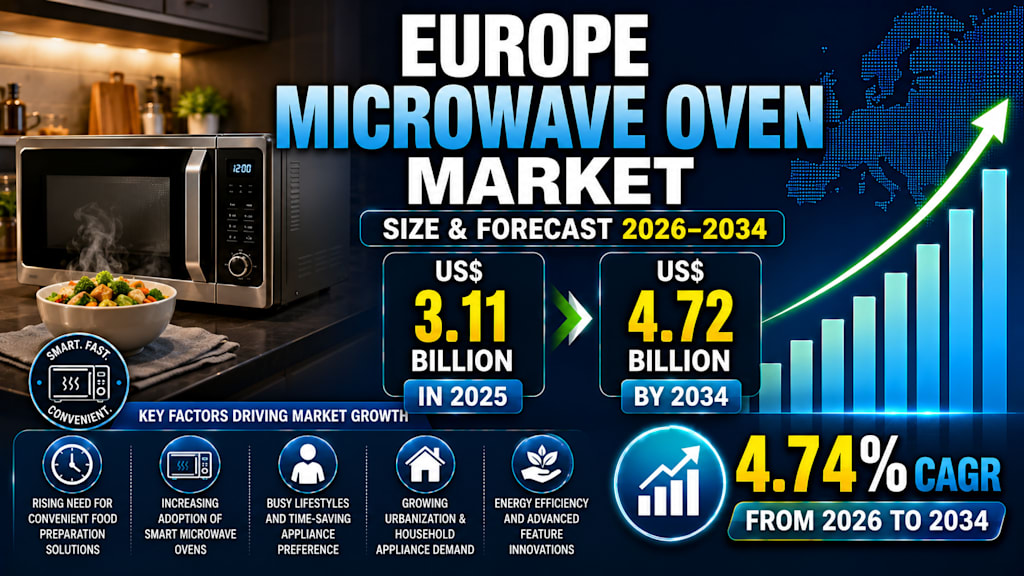
According to Renub Research, the Europe Microwave Oven Market is expected to grow from US$ 3.11 billion in 2025 to US$ 4.72 billion by 2034, registering a compound annual growth rate (CAGR) of 4.74% between 2026 and 2034. Rising demand for convenient food preparation, increasing adoption of smart microwave ovens, and the growing number of consumers with busy lifestyles are key factors driving market expansion.
As kitchen technology continues to evolve, microwave ovens are becoming increasingly important in shaping the future of food preparation across Europe.
The Microwave Oven Has Become a Modern Kitchen Essential
Microwave ovens have long been valued for their ability to cook, reheat, and defrost food quickly. By using electromagnetic waves to generate heat within food molecules, microwave ovens significantly reduce cooking times compared to conventional methods.
Initially viewed as convenience appliances, modern microwave ovens now offer a much broader range of capabilities. Today's models can grill, bake, roast, steam, and perform complex cooking functions that were previously associated with traditional ovens.
Consumers appreciate their versatility, compact size, and ability to simplify meal preparation.
As modern lifestyles become increasingly fast-paced, microwave ovens have transitioned from optional appliances to essential components of many European households.
Their widespread adoption reflects broader shifts in consumer behavior, including growing demand for convenience, efficiency, and flexible cooking solutions.
Busy Lifestyles Are Driving Consumer Demand
One of the strongest factors supporting market growth is the increasing demand for time-saving appliances.
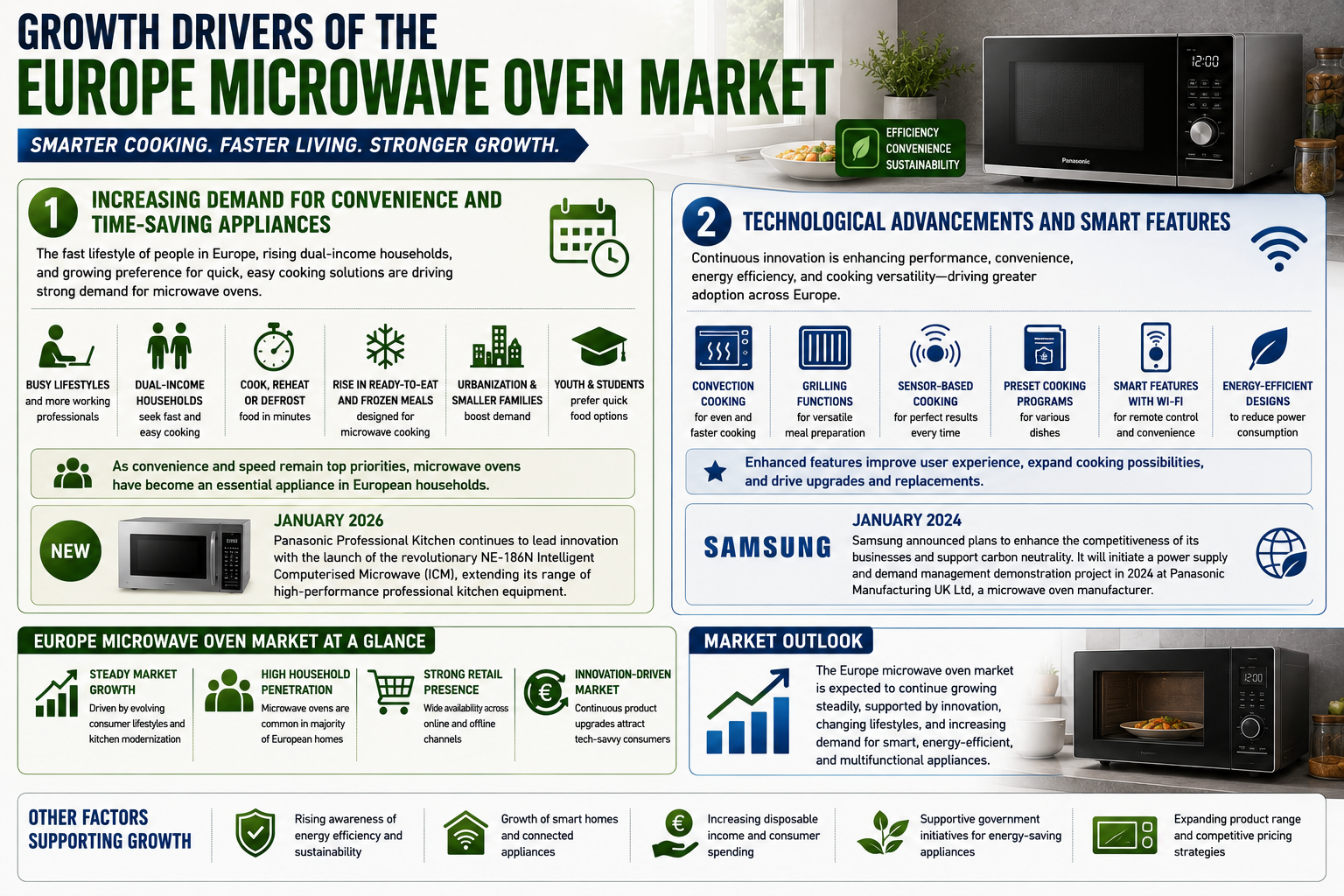
Across Europe, working professionals, dual-income households, students, and urban residents are seeking solutions that simplify daily routines and reduce time spent preparing meals.
Microwave ovens provide a practical answer to these needs.
Consumers can quickly reheat leftovers, prepare frozen meals, defrost ingredients, and cook simple dishes in a matter of minutes. This convenience is particularly valuable for individuals managing demanding work schedules and busy family responsibilities.
The growing popularity of ready-to-eat meals has further accelerated microwave oven adoption.
Food manufacturers continue expanding their offerings of microwave-compatible products, creating a mutually beneficial relationship between appliance sales and convenience food consumption.
As consumers continue prioritizing efficiency and convenience, microwave ovens are expected to remain highly relevant within modern kitchens.
Technology Is Transforming the Microwave Experience
Technological innovation is playing a central role in reshaping the European microwave oven market.
Manufacturers are introducing increasingly sophisticated products equipped with advanced features that improve functionality and user experience.
Modern microwave ovens often include convection cooking, grilling capabilities, sensor-based cooking systems, automatic programs, and touchscreen controls.
These features allow consumers to prepare a wider variety of meals while achieving more consistent cooking results.
Perhaps the most significant trend is the emergence of smart microwave ovens.
Wi-Fi connectivity enables users to monitor and control appliances remotely through smartphones and smart home platforms. Some models can even integrate with voice assistants and connected home ecosystems.
These innovations appeal particularly to tech-savvy consumers seeking greater convenience and automation within their homes.
As smart home adoption continues expanding across Europe, intelligent kitchen appliances are expected to play an increasingly important role.
Smart Homes Are Creating New Opportunities
The rise of smart home technology is creating substantial opportunities for microwave oven manufacturers.
Consumers increasingly expect household appliances to communicate seamlessly with other connected devices.
Smart microwave ovens can provide remote operation, cooking notifications, maintenance alerts, and access to digital recipe libraries.
These capabilities enhance convenience while supporting more personalized cooking experiences.
Manufacturers are investing heavily in smart appliance development as they compete to differentiate products in an increasingly competitive marketplace.
The integration of artificial intelligence and machine learning technologies may further transform microwave functionality in the coming years.
Future models could automatically adjust cooking settings based on food type, quantity, and user preferences.
As connected living becomes more mainstream, smart microwave ovens are expected to become increasingly attractive to European consumers.
Urbanization Is Supporting Market Expansion
Rapid urbanization continues to influence appliance purchasing decisions across Europe.
Urban residents often live in apartments and smaller homes where kitchen space is limited.
Microwave ovens provide an ideal solution because they offer powerful cooking capabilities while occupying relatively little space.
Compact designs make them particularly appealing to young professionals, students, and smaller households.
Urban lifestyles also tend to emphasize convenience, flexibility, and efficient use of time—all factors that favor microwave oven adoption.
The growing number of single-person households throughout Europe further supports market demand.
As cities continue expanding and housing patterns evolve, microwave ovens are likely to remain essential appliances for urban consumers.
Changing Food Habits Are Influencing Growth
European food habits are evolving in response to demographic changes, lifestyle shifts, and consumer preferences.
Ready-to-eat meals, frozen foods, meal kits, and convenience products have become increasingly popular among consumers seeking quick meal solutions.
Microwave ovens play a central role in preparing many of these products.
At the same time, consumers continue valuing traditional foods and local culinary heritage.
Manufacturers are responding by developing appliances capable of supporting a broader range of cooking methods, including grilling and convection cooking.
This combination of convenience and versatility allows microwave ovens to accommodate both modern and traditional food preparation practices.
As food consumption patterns continue evolving, microwave ovens will remain closely linked to changing consumer lifestyles.
Household Applications Continue to Dominate
The household segment represents the largest application area within the European microwave oven market.
Microwave ovens have become standard appliances in many homes due to their convenience, affordability, and versatility.
Consumers increasingly seek appliances that simplify meal preparation while complementing modern kitchen designs.
Compact and energy-efficient models are particularly popular among urban households with limited space.
Manufacturers continue introducing innovative products tailored to the needs of families, students, and individual consumers.
As home cooking trends continue evolving, household demand is expected to remain a major driver of market growth.
Commercial Demand Is Also Rising
Beyond residential use, microwave ovens play an important role within commercial foodservice environments.
Restaurants, cafés, hotels, catering businesses, convenience stores, and quick-service restaurants rely on microwave ovens to improve operational efficiency.
Commercial microwave ovens offer higher power levels, greater durability, and advanced features designed for demanding environments.
The growth of food delivery services, cloud kitchens, and quick-service dining concepts has increased demand for high-performance microwave equipment.
Businesses value microwave ovens because they enable rapid food preparation while maintaining consistency and productivity.
As Europe's foodservice sector continues expanding, commercial demand is expected to contribute significantly to market growth.
Built-In Microwave Ovens Are Gaining Popularity
One of the fastest-growing product categories is built-in microwave ovens.
These appliances are integrated directly into kitchen cabinetry, creating a seamless and modern appearance.
Built-in models are particularly popular among homeowners investing in premium kitchens and renovation projects.
Consumers appreciate their space-saving design, aesthetic appeal, and compatibility with contemporary interior styles.
Rising disposable incomes and increasing demand for smart home solutions are supporting growth within this segment.
As modern kitchen design trends continue evolving, built-in microwave ovens are expected to gain an even larger share of the market.
Online Retail Is Transforming Distribution
The rise of e-commerce is changing how consumers purchase microwave ovens.
Online platforms provide access to extensive product selections, detailed specifications, customer reviews, and competitive pricing.
Consumers appreciate the convenience of comparing products and completing purchases without visiting physical stores.
The COVID-19 pandemic accelerated adoption of online shopping behaviors, creating lasting changes in appliance purchasing habits.
Manufacturers and retailers are increasingly investing in digital sales channels to reach broader audiences.
As online shopping continues growing, e-commerce will play an increasingly important role in microwave oven distribution across Europe.
Challenges Facing the Market
Despite strong growth prospects, several challenges could affect market expansion.
Competition from Alternative Appliances
Consumers increasingly have access to alternative cooking technologies such as air fryers, induction cookers, multi-cookers, and smart ovens.
Many of these products offer multifunctionality and are often perceived as healthier cooking solutions.
Manufacturers must continue innovating to ensure microwave ovens remain competitive.
Environmental Concerns
Growing awareness regarding energy consumption and electronic waste presents additional challenges.
Although modern microwave ovens are increasingly energy efficient, consumers are paying closer attention to sustainability and appliance lifecycles.
Manufacturers must focus on environmentally responsible designs, energy efficiency improvements, and recyclable materials to meet evolving consumer expectations.
Regional Markets Continue to Expand
France
French consumers increasingly value multifunctional microwave ovens capable of supporting diverse cooking needs. Compact and energy-efficient models remain particularly popular in urban areas.
Germany
Germany's emphasis on energy efficiency, technological innovation, and smart home adoption continues driving demand for advanced microwave ovens.
Belgium
Belgian consumers increasingly seek convenient cooking solutions, particularly among younger households and urban professionals.
Italy
Italian consumers are embracing microwave ovens as modern kitchen solutions that complement traditional cooking practices while offering greater convenience.
Final Thoughts
Microwave ovens have evolved far beyond their original purpose of reheating food. Today's appliances combine convenience, intelligence, efficiency, and versatility, making them essential tools for modern living.
According to Renub Research, the Europe Microwave Oven Market is projected to grow from US$ 3.11 billion in 2025 to US$ 4.72 billion by 2034, reflecting strong demand driven by changing lifestyles, urbanization, technological innovation, and smart home adoption.
As consumers continue seeking faster, smarter, and more efficient ways to prepare meals, microwave ovens will remain at the heart of Europe's evolving kitchen landscape. The future of cooking is no longer just about speed—it is about combining convenience, connectivity, and innovation to meet the needs of modern consumers.
About the Creator
Enjoyed the story? Support the Creator.
Subscribe for free to receive all their stories in your feed.
Comments
There are no comments for this story
Be the first to respond and start the conversation.