
Europe Respiratory Care Devices Market: Growth, Innovation, and the New Homecare Era
Rising respiratory disease burden, an aging population, and smarter device technology are shaping a stronger outlook for Europe’s respiratory care industry through 2033.

Europe Respiratory Care Devices Market Overview
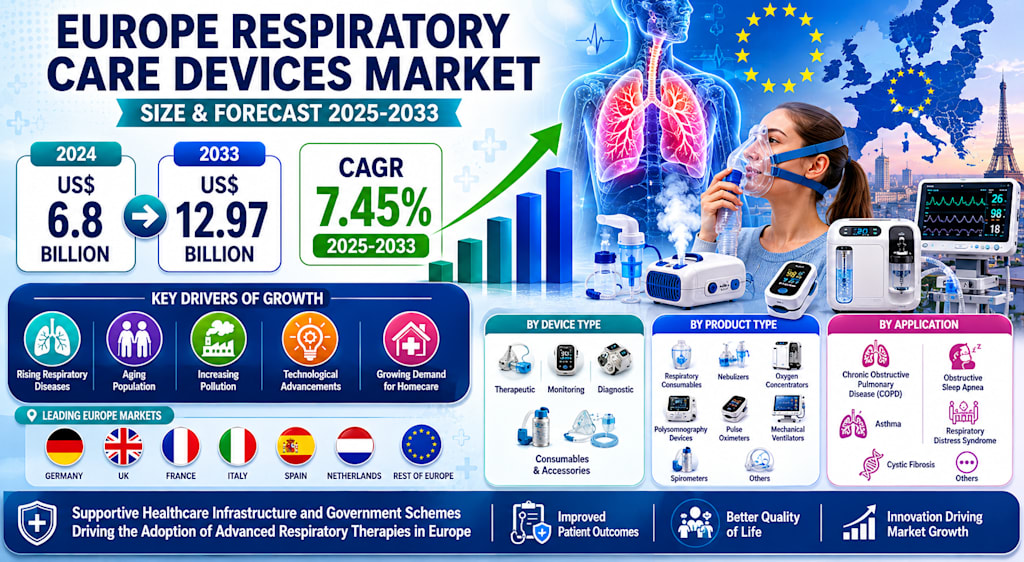
Europe’s respiratory care devices market is gaining strong momentum as healthcare systems across the region respond to rising respiratory illness, expanding homecare adoption, and more advanced device technologies. According to Renub Research, the market is expected to grow from US$ 6.8 billion in 2024 to US$ 12.97 billion by 2033, registering a CAGR of 7.45% between 2025 and 2033. The report highlights the impact of respiratory diseases, aging populations, pollution, technological progress, homecare demand, and post-COVID awareness as the main forces driving this expansion.
Respiratory care devices include products such as ventilators, nebulizers, oxygen concentrators, CPAP machines, inhalers, spirometers, pulse oximeters, and other diagnostic and therapeutic tools. These products are used in hospitals, clinics, ambulatory settings, and increasingly in homecare environments. The market is no longer limited to acute treatment. It is becoming a long-term care ecosystem built around comfort, monitoring, disease management, and better patient adherence.
Why the Market Is Expanding
One of the strongest drivers is the growing prevalence of respiratory disorders across Europe. Diseases such as asthma, chronic obstructive pulmonary disease (COPD), obstructive sleep apnea, and other chronic respiratory illnesses are creating sustained demand for diagnostic, monitoring, and treatment devices. The report notes that in Germany, asthma affects nearly 10% of children and 4–5% of adults, showing how deeply respiratory disease is embedded in everyday healthcare needs.
Environmental factors are also pushing demand upward. Pollution, smoking, and urbanization continue to raise respiratory health risks, while the aging population adds another layer of pressure. Older adults are more vulnerable to breathing problems and often need ongoing monitoring or therapy. This is one reason the market is moving beyond hospital-only use and toward portable and easy-to-use devices that support long-term care at home.
Technological progress is making respiratory devices more attractive to both providers and patients. Smart inhalers, AI-enabled ventilators, portable oxygen concentrators, and connected monitoring tools are improving convenience and treatment compliance. The report also points to telemedicine and cloud-based monitoring as important enablers of remote management, especially in homecare environments where patients need ongoing support without constant hospital visits.
The Role of Aging and Homecare
Europe’s aging population is one of the most important long-term growth factors. The file cites European Commission data showing that 21.6% of the EU’s 449.3 million residents were aged 65 and above as of January 1, 2024. That demographic shift matters because age naturally increases vulnerability to respiratory disease, while also increasing demand for simpler, more comfortable, and more reliable treatment options.
Homecare is becoming a central part of the market’s future. Many patients and caregivers now prefer devices that can be used outside hospitals, particularly for chronic conditions such as sleep apnea and COPD. Compact nebulizers, portable oxygen concentrators, CPAP devices, and connected respiratory monitors are helping reduce dependence on hospital-based care. This shift is not only improving convenience, but also supporting healthcare systems that are under pressure to manage costs and capacity more efficiently.
Key Market Challenges
Despite the strong outlook, the market still faces meaningful barriers. High device cost remains one of the biggest constraints. Advanced respiratory care equipment often requires substantial upfront investment, along with ongoing maintenance and replacement expenses. For patients on fixed incomes and for public healthcare systems operating under budget pressure, this can slow adoption and limit access.
Regulation is another challenge. Europe’s stricter medical device requirements have raised the bar for clinical evaluation, labeling, and post-market surveillance. The EU Medical Device Regulation has improved safety and quality standards, but it has also increased compliance costs and lengthened approval timelines. Smaller companies may struggle most with these demands, which can slow innovation and make it harder for new products to reach patients quickly.
Country-Wise Market Highlights
Germany remains one of the most important national markets in Europe because of its aging population, high respiratory disease burden, and strong innovation environment. The report notes increasing adoption of devices such as smart inhalers, CPAP machines, and portable oxygen concentrators. It also highlights a Bavarian research grant for a wearable breathing-monitoring device, showing how digital health and respiratory innovation are moving together in the German market.
France is another major market with strong growth potential. The report points to high asthma prevalence and increasing demand for oxygen concentrators, nebulizers, and inhalers. A growing preference for portable and user-friendly solutions is improving adherence and treatment outcomes. France’s hospital infrastructure and wider acceptance of homecare solutions are also supporting market growth.
The United Kingdom is seeing steady demand from an aging population and a rising incidence of asthma, COPD, and sleep apnea. The report also highlights new respiratory product introductions and a wider move toward homecare-oriented solutions. In the UK, the combination of strong healthcare infrastructure and growing awareness of respiratory illness is helping keep demand stable across both diagnostic and therapeutic categories.
Market Segmentation and What It Means
The report divides the market by device type, product type, application, end user, and country. Therapeutic devices, monitoring devices, diagnostic devices, consumables, and accessories all play distinct roles in the value chain. Product categories such as respiratory consumables, nebulizers, oxygen concentrators, polysomnography devices, pulse oximeters, mechanical ventilators, and spirometers reflect how broad the market has become.
On the application side, COPD, obstructive sleep apnea, asthma, respiratory distress syndrome, and cystic fibrosis represent the major clinical segments. Hospitals remain the largest institutional users, but home care is expanding quickly, while ambulatory care continues to support diagnosis and follow-up. That mix shows that respiratory care devices are serving both acute and chronic healthcare needs, and both institutional and personal treatment settings.
Competitive Landscape
The market is led by well-known global players, including Medtronic Plc, Koninklijke Philips, General Electric Company, Masimo Corporation, ResMed Inc., Becton, Dickinson and Company, Chart Industries Inc., and Getinge AB. These companies are not just competing on product availability. They are also competing on innovation, digital connectivity, clinical performance, patient comfort, and their ability to meet Europe’s regulatory standards.
The report also notes that all companies are analyzed from four angles: overview, key persons, recent development, and financial insights. That framework reflects how important strategic positioning has become in this market. Manufacturers are expected to deliver more than hardware. They must also provide software support, service ecosystems, data integration, and devices that fit the shift toward home-based care.
Recent Developments by Companies
Philips Respironics reached a consent decree agreement with the US government in 2024. The company said the arrangement creates a clearer operating path forward for its respiratory and sleep care business, including servicing and supplying accessories, consumables, and replacement parts. This is important because it helps stabilize one of the most recognizable names in respiratory care.
Medtronic announced a strategic partnership with Philips in July 2025. The collaboration is aimed at expanding access to patient monitoring technology, which supports respiratory care settings where continuous observation is essential.
ResMed unveiled a unified brand identity in March 2025. The company brought its sleep and breathing health technology under one global identity, reinforcing its positioning as a broader health-tech player rather than just a device seller.
ResMed launched NightOwl in April 2025. This small home sleep apnea test is designed to simplify diagnosis at home, which aligns with the growing move toward remote respiratory and sleep care.
ResMed acquired VirtuOx in May 2025. VirtuOx specializes in diagnostic testing for sleep, respiratory, and cardiac conditions, strengthening ResMed’s reach in home-based diagnostic pathways.
ResMed presented clinical research at SLEEP 2025 in June 2025. The company highlighted evidence supporting CPAP therapy’s role in reducing emergency-room and hospitalization risk, which helps reinforce the value of long-term respiratory treatment.
ResMed reported strong fiscal-year 2025 results in July 2025. The company said revenue rose by 10% to US$ 1.3 billion in the quarter, reflecting healthy demand across sleep devices, masks, and accessories.
ResMed won Red Dot design awards in August 2025. The recognition for the AirTouch N30i mask highlights how comfort and design are becoming more important in respiratory care, especially for long-term use.
ResMed received FDA clearance for its AI-enabled Smart Comfort device in January 2026. The device is designed to personalize CPAP comfort settings and improve adherence, showing how software is now shaping respiratory care just as much as hardware.
Getinge advanced ICU ventilation in 2025 with new product updates. In March 2025, the company introduced Neural Pressure Support for Servo-u ventilators, and in June 2025 it extended the Servo-c ventilator with a neonatal option for very small premature infants. These moves underline the growing precision of modern respiratory therapy.
Final Thoughts
The Europe respiratory care devices market is set for sustained growth because the clinical need is not going away. Respiratory illness remains widespread, the population is aging, and healthcare systems are pushing more care into home settings. At the same time, innovation is making devices smaller, smarter, and easier to use, which broadens adoption across patient groups.
The next phase of competition will likely favor companies that can combine clinical reliability with digital capability, patient comfort, and regulatory strength. In a market shaped by both chronic disease and technology, the winners will be those that make respiratory care more accessible, more connected, and more effective for everyday use.
About the Creator
Enjoyed the story? Support the Creator.
Subscribe for free to receive all their stories in your feed.
Comments
There are no comments for this story
Be the first to respond and start the conversation.