
Europe Professional Coffee Machine Market Expands as Café Culture and Premium Coffee Demand Rise
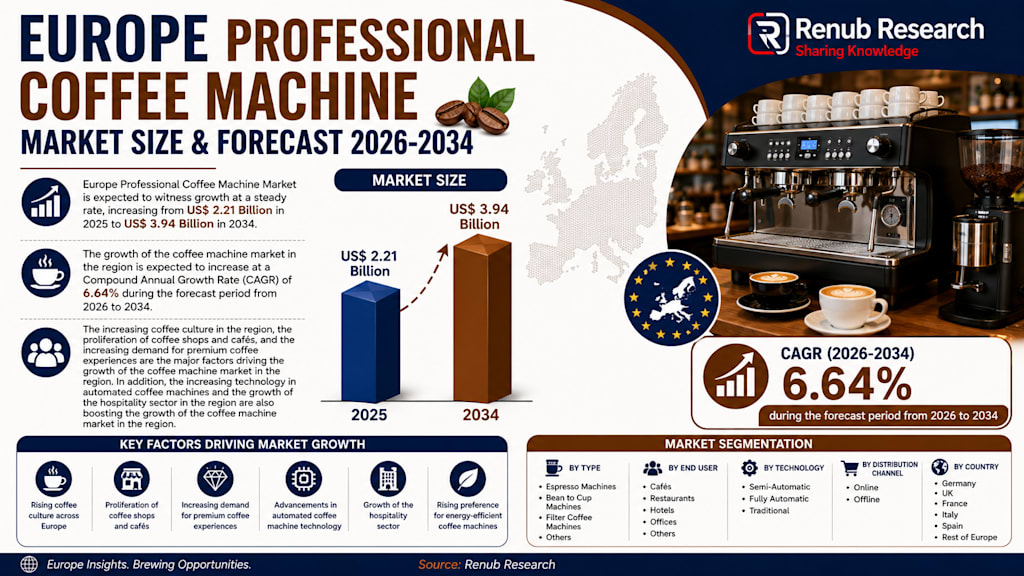
Europe’s professional coffee machine market is projected to grow from US$ 2.21 billion in 2025 to US$ 3.94 billion by 2034, fueled by specialty coffee demand, hospitality expansion, and smart brewing technologies.

Europe’s deep-rooted coffee culture continues to shape the market
Coffee has always been more than just a beverage in Europe. Across countries such as Italy, France, Germany, and the United Kingdom, coffee culture is deeply tied to social interaction, business meetings, hospitality, and everyday routines. Cafés, restaurants, bakeries, and hotels have long treated coffee as an essential part of customer experience, and this tradition continues to drive strong demand for professional coffee machines throughout the region.
According to the latest market outlook, the Europe Professional Coffee Machine Market is expected to increase from US$ 2.21 billion in 2025 to US$ 3.94 billion by 2034, growing at a CAGR of 6.64% during the forecast period from 2026 to 2034. The market’s expansion is being fueled by rising specialty coffee consumption, rapid café expansion, hospitality sector growth, and technological advancements in automated coffee systems.
Professional coffee machines are designed specifically for commercial environments such as cafés, hotels, restaurants, offices, and catering businesses. Unlike standard household coffee makers, these machines are built for high-volume brewing, precision, consistency, durability, and the preparation of premium coffee beverages including espresso, cappuccino, latte, and americano.
Specialty coffee culture is driving premium machine demand
One of the biggest growth drivers in the European market is the increasing popularity of specialty coffee culture. Consumers are no longer satisfied with basic coffee offerings. They are increasingly seeking barista-style beverages prepared with precision, customization, and high-quality ingredients.
Coffee shops and cafés across Europe are investing heavily in advanced professional coffee machines to deliver premium coffee experiences that meet changing customer expectations. Espresso-based beverages such as cappuccino, latte, and macchiato remain highly popular, while consumers are also exploring artisan brewing techniques and customized flavor options.
The report highlights the expansion of Roastery Coffee House into Finland in January 2024 as part of efforts to strengthen specialty coffee culture and connect coffee enthusiasts globally. This reflects how specialty coffee is becoming an increasingly influential force in shaping commercial coffee demand across Europe.
For cafés and hospitality businesses, coffee quality has become a major competitive advantage. Customers increasingly associate premium coffee service with brand value, ambience, and overall customer experience.
Hospitality and foodservice industries are supporting market growth
The rapid expansion of Europe’s hospitality and foodservice sectors is another major factor boosting the professional coffee machine market. Hotels, cafés, bakeries, restaurants, quick-service restaurants, and catering businesses all depend on commercial coffee machines to deliver beverages efficiently and consistently.
Tourism remains a major contributor to Europe’s hospitality industry, and many hotels now consider high-quality coffee service an essential part of guest satisfaction. Professional coffee machines are increasingly being installed not only in hotel restaurants and lounges, but also directly inside guest rooms to improve convenience and customer experience.
Restaurants are also paying greater attention to coffee presentation and beverage quality as part of the dining experience. Premium coffee drinks are often served alongside desserts or after meals, making professional coffee equipment an important investment for fine dining and casual restaurants alike.
The report notes that in January 2026, Lexington and Elior Vending launched the United Kingdom’s first fully robotic barista coffee counter at BT’s Snowhill office in Birmingham. The system uses robotic automation and professional coffee technology to deliver barista-quality beverages with speed and consistency, highlighting how automation is entering the coffee service industry.
Smart technology is reshaping professional coffee machines
Technology innovation is becoming one of the defining trends in the professional coffee machine market. Manufacturers are increasingly introducing smart coffee systems equipped with automation, programmable settings, digital monitoring, energy-saving functions, and connected technologies.
Super-automatic coffee machines are gaining popularity because they simplify operations while maintaining beverage consistency. These systems can automate grinding, brewing, milk frothing, and cleaning processes, reducing the need for extensive manual involvement.
Connected coffee machines also allow businesses to monitor machine performance remotely, track maintenance schedules, analyze consumption patterns, and improve operational efficiency.
Energy-efficient designs are another important focus area because commercial coffee equipment can consume significant amounts of electricity. Manufacturers are increasingly developing systems that reduce energy use while maintaining brewing quality and speed.
The report also highlights that the European Coffee Brewing Centre approved Wittenborg’s W100 coffee machine in November 2024 for meeting the organization’s “Golden Cup Standard” for quality and consistency. Such certifications help reinforce consumer confidence in professional-grade brewing equipment.
Espresso machines continue to dominate the market
Espresso coffee machines remain one of the strongest segments within Europe’s professional coffee machine industry. Espresso forms the foundation for many of Europe’s most popular coffee beverages, including cappuccino, latte, and macchiato.
Countries such as Italy, Spain, and France maintain strong cultural ties to espresso-based coffee preparation, which continues to support demand for high-end espresso machines in cafés, restaurants, and hotels.
Modern espresso machines now include programmable settings, automated milk frothing systems, pressure control technology, and temperature precision capabilities that allow businesses to deliver consistent beverage quality.
As customer expectations continue to rise, hospitality businesses increasingly rely on professional espresso equipment to differentiate themselves in competitive urban coffee markets.
Filter coffee machines remain important for offices and hotels
While espresso machines dominate specialty coffee environments, filter coffee machines continue to play a major role in offices, hotels, cafeterias, and business environments where large volumes of coffee must be served quickly and efficiently.
These machines are valued for their simplicity, convenience, and ability to produce multiple servings with minimal technical expertise. Hotels frequently use filter coffee systems during breakfast service and self-service buffet operations.
Modern filter coffee machines are also being upgraded with advanced brewing technologies, timers, and energy-saving features to improve operational efficiency and beverage consistency.
Hotels are increasingly investing in premium coffee experiences
Hotels across Europe are increasingly using professional coffee machines to improve guest experiences and strengthen customer satisfaction. Coffee has become a core hospitality offering, particularly in premium and luxury hotel segments.
Automatic and super-automatic coffee machines are especially popular in hotels because they deliver consistent beverage quality while minimizing labor requirements. In-room coffee systems are also becoming more common as travelers increasingly expect café-style coffee convenience during their stay.
The continued growth of tourism and international travel throughout Europe is expected to support long-term demand for hotel coffee machine installations.
Restaurants are treating coffee as part of the dining experience
Restaurants throughout Europe are increasingly recognizing coffee quality as an important component of customer service. Professional coffee machines allow restaurants to serve premium beverages that complement meals, desserts, and after-dinner experiences.
Fine dining establishments are particularly focused on presentation, beverage consistency, and premium coffee preparation techniques. Even casual dining restaurants and quick-service chains are investing in automated coffee systems to improve speed and beverage quality.
As customer expectations evolve, restaurants are treating coffee service as an extension of their overall brand identity and dining experience.
France continues to represent a strong coffee culture market
France remains one of Europe’s most important coffee machine markets due to its deeply established café culture. Cafés and bistros continue to play a central role in social life, creating strong demand for professional coffee equipment across hospitality and commercial sectors.
The report highlights the planned launch of the Seine X by Maxim’s de Paris in September 2025. This intelligent semi-automatic espresso machine with variable pressure capabilities is designed to improve espresso preparation precision and is already being promoted as a major innovation within the coffee industry.
France’s tourism sector and growing specialty café segment are expected to continue supporting demand for premium coffee equipment.
The United Kingdom is experiencing strong coffee shop growth
The United Kingdom has experienced remarkable growth in coffee shop culture during the last decade. International café chains, independent specialty coffee shops, and hospitality businesses are increasingly investing in modern coffee equipment to meet rising consumer demand for espresso-based drinks and premium beverages.
The UK market is also seeing increasing demand for home coffee machines as consumers attempt to recreate café-style beverages at home. Automated brewing systems, smart connectivity, and convenience-focused features are becoming increasingly attractive to both commercial and residential buyers.
Germany combines strong coffee demand with manufacturing expertise
Germany represents another major market because of its high coffee consumption and advanced manufacturing capabilities. Commercial establishments including hotels, offices, restaurants, and cafés rely heavily on professional coffee equipment to deliver quality beverages.
German manufacturers are known for producing technologically advanced coffee systems with high levels of automation and precision engineering. Consumers and businesses in the country increasingly prefer fully automatic and super-automatic coffee machines capable of delivering premium beverages efficiently.
The report also notes that Switzerland-based Cup&Cino Group acquired Tone, a boilerless brewing equipment manufacturer, further highlighting the ongoing innovation occurring within Europe’s coffee equipment industry.
Rising competition and investment costs remain challenges
Despite strong market growth, the professional coffee machine industry faces several challenges. One of the biggest barriers is the high initial investment required for premium commercial coffee equipment. Advanced machines with automation, large brewing capacities, and smart technologies can be expensive to purchase and maintain.
Small cafés, independent coffee shops, and startup businesses may struggle to afford premium systems, especially when maintenance, servicing, and repairs are also considered.
The market is also becoming increasingly competitive and saturated, particularly in Western Europe where coffee culture is already highly developed. Manufacturers must therefore focus heavily on innovation, reliability, energy efficiency, and customer experience to remain competitive.
Major companies continue shaping the market
The professional coffee machine market includes several major international players competing across commercial and hospitality sectors. Key companies mentioned in the report include Nestlé Nespresso SA, Koninklijke Philips N.V., Illycaffè S.p.A., Dualit Limited, AB Electrolux, De'Longhi S.p.A., BSH Hausgeräte GmbH, and Schaerer AG.
Competition is increasingly centered around automation, brewing consistency, energy efficiency, smart connectivity, and user-friendly operation.
Final thoughts
Europe’s professional coffee machine market continues to grow alongside the region’s evolving café culture, hospitality sector, and consumer demand for premium coffee experiences. Coffee has become an essential part of both social and commercial environments, encouraging businesses to invest in advanced coffee equipment capable of delivering high-quality beverages consistently.
The projected growth from US$ 2.21 billion in 2025 to US$ 3.94 billion by 2034 reflects the long-term strength of Europe’s coffee industry. As specialty coffee culture expands and automation technologies continue improving, professional coffee machines are expected to become even more sophisticated and central to hospitality operations across the region.
About the Creator
Enjoyed the story? Support the Creator.
Subscribe for free to receive all their stories in your feed.
Comments
There are no comments for this story
Be the first to respond and start the conversation.