
Europe Nanosatellite and Microsatellite Market Set to Reach US$ 5 Billion by 2034 as Small Satellites Revolutionize Space Applications
Growing Demand for Earth Observation, Climate Monitoring, Defense Surveillance, and Commercial Space Services Accelerates Europe's Small Satellite Industry

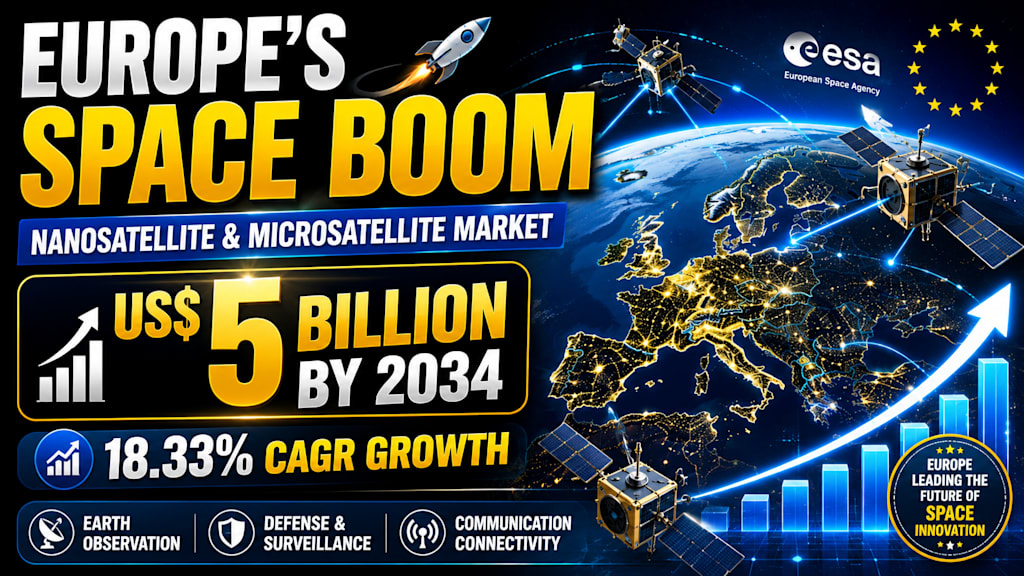
Europe Nanosatellite and Microsatellite Market Size & Forecast 2026–2034
Europe is rapidly emerging as one of the world's most dynamic hubs for small satellite innovation. Driven by advancements in satellite miniaturization, increasing climate monitoring initiatives, defense modernization programs, and the growth of commercial space ventures, the region's nanosatellite and microsatellite industry is entering a period of exceptional expansion.
According to Renub Research, the Europe Nanosatellite and Microsatellite Market is projected to increase from US$ 1.10 Billion in 2025 to US$ 5.00 Billion by 2034, expanding at a remarkable CAGR of 18.33% during 2026–2034.
The transformation is being fueled by strong government investments, active participation from private space startups, and rising demand for cost-effective satellite systems capable of delivering high-quality Earth observation, communication, navigation, scientific research, and defense capabilities.
Understanding Nanosatellites and Microsatellites
Nanosatellites and microsatellites are compact artificial satellites that offer significant advantages over traditional large satellite platforms.
Nanosatellites generally weigh between 1 and 10 kilograms, while microsatellites range from 10 to 100 kilograms. Despite their small size, these satellites perform highly sophisticated missions involving:
Earth observation
Climate monitoring
Navigation
Communication services
Scientific research
Defense surveillance
Biological experiments
Technology validation
Their lower manufacturing and launch costs allow organizations to deploy entire constellations of satellites, enabling broader coverage and faster data collection than ever before.
As Europe intensifies efforts toward digital transformation, environmental sustainability, and strategic autonomy, small satellite technologies are becoming indispensable assets across both public and private sectors.
Earth Observation and Climate Monitoring Fuel Market Expansion
One of the most powerful drivers behind Europe's nanosatellite and microsatellite growth is the increasing demand for Earth observation services.
European governments are investing heavily in technologies that can monitor environmental changes, support climate research, improve disaster response capabilities, and enhance resource management.
Small satellites provide frequent, high-resolution imagery of land, oceans, atmosphere, forests, and urban infrastructure while maintaining lower operational costs compared to traditional satellite systems.
Climate-related challenges such as rising temperatures, wildfires, floods, droughts, and coastal erosion have elevated the importance of continuous environmental monitoring. Satellite-generated data helps policymakers make informed decisions while supporting sustainability initiatives across the continent.
The launch of the Metop Second Generation A1 satellite and the integration of Copernicus Sentinel missions demonstrate Europe's commitment to leveraging advanced space technologies for environmental protection and economic growth.
Government Support Strengthens the Industry
Government backing remains one of the most significant growth catalysts for Europe's small satellite ecosystem.
Multiple national space agencies and European institutions actively fund research, satellite development, launch infrastructure, and innovative space applications.
Organizations supporting industry growth include:
European Space Agency (ESA)
French Space Agency (CNES)
German Aerospace Center (DLR)
Italian Space Agency (ASI)
UK Space Agency
The European Union's integrated Space Programme has unified investments across Earth observation, navigation, secure communications, and space situational awareness under a coordinated framework.
Programs such as:
Copernicus
Galileo
EGNOS
GOVSATCOM
IRIS²
Space Situational Awareness (SSA)
are creating long-term opportunities for satellite manufacturers, software developers, launch providers, and data analytics companies.
These initiatives are helping Europe reduce dependency on external technologies while enhancing strategic capabilities across critical sectors.
Rise of NewSpace Startups Reshaping the Market
Europe's NewSpace movement has become a major force behind market growth.
Unlike traditional aerospace organizations, NewSpace companies emphasize innovation, agility, and commercial applications. Startups across Europe are developing satellite platforms tailored for broadband connectivity, maritime monitoring, agriculture, logistics, asset tracking, and Internet of Things (IoT) applications.
The growing availability of venture capital funding and public-private partnerships has accelerated commercialization across the sector.
Many startups are creating satellite-as-a-service business models that make space-based services accessible to organizations that previously lacked the resources to invest in space infrastructure.
As launch costs continue to decrease and satellite technologies become more sophisticated, Europe is witnessing a new wave of entrepreneurial activity driving innovation throughout the value chain.
Space Debris Creates Sustainability Concerns
Despite promising growth prospects, the industry faces important challenges.
One of the most pressing concerns is orbital congestion caused by the increasing number of satellites operating in Low Earth Orbit (LEO).
As more satellites are launched, the risk of collisions rises significantly. Such incidents can generate additional space debris that threatens existing spacecraft and future missions.
To address these risks, regulatory authorities are introducing stricter requirements regarding:
Satellite tracking
Collision avoidance
End-of-life disposal
Responsible deorbiting
While these regulations improve long-term sustainability, they also increase operational complexity and compliance costs for satellite operators.
Managing orbital traffic effectively will be essential to maintaining industry growth over the coming decades.
Launch Capacity and Regulatory Challenges Persist
Europe's satellite industry also faces challenges related to launch availability and regulatory procedures.
Although launch services have expanded significantly, demand often exceeds supply, causing scheduling delays for satellite deployments.
Additionally, operators must navigate complex regulations concerning:
Spectrum allocation
Licensing requirements
International coordination
Frequency management
Different regulatory frameworks across European countries can slow project approvals and increase administrative burdens.
Improving launch infrastructure and streamlining regulatory processes will be important priorities for policymakers seeking to strengthen Europe's competitiveness in the global space economy.
Europe Nanosatellite Market Gains Momentum
The nanosatellite segment is experiencing rapid growth due to its affordability and flexibility.
Universities, research institutions, startups, and government agencies increasingly favor nanosatellites because they can be developed quickly and launched at relatively low cost.
Countries such as Germany, France, and the United Kingdom have established strong ecosystems supporting nanosatellite innovation through academic research and industrial collaboration.
Nanosatellites are widely used for:
Educational missions
Scientific research
Earth observation
Communication experiments
Technology demonstrations
As miniaturization technologies continue advancing, nanosatellites are becoming capable of handling increasingly complex missions once reserved for much larger spacecraft.
Microsatellites Continue Expanding Their Role
Microsatellites occupy a critical position within Europe's space ecosystem.
Their larger size allows them to carry more advanced payloads, resulting in enhanced imaging capabilities, greater communication bandwidth, and longer mission durations.
Microsatellites are extensively utilized in:
Defense operations
Environmental monitoring
Telecommunications
Navigation support
Maritime surveillance
Advancements in propulsion technologies, onboard processing systems, and energy management solutions are making microsatellites increasingly attractive for government and commercial applications.
Their ability to balance performance and affordability positions them as a key growth segment throughout the forecast period.
Software Becomes a Strategic Growth Segment
Software is becoming one of the most valuable components within the European nanosatellite and microsatellite market.
Modern satellite missions generate enormous amounts of data that require sophisticated processing and analysis.
Space software solutions support:
Mission planning
Satellite control
Data management
Artificial intelligence applications
Real-time analytics
Cloud-based operations
AI and machine learning technologies are enabling satellites to process information directly in orbit, reducing latency and improving operational efficiency.
European software developers are increasingly creating specialized platforms that enhance mission performance while lowering operational costs.
Biological Experiments Open New Opportunities
Biological research conducted in space is becoming an increasingly important application area.
Nanosatellites and microsatellites offer researchers affordable platforms for studying biological processes in microgravity environments.
European institutions are conducting experiments involving:
Cell growth
Radiation exposure
Microbial behavior
Human health studies
Pharmaceutical research
These experiments contribute to advancements in healthcare, biotechnology, and future deep-space exploration initiatives.
As Europe's investment in scientific research continues to grow, biological experiments are expected to become a significant niche segment within the small satellite market.
Defense Applications Gain Strategic Importance
Defense remains one of the fastest-growing end-use sectors for nanosatellites and microsatellites.
European governments are investing heavily in satellite systems designed to support:
Intelligence gathering
Border surveillance
Reconnaissance
Secure communications
Early warning systems
Growing geopolitical tensions have increased the importance of independent space capabilities and strategic autonomy.
Small satellites provide military organizations with flexible, rapidly deployable assets that can enhance situational awareness while reducing costs compared to traditional satellite programs.
Consequently, defense-related investments are expected to contribute substantially to market expansion through 2034.
Country Spotlight: France, Germany, and the United Kingdom
France
France remains one of Europe's leading satellite technology centers.
Strong government support, advanced aerospace infrastructure, and significant R&D investments continue to drive innovation.
The country's plans to deploy maneuverable satellites capable of protecting national assets demonstrate its growing focus on space security and strategic autonomy.
Germany
Germany's engineering excellence positions it as a major contributor to Europe's satellite industry.
Research institutions and commercial organizations continue to develop advanced technologies supporting Earth observation, industrial monitoring, and future quantum communication systems.
The successful launch of the QUICK³ nanosatellite highlights Germany's commitment to next-generation space innovation.
United Kingdom
The UK has emerged as a major NewSpace hub.
The country excels in satellite manufacturing, Earth observation services, and IoT connectivity solutions.
Strong startup activity and international collaborations such as the Redwing microsatellite project with Canada reinforce the UK's leadership position within Europe's small satellite market.
10 Recent Developments Shaping the Industry
ESA supported multiple Earth observation missions using advanced small satellite technologies throughout 2025.
Metop-SGA1 launched successfully as part of Europe's next-generation weather satellite program.
Sentinel-5 Earth observation capabilities were integrated into new environmental monitoring initiatives.
The European Union continued expanding the IRIS² secure satellite communication program.
Space Situational Awareness programs received additional support across Europe.
France announced plans to deploy maneuverable defense satellites in Low Earth Orbit.
Germany participated in the launch of the QUICK³ nanosatellite supporting future quantum communication research.
The United Kingdom advanced collaboration with Canada on the Redwing Space Domain Awareness project.
NewSpace startups across Europe attracted increasing private investment for commercial satellite applications.
Research institutions expanded biological experiments utilizing nanosatellite and microsatellite platforms for microgravity studies.
Final Thoughts
Europe's nanosatellite and microsatellite market is entering a transformative era. Growing environmental concerns, increasing defense requirements, expanding commercial opportunities, and strong governmental support are collectively creating a robust growth environment.
With market value expected to rise from US$ 1.10 Billion in 2025 to US$ 5.00 Billion by 2034, the industry is positioned to become a cornerstone of Europe's future digital and space economy.
As satellite technologies continue becoming smaller, smarter, and more affordable, nanosatellites and microsatellites will play an increasingly critical role in shaping how Europe monitors its environment, secures its interests, advances scientific discovery, and participates in the rapidly evolving global space sector.
About the Creator
Enjoyed the story? Support the Creator.
Subscribe for free to receive all their stories in your feed.
Comments
There are no comments for this story
Be the first to respond and start the conversation.