
Europe Lost the Battery Race. Now It’s Going Nano.
After Northvolt’s collapse, a handful of Dutch startups are betting the future of batteries is one billionth of a metre wide.
One billionth of a metre: another way for Europe’s battery industry
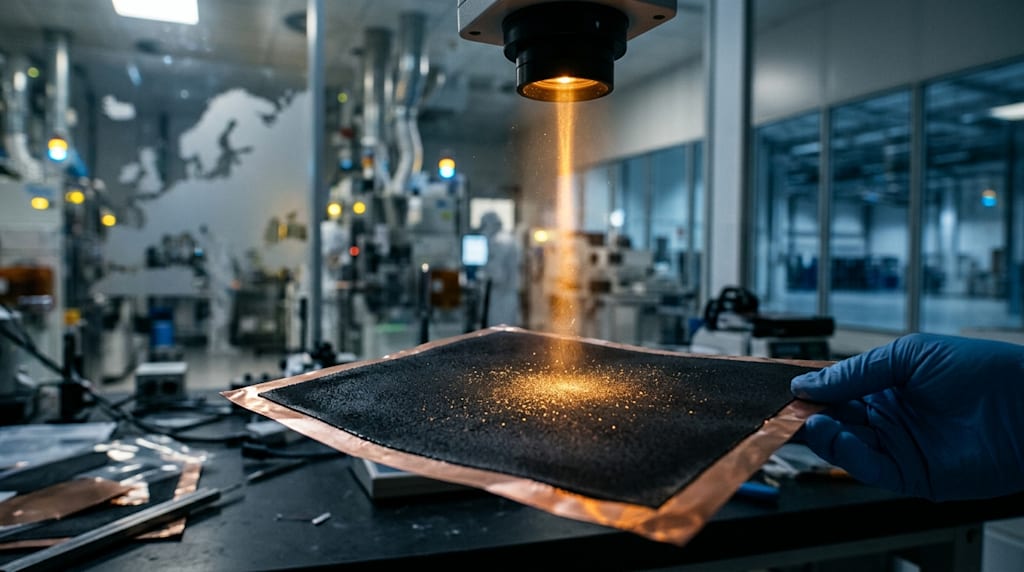
In a factory in Eindhoven, a roll of copper foil moves slowly through a machine. On its surface, plasma deposition has grown a black layer of pure silicon. Christian Rood, CEO of LeydenJar, picks up a treated battery sheet and holds it up to the light. The silicon layer is so thin that the naked eye can barely detect its thickness. This layer, he says, determines whether a battery can charge to 80 per cent in ten minutes.
The company takes its name from the 18th-century Leiden jar. The Leiden jar was one of the forerunners of the battery. Three hundred years later, LeydenJar in the Netherlands makes battery anodes. The anode is an important part of a battery. Pure silicon can store more lithium ions, but it expands and contracts during charge and discharge, causing cracks and eventually falling apart. This has been a longstanding problem in the industry.
LeydenJar uses plasma deposition to build ultra-thin pure silicon foils layer by layer. Rood says a conventional pure silicon anode falls apart, but this technology remains stable. According to LeydenJar’s figures, energy density can be increased by up to 50 per cent. Commercial-scale production will begin at the end of 2026. It has taken the company ten years to reach this point.
Ten years is a typical timeframe for deep-tech innovation. The technical barrier is high, the R&D cycle is long, and the risk of failure is great. “If you can make this technology work, it will affect many industries,” Rood says. “But it is a high-risk business.”
After Northvolt
Europe has tried to build a battery industry at home. Sweden’s Northvolt and Norway’s Morrow have both filed for bankruptcy. Northvolt was once seen as the hope of Europe’s battery industry. It tried to build a complete domestic supply chain in Europe, from materials to cells. High energy costs, a complex supply chain, difficulties in scaling up technology and financing pressure ultimately drove the company into bankruptcy.
Chinese companies hold a dominant position in battery production. From raw material processing and cell manufacturing to supply chain integration, China has built up advantages of scale. Europe fears it is missing another technological transition. As transport and industrial activity shift from fossil fuels to electricity, batteries are becoming a growth industry. But bringing new products to market takes time, competition is fierce, and Europe must take on risk.
So some investors and researchers have turned to the nanoscale. One nanometre is one billionth of a metre. Some of the most influential work is happening at this level.
A protective coat for powder
In a laboratory in Delft, Roderik Colen, CEO of Powall, watches the equipment. Powder particles tumble in a gas as a chemical reaction takes place on their surfaces. A single powder particle is measured in micrometres; the coating is measured in nanometres. The coating is applied using atomic layer deposition.
Colen says batteries lose performance after thousands of cycles. A nanocoating can slow this decline, or ageing. You may have an exciting new material with higher capacity or fast-charging capability, but it has a durability problem. That means it can never become a commercial product. Powall provides a protective coating that effectively makes these new materials viable.
The powder and coating materials are carried by gas and combined through chemical reactions. Colen says it is a precise but flexible process that can be adjusted almost indefinitely. You can control the coating thickness very precisely, and that has an impact on performance.
Powall has not tried to manufacture complete batteries itself. It has chosen to build commercial partnerships with Asian customers. LeydenJar has done the same. Both companies position themselves as technology providers in the supply chain.
Where semiconductors meet batteries
LeydenJar’s factory is in Eindhoven. ASML and other major chip industry companies are also based there. Rood says many people talk about ecosystems in theory. For him, it is one of the sources of competitive advantage.
“What really sets us apart is the cross-fertilisation between semiconductors and batteries,” Rood says. “Once you have proved the principle in the lab, industrialisation requires you to work with semiconductor technology and suppliers.”
This carries a lot of risk, and opportunity. There are opportunities in patents and in protecting intellectual property overall. Rood says doing this in the US or China would be much more difficult.
He uses the semiconductor industry as an analogy. ASML does not make chips; it focuses on a key step in chip production. That is how ASML has secured a place in the wider semiconductor competition. “That is also our goal: to make our battery anode unique, and thereby occupy an important position in the supply chain.”
Powall likewise benefits from the semiconductor and precision manufacturing base in and around Delft. Europe has long accumulated capabilities in semiconductor equipment, materials science and precision engineering. These capabilities are being reapplied to the battery industry.
The China variable
In Berlin, at the Mercator Institute for China Studies, senior analyst Alexander Brown says it is good to have part of the supply chain located in Europe. It would be even better if that part could be a highly advanced segment with the potential to generate high profits.
But he warns that cooperation and competition can coexist. China will continue to work hard to reduce its dependence on other regions. “China is working very hard to develop domestic technological alternatives, including these niche technologies,” Brown says. “It is no secret that China wants to replace ASML. They are working very hard in that direction, and it is not inconceivable that they will eventually achieve that goal.”
Brown believes Europe has a traditional strength in developing refined, high-quality products. These products can find markets around the world. “But I also think this should not be the only strategy for European policymakers.”
China also has an advantage in battery technology patents. One study showed that among battery patent families across China, the US and Europe in 2023, Chinese applicants accounted for 79 per cent, while the EU accounted for only 6 per cent. Chinese companies are also positioning themselves in next-generation technologies such as solid-state batteries and sodium-ion batteries. Europe’s nanotechnology companies need to run faster.
Capital patience
LeydenJar has reached commercial scale. But Rood says raising money in Europe is not always easy.
“Europe has enough money, but its attitude to risk is very different from Asia and the US,” Rood says. This means companies like LeydenJar have to work with different sources of funding at the same time. He lists government grants, debt financing, support from the European Investment Bank, and investors willing to buy company shares.
“They set many challenging conditions, and they all want to carry out their own due diligence. It is a tough job.”
European deep-tech startups generally face this financing environment. Money is not scarce, but capital willing to take on high-risk, long-cycle, hard-tech investment is relatively limited. Some venture capital in the US and Asia is more willing to bet on early-stage hard tech and accept longer return cycles. If Europe wants to stay ahead in battery nanotechnology, it must change its financing culture: more long-term capital, more tolerance of failure, and more collaboration between industry, academia and research.
Powall’s Colen calls Europe, especially the Netherlands, an “innovation powerhouse”. As long as it is willing to take risks, battery technology can offer Europe a chance to exert influence. “This is a relatively young industry, and factories are being built everywhere. They are looking for the right technology. So you have a chance to play an important role, because the scale of demand is enormous.”
Small changes
Europe’s place in the battery industry may not lie in building giant gigafactories. It lies at the other end of the scale spectrum.
“Small changes can make a big difference,” Colen says.
The machines in Eindhoven are still running. Roll after roll of copper foil passes through the deposition zone, and a black silicon layer grows on the surface. In the Delft laboratory, powder tumbles in gas as coatings are added layer by layer. Rood says he is solving a bottleneck in the battery industry. Colen says he is making new materials viable. Northvolt’s factory has gone quiet. Europe’s battery industry is recharging in a world one billionth of a metre across.
About the Creator
Jin
Writer of reamstories
https://reamstories.com/jin
Enjoyed the story? Support the Creator.
Subscribe for free to receive all their stories in your feed. You could also become a paid subscriber, letting them know you appreciate their work.
Comments
There are no comments for this story
Be the first to respond and start the conversation.