
Europe Electric Vehicle Market Accelerates Toward a Sustainable Future as EV Adoption and Charging Infrastructure Expand Rapidly
Government incentives, battery innovation, and stricter emission regulations are transforming Europe into one of the world’s fastest-growing electric vehicle markets.

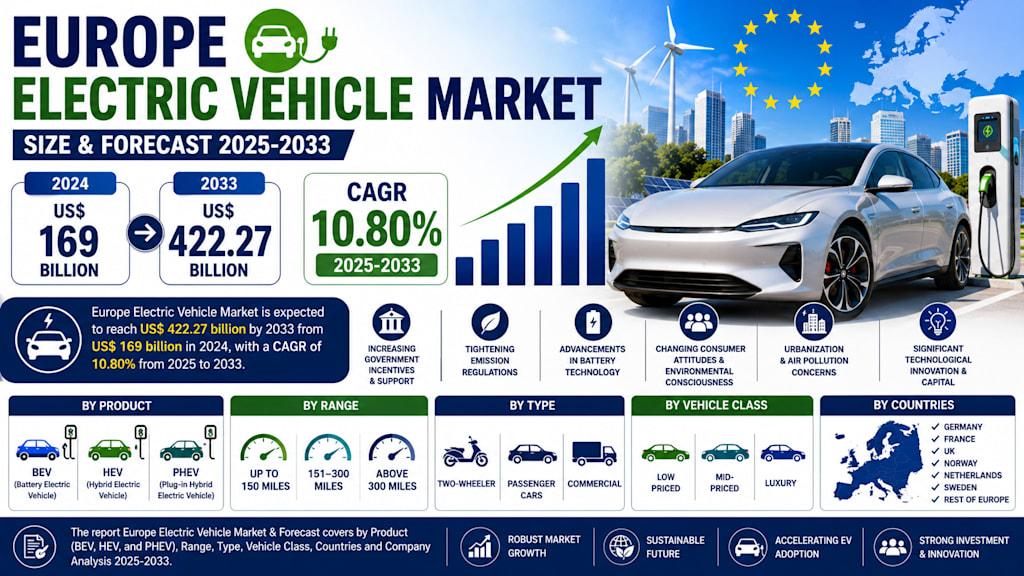
Europe Electric Vehicle Market Overview
The Europe electric vehicle (EV) market is witnessing remarkable growth as governments, automakers, and consumers increasingly embrace sustainable transportation solutions. According to the uploaded report, the Europe Electric Vehicle Market is expected to grow from US$ 169 billion in 2024 to US$ 422.27 billion by 2033, registering a strong CAGR of 10.80% during 2025–2033.
Electric vehicles are rapidly becoming a mainstream mobility solution across Europe because of stricter environmental regulations, growing climate awareness, technological innovation, and expanding charging infrastructure. Unlike conventional vehicles powered by fossil fuels, EVs operate using electric motors and rechargeable batteries, producing zero tailpipe emissions and significantly reducing carbon footprints.
Europe has emerged as one of the global leaders in electric mobility due to strong policy support, aggressive emission targets, and substantial investments in battery technology and charging infrastructure. Consumers across the region are increasingly shifting toward electric transportation as urban pollution concerns, fuel prices, and environmental consciousness continue to rise.
The market includes Battery Electric Vehicles (BEVs), Hybrid Electric Vehicles (HEVs), and Plug-in Hybrid Electric Vehicles (PHEVs), covering passenger cars, commercial vehicles, and two-wheelers across multiple price categories.
Strict Emission Policies Are Driving Market Expansion
One of the biggest growth drivers for the European EV market is the region’s increasingly strict environmental and carbon-emission regulations.
The report highlights that the European Union’s “Fit for 55” climate package aims to reduce carbon emissions by 55% by 2030, while the EU also plans to ban the sale of new internal combustion engine vehicles by 2035.
These ambitious climate goals are forcing automakers to accelerate electrification strategies and increase investment in EV production.
Governments across Europe are also offering powerful incentives to encourage EV adoption, including:
- Purchase subsidies
- Tax rebates
- Reduced registration fees
- Lower road taxes
- Benefits for low-emission zone access
Such incentives are reducing financial barriers for consumers while helping EVs become increasingly competitive with traditional gasoline and diesel vehicles.
As a result, both consumer demand and manufacturer investment in electric mobility are growing rapidly throughout Europe.
Battery Technology Improvements Are Changing the Industry
Advancements in battery technology are playing a major role in making electric vehicles more affordable, practical, and attractive to consumers.
Continuous improvements in lithium-ion batteries and emerging solid-state battery technologies are increasing energy density, improving driving range, reducing charging time, and lowering production costs.
Historically, battery systems represented the most expensive component of electric vehicles. However, ongoing research and large-scale manufacturing are gradually reducing battery costs, making EVs more accessible to mainstream buyers.
European automakers and research institutions are investing heavily in battery innovation through strategic partnerships and research collaborations. These efforts are helping improve vehicle performance while reducing range anxiety and charging inconvenience—two concerns that previously slowed EV adoption.
Better battery technology is also strengthening Europe’s ambition to become a global leader in sustainable transportation and advanced automotive manufacturing.
Charging Infrastructure Expansion Is Supporting EV Adoption
The rapid expansion of charging infrastructure is another major factor accelerating electric vehicle growth across Europe.
Public charging availability is improving significantly in both urban areas and major transportation corridors, making EV ownership more practical for long-distance travel and daily commuting.
The report highlights that by December 2023, Europe had installed approximately 700,000 public charging points, representing a 35% increase compared to the previous year.
One notable example is Volkswagen France’s “Electrify France” initiative, launched in September 2023, which aimed to install 150 ultra-fast charging stations across dealership networks by summer 2024.
In addition, partnerships such as Spark, which integrates more than 11,000 charging points across 25 countries, are helping create a more connected European EV charging ecosystem.
As charging networks continue to expand, consumer confidence in electric mobility is expected to rise further.
Growing Urbanization and Environmental Awareness
Rapid urbanization across Europe has increased concerns about air pollution, traffic congestion, and greenhouse gas emissions.
Electric vehicles are increasingly viewed as a cleaner and quieter alternative to traditional internal combustion engine vehicles, especially in densely populated cities where governments are introducing low-emission zones and stricter environmental policies.
Ride-hailing services, car-sharing platforms, and corporate fleet operators are also integrating EVs into their operations, helping increase public exposure to electric mobility.
This growing familiarity is gradually changing consumer attitudes and encouraging broader EV acceptance across different demographic groups.
Challenges Facing the Europe Electric Vehicle Market
High Upfront Costs
Despite falling battery prices and government incentives, electric vehicles still remain more expensive upfront compared to many conventional vehicles.
For middle-income and budget-conscious consumers, the higher initial purchase cost can still be a major barrier, especially in countries where subsidies are limited or inconsistent.
Although long-term operating costs are often lower because of reduced fuel and maintenance expenses, affordability remains a critical challenge for mass-market EV adoption.
Supply Chain Limitations
The European EV industry also faces supply-chain risks related to critical raw materials such as lithium, cobalt, and nickel, which are essential for battery production.
Europe remains heavily dependent on imports for these materials, making the market vulnerable to geopolitical tensions, price fluctuations, and supply disruptions.
Global competition for battery materials is intensifying, increasing pressure on automakers and battery manufacturers to secure long-term supply agreements and develop local production capabilities.
Country-Level Market Insights
Germany
Germany remains Europe’s largest and most influential EV market, supported by strong government incentives, major automotive manufacturers, and advanced charging infrastructure.
Companies such as Volkswagen, BMW, and Mercedes-Benz are investing heavily in electric mobility, battery development, and sustainable transportation technologies.
Germany aims to significantly expand its EV fleet by 2030 while strengthening domestic battery manufacturing and charging networks.
France
France’s EV market has experienced strong momentum, with electric vehicles accounting for 26% of new car sales in 2023.
Government incentives, affordable EV models, and investments in charging infrastructure are accelerating adoption across the country.
The report also highlights Volkswagen France’s charging network expansion efforts as part of the broader transition toward sustainable transportation.
United Kingdom
The United Kingdom remains one of Europe’s fastest-growing EV markets, driven by ambitious zero-emission targets and growing consumer interest in battery electric vehicles.
The UK government aims for 80% of new car sales to be zero-emission by 2030 and 100% by 2035.
However, the market still faces challenges related to electricity costs and changing public attitudes toward EV adoption.
10 Recent Developments in the Europe Electric Vehicle Market
Volkswagen France launched the “Electrify France” ultra-fast charging network initiative in September 2023.
Europe installed approximately 700,000 public charging points by December 2023, marking strong infrastructure expansion.
Spark Alliance expanded cross-border charging accessibility with 11,000 charging points across 25 countries.
Volkswagen AG accelerated investment in next-generation EV platforms and battery technologies across Europe.
BMW Group continued expanding its premium electric vehicle portfolio and battery innovation initiatives.
Mercedes-Benz Group AG increased focus on luxury EV production and advanced autonomous mobility technologies.
Tesla, Inc. expanded its European manufacturing and charging infrastructure footprint to support rising EV demand.
BYD Company Ltd. strengthened its presence in the European EV market through new model launches and dealership expansion.
Ford Motor Company accelerated electrification strategies for its European vehicle lineup.
Audi AG continued investing heavily in premium electric mobility and high-performance battery systems.
Major Companies Operating in the Market
Leading companies covered in the report include:
- Tesla, Inc.
- BMW Group
- BYD Company Ltd.
- Mercedes-Benz Group AG
- Ford Motor Company
- Nissan Motor Co. Ltd
- Toyota Motor Corporation
- Audi AG
Final Thoughts
The Europe electric vehicle market is rapidly evolving into one of the world’s most advanced and competitive EV ecosystems. Government regulations, environmental awareness, charging infrastructure growth, and technological innovation are collectively driving the transition toward sustainable mobility.
Although challenges such as battery costs and raw material supply risks remain important concerns, long-term market fundamentals remain exceptionally strong.
As consumers increasingly prioritize clean transportation and governments intensify climate commitments, electric vehicles are expected to dominate Europe’s automotive future. Companies capable of combining affordability, innovation, charging convenience, and sustainability will likely lead the next era of European mobility transformation.
About the Creator
Enjoyed the story? Support the Creator.
Subscribe for free to receive all their stories in your feed.
Comments
There are no comments for this story
Be the first to respond and start the conversation.