
Europe Distributed Control Systems Market to Reach US$ 9.33 Billion by 2033 Driven by Industry 4.0 and Smart Manufacturing
Europe’s Industrial Automation Boom Accelerates as Distributed Control Systems Become Essential for Energy Efficiency, Sustainability, and Digital Transformation

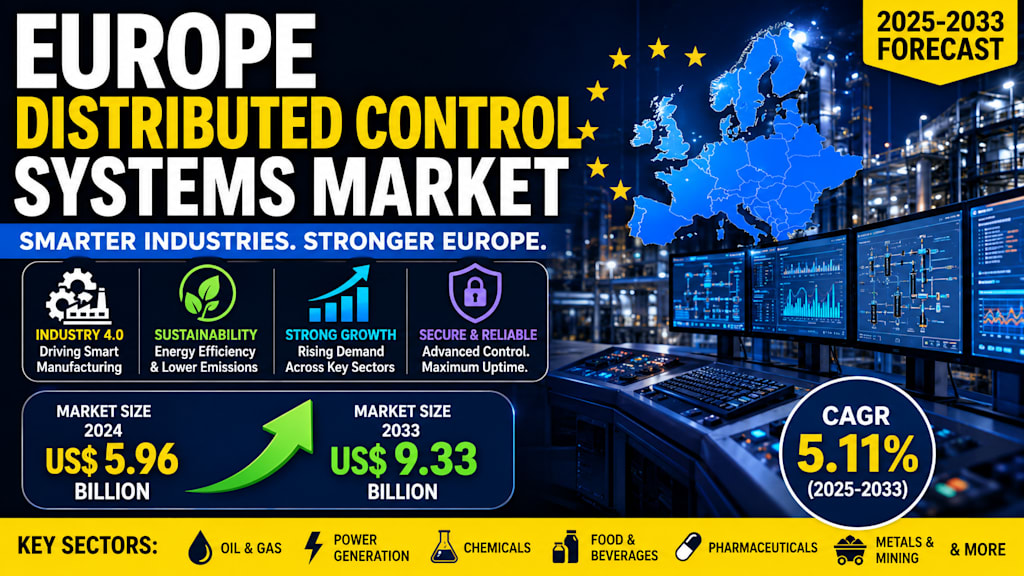
Europe’s industrial automation sector is entering a transformative decade, and Distributed Control Systems (DCS) are at the center of this technological evolution. From power plants and oil refineries to pharmaceutical facilities and food processing plants, industries across Europe are increasingly adopting advanced DCS platforms to improve operational efficiency, strengthen cybersecurity, optimize production, and meet ambitious sustainability goals.
According to Renub Research, the Europe Distributed Control Systems Market is projected to rise from US$ 5.96 billion in 2024 to US$ 9.33 billion by 2033, expanding at a CAGR of 5.11% between 2025 and 2033.
The market’s momentum reflects Europe’s growing commitment to industrial modernization, Industry 4.0 integration, and renewable energy expansion. As organizations look to reduce downtime, improve plant safety, and increase process automation, DCS technologies are becoming a mission-critical investment across multiple sectors.
What Are Distributed Control Systems and Why Are They Important?
Distributed Control Systems are automated control platforms designed to monitor and manage industrial processes across interconnected systems. Unlike traditional centralized control methods, DCS platforms distribute control functions throughout a facility, allowing operators to monitor equipment, processes, and production lines in real time.
These systems are widely used in industries where uninterrupted operations and process precision are essential. DCS technology supports:
Real-time monitoring
Automated process control
Data analytics
Predictive maintenance
Remote monitoring
Improved operational safety
Energy optimization
In Europe, where industries face increasing pressure to lower emissions and maximize efficiency, DCS solutions are rapidly becoming indispensable.
Industry 4.0 Is Transforming Europe’s Manufacturing Landscape
One of the strongest growth drivers behind the Europe Distributed Control Systems Market is the rapid adoption of Industry 4.0 technologies. Manufacturers across Germany, France, the United Kingdom, and Spain are integrating IoT, AI-driven analytics, robotics, and smart factory systems into their operations.
DCS platforms play a central role in enabling these intelligent manufacturing environments. By collecting and analyzing massive volumes of operational data, DCS systems help companies improve productivity, reduce waste, and minimize equipment downtime.
European manufacturers are also embracing predictive maintenance strategies powered by DCS and Industrial IoT technologies. Instead of reacting to equipment failures after they occur, businesses can now identify potential problems before disruptions happen.
This proactive approach significantly improves production continuity while reducing maintenance costs.
Energy Efficiency and Sustainability Goals Fuel Demand
Europe’s ambitious climate and decarbonization initiatives are accelerating investment in smart industrial automation technologies. Governments and corporations alike are prioritizing sustainability, and DCS platforms provide the advanced process optimization capabilities needed to meet these environmental objectives.
Energy-intensive sectors such as oil & gas, chemicals, power generation, and metals manufacturing are under increasing pressure to reduce emissions while maintaining profitability. Distributed Control Systems help organizations optimize energy consumption through:
Automated energy management
Real-time operational insights
Intelligent process adjustments
Reduced waste generation
Improved resource allocation
As renewable energy capacity expands across Europe, DCS solutions are also being deployed to manage increasingly complex power grids and intermittent renewable energy sources like solar and wind.
The transition toward cleaner energy systems is creating substantial growth opportunities for automation providers throughout the region.
Aging Industrial Infrastructure Creates Major Opportunities
A significant portion of Europe’s industrial infrastructure was developed decades ago and now requires modernization. Many legacy control systems are becoming difficult and expensive to maintain, prompting industries to replace outdated equipment with advanced DCS solutions.
Modern DCS systems offer scalable and flexible architectures that integrate with existing industrial infrastructure while delivering improved efficiency and reliability.
Industries upgrading their facilities are particularly attracted to features such as:
Predictive analytics
Remote diagnostics
Cybersecurity enhancements
Cloud connectivity
Real-time operational dashboards
AI-powered optimization
The modernization trend is especially visible in Europe’s power generation, chemical processing, and oil & gas industries, where operational reliability is critical.
Renewable Energy Expansion Strengthens Market Potential
Europe’s renewable energy expansion strategy is another major factor boosting the DCS market. Countries including Germany, Spain, and the United Kingdom are aggressively increasing investments in wind, solar, and hydropower infrastructure.
Managing renewable energy networks requires highly advanced automation and control systems capable of balancing fluctuating energy generation with real-time demand.
Distributed Control Systems provide utilities and energy providers with the operational intelligence necessary to stabilize grids, monitor energy flows, and improve infrastructure resilience.
As Europe accelerates its green energy transition, DCS adoption within renewable energy facilities is expected to rise significantly throughout the forecast period.
United Kingdom Accelerates Smart Manufacturing Investments
The United Kingdom is emerging as one of Europe’s most dynamic DCS markets due to strong government support for industrial modernization initiatives.
The UK government’s “Manufacturing Made Smarter” program has encouraged industries to adopt advanced digital technologies and automation systems. The initiative aims to improve manufacturing efficiency, encourage innovation, and strengthen industrial connectivity across the country.
Sectors such as pharmaceuticals, food processing, chemicals, and energy are actively deploying DCS platforms to improve operational control and regulatory compliance.
The UK market is also benefiting from increased demand for smart factories and data-driven industrial processes.
Germany Remains a Leader in Industrial Automation
Germany continues to dominate Europe’s industrial automation landscape, supported by its globally recognized manufacturing ecosystem and strong Industry 4.0 leadership.
German industries are investing heavily in intelligent automation technologies to maintain competitiveness in global markets. Distributed Control Systems are widely used across automotive manufacturing, chemicals, pharmaceuticals, and energy production.
The country’s emphasis on precision engineering, energy efficiency, and smart production technologies makes it one of the most influential DCS markets worldwide.
Leading automation companies headquartered in Germany are continuously introducing advanced DCS innovations that combine AI, cloud computing, and industrial cybersecurity.
France Focuses on Sustainability and Digital Transformation
France’s Distributed Control Systems Market is expanding steadily due to growing investments in industrial modernization and sustainability initiatives.
French industries are increasingly adopting intelligent automation solutions to improve operational efficiency while complying with strict environmental regulations.
The country’s strong focus on renewable energy, smart manufacturing, and industrial digitalization is creating sustained demand for advanced DCS technologies.
Industries including chemicals, pharmaceuticals, manufacturing, and energy production are leading adoption across the French market.
Spain Emerges as a Fast-Growing DCS Market
Spain is becoming a key growth market for Distributed Control Systems thanks to aggressive Industry 4.0 initiatives and renewable energy investments.
The Spanish government has introduced various financial incentives, tax programs, and training initiatives to encourage digital transformation across industrial sectors.
As Spain expands solar and wind energy generation capacity, demand for sophisticated automation and grid management solutions continues to increase.
DCS platforms are helping Spanish industries improve efficiency, strengthen competitiveness, and optimize increasingly complex energy systems.
Challenges Facing the Europe Distributed Control Systems Market
Despite strong long-term growth potential, the DCS industry also faces several important challenges.
High Initial Investment Costs
Implementing modern Distributed Control Systems requires substantial upfront investment in hardware, software, integration services, and workforce training.
Small and medium-sized enterprises often struggle with these capital requirements, slowing adoption in some industrial segments. Legacy infrastructure upgrades can also add significant implementation costs.
Technological Complexity
DCS systems are becoming increasingly sophisticated, requiring highly skilled personnel for operation, maintenance, and cybersecurity management.
Many organizations must invest heavily in employee training programs to successfully transition toward advanced industrial automation environments.
Frequent software updates and evolving cybersecurity threats further increase operational complexity for industrial operators.
Major Companies Driving Innovation in Europe’s DCS Market
Several global industrial automation leaders are shaping the future of Europe’s Distributed Control Systems Market through product innovation, AI integration, and smart factory technologies.
Key players include:
ABB
Siemens AG
Schneider Electric SE
Honeywell International Inc.
Emerson Electric Co
Omron Corporation
Valmet Oyj
Azbil Corporation
These companies continue to expand their industrial automation portfolios through AI-enabled systems, cloud-based analytics, cybersecurity enhancements, and next-generation process optimization technologies.
10 Recent Developments in the Distributed Control Systems Industry
Siemens AG expanded its digital factory automation solutions with stronger AI-driven analytics integration.
ABB enhanced cybersecurity capabilities for industrial control systems targeting energy and manufacturing sectors.
Schneider Electric SE introduced upgraded EcoStruxure automation solutions focused on sustainability and energy optimization.
Honeywell International Inc. expanded cloud-enabled industrial monitoring solutions for remote operations management.
Emerson Electric Co strengthened predictive maintenance technologies using advanced AI analytics.
Omron Corporation launched enhanced smart manufacturing platforms supporting Industry 4.0 integration.
Valmet Oyj developed new automation solutions for pulp, paper, and energy industries.
Azbil Corporation improved intelligent process control systems for industrial efficiency enhancement.
European industries increasingly adopted hybrid cloud-connected DCS platforms for real-time industrial monitoring and remote diagnostics.
Renewable energy operators across Europe accelerated deployment of advanced DCS technologies to support grid stability and energy transition goals.
Final Thoughts
Europe’s Distributed Control Systems Market is entering a powerful growth phase fueled by industrial digitalization, smart manufacturing initiatives, and sustainability-driven transformation.
As industries modernize aging infrastructure and embrace Industry 4.0 technologies, DCS solutions are becoming essential for maintaining operational efficiency, reducing downtime, improving cybersecurity, and supporting cleaner industrial processes.
The region’s strong commitment to renewable energy and carbon reduction will continue creating significant opportunities for automation providers over the coming decade.
With the market projected to reach US$ 9.33 billion by 2033, Distributed Control Systems are poised to become one of the most critical pillars of Europe’s future industrial ecosystem.
About the Creator
Enjoyed the story? Support the Creator.
Subscribe for free to receive all their stories in your feed.
Comments
There are no comments for this story
Be the first to respond and start the conversation.