
Europe Automotive Robotics Market Gains Momentum as EV Growth, Smart Manufacturing, and AI Push the Industry Forward
Rising adoption of automation across European vehicle production, strong automotive manufacturing hubs, and rapid Industry 4.0 integration are shaping the next phase of automotive robotics in Europe.

Market Overview
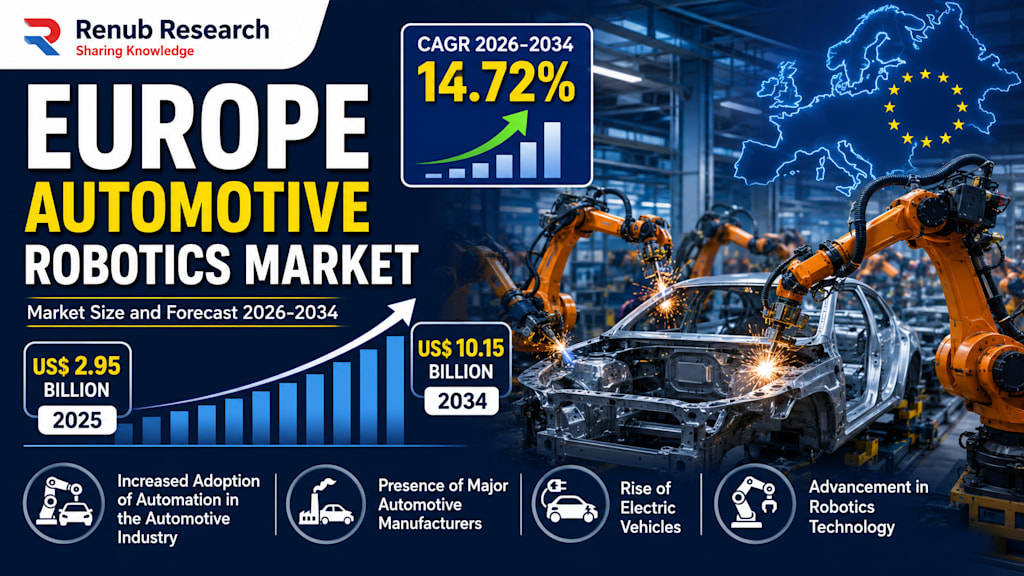
The Europe automotive robotics market is entering a high-growth phase as manufacturers accelerate automation to improve precision, speed, safety, and production efficiency. Automotive robotics refers to the use of programmable robots in vehicle manufacturing activities such as welding, painting, assembly, inspection, and material handling. These robots are increasingly central to modern automotive production because they help manufacturers maintain consistency while managing rising complexity in vehicle design and assembly. According to Renub Research, the Europe automotive robotics market is expected to grow from US$ 2.95 billion in 2025 to US$ 10.15 billion by 2034, registering a strong CAGR of 14.72% during 2026–2034.
This expansion is being fueled by the region’s strong automotive manufacturing base, the growing shift toward electric vehicles, and the rapid adoption of Industry 4.0 technologies. European automakers are increasingly investing in robotic systems to remain globally competitive, improve factory throughput, and support the transition to smart manufacturing. Countries such as Germany, France, Italy, and Spain are leading the move toward advanced automation, with robotics becoming a core part of vehicle production strategy.
The market is also benefiting from the wider push toward cleaner mobility. As Europe intensifies its focus on electric and sustainable vehicles, automakers are redesigning production systems to accommodate battery assembly, precision inspection, and lightweight material handling. These changes require highly sophisticated robotic solutions, especially in welding and assembly operations where accuracy is essential. In that sense, the robotics market is not just responding to industrial demand; it is actively enabling the region’s automotive transformation.
Growth Drivers
One of the strongest growth drivers in the Europe automotive robotics market is the presence of major automotive manufacturing hubs. Europe has long been home to some of the world’s most advanced vehicle production ecosystems, and countries such as Germany, France, Italy, and Spain continue to invest heavily in modern manufacturing technologies. These hubs are under pressure to improve efficiency, enhance quality, and reduce production costs, making robotics an increasingly attractive solution.
Automotive companies in Europe are also moving toward smart factories, where robotics works together with digital systems, analytics, and machine learning to improve performance across the production line. This shift is supported by well-developed supply chains and a strong industrial base, both of which make the deployment of robotic systems more practical and scalable. In February 2025, the European Commission launched a €200 billion InvestAI initiative to accelerate AI deployment in key sectors, including automotive manufacturing. That initiative reflects how seriously Europe is investing in the future of intelligent manufacturing.
The rising demand for electric and sustainable vehicles is another major catalyst. EV production requires a high level of precision, particularly in battery assembly and quality inspection, both of which are ideal use cases for robotics. As governments across Europe continue enforcing environmental regulations and supporting clean mobility incentives, automakers are being pushed to expand EV output. That shift directly increases demand for automotive robots.
A notable example of this trend came in September 2024, when Leapmotor International and Stellantis launched orders for the T03 compact city car and the C10 SUV in Europe. This move highlights the rising appetite for affordable high-tech EVs and underscores the broader push toward electrified mobility across the region. Since EV manufacturing often involves more automated and battery-intensive processes than traditional vehicle production, robot adoption is expected to continue rising.
Industry 4.0 adoption is also reshaping the market. European manufacturers are increasingly integrating robotics with AI, machine learning, IoT, and machine vision to create more intelligent and adaptive production systems. Collaborative robots, or cobots, are becoming more common because they allow safe human-machine interaction while improving productivity. Machine vision systems are also helping robots perform more complex tasks with greater accuracy and flexibility.
Government support is further accelerating this trend. In June 2024, the UK Government announced a £4.5 billion investment plan focused on reducing carbon emissions and boosting manufacturing, with £2 billion allocated to the automotive sector. This shows how strongly public policy is aligned with industrial automation, clean mobility, and digital transformation.
Market Challenges
Despite its strong outlook, the Europe automotive robotics market faces some important challenges. High implementation and operational costs remain one of the biggest barriers, especially for small and medium-sized enterprises. Robotics systems require significant upfront investment, as well as ongoing maintenance and upgrades. For many manufacturers, the return on investment can take time, which makes adoption more difficult in a cost-sensitive market environment.
Economic uncertainty and fluctuations in the automotive industry also make companies cautious about major capital expenditure. Even though robotics can deliver strong long-term efficiency gains, the initial burden remains substantial. This is particularly important in Europe, where many suppliers and manufacturers operate within highly competitive and margin-sensitive environments.
Workforce skill gaps and labor concerns are another major challenge. Advanced robotic systems require trained professionals who can program, service, and operate automated systems efficiently. However, there is still a shortage of workers with the necessary technical expertise across many European markets. This skill gap slows adoption because companies must invest in training and reskilling before they can fully utilize robotics.
There is also resistance from labor groups due to concerns about job displacement. As automation becomes more widespread, some workers fear that robotics will replace manual roles in manufacturing. This creates a more cautious adoption environment and means that companies must balance automation with workforce development to ensure sustainable progress.
Europe Automotive Robotics Sensors Market
The sensors segment is becoming increasingly important within the Europe automotive robotics market. Sensors provide real-time feedback on motion, position, force, and environmental conditions, allowing robots to operate with greater precision and safety. In vehicle manufacturing, sensors are widely used for assembly, inspection, and predictive maintenance applications.
As EV production increases, the need for accurate sensor systems becomes even more important, especially in battery assembly and defect detection. Vision sensors powered by AI are also improving quality control and helping manufacturers maintain high production standards. This segment is expected to remain vital as European companies continue upgrading their automation capabilities.
Europe Automotive Robotic Arm Market
The robotic arm segment is growing steadily because robotic arms are essential for vehicle welding, painting, assembly, and material handling. These systems provide flexibility, consistency, and speed, making them highly valuable in large-scale automotive production. As EV production expands, robotic arms are becoming even more critical in battery assembly and other complex manufacturing processes.
Technological improvements such as AI integration and enhanced motion control are further strengthening this segment. Collaborative robotic arms are also gaining popularity because they enable safer interaction between humans and machines. Although investment and maintenance costs remain a challenge, demand for robotic arms continues to grow across Europe’s automotive factories.
Europe Automotive Robotics Articulated Market
Articulated robots represent one of the most widely used robotic categories in the European automotive sector because they are highly flexible and capable of performing repetitive and complex tasks. Their multi-joint structure allows them to operate effectively in confined spaces, making them ideal for welding, painting, and assembly operations.
European manufacturers are increasingly relying on articulated robots to improve production accuracy and maintain competitiveness. The integration of AI and machine vision is enhancing performance further, while the broader move toward smart manufacturing is continuing to strengthen demand for these systems.
Europe Automotive Robotics Welding Market
The welding segment is one of the most important applications within the Europe automotive robotics market. Robotic welding is widely used in body assembly and structural manufacturing because it delivers precision, speed, and consistency. European automakers are increasingly adopting laser welding and robotic arc welding systems to improve quality and reduce production time.
Welding demand is also being supported by EV manufacturing, especially in battery-related components and lightweight vehicle materials. As automakers continue focusing on sustainability and efficiency, robotic welding systems are likely to remain one of the strongest growth areas in the regional market.
Europe Automotive Robotics Cutting Market
The cutting segment is also expanding steadily as manufacturers use robotics to improve precision and reduce losses. Robotic cutting systems are used for laser cutting, trimming, and shaping metals, plastics, and composite materials in automotive production. These systems are especially important as automakers increasingly use lightweight materials to improve fuel efficiency and vehicle performance.
By reducing accidents, minimizing waste, and improving cutting accuracy, robotic cutting technologies are helping European manufacturers stay competitive in a highly demanding industrial environment.
Country Outlook
Germany remains one of the most advanced automotive robotics markets in Europe because of its dominant automotive industry, strong engineering capabilities, and leadership in Industry 4.0 adoption. The presence of global automotive giants and a clear focus on AI and IoT integration make Germany a central hub for innovation in vehicle manufacturing automation.
France is also growing steadily, supported by a robust automotive base and a strong push toward Industry 4.0 and EV adoption. The country is seeing increasing use of robotics in welding, painting, and assembly, though cost and skill shortages remain challenges.
Italy continues to strengthen its position through automation in its well-established manufacturing sector. The country’s automotive companies are gradually adopting robotics to improve productivity and remain competitive, especially as EV manufacturing grows.
The United Kingdom is also seeing steady growth, supported by government initiatives and increased interest in advanced manufacturing technologies. EV production and innovation in automation are helping the market expand, even though cost pressures and labor shortages remain relevant concerns.
Recent Developments Companies in Vocal Format
- European Commission launched a €200 billion InvestAI initiative to accelerate AI deployment in automotive manufacturing.
- UK Government announced a £4.5 billion investment plan to support carbon reduction and automotive manufacturing.
- Leapmotor International and Stellantis launched EV orders in Europe for the T03 and C10 models.
- GXO Logistics implemented large-scale robotics in Europe for a leading sporting goods retailer.
- Locus Robotics and The Quality Group announced a joint venture to deploy mobile robotics solutions in Germany.
- ABB continues to play a major role in industrial robotics and automation across Europe’s automotive sector.
- FANUC CORPORATION remains a key supplier of robotic automation technologies for vehicle manufacturing.
- Yaskawa Electric Corporation continues expanding advanced robotics solutions for automotive production.
- KUKA Robotics remains deeply embedded in Europe’s automotive automation ecosystem.
- Omron Corporation continues supporting smart manufacturing and robotics integration across industrial applications.
Final Thoughts
The Europe automotive robotics market is evolving into one of the most dynamic automation sectors in the world. Strong automotive manufacturing hubs, rising EV production, and accelerating Industry 4.0 adoption are creating a powerful foundation for long-term growth. At the same time, the market is moving through important challenges such as high costs and workforce skill gaps, which means success will depend on both technology investment and training. Renub Research’s forecast of US$ 10.15 billion by 2034 shows just how significant this opportunity has become. Companies that combine robotics, AI, smart manufacturing, and sustainable production will be best positioned to lead Europe’s next phase of automotive transformation.
About the Creator
Enjoyed the story? Support the Creator.
Subscribe for free to receive all their stories in your feed.
Comments
There are no comments for this story
Be the first to respond and start the conversation.