
Europe Agricultural Equipment Market Gains Momentum as Mechanization, Precision Farming, and Policy Support Reshape the Sector
Valued at USD 46.86 billion in 2024 and projected to reach USD 67.68 billion by 2033, Europe’s agricultural equipment market is moving into a new phase of smart mechanization, stronger sustainability pressure, and product innovation.

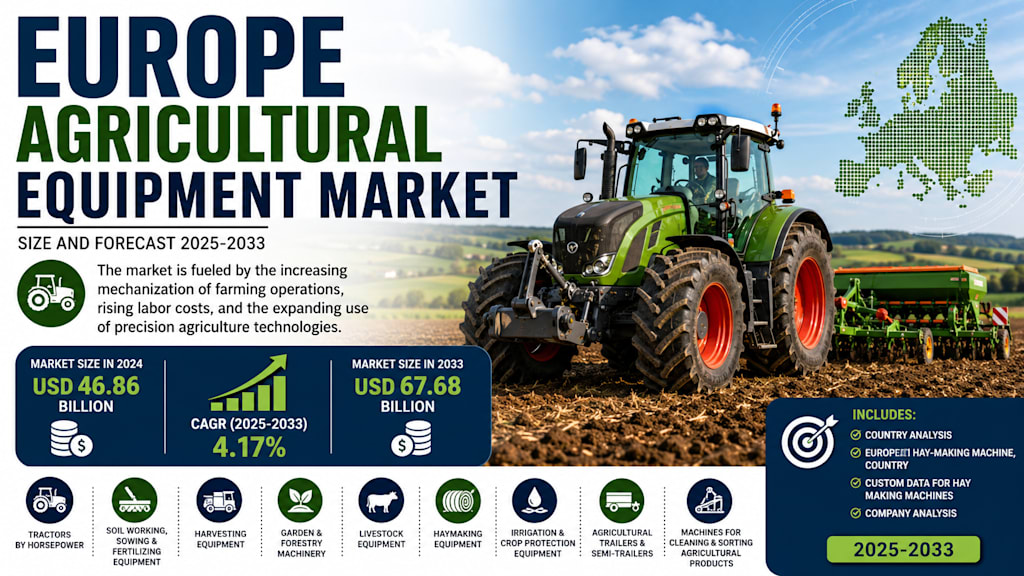
Europe’s agricultural equipment market is entering a decisive growth phase
Europe’s agricultural equipment market is entering a decisive growth phase, supported by the region’s push toward higher farm productivity, lower labor dependence, and more intelligent field operations. According to the report, the market was valued at USD 46.86 billion in 2024 and is expected to reach USD 67.68 billion by 2033, expanding at a CAGR of 4.17% from 2025 to 2033.
That growth story is not only about buying more tractors or harvesters. It is about a broader structural transformation in how European farms operate. Across the continent, producers are adopting machinery that can do more with less: less fuel, less labor, less waste, and less downtime. GPS-guided equipment, smart sensors, automated controls, and data-driven field management are becoming part of the normal conversation in modern farming. The report makes it clear that Europe is no longer just a large agricultural machinery market; it is also one of the world’s most important innovation hubs for farm equipment.
A market shaped by mechanization and necessity
The most immediate driver of demand is mechanization. Europe’s farms are dealing with rising labor costs, labor shortages, and an aging farming population. In that environment, machinery is no longer optional. It is the practical answer to maintaining yields and protecting margins. Tractors, harvesters, plows, seeders, sprayers, and feeding systems help farms carry out time-sensitive tasks faster and with greater accuracy than manual methods ever could. The report highlights that government subsidies and EU-level support are also reinforcing this shift, especially in countries where small and medium farms need help financing new equipment.
At the policy level, the Common Agricultural Policy for 2023 to 2027 remains highly influential, with an emphasis on biodiversity, ecosystem services, and the modernization of farming practices. That matters because public support often determines whether farmers upgrade from older machines to more efficient, lower-emission alternatives. In other words, Europe’s agricultural equipment market is being powered by both economics and policy.
Precision agriculture is redefining value
If mechanization is the foundation of the market, precision agriculture is its accelerator. European farmers increasingly want machinery that can measure, monitor, and respond in real time. GPS guidance, IoT connectivity, yield mapping, sensor-based soil monitoring, and automated controls are turning traditional machines into intelligent systems. This evolution helps farmers reduce overuse of seed, fertilizer, water, and fuel while improving output and consistency.
The report also points to Europe’s leadership in adopting these technologies, particularly in Germany, France, and the Netherlands. These countries are not just buying machines; they are shaping the future standard for agricultural efficiency. That is why premium product segments and specialized equipment are gaining visibility. Compact tractors, autonomous systems, and digitally enabled harvesters are becoming more attractive because they fit the realities of modern European farming, where land use is often intensive and margins depend on precision.
Product categories tell the real story
The market’s strength becomes even clearer when viewed by equipment category. Tractors remain the backbone, especially the 100-120 HP range, which is popular because it strikes a balance between power, efficiency, and affordability for medium-sized farms. Harvesting equipment, especially combine harvesters, continues to see strong demand as farmers seek faster harvesting and lower crop losses during short seasonal windows.
Other categories are also gaining attention. Ploughs remain essential for land preparation, while mounted and trailed implements are valued for flexibility and cost-effectiveness. In livestock-heavy regions, feed preparation machines are seeing more demand as farms move toward automation in feeding and nutrition management. Irrigation and crop protection equipment is another important segment, especially as farmers look for better water management and more precise spraying. Even lawnmowers and forestry equipment have relevance in a broader European landscape where landscaping, vineyard care, and small-scale agricultural maintenance all support the machinery ecosystem.
Country-level momentum remains uneven but strong
Europe is not a single agricultural market; it is a cluster of national markets with different farming structures, crop profiles, and adoption speeds. Germany stands out as a technology leader with a strong manufacturing base and widespread use of GPS-guided and autonomous equipment. France remains one of the region’s biggest agricultural machinery markets because of its large cereal and vineyard sectors. The United Kingdom is evolving toward precision and sustainable farming, with strong interest in low-emission equipment and leasing models.
Elsewhere, Eastern European markets are catching up as modernization programs expand access to new machines. Poland, Romania, Hungary, and other countries are increasingly important because mechanization there can deliver rapid productivity gains. This uneven but broad-based growth is one reason the overall market outlook remains healthy. Europe is not just replacing old equipment; it is expanding the installed base of advanced machinery.
Why the market is expanding despite cost pressure
The market is not without obstacles. High equipment costs remain a major barrier, especially for smaller farms. Advanced machinery with automation, telematics, and precision systems can be expensive to purchase, service, and repair. Environmental regulations also add pressure on manufacturers, since European equipment must increasingly meet strict emissions and sustainability standards. These are real constraints, not minor ones. Yet they are also reshaping demand in a way that benefits higher-value machinery makers.
In practice, the same forces that raise the barrier to entry also push the market toward premiumization. Farmers are not simply buying “more equipment.” They are investing in equipment that improves productivity enough to justify the cost. That logic is especially strong where labor is scarce and where policy support helps offset purchase prices. The result is a market that is expanding, but also becoming more sophisticated and selective.
Recent developments by companies
The report’s company coverage includes John Deere, AGCO, CLAAS KGaA, First Tractor Company Limited, and Kubota Corporation, reflecting the competitive core of the market. Around that core, the most visible recent moves are centered on product innovation, higher capacity, and smarter farm operations.
CLAAS strengthened its compact tractor lineup in July 2023 by introducing the AXOS 230 and AXOS 240 for mixed and special crop farms.
CNH Industrial expanded high-capacity harvesting capability in November 2023 with the New Holland CR11 combine.
Case IH upgraded baling performance in 2022 with the LB 424 XLD large square baler.
The UK government supported agri-tech investment in 2022 through a major grant scheme tied to mechanization.
France reinforced machinery investment demand through sizable agricultural support measures aimed at modernization.
John Deere remains positioned around precision agriculture and productivity-enhancing machinery, a key competitive theme in Europe.
AGCO continues to sit at the center of the smart machinery transition, where efficiency and digital capability matter more each year.
Kubota is well placed in compact and utility machinery, especially in markets that value versatility and smaller-scale operations.
First Tractor Company Limited remains part of the wider competitive set serving tractor demand and regional machinery needs.
Across the sector, manufacturers are prioritizing low-emission, connected, and specialized equipment to match Europe’s evolving farming model.
The bigger investment picture
For investors, suppliers, and distributors, the key message is straightforward: Europe’s agricultural equipment market is becoming more technology-led, more policy-sensitive, and more segmented by farm size and application. That creates opportunities in tractors, harvesters, feed systems, irrigation, and precision tools, but it also rewards companies that can support farmers after the sale through maintenance, software, leasing, and service networks. The next phase of competition will not be won by hardware alone. It will be won by the ecosystem around the machine.
The report’s structure also shows how broad the opportunity set is. It covers tractors by horsepower, soil working and sowing equipment, harvesting equipment, garden and forestry machinery, livestock equipment, haymaking machinery, irrigation and crop protection equipment, agricultural trailers, and cleaning and sorting machines. That breadth matters because Europe’s agricultural sector is not standardized. Different crops, climates, and farm sizes require different solutions, which is why specialization is becoming so valuable.
What will shape the next phase
Replacement demand will likely remain a major support factor over the forecast period. Many farms across Europe already own a core fleet of tractors and implements, but those fleets are aging and increasingly inefficient compared with newer, connected models. As fuel prices, labor costs, and sustainability pressures continue to matter, the decision to replace old machinery rather than simply repair it becomes easier to justify. That makes the aftermarket, spare parts business, and service contracts strategically important for suppliers.
Another important trend is the move toward equipment that can do multiple jobs. Farmers do not always want a highly specialized machine that sits idle for much of the year. They want flexible tractors, mounted implements, and modular systems that can shift between tilling, sowing, spraying, hauling, and harvesting support. This is especially relevant in Europe, where farm sizes and crop patterns vary widely from one country to the next. The equipment that wins in this market is often the equipment that saves time, reduces passes across the field, and makes better use of every hectare.
The opportunity is also geographic. Western Europe is driving premium adoption, while Central and Eastern Europe offer room for volume growth as modernization continues. That dual structure gives the market both stability and upside. It also explains why leading brands keep investing in a mix of high-tech solutions and practical, mid-range products. From compact tractors to large harvesters, the winning formula is flexibility paired with performance.
Final thoughts
Europe’s agricultural equipment market is moving from a traditional machinery cycle into a smarter, more strategic era. Demand is being supported by mechanization, precision agriculture, policy incentives, and the need to solve labor and productivity challenges at the farm level. At the same time, stricter environmental expectations are pushing manufacturers to innovate faster and farmers to upgrade more thoughtfully. The forecast to USD 67.68 billion by 2033 suggests that this is not a temporary upswing. It is a durable transformation in how European agriculture is powered, managed, and scaled.
About the Creator
Enjoyed the story? Support the Creator.
Subscribe for free to receive all their stories in your feed.
Comments
There are no comments for this story
Be the first to respond and start the conversation.