
Ethical Hacking vs. Illegal Hacking: What's the Real Difference?
One is a legitimate, high-paying career. The other can land you in federal prison. Here is what separates them in 2026.

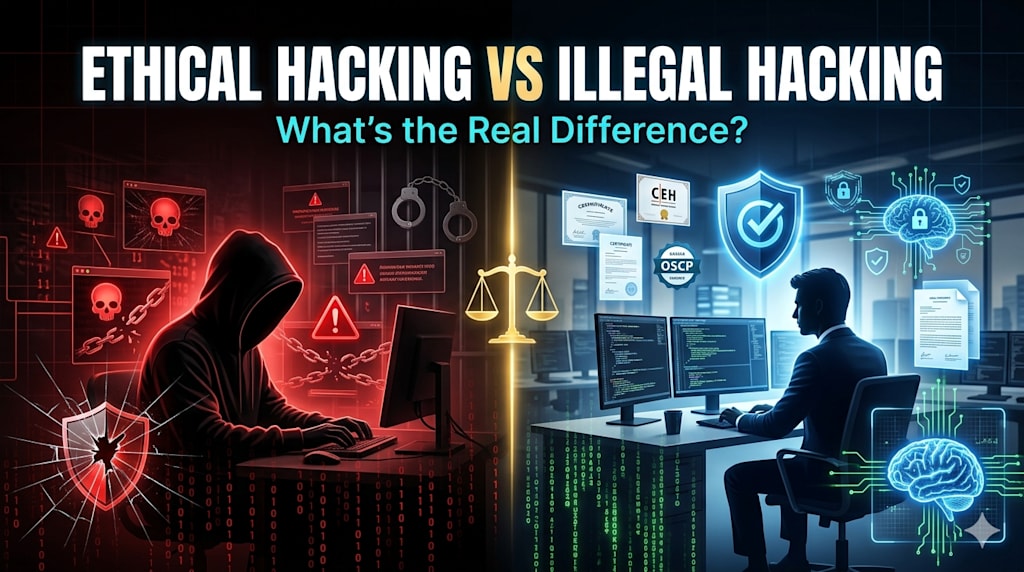
Ethical Hacking vs. Illegal Hacking: What's the Real Difference? One is a legitimate, high-paying career. The other can land you in federal prison. Here is what separates them in 2026. Let me start with a hard truth. The same technical skills that make someone a highly paid cyber security professional can also make them a convicted felon. The difference is not about how good you are at hacking. It is about one simple thing: permission. I have spent years researching the cyber security landscape. I have seen talented young people make terrible mistakes because they did not understand the line between legal and illegal hacking. And I have seen ethical hackers build thriving careers while helping protect the systems we all rely on. This article is about understanding that line. What Actually Is Hacking? Hacking is simply gaining unauthorized access to computer systems, networks, or data . The term itself is neutral. It describes an action, not a moral judgment. What makes hacking good or bad is the context. The intent. The permission. The outcome. Let me break down the three main categories of hackers, starting with the ones you should never emulate. The Bad Guys: Black Hat Hackers Black hat hackers are the villains of the digital world. They maliciously search for and exploit vulnerabilities in computer systems or networks, often using malware and other hacking techniques to do harm . These are the stereotypical hackers you see in movies. They break laws as part of their hacking exploits, infiltrating victims' networks for monetary gain, stealing or destroying data, disrupting systems, conducting cyberespionage, or just for the thrill of it . Why Do They Do It? The motivations vary, but they usually fall into a few categories : Financial gain is the most common reason. Black hat hackers steal sensitive information to use or sell it, or compromise systems to demand ransom payments. The WannaCry ransomware attack in 2017 is a textbook example. Black hat hackers spread dangerous ransomware that encrypted business-critical data and demanded ransom payments for decryption . Ideology and beliefs drive another group, sometimes called "hacktivists." They perform attacks that either uphold their beliefs or bring down entities they oppose. State-sponsored hacktivists, in particular, rely on sophisticated tools, try to find unknown vulnerabilities, and have vast resources at their disposal . Revenge is another motivation. Some hackers attack when they believe some individual or system has wronged them. This could be ex-employees of an organization launching attacks as payback . And some people just want the adrenaline rush. They launch attacks because they seek thrill from it and get satisfaction when they succeed . The Legal Consequences Here is where things get serious. The Computer Fraud and Abuse Act (CFAA) is the primary US law governing hacking . It was drafted in an era of far more limited technological capability, but it still carries severe penalties. In Austria, a hacker who overcomes security measures and intrudes into foreign IT systems faces up to two years in prison, and up to three years if critical infrastructure is involved . In the United States, accessing systems without consent, cracking passwords, stealing data, or launching attacks on networks are all illegal activities punishable under law . Even experimenting "for learning" without permission can lead to serious legal consequences . The law does not care about your intentions if you did not have authorization. The Good Guys: White Hat Hackers White hat hackers, also known as ethical hackers, are the complete opposite . They are security specialists hired to find vulnerabilities in software, hardware, and networks that black hats might target . Unlike black hats, white hats only hack networks when legally permitted to do so . They disclose all vulnerabilities to their employers or to the vendors whose hardware or software is affected, so they can patch other customers' systems . What Makes It Legal and Ethical? The key characteristics of ethical hacking are clear : · Conducted with official permission · Focused on identifying and fixing vulnerabilities · Follows legal and ethical guidelines · Aims to protect systems and users Organizations today actively hire ethical hackers to test their systems and prevent potential cyber threats . The work includes penetration testing and vulnerability assessments . Why Do Ethical Hackers Do It? The motivations are very different from black hats : Improving security is the primary goal. White hat hackers identify security weaknesses so organizations can prioritize and fix them before malicious actors exploit them. Protecting data is another key motivation. They play a vital role in safeguarding personal and corporate data, helping prevent breaches that could result in identity theft, financial loss, or legal repercussions. Regulatory compliance is also important. Their evaluations help organizations determine whether they comply with applicable regulations. And yes, the money is good. According to industry data, the average base salary of a white hat hacker is over $100,000 . In recent years, the scope of white hat hacking has extended beyond internal cybersecurity departments through bug bounty programs . Real-World Examples When the Heartbleed vulnerability was discovered in OpenSSL cryptography in 2014, it was white hat hackers who found it and helped mitigate it . When the Synacktiv team discovered multiple security weaknesses in Tesla's software, the company rewarded them with good compensation and even a car . The Grey Area: Gray Hat Hackers Not everything is black and white. Gray hat hackers sit somewhere in between. A fusion of black and white, gray hats exploit security vulnerabilities without malicious intent, like white hats, but might use illegal methods to find flaws, like black hats. They often hack without the target's permission or knowledge . Here is the critical distinction. Gray hat hackers typically do not cause damage to a victim. They discover vulnerabilities and then reach out to the affected parties to notify them. If the party fails to respond, the gray hats often expose the exploit publicly . Why Is This Risky? Even though their intentions may be good, the methods are still illegal in most jurisdictions. A hacker who discovers a security issue in a hospital's Electronic Health Records system and reports it might be doing a public service. But if they accessed that system without authorization, they still broke the law . In Austria, even the fear of criminal prosecution can deter ethical hackers from reporting vulnerabilities they discover on their own initiative. In the Interior Committee, all parties except one recently called for clear legal frameworks for ethical hacking to address this problem . The law simply has not caught up to the reality of security research . The Legal and Regulatory Landscape in 2026 The distinction between ethical and illegal hacking is becoming more nuanced as governments and organizations update their legal frameworks. New Laws Are Emerging In Ecuador, the Organic Law on Strengthening Cybersecurity, published in May 2026, explicitly authorizes ethical hacking activities and penetration testing, subject to principles of consent, legitimate purpose, and personal data protection . In Europe, the NIS2 Directive and the Cyber Resilience Act are strengthening EU-wide cybersecurity. These regulations require software manufacturers to report actively exploited vulnerabilities to government computer emergency teams . The Czech Republic has legal research focused on the legal aspects of vulnerability disclosure, bug bounty programs, and associated risks. Researchers have identified two areas that likely require legislative intervention: safeguarding the anonymity of reporters and the problematic ability to consent to testing procedures by public bodies . The Tension with Bug Bounties Here is an interesting problem. Bug bounty programs sometimes require researchers to sign confidentiality agreements that prohibit them from ever sharing their findings publicly. This compromises the original bargain of coordinated vulnerability disclosure, where the public good was supposed to outweigh vendor embarrassment . Some researchers argue that full disclosure must remain a threat to keep coordinated disclosure honest. Otherwise, companies can simply pay researchers to stay silent and never fix the vulnerabilities . The Real Difference in One Table What Does This Mean for You? If you are considering a career in cybersecurity, the path is clear. Stick to authorized testing. Get permission before you start. Use legal practice platforms like HackTheBox and TryHackMe. Participate in bug bounty programs where the company has explicitly invited researchers to test their systems. The same skills that could get you arrested can also earn you a six-figure salary and the respect of the cybersecurity community. The difference is three things: permission, intent, and transparency. Do not be the person who learns this lesson the hard way. Written by DDM ATIQ #ethical_hackers #ethical hacking, cyber security, learn ethical hacking, ethical hacker vs hacker, how to be a hacker, is hacking illegal
About the Creator
DDM ATIQ
ll
Enjoyed the story? Support the Creator.
Subscribe for free to receive all their stories in your feed.
Comments
There are no comments for this story
Be the first to respond and start the conversation.