
Elon Musk’s $1.4 Trillion Lie: A Nobel Laureate Just Called His Bluff (And the Future of Money Hangs in the Balance)
The brutal clash between techno‑utopianism and cold, hard economics — and why a single unopened envelope could expose everything.
I. Introduction: The Billionaire’s Apocalyptic Prophecy and the Nobel Laureate’s Ruthless Challenge
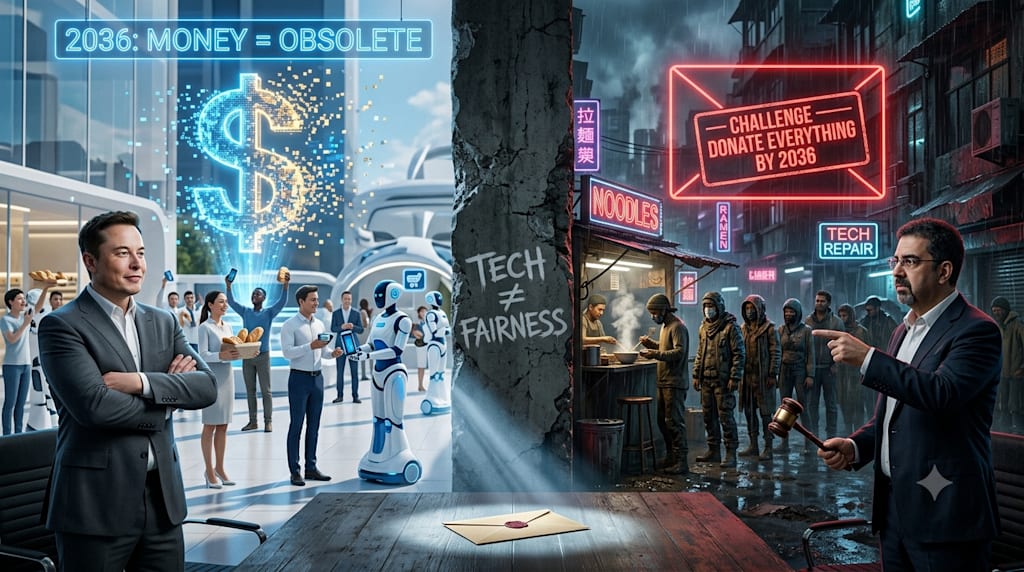
In July 2026, Elon Musk dropped another intellectual bombshell during an interview: AI will surpass the total intelligence of all humans within five years (no later than 2031); by 2036, when AI and robots dominate every link of production, from mines to chips and farmland to factories, the supply of goods and services will explode exponentially, production costs will approach zero, and money in the traditional sense will lose all meaning.
The response split. Some called it technological liberation; others, Silicon Valley fantasy. The debate boiled over when Daron Acemoglu, the 2024 Nobel laureate in economics and MIT professor, issued a public challenge on social media:
“If you believe money will be worthless in ten years, then pledge to donate your entire net worth—currently estimated at $1.4 trillion—to independent charitable organizations, audited and disbursed by neutral bodies, no later than 2036. Since money is about to become obsolete, divesting these assets would cost you nothing. If this is merely a publicity stunt, this challenge will be the perfect litmus test to expose the pretense.”
Musk, who has long scoffed at conventional philanthropy, replied: “I actually plan to do something like that!” Observers noted that the shift in tone coincided with a near‑halving of his personal fortune, from a peak of roughly $1.4 trillion down to about $700 billion amid recent market rotations and a sharp drop in SpaceX’s valuation.
Beneath the surface lies a deeper clash over the relationship between technological progress and social distribution. Is Musk’s “death of money” a genuine foresight, or is it techno‑messianism driven by personal branding?
II. The Inner Logic of Musk’s Prophecy: A Script for “Quasi‑Infinite Supply”
Musk’s argument rests on a coherent techno‑accelerationist worldview.
First, the approach of an intelligence singularity. Musk asserts that AI’s combined logical and computational power will exceed that of all humans no later than 2031. With exponential growth in model parameters, leaps in multimodal capabilities, and breakthroughs in embodied intelligence, AI will soon evolve from a passive tool into a “digital life form” capable of autonomous decision‑making and creation, dwarfing the sum total of human intellect.
Second, the complete automation of physical labor. In Musk’s blueprint, the next five years will witness the explosive deployment of humanoid robots across every domain. From mining and chip fabrication to crop cultivation, every repetitive, high‑intensity, or precision‑based physical task will be taken over by robotic networks. Labor costs, the largest component of production expenses, will compress to zero, freeing goods from the constraints of labor supply elasticity.
Third, historic deflation. As marginal production costs approach zero, Musk envisions a “benign deflation” driven by infinite supply expansion. Price mechanisms will break down, and money’s function as a medium for scarce resources will naturally wither.
Fourth, the post‑scarcity society. After money becomes obsolete, humanity enters a state akin to “universal high income”: work becomes a hobby rather than a means of survival, material goods are distributed on demand, and humanity is liberated from the “iron law of scarcity.”
The fatal flaw in this logical chain is its conflation of technological possibility with social inevitability, and its equation of productive efficiency with distributive fairness. This is precisely the “technological determinism” that institutional economists like Acemoglu have long criticized.
III. Acemoglu’s “Killer Move”: Why the “Donate Your Fortune” Challenge Is the Cruelest Test
The brilliance of Acemoglu’s challenge lies not in moral condemnation but in airtight logic.
From a game‑theoretic perspective, Musk faces a classic “credible commitment” dilemma. If he believes his prophecy, donating all his wealth would entail no loss. On the contrary, it would be a rational cash‑out, converting symbolic wealth into historical legacy before money depreciates. If it is merely rhetoric, refusing the commitment would expose his insincerity. Musk’s reply, “I actually plan to do something like that!”, artfully dodges the core issue: no timeline, no designated beneficiaries, no independent auditing, no legally binding promise. This “vague goodwill” appeases moral expectations from critics while retaining his practical control over the assets.
On a deeper level, Acemoglu’s challenge exposes a blind spot: the accumulation of wealth and the advancement of technology have never run on parallel tracks. Musk’s immense fortune is itself a product of existing monetary and capital markets. If money were to lose all meaning, his Tesla shares, SpaceX equity, and X holdings would likewise vanish in value. Acemoglu demands divestment now, at a time when Musk can still use this money to influence political agendas, fund AI lobbying, and steer public discourse on X. Money has not yet expired; precisely because it has not, it remains a vehicle of power. Musk is not so much painting a future of “universal abundance” as constructing a new Tower of Babel built on technological monopoly. The form of money may change, but the dynamics of domination and subordination will only be reinforced by technical means.
IV. The Mirror of History: Technological Progress Has Never Automatically Solved Distribution
The earlier observation cuts deep: “Continuously raising productivity and expanding output will eliminate scarcity and hunger—this idea was proposed over 200 years ago… yet poverty not only persisted, but periodic crises, bankruptcies, unemployment, and hunger recurred.”
This insight strikes at the Achilles’ heel of Musk’s prophecy: there has never been an automatic, inevitable bridge between technological progress and human welfare.
During the First Industrial Revolution (1760–1840), the steam engine and the spinning jenny multiplied British productivity exponentially. What followed were “dark satanic mills” with children working 16‑hour days, urban slums, and cyclical overproduction crises. In Britain’s first modern economic crisis (1825), vast quantities of goods were dumped into the sea while unemployed workers starved on the streets. Productivity soared alongside distributional collapse.
In the Second Industrial Revolution (1870–1914), electricity, the internal combustion engine, and the chemical industry dramatically expanded production, but the United States entered the “Gilded Age.” Railroad barons and oil magnates amassed unimaginable fortunes while immigrant workers and farmers struggled under debt and bankruptcy. It took the Great Depression of the 1930s to painfully force through the social security legislation, union recognition, and progressive income taxes of the New Deal.
History shows a consistent pattern: technology determines “how much can be done,” while institutions determine “who gets what.” To pin hopes on a unilateral technological breakthrough dissolving distributional conflicts is to chase a will‑o’‑the‑wisp.
Moreover, leaps in productivity can exacerbate distributive tensions. Thomas Piketty, in Capital in the Twenty‑First Century, empirically demonstrated that under free‑market conditions, the return on capital (r) persistently exceeds the economic growth rate (g); wealth concentrates faster than national income grows. The AI revolution may become a “super‑accelerator” of this law. Consider the contrast: in 1980, the CEO of a top U.S. automaker earned roughly 40 times the wage of a factory worker; in 2023, the compensation and valuation gains of OpenAI’s CEO stood at a gap hundreds of thousands of times larger than the earnings of Kenyan outsourced laborers labeling training data. This is not a problem of technological advancement but of distributional institutions lagging behind.
V. Why the AI Era Is More Likely to Head Toward “Cyberpunk” Than “Star Trek”
As noted: “Under K‑shaped divergence, wealth inequality will only worsen. Cyberpunk 2077 stands a good chance of becoming reality—class solidification, power and capital controlling the means of production, the middle and lower classes having less and less to sell, even physical spatial segregation.”
This prognosis rests on solid logic.
First, the “creative‑destructive” scissors of the labor market. AI’s displacement of jobs is not uniform; it is funnel‑shaped. Top‑tier AI R&D, system architecture, and data science roles will command super‑premiums. Mid‑tier white‑collar jobs (administration, customer service, copywriting, translation, basic programming) face mass substitution. Low‑end manual labor, though momentarily cost‑advantageous, will vanish once the production cost of humanoid robots drops below a critical threshold. Musk has claimed Optimus robots will eventually sell for around $20,000. Once that tipping point is reached, these jobs disappear too.
Second, “digital colonialism” in Globalization 2.0. In the earlier wave of globalization, manufacturing migrated from developed to developing countries, creating a core‑periphery division of labor. In the AI era, the “digital brains” controlled by a handful of tech giants can serve global markets directly, without allocating any jobs to any nation. Both Rust Belt workers and Southeast Asian factory laborers will be simultaneously squeezed out of the production chain. This is a more brutal form of “de‑employment” than traditional globalization.
Third, the “symbolization” and “enclavization” of wealth. Once material production is highly automated, truly scarce goods will no longer be bread or cars but premium education, top‑tier healthcare, safe environments, clean air, and virtual real estate in the metaverse. These will not become abundant thanks to AI; if anything, inequitable distribution may make them more expensive. The wealthy will retreat into “intelligent safe zones,” while ordinary people remain stranded in decaying “digital ruins.” This is the dystopian reality of Night City in Cyberpunk 2077.
VI. The Way Forward: Institutional Innovation Is More Urgent Than Technological Breakthroughs
Acknowledging the gravity of the problem does not mean succumbing to despair. Recognizing the essence of the AI revolution is the prerequisite for a sober search for solutions.
After every major technological upheaval, human societies have painfully built new social contracts. The Great Depression gave rise to the modern welfare state; the postwar era established Bretton Woods and international labor standards; the 2008 financial crisis spurred stricter financial regulations. Several institutional innovations are now urgently needed.
First, revamping labor‑capital bargaining mechanisms. Under the specter of mass displacement, the traditional framework of labor contracts, wages, and working hours no longer suffices to protect workers. Universal Basic Income (UBI), shorter standard working hours, and “work‑sharing” are no longer radical fantasies but pragmatic responses to technologically driven unemployment. Pilot UBI experiments in Spain and Finland have already provided preliminary evidence.
Second, taxing capital rather than labor. Current tax systems rely excessively on labor income taxes and consumption taxes, while capital gains, inheritance, and data assets remain under‑taxed. In the AI era, wealth will concentrate even more in capital, necessitating global minimum corporate taxes (the OECD has already proposed a framework), “robot taxes” on automation equipment, and “data usage taxes” on AI companies. The massive valuations of Tesla and SpaceX represent a potential tax base.
Third, democratizing data property rights. AI training depends on vast datasets generated by billions of users, yet the value is captured by a few platform companies. Promoting individualized and collective management of data rights through “data trusts” or “data dividends” would allow ordinary users to share in the value created by AI, addressing the root of inequality.
Fourth, forward‑looking reforms in education and social security. Instead of mass‑producing college graduates for white‑collar jobs that AI will soon replace, we should cultivate capacities that AI cannot replicate: critical thinking, creativity, interdisciplinary synthesis, and emotional communication. Social safety nets must shift from ex post relief to ex ante empowerment, providing displaced workers with ample retraining and transitional support.
VII. Three Forecasts: A More Plausible Scenario
Forecast One: AI bubble burst and shakeout (2026–2031). Every major technological revolution goes through a cycle of over‑expectation, bubble burst, and rational consolidation. The current AI investment frenzy bears striking similarities to the dot‑com bubble of 2000. Over the next five years, the sector will undergo severe valuation corrections; many startups lacking viable business models will be eliminated; and industry focus will shift from “model‑parameter arms races” to “real‑world application viability.” This shakeout will likely conclude no later than 2031.
Forecast Two: The paradox of jobless prosperity (2031–2036). After the bubble clears, genuinely useful AI applications will scale up broadly. Macroeconomic output will continue to grow, but employment will stagnate or decline, creating an anomalous “growth‑without‑jobs” state. Most people will face downward pressure on income from AI displacement while bearing higher prices for electronics and services driven by AI infrastructure investment. Consider an “inverse Moore’s Law”: a flagship GPU that cost 15,000 yuan five years ago now costs 30,000 yuan, while the average household’s disposable income has risen by less than 5%.
Forecast Three: The window for institutional awakening (post‑2036). As social contradictions accumulate to a tipping point, they may force a new distributional regime. This may not be Musk’s “death of money” but rather a “tamed capitalism,” where AI‑generated wealth is channeled back to the populace through mandatory redistribution (UBI, negative income tax, wealth taxes). Achieving this will require a profound sociopolitical struggle, the outcome of which is far from predetermined.
VIII. Conclusion
Musk’s prediction, “AI will surpass humanity in five years, and money will lose meaning in ten,” has a kernel of technological plausibility. AI exceeding human intelligence is not science fiction, and AI dramatically boosting productivity is all but certain. But the “death of money” leaps across economic logic. It mistakes “productive capacity” for “distributional institutions” and “technological limits” for “social inevitability.”
Money will not vanish. As long as there is choice, there is scarcity; as long as there is scarcity, there is exchange; and as long as there is exchange, some medium of value will exist. AI may eliminate material destitution, but it can never abolish the boundlessness of human desire or the competitiveness of choices. Bread may be free, but prime real estate, elite university degrees, and appointments with renowned doctors will still require an allocation mechanism—money, power, lineage, luck, but never costless universal access.
The real value of Musk’s prophecy lies not in its conclusion but in the fissure it has opened: if AI creates unprecedented wealth, how do we ensure it benefits all of humanity rather than a microscopic elite? Acemoglu’s challenge has not received a direct answer. That question now sits on the table like an unopened envelope. Everyone has seen it; no one has opened it yet. Opening it will require not just technological prophecies but a whole set of social imagination and institutional courage around distribution.
About the Creator
Jin
Writer of reamstories
https://reamstories.com/jin
Enjoyed the story? Support the Creator.
Subscribe for free to receive all their stories in your feed. You could also become a paid subscriber, letting them know you appreciate their work.
Comments
There are no comments for this story
Be the first to respond and start the conversation.