
Electric Vehicle Aftermarket Set for Explosive Growth as Global EV Adoption Accelerates
From Battery Services to Smart Charging Solutions, the EV Aftermarket Is Becoming One of the Fastest-Growing Segments in the Automotive Industry

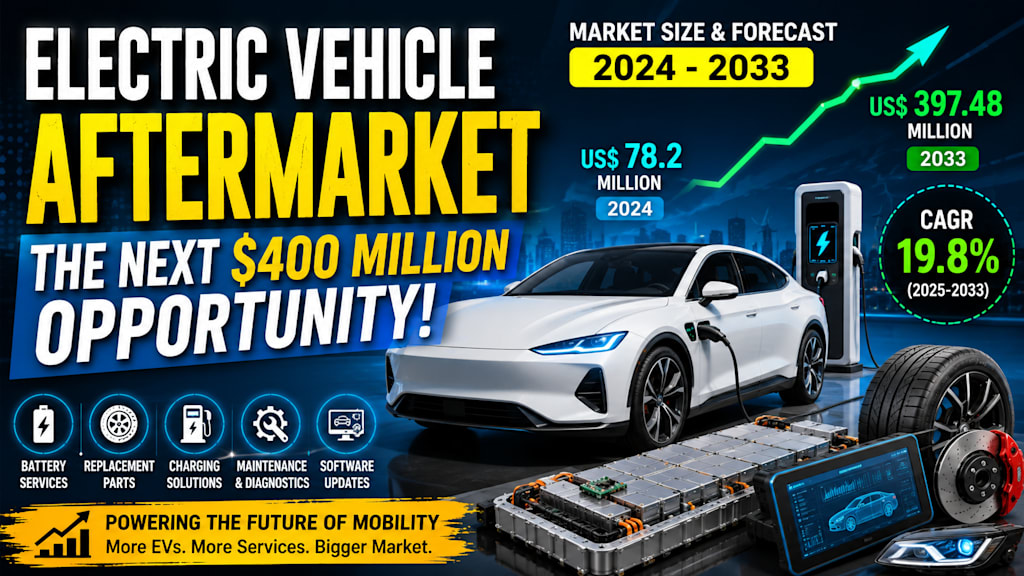
The global automotive industry is undergoing a historic transformation. As governments, businesses, and consumers increasingly embrace sustainable transportation, electric vehicles (EVs) are becoming a mainstream choice across developed and emerging economies. While much attention has been focused on EV manufacturing and sales, another lucrative sector is rapidly emerging behind the scenes—the electric vehicle aftermarket.
According to industry analysis, the global Electric Vehicle Aftermarket is projected to grow from US$ 78.2 million in 2024 to US$ 397.48 million by 2033, expanding at an impressive CAGR of 19.8% between 2025 and 2033. This remarkable growth reflects the increasing number of EVs on roads worldwide and the growing demand for maintenance, replacement parts, charging solutions, software upgrades, and specialized services.
As electric mobility continues to reshape transportation, the EV aftermarket is becoming an essential pillar supporting long-term vehicle ownership and performance.
Understanding the Electric Vehicle Aftermarket
The electric vehicle aftermarket includes all products and services required after the sale of an EV. Unlike traditional automotive aftermarkets that focus heavily on engine components and mechanical repairs, the EV aftermarket centers on batteries, charging equipment, software systems, electric drivetrains, diagnostics, and specialized maintenance solutions.
As EV ownership grows globally, vehicle owners require reliable services to maintain battery efficiency, update software, replace worn components, and enhance vehicle performance. This demand creates significant opportunities for manufacturers, service providers, technology companies, and independent repair networks.
The evolution of connected vehicles and digital technologies is also transforming the aftermarket landscape. Predictive maintenance, remote diagnostics, over-the-air updates, and AI-powered monitoring systems are creating entirely new revenue streams for aftermarket participants.
Rising EV Sales Are Driving Market Expansion
One of the most significant factors fueling aftermarket growth is the rapid increase in EV adoption worldwide.
Governments are implementing aggressive emissions-reduction policies, offering tax incentives, and investing heavily in charging infrastructure. Major automotive manufacturers are introducing new electric models across multiple price segments, making EV ownership more accessible than ever.
As the number of electric vehicles on roads continues to rise, so does the demand for replacement components, maintenance services, software upgrades, and battery-related solutions.
Unlike traditional vehicles, EVs rely heavily on sophisticated electronics and software systems. Owners frequently seek updates that improve battery performance, enhance safety features, optimize energy consumption, and introduce new functionalities.
This growing installed base of EVs creates long-term opportunities for aftermarket companies worldwide.
Charging Infrastructure Creates New Business Opportunities
The expansion of EV charging infrastructure is emerging as a major growth driver for the aftermarket sector.
Consumers increasingly expect convenient, fast, and reliable charging solutions for both residential and commercial use. This demand has encouraged aftermarket providers to develop advanced charging systems, portable charging equipment, smart charging technologies, and wireless charging solutions.
Governments and private companies are investing billions of dollars into charging networks to support the transition toward electric mobility. As charging infrastructure expands, aftermarket businesses benefit from increased demand for installation, maintenance, upgrades, and associated services.
Modern charging systems are becoming smarter, integrating mobile applications, energy management tools, and real-time monitoring capabilities that enhance user convenience and operational efficiency.
Battery Technology Continues to Transform the Industry
Battery systems represent the most critical and expensive component in an electric vehicle. As a result, battery-related products and services are becoming a cornerstone of the EV aftermarket.
Continuous advancements in lithium-ion technology are improving battery lifespan, energy density, charging speed, and overall vehicle range. These innovations create opportunities for battery upgrades, replacement services, refurbishment programs, and performance enhancements.
The growing emphasis on battery health monitoring has also increased demand for diagnostic tools and predictive maintenance solutions. Consumers want assurance that their batteries will maintain optimal performance throughout the vehicle's lifecycle.
As battery manufacturing capacity expands globally, aftermarket suppliers are expected to introduce increasingly sophisticated solutions that improve vehicle efficiency and extend battery longevity.
Personalization and Vehicle Customization Gain Popularity
Today's EV owners are looking for more than transportation—they seek personalized driving experiences.
This trend has fueled demand for aftermarket customization products such as upgraded lighting systems, premium interiors, custom body kits, enhanced infotainment systems, and performance accessories.
Consumers are increasingly interested in making their electric vehicles unique while improving comfort, convenience, and aesthetics.
Aftermarket providers are responding by offering a diverse range of customization solutions that cater to individual preferences. Advanced entertainment systems, luxury seating options, intelligent dashboards, and connected technologies are becoming popular upgrades among EV owners.
The growing personalization trend is expected to remain a major contributor to aftermarket revenue growth over the next decade.
Commercial Fleets Are Creating Significant Demand
Commercial fleet electrification represents another major growth opportunity for the EV aftermarket.
Delivery companies, logistics providers, ride-sharing services, and public transportation operators are rapidly adopting electric vehicles to reduce operating costs and meet sustainability goals.
Fleet operators require dependable maintenance programs, battery management services, replacement components, and predictive maintenance solutions to maximize vehicle uptime.
As businesses continue expanding their electric fleets, aftermarket providers are developing specialized service contracts and fleet management solutions tailored to commercial customers.
The growing adoption of electric buses, vans, and trucks is expected to generate substantial demand for aftermarket products and services worldwide.
Digital Technologies Are Revolutionizing Vehicle Maintenance
The EV aftermarket is increasingly becoming a technology-driven industry.
Connected vehicles generate large volumes of operational data that can be analyzed to predict maintenance requirements before problems occur. Remote diagnostics enable technicians to identify issues quickly, reducing repair times and improving customer satisfaction.
Artificial intelligence, cloud computing, and telematics technologies are transforming how maintenance services are delivered.
Over-the-air software updates have become particularly important in the EV ecosystem. Manufacturers and service providers can remotely improve vehicle performance, enhance cybersecurity, and introduce new features without requiring physical service appointments.
These digital innovations are creating entirely new business models within the aftermarket sector.
Key Challenges Facing the EV Aftermarket
Despite strong growth prospects, the industry faces several challenges that could influence future development.
Battery Recycling and Disposal
As more EV batteries reach the end of their useful life, proper disposal and recycling become increasingly important.
Used batteries contain valuable materials such as lithium, cobalt, and nickel. Recovering these resources efficiently is essential for environmental sustainability and supply chain security.
However, battery recycling remains technically complex and requires significant investment in infrastructure and processing capabilities.
Developing scalable recycling solutions will be crucial for supporting long-term industry growth while minimizing environmental impact.
Competition from Traditional Automotive Aftermarkets
The traditional automotive aftermarket has decades of experience, extensive service networks, and established customer relationships.
Many independent repair shops and parts suppliers are still adapting to EV technologies, creating challenges for industry transformation.
Building specialized expertise, acquiring new equipment, and training technicians require substantial investment.
As the market matures, successful companies will be those capable of combining traditional service capabilities with advanced EV-specific expertise.
Regional Market Outlook
North America
North America remains one of the most important markets for the EV aftermarket.
Strong EV adoption rates, government support programs, and significant investments in charging infrastructure continue to drive market growth. The presence of leading automotive and technology companies further strengthens the region's competitive position.
The United States, in particular, is witnessing increased demand for battery services, software upgrades, and advanced charging solutions.
Europe
Europe's strict emissions regulations and ambitious climate targets are accelerating EV adoption across the region.
Countries such as Germany, France, and the United Kingdom are investing heavily in charging networks and sustainable transportation initiatives.
These developments create favorable conditions for aftermarket providers offering specialized EV maintenance and technology solutions.
Asia-Pacific
Asia-Pacific remains the global leader in EV production and adoption, led by China.
The region benefits from strong government support, large-scale battery manufacturing capabilities, and rapidly expanding charging infrastructure.
China's dominant position in electric vehicle manufacturing continues to influence global aftermarket trends and innovations.
Middle East and Africa
Emerging markets, particularly the United Arab Emirates, are making notable progress in electric mobility.
Government incentives, sustainability programs, and infrastructure investments are encouraging EV adoption and creating opportunities for aftermarket growth.
Although the market remains in its early stages, long-term prospects appear promising.
10 Recent Developments Shaping the Electric Vehicle Aftermarket
1. Polestar Introduced Battery Health Certifications
In April 2025, Polestar launched battery health certification programs designed to increase transparency and confidence in the used EV market.
2. Hyundai and Kia Expanded Battery Collaboration
In October 2024, Hyundai and Kia announced a strategic partnership focused on advancing lithium iron phosphate battery technologies.
3. Siemens Strengthened eMobility Investments
Siemens revealed plans to expand its eMobility operations to capitalize on growing EV infrastructure opportunities.
4. ZF Aftermarket Launched Electric Axle Drive Repair Kits
ZF introduced 25 Electric Axle Drive Repair Kits across North America, helping workshops service EV drivetrains more efficiently.
5. ChargePoint Expanded Smart Charging Capabilities
ChargePoint continued enhancing intelligent charging technologies to improve charging efficiency and user experience.
6. ABB Advanced Fast-Charging Solutions
ABB expanded its portfolio of high-speed charging products to support growing global EV demand.
7. EVBox Increased Focus on Commercial Charging Networks
EVBox accelerated deployment of scalable charging solutions targeting fleet and commercial customers.
8. Schneider Electric Enhanced Energy Management Platforms
The company strengthened EV charging integration with smart energy management technologies.
9. Bosch Expanded EV Diagnostic Services
Bosch introduced advanced diagnostic tools designed specifically for electric vehicle maintenance and repair.
10. Webasto Accelerated Charging Infrastructure Innovation
Webasto continued investing in next-generation charging systems supporting residential and commercial applications.
Final Thoughts
The electric vehicle aftermarket is rapidly evolving from a niche support segment into a critical component of the global mobility ecosystem. As EV adoption accelerates worldwide, demand for charging infrastructure, battery services, software upgrades, maintenance solutions, and customization products will continue to rise.
With the market expected to grow from US$ 78.2 million in 2024 to US$ 397.48 million by 2033, the sector presents substantial opportunities for manufacturers, technology providers, service centers, and investors.
Companies that embrace innovation, sustainability, digitalization, and customer-focused solutions will be best positioned to capitalize on this next phase of automotive transformation. The future of mobility extends far beyond vehicle production, and the electric vehicle aftermarket is set to play a defining role in that journey.
About the Creator
Enjoyed the story? Support the Creator.
Subscribe for free to receive all their stories in your feed.
Comments
There are no comments for this story
Be the first to respond and start the conversation.