
Electric Toothbrush Market Gains Momentum as Smart Oral Care Becomes a Daily Habit
Strong consumer awareness, advanced brushing technologies, and expanding e-commerce access are reshaping the global electric toothbrush industry, which is projected to rise from US$ 5.21 billion in 2025 to US$ 10.47 billion by 2034.

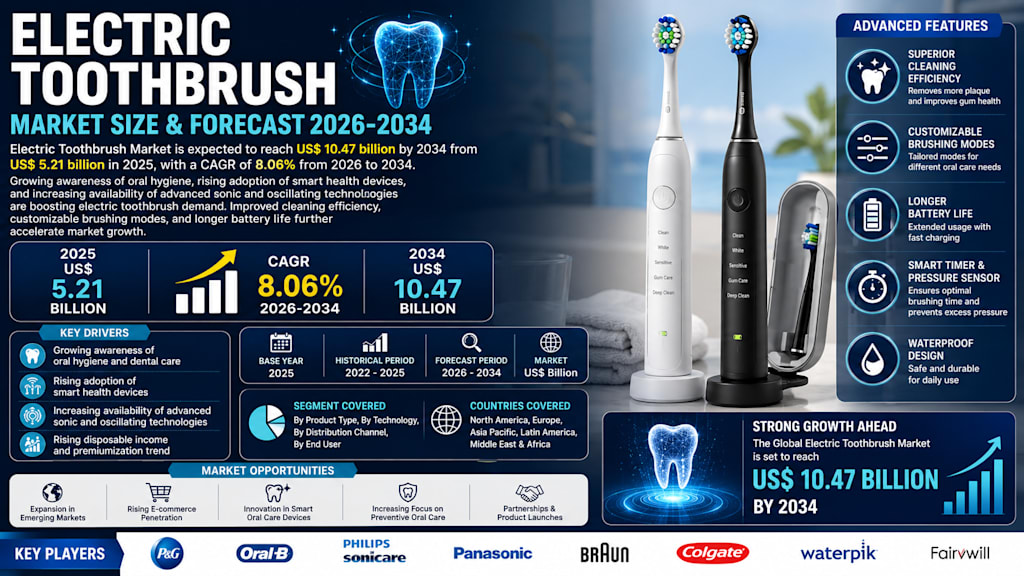
Electric Toothbrush Market Overview
The electric toothbrush market is moving from a premium convenience category into a mainstream oral care essential. What was once viewed as an upgrade over a manual brush is now increasingly seen as a smarter, more effective, and more personalized tool for long-term dental health. Renub Research estimates that the market will expand from US$ 5.21 billion in 2025 to US$ 10.47 billion by 2034, reflecting a CAGR of 8.06% during 2026–2034.
This growth is being driven by a broader change in consumer behavior. People are paying closer attention to preventive care, digital wellness, and products that deliver measurable benefits in daily routines. Electric toothbrushes fit that shift well because they combine hygiene, convenience, and technology in one product. Their appeal is strengthening across premium, mid-range, and entry-level price segments.
Why the Electric Toothbrush Market Is Growing
One of the strongest drivers of market expansion is rising oral health awareness. Consumers increasingly recognize that oral hygiene is closely linked to overall health, including gum health and plaque control. Electric toothbrushes are attractive because they support more consistent brushing performance than manual brushes and often include timers, pressure sensors, and guided brushing modes that encourage better habits.
Technology is also pushing the category forward. Modern electric toothbrushes now include oscillating, rotating, and sonic cleaning systems designed to improve plaque removal and gum care. The file highlights ORAL-B’s January 2025 launch of the iO Series 2, which was promoted as offering 150% better plaque removal, especially in hard-to-reach areas. This kind of innovation shows how intensely brands are competing on performance and dental-health benefits.
Battery life and convenience are equally important. Consumers want products that are easy to use, reliable, and low maintenance. Xiaomi’s Mijia electric toothbrush series, launched in September 2024, offered up to 180 days of battery life along with multiple brushing modes. For many buyers, this type of long-lasting convenience reduces friction and makes the switch from manual brushing more practical.
Smart Features Are Reshaping Oral Care
A major reason behind the market’s momentum is the rise of smart personal care. Today’s buyers are familiar with connected devices in everyday life, so they are more open to toothbrushes that include Bluetooth connectivity, AI-based brushing feedback, app support, and personalized recommendations. These features make oral hygiene feel more modern and measurable.
Younger consumers in particular are drawn to devices that fit a digital lifestyle. They value convenience, data, and customization, and electric toothbrushes now offer all three. In many cases, the toothbrush is no longer just a bathroom product; it is becoming part of a broader wellness ecosystem. That shift is helping the category gain stronger relevance across urban markets.
Challenges Affecting Market Expansion
Despite its strong growth, the market still faces some important barriers. Price remains one of the biggest challenges, especially in price-sensitive regions. Premium electric toothbrushes with advanced features often cost significantly more than manual brushes, and the recurring cost of replacement heads adds to the total expense. This can discourage long-term adoption, particularly in developing markets where budget is a major factor.
Awareness is another issue. In some regions, consumers still do not fully understand how electric toothbrushes work or why they may offer better cleaning results. Concerns about charging, durability, and possible gum damage from incorrect use can also slow adoption. Dental education and stronger consumer outreach will be essential if brands want to reduce skepticism and expand their customer base.
United States Electric Toothbrush Market
The United States represents one of the most mature markets for electric toothbrushes. Strong consumer awareness, high disposable income, and broad acceptance of smart personal care products support steady demand. Dental professionals frequently recommend electric toothbrushes, which adds further trust to the category.
Premium products with AI guidance, pressure sensors, and multiple cleaning modes are especially popular in the U.S. The market is also supported by subscription services for replacement heads and wide availability through pharmacies, online stores, and specialty retailers. As a result, electric toothbrushes are increasingly seen as a normal part of home oral care rather than a niche product.
Germany Electric Toothbrush Market
Germany is one of Europe’s strongest electric toothbrush markets. Consumers there place high importance on oral hygiene, preventive care, and technologically advanced health products. This makes the country a natural fit for smart toothbrushes that offer AI guidance, real-time analytics, and personalized brushing programs.
Sustainability also plays an important role in Germany, which supports interest in rechargeable and durable models. The market benefits from a well-developed retail and e-commerce network, making products accessible across different age groups. In this environment, premium oral care and digital wellness work together to support market growth.
China Electric Toothbrush Market
China is one of the fastest-expanding electric toothbrush markets. Rising urban incomes, growing awareness of dental health, and strong demand for smart consumer electronics are all contributing to this growth. Younger consumers are especially open to technologically advanced models with app-based tracking, sonic cleaning, and customizable settings.
Domestic brands such as Xiaomi, Soocas, and Huawei are helping make electric toothbrushes more accessible by offering long battery life and competitive pricing. E-commerce platforms also play a major role by improving visibility and enabling fast delivery. As smart lifestyle products become more mainstream, the electric toothbrush market in China is expected to keep expanding across urban and semi-urban areas.
Saudi Arabia Electric Toothbrush Market
Saudi Arabia’s electric toothbrush market is growing steadily as consumers place greater importance on oral hygiene and premium personal care. Rising disposable incomes and a young, tech-savvy population are supporting demand for smart toothbrushes with sonic vibration, pressure control, and multiple cleaning modes.
The market also benefits from better access through retail pharmacies, supermarkets, and online channels. Expanding dental services and preventive-health campaigns are helping raise awareness as well. In Saudi Arabia, electric toothbrushes are increasingly being associated with modern, health-conscious lifestyles.
Recent Developments in the Electric Toothbrush Market
Innovation remains central to the market’s evolution. In July 2024, quip launched its first oscillating electric toothbrush, the quip 360 Oscillating Toothbrush, featuring a pressure sensor, three intensity levels, and up to 30 days of battery life. The product also received American Dental Association approval, which strengthens its credibility with consumers.
In March 2024, Keosaa introduced a new electric toothbrush lineup on Amazon with two brushing modes, DuPont nylon bristles, and ultrasonic cleaning technology. The company positioned the range as an affordable option for consumers looking for efficient oral hygiene.
Also in March 2024, Philips Sonicare launched Philips One for Kids, designed for children aged 3 to 12. The product’s bright colors and kid-friendly style show how brands are expanding the market beyond adults and encouraging early oral care habits.
Market Segmentation
The market is segmented by technology, bristle type, distribution channel, end user, and geography. Rotational and vibrational technologies remain the key product types, while soft bristle and nanometer bristle options serve different comfort and cleaning preferences. Online sales are growing rapidly, but offline retail still matters because many consumers prefer to compare products physically before buying. Adults represent the largest end-user category, while children’s products are gaining visibility as parents place greater emphasis on early oral care.
Key Companies in the Market
The competitive landscape includes Church & Dwight Co. Inc., Colgate-Palmolive Company, Conair Corporation, FOREO, Koninklijke Philips N.V., Lion Corporation, Panasonic Corporation, and Procter & Gamble Company. These companies are shaping the market through product innovation, brand strength, credibility, and broad distribution. Their strategies show that the category is becoming more sophisticated and more competitive at the same time.
Final Thoughts
The electric toothbrush market is no longer just about replacing a manual toothbrush with a powered one. It is about improving daily oral care through smarter design, stronger performance, and greater convenience. As consumers continue to focus on preventive health and smart personal care, electric toothbrushes are becoming a standard part of modern routines. With the market projected to more than double by 2034, the industry appears well positioned for long-term expansion.
About the Creator
Enjoyed the story? Support the Creator.
Subscribe for free to receive all their stories in your feed.
Comments
There are no comments for this story
Be the first to respond and start the conversation.