
Electric Scooters Are Revolutionizing Urban Mobility Through Affordable, Sustainable Transportation
Rising Fuel Costs, Battery Innovation, and Government Support Are Accelerating the Global Electric Scooter Market

c
Cities around the world are facing increasing transportation challenges. Rapid urbanization, growing traffic congestion, rising fuel prices, and environmental concerns are forcing governments and consumers to rethink how people move through urban environments. In response, electric scooters have emerged as one of the most practical and rapidly growing mobility solutions of the modern era.
Once viewed as niche transportation products, electric scooters have evolved into mainstream mobility options that combine affordability, convenience, and environmental sustainability. Advances in battery technology, smart connectivity, lightweight materials, and charging infrastructure have transformed electric scooters into reliable vehicles suitable for everyday commuting.
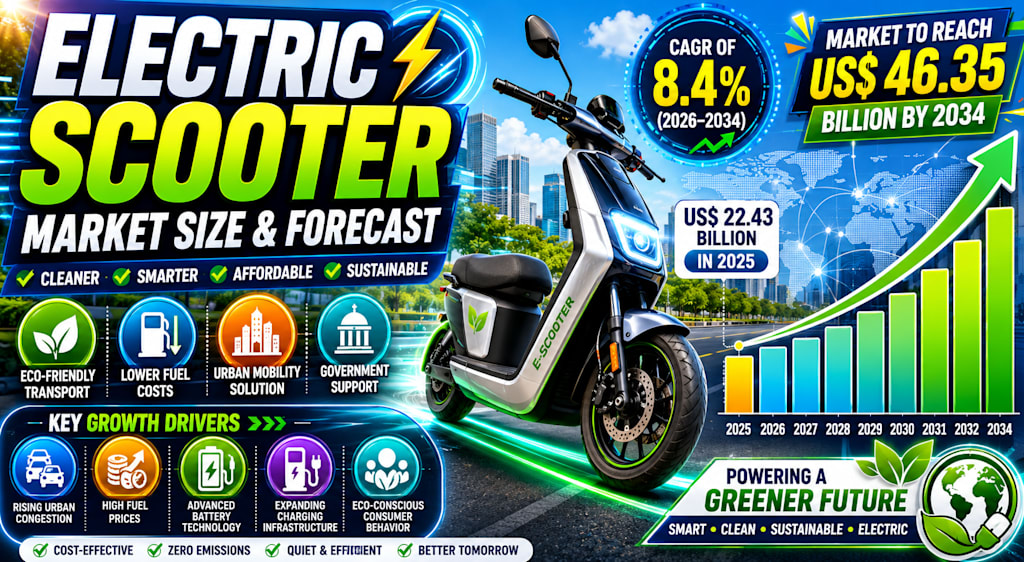
According to Renub Research, the Electric Scooter Market is projected to grow from US$ 22.43 billion in 2025 to US$ 46.35 billion by 2034, expanding at a CAGR of 8.4% between 2026 and 2034. Growing urban congestion, increasing fuel costs, supportive government policies, expanding charging ecosystems, and improvements in battery technology are among the key factors driving market expansion worldwide.
As countries continue investing in sustainable transportation solutions, electric scooters are becoming an increasingly important part of the future mobility landscape.
Electric Scooters Are Redefining Everyday Transportation
Electric scooters are two-wheeled vehicles powered by rechargeable batteries instead of conventional internal combustion engines.
Designed primarily for short and medium-distance travel, these vehicles offer a practical alternative for urban commuters seeking economical and environmentally friendly transportation.
Most modern electric scooters utilize lithium-ion battery systems that provide longer driving ranges, faster charging times, and lower maintenance requirements compared to traditional gasoline-powered scooters.
Many newer models also feature advanced technologies such as smartphone connectivity, regenerative braking systems, GPS tracking, digital dashboards, and intelligent battery management systems.
These innovations have significantly improved performance and user experience, helping electric scooters gain acceptance among a broader range of consumers.
As cities become increasingly crowded, electric scooters provide a flexible mobility solution capable of navigating urban environments more efficiently than larger vehicles.
Rising Fuel Prices Are Encouraging Consumer Adoption
One of the strongest drivers behind electric scooter adoption is the continued increase in fuel costs across many regions.
Consumers are becoming increasingly aware of the long-term operating expenses associated with gasoline-powered vehicles. Rising fuel prices have prompted many commuters to seek more affordable transportation alternatives.
Electric scooters offer significantly lower running costs because electricity is generally less expensive than gasoline. Maintenance costs are also lower due to fewer moving parts and simplified mechanical systems.
For daily commuters, these savings can accumulate substantially over time.
As economic pressures continue influencing transportation decisions, electric scooters are becoming an increasingly attractive option for cost-conscious consumers.
The ability to reduce both fuel expenses and maintenance costs is expected to remain a major factor supporting market growth.
Affordable Models Are Expanding Mass-Market Adoption
Affordability remains one of the most important growth drivers in the electric scooter industry.
Manufacturers are increasingly focused on producing competitively priced models that appeal to mainstream consumers without sacrificing essential functionality.
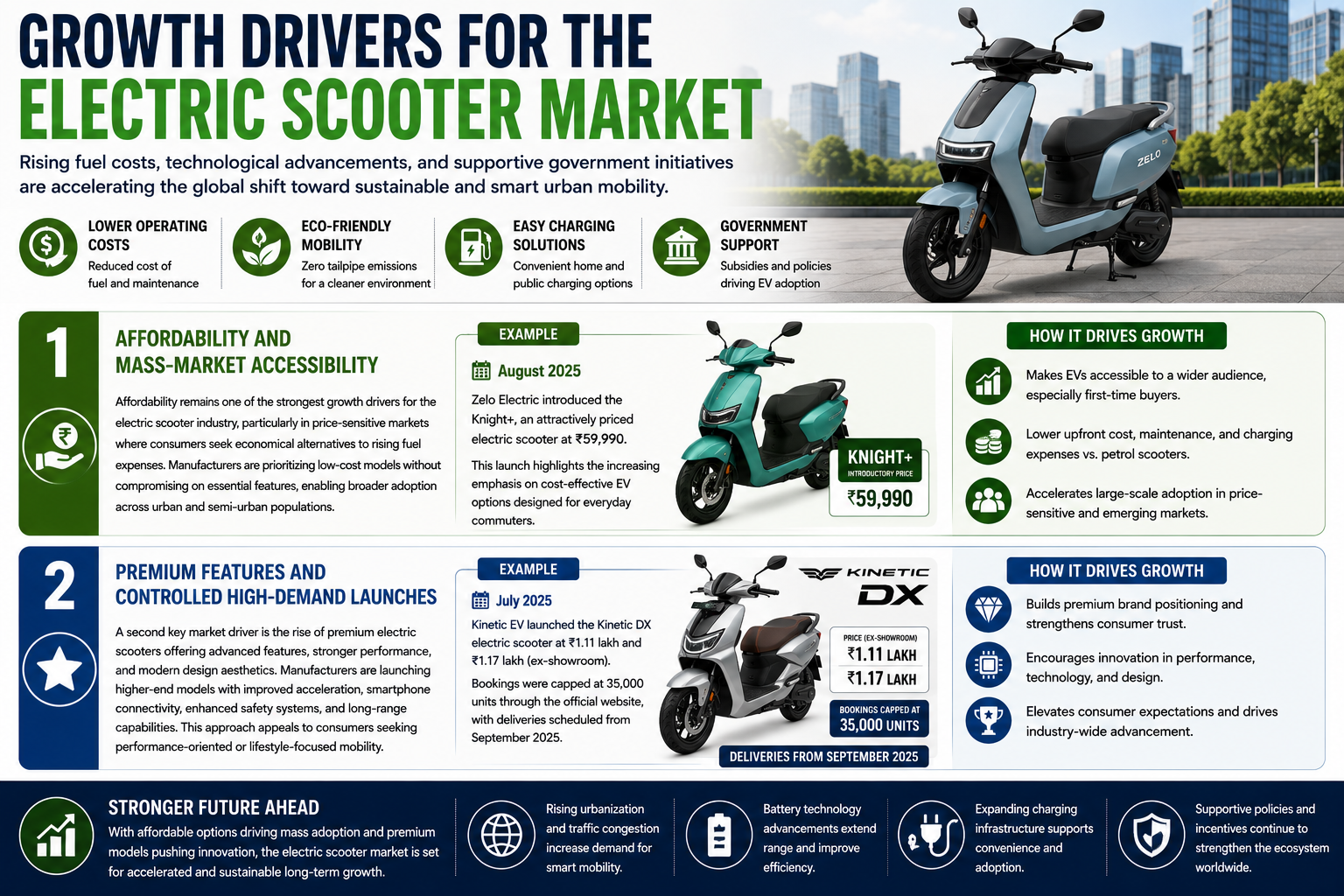
A notable example occurred in August 2025 when Zelo Electric introduced the Knight+ electric scooter at an attractive price point of ₹59,990. The launch demonstrated how manufacturers are targeting budget-conscious consumers seeking affordable electric mobility solutions.
Lower acquisition costs, combined with reduced operating expenses, make electric scooters highly competitive against traditional two-wheelers.
As more companies introduce economical models, electric scooter ownership is becoming accessible to a wider population across both developed and emerging markets.
Premium Models Are Raising Consumer Expectations
While affordability drives volume growth, premium electric scooters are creating excitement at the higher end of the market.
Manufacturers are increasingly introducing feature-rich models that offer enhanced performance, longer range, advanced safety systems, and sophisticated connectivity features.
Consumers now expect capabilities such as smartphone integration, navigation assistance, anti-theft systems, advanced braking technologies, and customizable riding modes.
A strong example emerged in July 2025 when Kinetic EV launched the Kinetic DX electric scooter, featuring premium specifications and a controlled booking strategy limited to 35,000 units. Deliveries were scheduled to begin in September 2025, highlighting growing consumer interest in technologically advanced electric mobility solutions.
The success of premium models is encouraging further innovation throughout the industry while elevating overall product quality standards.
Battery Innovation Is Transforming the Industry
Battery technology remains at the heart of electric scooter development.
Continuous improvements in battery performance are helping manufacturers address many of the concerns that previously limited consumer adoption.
Modern battery systems offer longer driving ranges, faster charging times, improved durability, and enhanced safety features.
Manufacturers are also exploring alternative battery chemistries designed to reduce costs and improve sustainability.
One of the most significant developments occurred in June 2025 when China accelerated its push toward sodium-ion battery technology. Leading manufacturer Yadea introduced multiple sodium-ion-powered electric scooter models while simultaneously expanding charging and battery-swapping infrastructure. Analysts expect sodium-ion batteries to gain increasing market share because of their lower material costs and sustainability advantages.
Battery innovation is expected to remain one of the most important factors shaping the future of electric mobility.
Government Support Continues Strengthening Market Growth
Governments worldwide are actively supporting electric vehicle adoption through various policies and incentive programs.
Many countries have introduced measures such as purchase subsidies, tax incentives, reduced registration fees, and investments in charging infrastructure.
Environmental regulations aimed at reducing greenhouse gas emissions are also encouraging the transition away from gasoline-powered transportation.
Urban planners increasingly view electric scooters as valuable tools for reducing traffic congestion, improving air quality, and supporting sustainable transportation ecosystems.
Government support not only lowers barriers to adoption but also encourages private-sector investment in charging networks and manufacturing capabilities.
As climate goals become more ambitious, policy support is expected to remain a significant driver of market growth.
Smart Features Are Enhancing User Experiences
Today's electric scooters offer much more than simple transportation.
Manufacturers are integrating smart technologies that improve convenience, safety, and overall user experience.
Modern scooters frequently include features such as:
Smartphone connectivity, Bluetooth integration, GPS navigation, anti-theft protection, real-time battery monitoring, regenerative braking systems, remote diagnostics, and software updates.
These technologies make electric scooters increasingly attractive to technology-savvy consumers.
The integration of digital features also supports broader smart-city initiatives focused on connected transportation networks.
As consumer expectations continue evolving, smart functionality is expected to become a standard feature across many product categories.
Personal Mobility Applications Dominate Demand
The personal-use segment remains the largest application area within the electric scooter market.
Consumers increasingly choose electric scooters for daily commuting, short-distance travel, and recreational transportation.
Their compact size, ease of operation, and low operating costs make them particularly attractive in densely populated urban environments.
Electric scooters are especially popular among students, working professionals, and younger consumers seeking practical transportation alternatives.
The flexibility offered by personal ownership continues driving strong demand across multiple geographic markets.
Commercial Applications Continue Expanding
Commercial applications are also contributing significantly to market growth.
Shared mobility operators, delivery companies, and last-mile logistics providers increasingly utilize electric scooters as efficient transportation solutions.
Their low operating costs and environmental benefits make them well-suited for urban delivery services and fleet operations.
As e-commerce activity continues increasing globally, electric scooters are becoming valuable assets for businesses seeking sustainable logistics solutions.
The expansion of commercial use cases is expected to create additional opportunities for manufacturers and service providers alike.
United States Continues Embracing Micromobility
The United States represents one of the fastest-growing electric scooter markets globally.
Urban congestion, increasing environmental awareness, and growing interest in micromobility solutions are driving adoption.
Shared scooter programs have become particularly popular in major metropolitan areas, introducing millions of consumers to electric transportation.
Government investments in EV infrastructure and sustainability initiatives further support market growth.
Although regulatory differences among states create some challenges, demand for compact and efficient mobility solutions continues increasing.
Germany Leads Sustainable Transportation Initiatives
Germany remains one of Europe's most important electric scooter markets.
The country's strong environmental policies, advanced transportation infrastructure, and commitment to reducing emissions have created favorable conditions for electric mobility adoption.
Consumers increasingly embrace electric scooters as practical solutions for last-mile transportation and urban commuting.
Government incentives and rising fuel costs continue strengthening demand despite competition from well-developed public transportation systems.
China Dominates the Global Market
China continues to lead the global electric scooter industry through its massive manufacturing capacity, extensive charging infrastructure, and strong government support.
Urban consumers widely embrace electric scooters because of their affordability, convenience, and compatibility with dense city environments.
The country's leadership in battery innovation and large-scale production enables manufacturers to introduce highly competitive products at attractive price points.
China's continued investment in charging networks and battery-swapping systems further reinforces its position as the world's largest electric scooter market.
Saudi Arabia Is Emerging as a Promising Market
Saudi Arabia's electric scooter market is gradually expanding as the country pursues sustainability objectives under Vision 2030.
Urban centers such as Riyadh and Jeddah are witnessing growing interest in micromobility solutions for short-distance transportation.
Government support, rising environmental awareness, and increasing availability of electric mobility products are contributing to market development.
Although challenges remain, younger consumers and expatriate populations are driving increasing adoption.
Challenges Continue to Affect Market Expansion
Despite impressive growth prospects, several challenges remain.
One important concern involves charging infrastructure availability, particularly in emerging markets where charging networks remain limited.
Insufficient infrastructure can create range anxiety and reduce consumer confidence in electric mobility solutions.
Another significant challenge involves battery degradation and replacement costs.
Over time, battery performance naturally declines, reducing driving range and requiring costly replacements. High replacement expenses may discourage some consumers from adopting electric scooters, especially in price-sensitive markets. Recycling and disposal infrastructure for used batteries also remains underdeveloped in many regions.
Addressing these issues will be essential for sustaining long-term market growth.
Final Thoughts
The electric scooter industry is rapidly transforming global transportation by providing consumers with affordable, sustainable, and technologically advanced mobility solutions.
According to Renub Research, the Electric Scooter Market is projected to grow from US$ 22.43 billion in 2025 to US$ 46.35 billion by 2034, reflecting strong demand driven by urbanization, battery innovation, government support, and changing consumer preferences.
As manufacturers continue improving affordability, performance, and infrastructure support, electric scooters are expected to become an increasingly important component of urban transportation systems worldwide.
The future of mobility is becoming cleaner, smarter, and more connected—and electric scooters are helping lead that transformation.
About the Creator
Enjoyed the story? Support the Creator.
Subscribe for free to receive all their stories in your feed.
Comments
There are no comments for this story
Be the first to respond and start the conversation.