
Electric Cargo Bikes Are Reshaping Urban Logistics and Sustainable Mobility Worldwide
As cities battle congestion, emissions, and rising delivery demands, electric cargo bikes are emerging as one of the most practical transportation solutions of the decade.

The way people and businesses move goods through cities is undergoing a dramatic transformation. Congested roads, rising fuel prices, stricter environmental regulations, and the explosive growth of e-commerce are forcing governments, logistics companies, and consumers to rethink transportation.
At the center of this shift stands a vehicle that was once considered niche but is now becoming mainstream: the electric cargo bike.
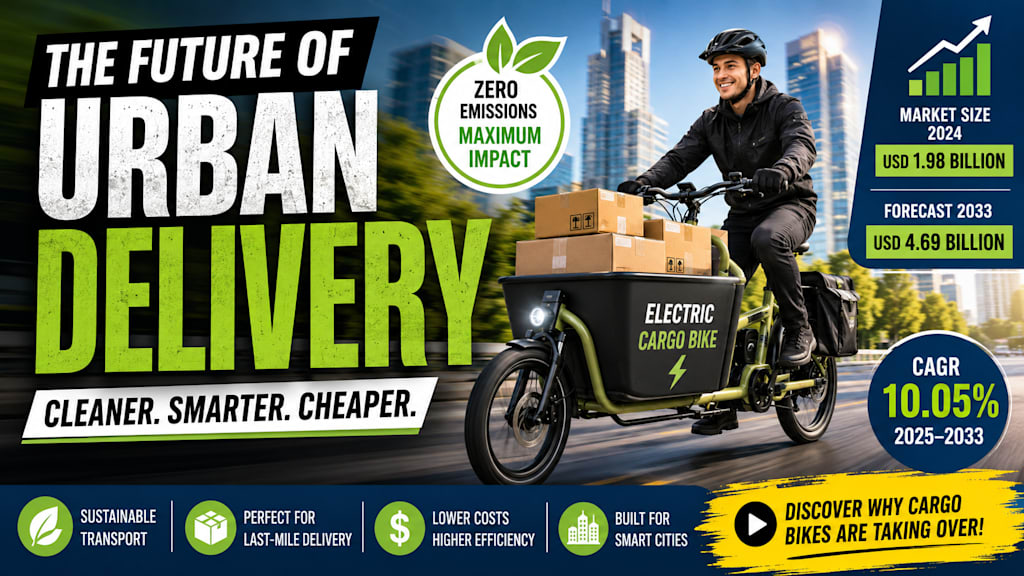
According to Renub Research, the Global Electric Cargo Bike Market was valued at USD 1.98 billion in 2024 and is projected to reach USD 4.69 billion by 2033, expanding at a CAGR of 10.05% during 2025–2033. The impressive growth reflects changing consumer behavior, sustainability goals, and increasing demand for efficient last-mile delivery solutions.
From courier companies navigating busy city streets to families replacing cars for daily errands, electric cargo bikes are proving that practical transportation doesn't have to come at the expense of the environment.
Understanding the Electric Cargo Bike Revolution
Electric cargo bikes combine traditional cycling with electric motor assistance and specially designed cargo compartments capable of carrying substantial loads. Unlike standard bicycles, these vehicles are engineered to transport goods, packages, groceries, equipment, or even passengers.
The electric motor provides pedal assistance, making it easier for riders to carry heavy loads over longer distances and across challenging terrains. Modern designs range from front-loading cargo bikes and rear-loading models to three-wheelers and four-wheel cargo solutions tailored for specific use cases.
What makes electric cargo bikes particularly attractive is their ability to solve multiple urban challenges simultaneously. They reduce traffic congestion, lower carbon emissions, minimize noise pollution, and significantly reduce transportation costs.
As urban populations continue to grow, city planners increasingly view electric cargo bikes as a key component of sustainable transportation ecosystems.
Why Cities Are Embracing Sustainable Urban Transportation
Around the world, governments are implementing ambitious climate initiatives aimed at reducing emissions from transportation. Urban centers are introducing low-emission zones, congestion charges, and stricter vehicle regulations to encourage greener mobility options.
Electric cargo bikes fit perfectly within these objectives.
Unlike conventional delivery vans and combustion-engine vehicles, electric cargo bikes produce zero tailpipe emissions. They require less road space, consume significantly less energy, and help improve air quality in densely populated areas.
Many municipalities are supporting adoption through:
Purchase subsidies
Tax incentives
Expanded cycling infrastructure
Dedicated cargo bike parking areas
Urban mobility grants
As cities strive to achieve carbon-neutral goals, electric cargo bikes are becoming a preferred transportation solution for businesses and individuals alike.
The growing focus on environmental responsibility is expected to remain one of the strongest drivers of market growth throughout the forecast period.
E-Commerce Is Creating Massive Demand
The rapid expansion of e-commerce has fundamentally changed how goods move through urban environments.
Consumers now expect same-day or next-day delivery for everything from groceries and meals to electronics and household goods. This expectation has placed tremendous pressure on logistics providers to find faster and more efficient last-mile delivery solutions.
Electric cargo bikes offer a compelling answer.
Unlike delivery vans that become trapped in traffic or struggle to find parking, cargo bikes can maneuver through congested streets and access locations more efficiently. This translates into:
Faster delivery times
Lower operational costs
Reduced fuel expenses
Improved customer satisfaction
Lower environmental impact
Food delivery platforms, courier services, parcel operators, and retailers increasingly view electric cargo bikes as essential assets within their logistics networks.
As urban deliveries continue growing, demand for cargo bikes is expected to rise accordingly.
Technological Innovation Is Accelerating Adoption
One of the most significant developments supporting market growth is continuous advancement in battery and motor technology.
Modern lithium-ion batteries provide:
Longer travel ranges
Faster charging times
Improved durability
Greater energy efficiency
Enhanced safety features
Today's electric cargo bikes often include sophisticated technologies such as:
GPS tracking systems
Smart fleet management software
Regenerative braking
Integrated navigation systems
Weather-resistant designs
Modular cargo compartments
These innovations improve usability while reducing operating costs.
As battery prices continue declining and performance improves, electric cargo bikes are becoming increasingly accessible to both businesses and consumers.
This technological evolution is helping transform cargo bikes from alternative transportation options into mainstream mobility solutions.
Challenges That Could Slow Market Growth
Despite strong momentum, several obstacles remain.
High Initial Investment
Electric cargo bikes typically cost significantly more than conventional bicycles due to their electric motors, battery systems, and reinforced frames.
For small businesses and budget-conscious consumers, the upfront cost can represent a barrier to adoption.
Although operational savings often offset the initial investment over time, many potential buyers still require financing options, leasing programs, or government incentives to justify the purchase.
Infrastructure Limitations
Many cities still lack the infrastructure needed to fully support widespread cargo bike usage.
Challenges include:
Limited bike lanes
Insufficient charging facilities
Inadequate parking spaces
Poor connectivity between cycling routes
Without continued investment in urban cycling infrastructure, adoption rates may remain constrained in certain regions.
Two-Wheeler Cargo Bikes Lead the Market
Among product categories, two-wheeler electric cargo bikes dominate global sales.
Their popularity stems from several advantages:
Lower cost
Lightweight construction
Excellent maneuverability
Easier maintenance
Urban compatibility
These models are particularly effective for:
Food delivery services
Courier companies
Small retailers
Personal transportation
Their ability to navigate dense city environments makes them the preferred choice for most commercial operators.
As urbanization accelerates globally, two-wheeler cargo bikes are expected to maintain their leadership position.
Four-Wheeler Models Gain Momentum
While two-wheelers dominate volume sales, four-wheel electric cargo bikes are attracting growing interest.
These vehicles provide:
Increased stability
Larger cargo capacity
Enhanced weather protection
Better suitability for industrial applications
Municipal services, campuses, industrial facilities, and logistics operators increasingly use four-wheel cargo bikes for transporting larger loads.
Although more expensive, they offer a practical alternative to small delivery vans, particularly in cities implementing strict emissions regulations.
Lithium-Ion Batteries Drive Market Expansion
Battery technology remains one of the most critical factors shaping market growth.
Lithium-ion batteries have emerged as the dominant choice due to their:
Superior energy density
Longer lifespan
Faster charging capability
Reduced weight
These characteristics make them ideal for commercial operations that require reliable daily performance.
Meanwhile, lead-acid batteries continue serving cost-sensitive markets, though their lower efficiency and shorter lifespan limit long-term growth potential.
As lithium-ion costs continue falling, adoption is expected to accelerate even further.
Personal Mobility Creates New Opportunities
Electric cargo bikes are no longer limited to commercial delivery services.
Families increasingly use them for:
School transportation
Grocery shopping
Daily commuting
Recreational travel
In many urban areas, cargo bikes are becoming viable alternatives to second cars.
The benefits are substantial:
Lower ownership costs
Reduced fuel expenses
Easier parking
Environmental sustainability
This trend is especially strong in Europe and North America, where cycling infrastructure is more developed.
As consumers prioritize sustainable lifestyles, personal-use adoption is expected to expand rapidly.
Regional Markets Driving Growth
United States
The U.S. market continues gaining momentum as businesses and consumers embrace greener transportation alternatives.
Major metropolitan areas such as New York, Portland, and San Francisco are leading adoption through infrastructure investments and pilot programs.
Growing e-commerce activity and sustainability commitments are creating favorable conditions for long-term expansion.
Germany
Germany remains one of the world's strongest electric cargo bike markets.
Government incentives, extensive cycling infrastructure, and environmental awareness have positioned the country as a global leader in cargo bike adoption.
Businesses and families alike increasingly view cargo bikes as practical alternatives to traditional automobiles.
China
China's massive two-wheeler ecosystem creates enormous opportunities for cargo bike growth.
The country's thriving e-commerce sector and dense urban environments make electric cargo bikes particularly valuable for logistics operations.
Local manufacturers continue developing affordable models tailored to high-volume urban delivery needs.
Saudi Arabia
Although still emerging, Saudi Arabia is exploring cargo bike deployment as part of broader sustainability initiatives under Vision 2030.
Smart-city projects and growing e-commerce activity are expected to create opportunities for future market development.
10 Recent Developments Shaping the Industry
1. Tenways Expands into Cargo Bikes
In April 2025, Tenways launched the Cargo One in the United States, targeting family transportation and urban mobility.
2. Maxion Wheels Partners with Antric
Maxion Wheels became the exclusive wheel supplier for Antric's heavy cargo bike platform.
3. Honda Strengthens Electric Mobility Presence
Honda introduced the E-VO electric vehicle platform in China, reinforcing its commitment to electrified transportation.
4. DHL Continues Cargo Bike Fleet Expansion
DHL is expanding urban cargo bike deployment to improve sustainable delivery operations.
5. Amazon Accelerates Green Delivery Programs
Amazon continues testing and expanding cargo bike logistics networks in major cities.
6. Rad Power Bikes Expands Commercial Solutions
The company is enhancing cargo-focused offerings for business customers.
7. Riese & Müller Introduces Premium Cargo Innovations
The manufacturer continues investing in advanced cargo bike technologies and family-focused designs.
8. Accell Group Advances Sustainable Mobility
The company remains focused on expanding electric mobility solutions across Europe.
9. Mahindra Explores Electric Mobility Opportunities
Mahindra continues strengthening its broader electric transportation ecosystem.
10. Smart City Projects Increase Cargo Bike Integration
Multiple municipalities worldwide are incorporating cargo bikes into sustainability and urban mobility programs.
Competitive Landscape
The electric cargo bike market features strong competition among established bicycle manufacturers and innovative mobility startups.
Key players include:
Butchers & Bicycles Ltd.
Accell Group N.V.
Mahindra & Mahindra Limited
Amsterdam Bicycle Company
Xtracycle Cargo Bikes
Riese & Müller GmbH
CERO Inc.
Kalkhoff Werke GmbH
Giant Bicycles
Rad Power Bikes Inc.
Companies continue focusing on battery innovation, product diversification, fleet solutions, and strategic partnerships to strengthen market position.
Final Thoughts
Electric cargo bikes are no longer a niche transportation concept. They are rapidly becoming a cornerstone of modern urban mobility.
As cities seek cleaner transportation alternatives and businesses demand more efficient last-mile delivery solutions, cargo bikes offer a rare combination of economic practicality and environmental responsibility.
Supported by technological advancements, government incentives, expanding cycling infrastructure, and growing consumer awareness, the industry is positioned for substantial long-term growth.
With the global market projected to rise from USD 1.98 billion in 2024 to USD 4.69 billion by 2033, electric cargo bikes are poised to play an increasingly important role in shaping the future of transportation.
For businesses, governments, and consumers alike, the shift toward electric cargo mobility represents not just a trend—but a meaningful step toward more sustainable and efficient cities.
About the Creator
Enjoyed the story? Support the Creator.
Subscribe for free to receive all their stories in your feed.
Comments
There are no comments for this story
Be the first to respond and start the conversation.