
E220P-400T22S LoRa Module In-depth Analysis
cost-effective solution for industrial wireless

E220P-400T22S LoRa Module In-depth Analysis: A Wireless Module Redefining Long-Distance Communication Performance
In the realm of wireless connectivity for the Industrial Internet of Things, communication distance, anti-interference capability, and stability have always been the core metrics that engineers care about most. The E220P-400T22S, launched by Chengdu Ebyte Electronic Technology Co., Ltd., stands as a high-performance upgraded version of the E22 series. With its exceptional RF performance and unique hardware design, this module has distinguished itself in the long-distance wireless communication market. This article provides an in-depth technical analysis of the module, exploring how it has become a compelling replacement for traditional E22 modules.
1. Product Overview: A High-Performance Upgrade of the E22 Series
The E220P-400T22S is a next-generation LoRa wireless UART module designed by Ebyte based on the LLCC68 chip solution. It operates in the 410.125–493.125 MHz frequency band (default 433.125 MHz) with a maximum transmit power of 22dBm. Compared to the standard E22-400T22S, this is not merely a name change but a substantial hardware design upgrade.
Product Positioning: A high-performance variant of the E22 series, targeting industrial-grade applications with higher demands for communication distance, stability, and anti-interference capability.
Product Form: SMD package, measuring 16×26mm, weighing only 1.95g, with 1.27mm stamp-hole interface — suitable for automated SMT production.
2. Features: Three Major Leaps in RF Technology
According to the detailed documentation in the knowledge base (AN2022003_E22P Series Advantages Over Standard E22 Modules), the E220P-400T22S achieves qualitative leaps over standard E22 modules in the following three areas:
2.1 Core Chip Upgrade: From SX1278 to SX1262
Standard E22 series modules are based on the legacy SX1278 RF chip, while the E220P series adopts Semtech's next-generation SX1262 chip. This upgrade delivers:
Faster data processing: The SX1262 operates at a higher clock frequency, providing superior underlying data processing capability.
Lower power consumption: The new-generation chip offers better power management in standby and receive modes.
Extended communication range: Advanced process technology and design yield significantly improved RF performance.
2.2 Built-in SAW Filter: A Powerful Tool for Interference Rejection
This is the most critical hardware upgrade in the E220P series. The module incorporates a Surface Acoustic Wave (SAW) filter, which works by converting received RF signals into mechanical energy, processing them, and then converting the mechanical energy back into electrical signals — effectively filtering out unwanted signals and noise. The SAW filter brings the following advantages:
Reduced noise entering the LNA: By filtering out out-of-band interference, the signal entering the Low Noise Amplifier (LNA) is cleaner.
Significantly improved reception performance: Ensures effective signal reception even in the harshest electromagnetic environments.
Excellent EMI immunity: Enables stable operation in strong interference environments.
2.3 Active Temperature-Compensated Crystal Oscillator (TCXO): Ensuring Full-Temperature-Range Stability
The E220P module adopts a 32MHz industrial-grade active TCXO, eliminating the need to rely on the chip's internal DSP oscillator. This brings direct benefits:
Frequency drift controlled within ±1 PPM: Maintains extremely high frequency accuracy under both high-temperature (+85°C) and low-temperature (-40°C) conditions, ensuring stable communication without frequency drift.
Suitable for all-weather operation: This is critical for devices that need to operate long-term in outdoor and field environments.
3. Detailed Technical Specifications
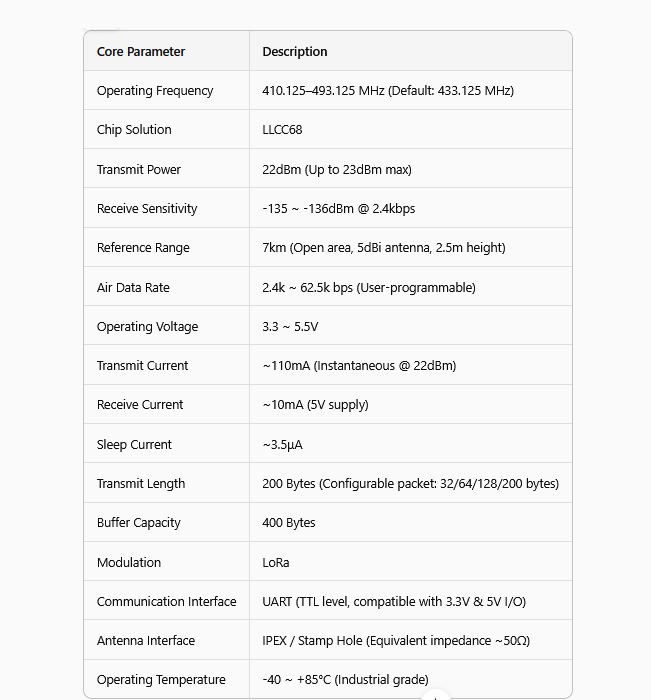
Key Parameter Insights
7km reference range: This is a standout figure. Compared to the standard E22-400T22S's 5km range, it represents a 40% improvement under equivalent conditions — a significant advantage in medium-to-long-distance applications.
Receive sensitivity: An ultra-high sensitivity of -135 ~ -136dBm means the module can capture extremely weak signals, providing the hardware foundation for long-distance communication
4. Application Scenarios: From Point to Wide-Area Wireless Coverage
Leveraging its core advantages of 7km ultra-long range, high interference immunity, and full-temperature-range stability, the E220P-400T22S is widely applicable in the following scenarios:
Home security alarms and remote keyless entry: Ideal for security systems covering large areas such as villas and estates, eliminating the need for repeaters.
Smart home and industrial sensors: Suitable for sensor data collection in complex electromagnetic environments like factory workshops and large warehouses.
Wireless alarm security systems: Building highly reliable long-distance alarm networks.
Building automation solutions: Wireless control and data acquisition across multi-story, large-scale buildings.
Wireless industrial-grade remote controls: Long-distance remote control of cranes and construction machinery.
Advanced Metering Infrastructure (AMI): Long-distance wireless meter reading for smart electricity, water, and gas meters.
Automotive industry applications: Parking lot management, EV charging station data collection, etc.
5. EBYTE Core Advantages: Why Choose the E220P Series?
Choosing the Ebyte E220P-400T22S means you get more than just a hardware module — you receive a complete, mature technical solution:
Seamless replacement: The E220P series is fully compatible with the standard E22 series in chip solution, package size, and software functionality, supporting seamless replacement without modifying PCB design or underlying drivers.
Significant performance improvement: 40% increase in communication range, improved receive sensitivity, and stronger anti-interference capability — giving your product a competitive edge in communication performance.
Rich feature set: Supports Wake-on-Radio (WOR), Listen Before Talk (LBT), communication encryption keys, RSSI signal strength indication, fixed-point/broadcast/channel monitoring transmission, and deep sleep mode (3.5μA).
Comprehensive development support: Provides detailed Chinese and English user manuals, hardware design guides, soldering guidelines, and professional technical support.
6. Frequently Asked Questions (FAQ) — Based on Knowledge Base
Q1: What are the main differences between the E220P-400T22S and the standard E22-400T22S?
A: The key differences lie in hardware RF performance. The E220P adopts the SX1262 chip, adds a SAW filter, and uses an active TCXO. This results in superior communication range (7km vs. 5.6km), better anti-interference capability, and improved full-temperature-range stability compared to the standard E22. Software functions are fully compatible, allowing direct replacement.
Q2: How could I troubleshoot unsatisfactory transmission distance?
A: First, check whether the antenna is properly matched (a 5dBi gain antenna is recommended). Second, verify that the supply voltage reaches 5V. Third, inspect the surrounding environment for strong interference sources. Finally, try lowering the air data rate (e.g., to 2.4kbps) to gain additional range.
Q3: What is the module's power consumption like?
A: In normal receive mode, the current draw is approximately 10mA. In deep sleep mode, it drops to as low as 3.5μA, making it well-suited for battery-powered applications. The transmit current is approximately 110mA (instantaneous), which is normal for a 22dBm module.
Q4: Does the module support EMC/EMI design?
A: The module itself incorporates a built-in SAW filter, enhancing its electromagnetic interference immunity. However, in overall product design, standard EMC design practices should still be followed, such as adding filtering capacitors at the power input and keeping antennas away from high-frequency digital traces.
Q5: What are the module's default parameters?
A: According to the knowledge base, the factory default parameters are: Frequency 433.125MHz, Air data rate 2.4kbps, UART baud rate 9600bps, UART format 8N1, Transmit power 22dBm.
The E220P-400T22S is far more than a simple "minor revision" product. It is Ebyte's high-performance answer to the three core pain points of medium-to-long-distance wireless communication: insufficient range, excessive interference, and harsh operating environments. Through chip upgrades, the addition of a SAW filter, and an active TCXO, it achieves a qualitative leap in RF performance. For engineers currently using the E22 series who wish to push the limits of LoRa communication technology, the E220P series is undoubtedly an upgrade option worth serious consideration.
About the Creator
rubinlee
Enjoy sharing product reviews and evaluations, providing insights and personal experiences with various products.
Enjoyed the story? Support the Creator.
Subscribe for free to receive all their stories in your feed.
Comments
There are no comments for this story
Be the first to respond and start the conversation.