
E160-TxF12S2 OOK Wirelss Transmitter Module In-depth Analysis
low-cost remote control scenario
E160-TxFS1 OOK Wireless Transmitter Module In-depth Analysis: An In-depth Analysis of a Remote Control Transmitter Module with Built-in Key Input
Introduction
In the field of wireless remote control and small home appliance control, cost, power consumption, and ease of use are often the key factors that determine the success or failure of a solution. The E160-TxFS1, launched by Chengdu Ebyte Electronic Technology Co., Ltd., as an OOK/ASK wireless transmitter module integrating 4-channel key input, has become an ideal choice for simple remote control applications with its low power consumption, wide voltage range, and high stability. This article provides an in-depth technical analysis of the module, exploring its working principle, core advantages, and key selection considerations.
Note: Based on the knowledge base documentation, the model "E160-TxF12S2" you mentioned does not clearly appear in the existing documents. You may be referring to the E160-TxFS1 (transmitter module with 4-channel key input) or the E160-TxMS1 (pure hardware data input transmitter module). This article will focus on the E160-TxFS1, which has the most detailed documentation in the knowledge base.
1. Product Overview: A Transmitter Module Designed for Key Remote Control
The E160-TxFS1 is a low-cost, high-performance OOK/ASK modulated wireless transmitter module developed by Ebyte. It operates in the two ISM frequency bands of 315MHz and 433.92MHz, with an integrated PLL (Phase-Locked Loop) and power amplifier, and features 4 independent key input pins. It comes from the factory with a pre-programmed 20-bit unique address code (supporting millions of groups).
Core Positioning: A plug-and-play remote control transmitter solution, suitable for application scenarios requiring key-based control.
Product Form: The module adopts an SMD package, measuring 20.3 × 13.3 × 3.0mm (L × W × H), with a stamp-hole interface. The front of the module is printed with "E160-T4FS1" (representing the 433.92MHz version), and the back shows the pin definitions.
Two Version
E160-T3FS1: Operating frequency 315MHz
E160-T4FS1: Operating frequency 433.92MHz
2. Features: Simple, Stable, and Efficient
2.1 Ultra-Low Power Consumption and Wide Voltage Range
Wide operating voltage: 1.8V ~ 5.5V, compatible with ordinary coin cell batteries or lithium batteries.
Ultra-low standby power consumption: Shutdown current as low as 0.01μA, making it ideal for battery-powered remote control products, significantly extending battery life.
2.2 Powerful RF Performance
High power output: At 5V supply, the transmit power can reach +17dBm (approximately 50mW).
Reference communication distance: When paired with the E160-RxFS1 receiver module, it can achieve up to 240 meters in clear, open environments.
High-temperature tolerance: Can operate normally at temperatures up to 120°C, suitable for certain special environments.
2.3 Unique Encoding and Address Design
Supports EV1527 standard encoding: This is one of the most widely used encoding formats in the remote control field, offering strong anti-interference capability.
Built-in 20-bit unique address code: The module comes with a factory-programmed 20-bit address code, providing millions of groups (2^20) of address space, making address conflicts virtually impossible.
4 independent key inputs: Four pins — K0, K1, K2, K3 — corresponding to different key values.
2.4 Excellent Protection Capability
ESD HBM protection: Up to 8KV for the whole unit, and up to 6KV for the RFout pin, effectively preventing electrostatic damage even in dry environments.
3. Detailed Technical Specifications
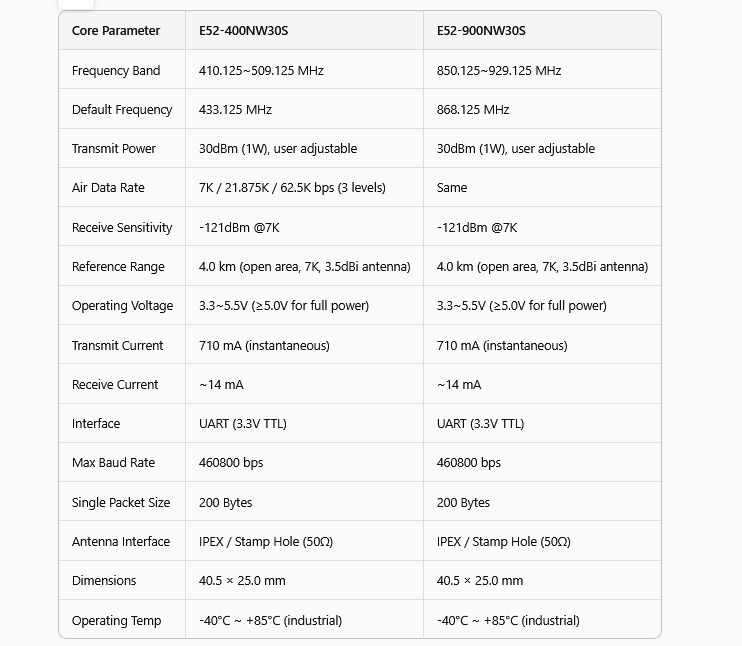
Key Parameter Insights
2.86kbps fixed data rate: This is a relatively low transmission rate, but combined with OOK modulation, it offers very strong anti-interference capability, making it suitable for simple key command transmission while ensuring remote control distance and reliability.
240-meter reference range: This is the ideal value when paired with the dedicated E160-RxFS1 receiver module. In practical applications, the range will be reduced due to environmental factors.
4. Working Principle: Data Frame Structure Analysis
The E160-TxFS1 follows the EV1527 encoding rules. When a key is pressed, the module transmits a data frame consisting of three parts:
Sync Code + 20-bit Address Code + 4-bit Key Value Code
Sync Code (SYNC): Composed of 1T high level + 31T low level, used to synchronize the receiver's clock.
Address Code (20 bits): The module's factory-programmed unique address, used to identify different transmitters.
Key Value Code (4 bits): Corresponds to the pressed key.
K0 pressed: Key value 0001
K1 pressed: Key value 0010
K2 pressed: Key value 0100
K3 pressed: Key value 1000
Data Bit Analysis (T = 0.35ms)
DATA(1): Composed of 3T high level + 1T low level.
DATA(0): Composed of 1T high level + 3T low level.
This encoding method is simple and reliable, making it easy for the receiver (e.g., E160-RxFS1) to decode.
5. Application Scenarios: Precisely Matching Simple Control Needs
The positioning of the E160-TxFS1 is very clear — it is designed for simple key-based remote control scenarios. Typical applications include:
Small home appliance remote control: Such as fan remotes, lighting controls, and smart socket controls.
Toy remote control: Such as direction and function control for remote-controlled cars, boats, and airplanes.
Access control system remote control: Such as remote opening of community unit doors and garage doors.
Electric bicycles: Used as alarm systems or central control remotes for electric vehicles.
Smart home control: Implementing simple on/off wireless control functions.
Difference from E160-TxMS1
E160-TxFS1: Comes with 4-channel key input, ready to use out of the box — the ideal choice for finished remote control products.
E160-TxMS1: Only has a DATA data input pin, requiring an external MCU for encoding, offering greater flexibility and suitability for scenarios requiring custom encoding or transmission of complex data.
6. Frequently Asked Questions (FAQ)
Q1: How do I pair the module with a receiver?
A: The pairing process between the E160-TxFS1 and the E160-RxFS1 receiver module is as follows:
Briefly press (≥100ms) the K/O pin of the receiver module. The LED will start flashing at 2Hz, indicating that the module has entered pairing mode (lasting 8 seconds).
During the pairing period, press any key on the transmitter module to complete the pairing.
After successful pairing, the receiver module will save the transmitter's address code and exit pairing mode.
Q2: What should I do if the transmission distance is unsatisfactory?
A: Please check the following factors:
Antenna installation: Ensure the antenna is exposed and positioned vertically upward. It must not be installed inside a metal enclosure.
Supply voltage: Ensure the module supply voltage is not lower than 3V. A 5V supply achieves maximum power.
Environmental factors: Obstacles such as trees and walls will significantly attenuate the signal. Testing near the ground will yield poor results.
Antenna matching: Ensure a 50Ω impedance antenna is used.
Q3: Why is the module prone to damage?
A: Please note the following protective measures:
Power supply safety: Ensure the voltage is between 1.8V and 5.5V. Reverse connection or overvoltage will cause permanent damage.
Electrostatic protection: Take anti-static precautions during handling, as high-frequency components are sensitive to static electricity.
Humidity control: Avoid using or storing the module in high-humidity environments.
Q4: Why is the module's bit error rate too high?
A: Possible auses and solutions:
Co-channel interference: There may be interference from signals on the same frequency nearby. Try changing the channel or moving away from the interference source.
Unstable power supply: Check whether the power supply ripple is too large. A ripple of <100mV is recommended.
Connection cables: Poor quality or excessively long antenna extension cables can increase the bit error rate.
Q5: Can the address code be customized?
A: No. The 20-bit addess code of the E160-TxFS1 is factory-programmed and inside the module. This is part of the module's "ready-to-use" design philosophy. If you need to modify the address code, you will need to choose other programmable module solutions.
The E160-TxFS1 is a precisely positioned and reliably performing wireless transmitter module. it provides a complete, low-cost remote control solution. For engineers developing products such as fan remotes, access control remotes, or toy remotes, this is a highly cost-effective option well worth considering.
About the Creator
rubinlee
Enjoy sharing product reviews and evaluations, providing insights and personal experiences with various products.
Enjoyed the story? Support the Creator.
Subscribe for free to receive all their stories in your feed.
Comments
There are no comments for this story
Be the first to respond and start the conversation.