
Digital Negative: How Apple Reference Image Restores Trust in the Age of AI
By introducing cryptographically signed sensor data and supporting the SynthID standard, Apple is positioning the iPhone 18 Pro not just as a camera, but as a verifiable source of truth in an era saturated with synthetic media.

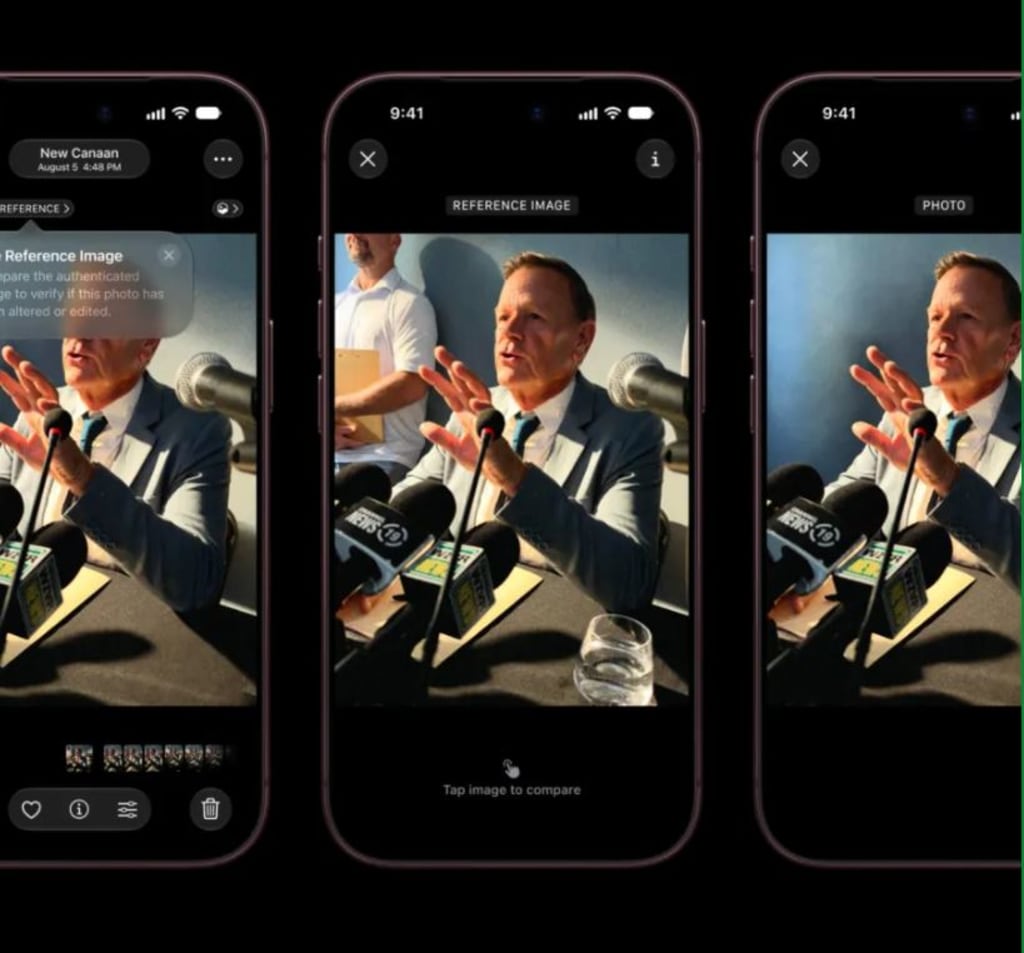
In a world awash in AI slop, Apple wants you to trust what gets captured on its iPhones. The proliferation of generative AI has eroded the foundational assumption of photography: that a picture represents reality. Deepfakes, manipulated news images, and algorithmic hallucinations have made it increasingly difficult to distinguish between what was seen and what was synthesized. To combat this epistemic crisis, the company announced Wednesday during its "Surprise and Shine" event that it is introducing Apple Reference Image, a feature it says can prove whether an image taken with the iPhone 18 Pro is authentic. This move transforms the smartphone from a mere content creation tool into an instrument of journalistic integrity.
“This is vital for photojournalists and photographers,” the company said. In professions where credibility is currency, the ability to prove provenance is paramount. When a photo is taken, the main camera sensor also captures signed sensor data, which Apple’s Private Cloud Compute service then turns into an “unalterable image” viewable in the Photos app. This process creates a cryptographic chain of custody, linking the digital file directly to the physical hardware that captured it. The reference image can then be compared with other versions of the photo to determine whether any changes have been made. Apple likens the reference image to a “digital negative,” invoking the historical authority of film photography where the negative served as the ultimate proof of origin.
While reference images will initially be viewable only in the Photos app, the company is making APIs available to developers so they can integrate the feature into their own apps. This openness is crucial for widespread adoption. Social media platforms, news agencies, and legal entities can use these APIs to verify images before publishing or admitting them as evidence. By creating an open standard for authenticity, Apple is attempting to build a firewall against misinformation that extends beyond its own walled garden. It is a proactive stance that acknowledges the societal impact of technology, positioning Apple as a steward of truth rather than just a vendor of devices.
Apple also said it will support the SynthID standard to help people determine whether images were created or altered with AI. Developed by Google DeepMind, SynthID embeds invisible watermarks into AI-generated images. By supporting this industry-wide standard, Apple is signaling a willingness to collaborate on solving the problem of synthetic media, even with competitors. This dual approach, verifying what is real via Reference Image and identifying what is fake via SynthID creates a comprehensive framework for visual literacy in the digital age.
Apple Reference Image is one of several new features and upgrades to the company’s hardware and software that are focused on the camera. The software verification is backed by significant hardware advancements that ensure the source material is of the highest quality. The company said the iPhone 18 Pro includes its biggest camera improvement in years. One upgrade that will surely get the attention of photographers is the variable aperture on the new 48-megapixel fusion main camera. The aperture is what controls how much light enters the lens. This new main camera has a variable aperture, which means users have more control over the amount of light coming in and ultimately what the final image looks like. It should be especially helpful for those who like to take photos at night, allowing for sharper images with less noise by optimizing light intake without relying solely on computational brightening, which can introduce artifacts.
To achieve this, Apple said it developed a system of six laser-cut blades, each thinner than a human hair and made from a specialized polymer composite, a new rotor mechanism to control movements, and a custom-designed lens. This mechanical complexity is a testament to Apple’s commitment to optical purity. In an era where many smartphones rely entirely on software to simulate depth of field or low-light performance, Apple is doubling down on physics. The variable aperture allows for genuine optical bokeh and better dynamic range, providing a richer, more authentic base image for the Reference Image to certify.
The combination of advanced optics and cryptographic verification creates a powerful narrative: the iPhone 18 Pro is the most trustworthy camera ever built. For professional photographers, this means they can shoot with confidence, knowing their work can be authenticated. For everyday users, it offers a sense of security in a digital landscape where seeing is no longer believing. It restores the sanctity of the moment, ensuring that memories remain distinct from manipulations.
As AI continues to blur the lines of reality, tools like Apple Reference Image will become essential infrastructure for society. They are not just features; they are safeguards. By embedding trust into the very pixels of its images, Apple is making a bold statement about the role of technology in preserving truth. In a world of infinite fabrication, the ability to prove what is real may be the most valuable feature of all.
About the Creator
Mark Lim
Hi I am mark an automotive student and a car, tech and food enthusiast ! Im gonna try and post daily & hope you enjoy what I write and do share my page with people you know. I would gladly appreciate it! Cheers
Enjoyed the story? Support the Creator.
Subscribe for free to receive all their stories in your feed.
Comments
There are no comments for this story
Be the first to respond and start the conversation.