
Digital Camera Market Set to Reframe the Future of Visual Storytelling
From mirrorless innovation to creator-led demand, the global digital camera industry is finding fresh momentum in a smartphone-dominated world.

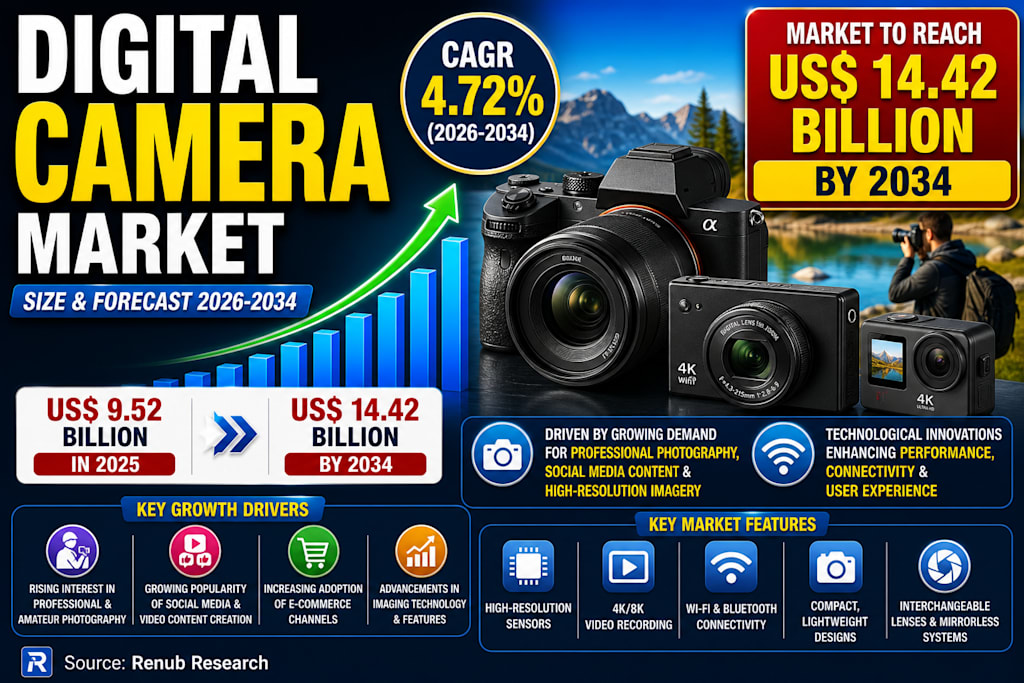
The digital camera market is no longer just about photography enthusiasts carrying heavy gear to capture special moments. It has evolved into a dynamic industry shaped by content creators, media professionals, social platforms, advanced imaging technology, and the growing demand for high-quality video production. According to Renub Research, the global digital camera market is expected to rise from US$ 9.52 billion in 2025 to US$ 14.42 billion by 2034, expanding at a CAGR of 4.72% from 2026 to 2034. That forecast reflects a market that is adapting rather than fading, even in an era where smartphones dominate everyday photography.
What makes this market especially interesting is the way it is being reshaped. Digital cameras are no longer positioned only as tools for professionals. They are now essential instruments for vloggers, YouTubers, streamers, travel creators, small businesses, and social media personalities who want more control over image quality, depth, lighting, zoom, and cinematic performance. In other words, the digital camera is not disappearing; it is redefining its value proposition.
A Market Reinvented by Creativity
The digital camera industry has always depended on one central promise: better visual quality. Today, that promise matters more than ever. Social media has turned visual content into a daily necessity, and audiences expect sharper photos, cleaner video, and more polished storytelling. This is one reason demand remains strong for DSLR and mirrorless systems, especially among users who need more than what a smartphone can offer.
The modern digital camera serves several roles at once. It is a professional imaging device, a creative production tool, a business asset, and in many cases, a personal brand-building machine. The rise of Instagram, TikTok, YouTube, Twitch, and live-streaming culture has turned image quality into a competitive advantage. Creators often prefer dedicated cameras because they provide better control over autofocus, background blur, lens flexibility, low-light performance, and high-resolution recording.
This is particularly important in a digital economy where attention is short and competition is intense. A crisp, professional-looking image can make a creator stand out. A camera that supports 4K or 8K video can help a brand look more premium. A lightweight mirrorless body can make travel vlogging easier. These practical advantages continue to support the relevance of the digital camera market.
Technology Is the Strongest Growth Engine
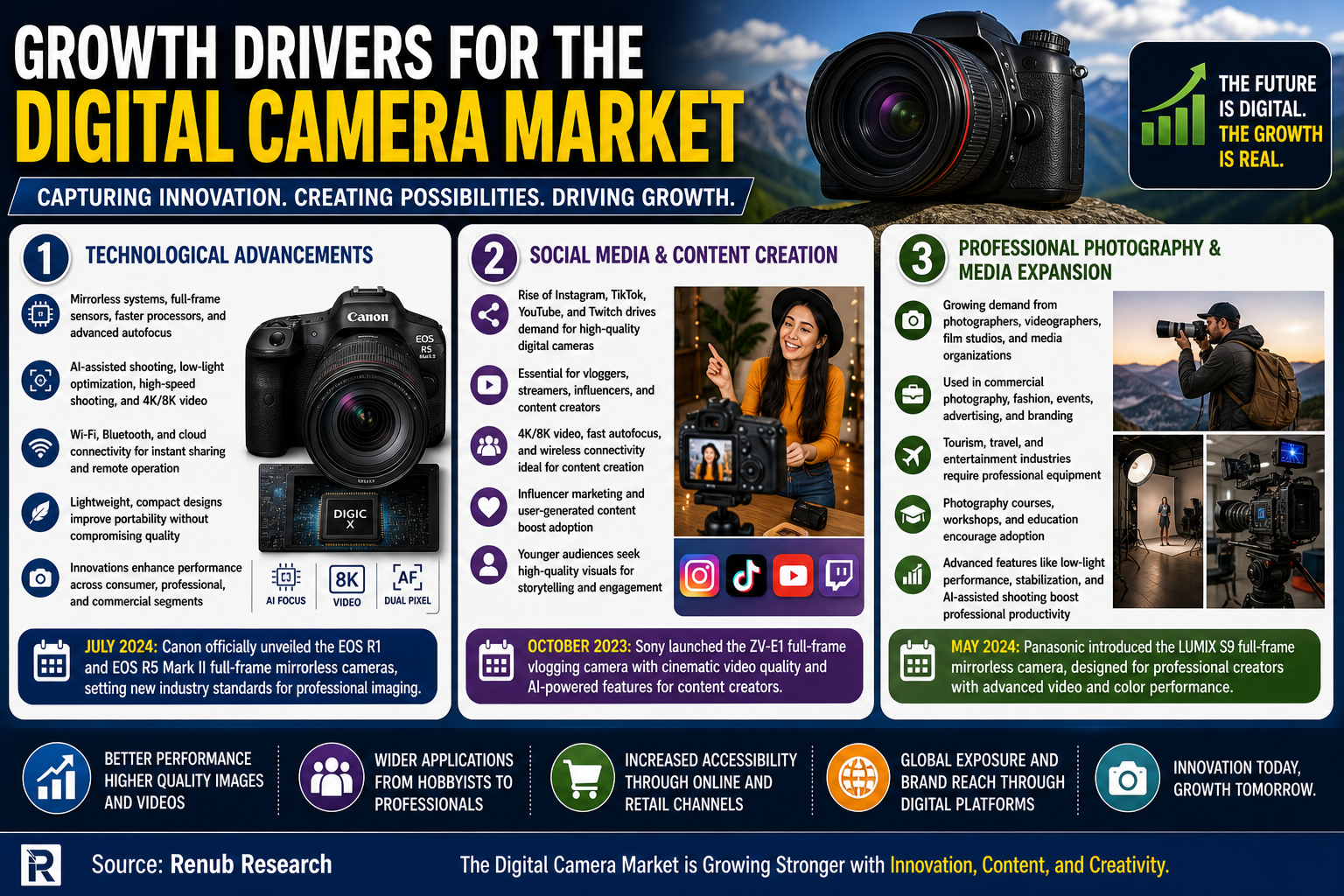
One of the biggest reasons the market still has room to grow is technological progress. Manufacturers have pushed digital cameras far beyond their original function, introducing mirrorless systems, full-frame sensors, AI-assisted shooting, faster processors, image stabilization, and improved autofocus systems. Features such as Wi-Fi and Bluetooth connectivity also make it easier to transfer content instantly and operate cameras remotely.
The shift toward compact yet powerful devices is especially significant. Many users want professional-grade performance without the bulk of traditional equipment. That demand has encouraged brands to design cameras that are smaller, lighter, and easier to carry while still delivering strong image quality. For creators who move frequently, such as travel bloggers, field reporters, and wedding photographers, portability matters just as much as performance.
Product launches continue to signal how competitive this space remains. The file highlights Canon’s EOS R1 and EOS R5 Mark II, which reflect major progress in sensor technology, autofocus, and video recording. These kinds of launches show that the market is not standing still; it is moving toward more intelligent, more powerful, and more adaptable imaging solutions.
Why Content Creation Is Changing Buying Behavior
A major shift in the market is that buyers are no longer limited to photographers. A growing number of customers are content creators first and photographers second. That change is important because it broadens the customer base and raises demand for cameras with video-focused features.
Today’s users often look for:
- smooth autofocus for face tracking and movement
- 4K/8K video support
- clean audio and wireless connectivity
- excellent performance in low light
- interchangeable lenses for varied creative styles
These needs are especially visible in sectors like vlogging, live shopping, tutorial creation, product reviews, online education, and digital marketing. The camera has become a content production tool, not just an imaging device. This is one of the clearest reasons the market can continue to expand even with smartphone competition.
The influence of younger consumers also cannot be ignored. Millennials and Gen Z users tend to prioritize aesthetics, storytelling, and digital presence. For them, a camera is part of identity and performance. That makes social media not just a demand driver, but a cultural driver for the entire industry.
Professional Photography Still Matters
Even with the creator economy rising rapidly, professional photography remains a core pillar of the market. Media organizations, studios, advertising agencies, event photographers, and filmmakers continue to need high-performance equipment that can deliver precision and consistency.
This is where DSLRs, mirrorless systems, and cinema-grade cameras continue to hold value. They offer control, lens choice, dynamic range, image depth, and reliability that still matter in commercial environments. Corporate branding, fashion shoots, travel campaigns, tourism promotions, and product photography all depend on visual quality that smartphones cannot fully replicate.
The education segment also supports demand. Photography students, aspiring filmmakers, and professional training programs introduce more users to advanced camera systems. Once a user learns to work with dedicated imaging equipment, they often stay in that ecosystem for years because of the investment in lenses and accessories. That creates recurring demand beyond the initial purchase.
Competition from Smartphones Remains the Biggest Challenge
No market analysis of digital cameras is complete without acknowledging the pressure from smartphones. Modern smartphones are incredibly capable. They offer multiple lenses, high-resolution sensors, AI-enhanced image processing, image stabilization, and even 4K or 8K video in some models. For casual users, that level of performance is often enough.
This is especially problematic for point-and-shoot cameras and lower-end compact models. Many consumers simply choose the device they already carry in their pocket. Convenience is a powerful competitor. Smartphones also integrate directly with social media platforms, making the workflow easier for everyday users.
Still, the digital camera market is not trying to beat smartphones at their own game. Instead, it is succeeding by offering what phones cannot fully match: larger sensors, interchangeable lenses, superior optical performance, deeper manual control, and a more professional shooting experience. That difference is what keeps the category relevant.
High Costs Limit Wider Adoption
Price remains another major hurdle. Advanced DSLR and mirrorless systems often require not only a camera body, but also lenses, batteries, memory cards, tripods, microphones, and other accessories. For beginners or budget-conscious buyers, this can become expensive quickly.
That cost issue affects the market in two ways. First, it limits entry-level adoption. Second, it encourages consumers to delay upgrades. Many buyers continue using older equipment longer than they otherwise would. Economic uncertainty, import duties, and regional price differences add even more pressure.
This is why manufacturers must continue balancing innovation with affordability. A camera that is technically excellent but too expensive for its target audience will struggle to scale. The market’s future depends not just on premium launches, but also on smart pricing and accessible product tiers.
Regional Markets Show Different Growth Stories
The global market is not moving uniformly. Different regions are adopting digital cameras for different reasons.
The United States remains a mature market with strong professional demand and a healthy creator economy. Consumers in the U.S. actively use mirrorless and DSLR cameras for content creation, vlogging, and professional imagery. The market benefits from strong retail distribution, e-commerce access, and a culture that values high-quality digital content.
Germany has a photography-savvy consumer base that values precision, durability, and optical performance. Enthusiasts and professionals remain important buyers, while social media and travel photography continue to support demand. Brand reputation matters strongly here.
China stands out as one of the fastest-growing markets. Rising disposable income, a strong middle class, and a vibrant content creation ecosystem are fueling demand for advanced cameras. Vlogging, live streaming, e-commerce photography, and social content creation all play a major role. Local and international brands compete aggressively in this market.
Saudi Arabia is emerging as a promising market as interest grows in social media, tourism, event photography, and professional content creation. Higher disposable income and expanding online retail make advanced cameras more accessible to younger buyers and professionals alike.
These regional differences show that the market is not driven by one single trend. It is being shaped by professional demand in mature economies and creator-led expansion in fast-growing ones.
Product Segments Reflect a Changing Audience
The market segmentation in the report reveals just how broad the industry has become. It includes DSLRs, digital rangefinders, line-scan camera systems, compact digital cameras, bridge cameras, and integration cameras, along with both built-in lens and interchangeable lens categories.
That range matters because it shows the market is serving multiple audiences at once. Beginners may gravitate toward compact models, while professionals prefer interchangeable-lens systems. Commercial and industrial applications add yet another layer of demand. This diversity helps stabilize the market, even when one segment slows down.
Recent Developments Show an Industry in Motion
The most recent developments point to a market that is actively innovating. Canon’s anniversary celebration of the EOS 5 series highlighted AI-powered upgrades in the EOS R5 Mark II. The company also introduced automated manufacturing processes to improve efficiency and output. Meanwhile, global compact camera shipments rose in early 2025, with China leading the growth. Leica and Nikon also continued expanding their product lines with new compact cameras and lenses.
These developments matter because they reveal two things at once: first, manufacturers still believe in the long-term value of the category; second, buyers still respond to innovation when it is tied to practical performance and creative flexibility. That combination helps support the market forecast.
Final Thoughts
The digital camera market is not a relic of the pre-smartphone era. It is a market that has adapted to new habits, new platforms, and new creative expectations. The forecast from Renub Research, which projects the market to grow from US$ 9.52 billion in 2025 to US$ 14.42 billion by 2034, shows that demand is still alive and evolving.
Its future will not depend on mass consumer nostalgia. It will depend on creators, professionals, and brands that need better control over visual quality than smartphones can provide. As social media, professional content production, and advanced imaging technologies continue to expand, the digital camera market looks set to remain relevant, competitive, and quietly resilient in the years ahead.
About the Creator
Enjoyed the story? Support the Creator.
Subscribe for free to receive all their stories in your feed.
Comments
There are no comments for this story
Be the first to respond and start the conversation.