
Did We Just Witness the GPT‑3 Moment for Robots?
One 12‑second demo. No fine‑tuning. 59% success rate. Welcome to the era of physical AI that learns like humans.
Introduction
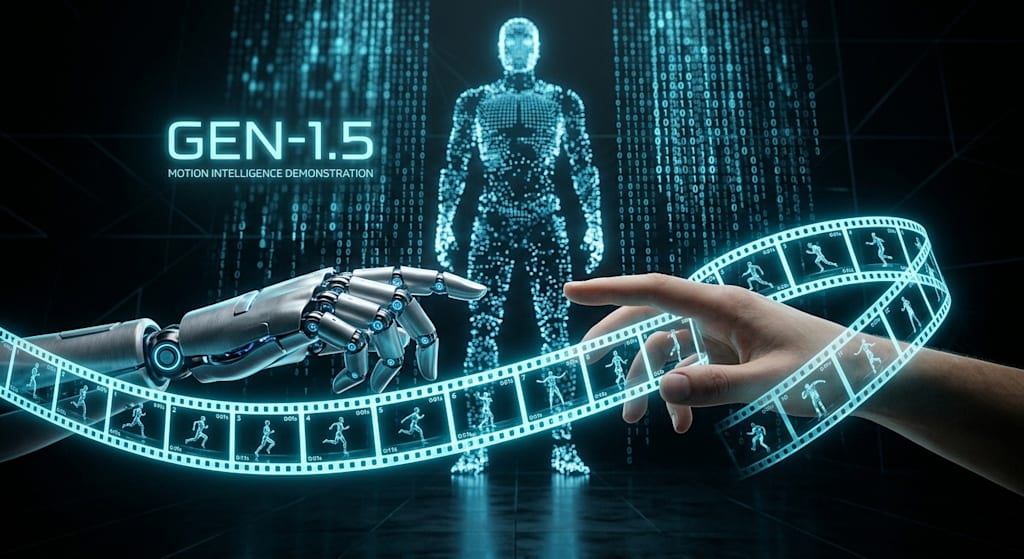
On August 21, 2026, Generalist AI released the GEN‑1.5 embodied model. The news spread through the tech community faster than expected: a cascade of retweets from researchers at OpenAI, DeepMind, and Anthropic filled timelines, with captions like "watch once, do it immediately" and claims that this was "the GPT‑3 moment for embodied AI."
That same day, inside Beijing's National Speed Skating Oval, the "Ice Ribbon," 2,056 humanoid robots were making final adjustments for the opening ceremony of the second World Humanoid Robot Games. There were 666 participating teams, up 138% from the inaugural event. Last year's champions were still fine‑tuning dance moves; this year, the vast majority of teams were testing picking, screwing, and folding clothes.
This was no coincidence. A technological inflection point and an industrial one converged in the same week.
I. GEN‑1.5: One "Physical Prompt" Is Enough
1.1 No More Training
The traditional way to teach a robot a new task involves programming, labelling, trial and error, or running tens of thousands of simulations in reinforcement learning and then transferring the policy to the physical hardware, usually with a performance drop. A simple task like twisting open a bottle cap could take an engineer two weeks.
GEN‑1.5 works differently.
Its input is a short video, three to twelve seconds, of a human performing a task with their hands. The camera watches, and the robotic arm can then do it. No gradient updates, no fine‑tuning, no retraining of any parameters. In tests on ten completely new tasks, the average success rate after a single demonstration reached 59%. With an additional one to five minutes of data and one to ten gradient steps, the success rate climbed to 83%.
This is not an incremental improvement. If we compare previous robot learning to "learning a new language from scratch," GEN‑1.5 is more like "watching someone speak a dialect once and then mimicking it."
1.2 What Emerged
The researchers ran two tests that yielded unexpected results.
The first was a composition test. They showed the model two separate demonstrations: (A) unzipping a pencil case, and (B) taking money out of the case. The tasks were demonstrated independently, with no transitional actions between them. After watching both, the model generated a seamless sequence on its own: unzipping, repositioning, swapping hands, retrieving the money, and automatically recovering from any mid‑task errors. The repositioning and hand‑swap in the transition phase had never appeared in the demonstrations; the model inserted them by itself.
The second was a generalisation test. The demonstration used a brush to sweep building blocks, but during execution the brush was replaced with a banana. The robot completed the sweeping task using the banana. Its vision system recognised this was "not a brush," but the motor system extracted the pattern of "a long object pushing across a horizontal surface" and applied it.
In language models, these abilities are called "in‑context learning" and "generalisation." In the physical world, they mean that the robot is no longer memorising trajectories; it is understanding the structure of the task.
1.3 Paid for with Data
Generalist AI did not produce this model overnight. Since GEN‑0, the company has been focused on one thing: collecting real‑world physical manipulation data. At the GEN‑0 stage, they announced over 270,000 hours of real manipulation data, adding 10,000 new hours per week. By GEN‑1, that number had grown to 500,000 hours. GEN‑1.5 was trained on that data foundation.
This trajectory mirrors the core logic of the GPT series: pile up data, and when the scale crosses a certain threshold, the model begins to exhibit abilities not present in the training set. Generalist AI calls it the "Physical Scaling Law": physical intelligence, too, follows scaling laws.
If that hypothesis holds, the next phase of competition becomes very clear: whoever can obtain the largest, most diverse, and most authentic dataset of real‑world physical interactions will build the strongest embodied model.
II. The Industry Is Moving Fast, but Stuck on Two Hurdles
Alongside the GEN‑1.5 release, the humanoid robot industry is undergoing a structural transformation.
Consider the numbers. In the first half of 2026, China shipped 40,000 humanoid robots, accounting for 97% of the global total. Annual production is expected to exceed 100,000 units. During the same period, revenue of large‑scale robot enterprises reached 165.5 billion RMB, up 24.5% year‑on‑year, and the domestic‑sourcing rate for core components surpassed 75%.
Mass production is no longer the problem, and supply chains are essentially operational. The real bottlenecks to scaling are two other issues.
2.1 Scenarios Are Not Yet Fixed
At the Zhongguancun Haidian Embodied Intelligence Innovation Industrial Park, engineers from Zhuoyu Technology were discussing motor iterations, staff from Nuoteng were setting up data‑collection workstations, and teams from Wujie Power were repeatedly revising their robotics architecture. The consensus across the three companies: hardware form factors are still converging, but application scenarios are converging even more slowly.
Industrial settings are relatively clear. For automotive assembly lines, the requirements for hand configuration, load capacity, and battery life are already specified by customers. But what about home environments? Kitchen operations and living‑room tidying impose completely different demands on robotic arms; folding clothes and carrying plates differ by orders of magnitude in fine‑motor precision. Without settled scenarios, hardware cannot be finalised; without standardised hardware, data collection cannot be standardised.
GEN‑1.5's "watch‑once‑and‑do" capability can precisely bypass this: no need to pre‑program for each scenario; the user demonstrates once. But the prerequisite is that the hardware itself must be adapted to home use: safe, quiet, and affordable. Currently, the mean time between failures of humanoid robots is far lower than that of industrial arms; joints and batteries do not yet have the longevity required for "set it and forget it" home deployment.
2.2 Data Is Still Far from Sufficient
The other bottleneck is data volume. Generalist AI's 500,000 hours of real‑world data is seen by the industry as only a starting point. To achieve general‑purpose embodied intelligence, you need coverage not just of hundreds of pre‑defined tasks, but of tens of thousands of object types, thousands of manipulation modes, and countless environmental variations that appear in homes and factories.
Professional data‑collection companies are ramping up, but capacity is limited. A single teleoperator can record only a few hours of high‑quality data per day, at a cost of thousands of yuan per hour. That is why the industry is turning to crowdsourcing. On August 26, Figure launched the "Index" project, committing USD 15 million to collect real‑world task data from ordinary people around the globe. The method is simple: wear motion‑capture equipment, go about your daily routine at home, and the data is recorded.
The advantage is coverage of a vast range of authentic scenarios; the downside is uneven data quality, which requires extensive cleaning and annotation. Nevertheless, industry consensus has formed: real‑world physical data is the deepest moat in embodied AI.
III. What GEN‑1.5 Changes
Is GEN‑1.5 truly a "GPT‑3 moment"?
What GPT‑3 changed was not the accuracy of language models, but how they are used. Before GPT‑3, every NLP task required its own dataset and fine‑tuning. After GPT‑3, you could tell the model what you wanted in a few sentences, and it would do it. The shift was from "train a model for each task" to "one model for all tasks, switched by prompts."
GEN‑1.5 does the same in the physical world. It moves from "train a policy for each task" to "one model for all manipulations, switched by demonstration videos." The industrial implications are:
Deployment costs drop off a cliff. No need to send roboticists to the site to program; an operator demonstrates once.
Long‑tail tasks become addressable. Operations that occur infrequently but are occasionally needed, such as opening a specific drawer model, are not worth training a dedicated policy for, but they are worth demonstrating once.
Users can teach directly. The end user need not be an engineer; they do not need to understand how the robot works. They just do what they want the robot to do.
Together, these three changes could reshape the economics of humanoid robots, moving them from specialised factory equipment to general‑purpose home tools.
IV. What's Still Missing
GEN‑1.5 validates the technical path, but it is far from true "out‑of‑the‑box" readiness.
On the hardware side, the perception‑to‑action mapping from demonstration to execution has been proven, but the precision, force control, and tactile feedback of robotic arms still lag far behind human hands. The model can only approximate the force and angles used in a demonstration; fine replication remains elusive. Manipulation of deformable objects, such as fabric, cables, and paper, is still a difficult problem.
On the safety side, a model that learns from a single demonstration will also pick up unsafe actions performed by the demonstrator. Generalist AI has not yet published any safety alignment scheme for the model. In a home environment, a single erroneous demonstration could lead to physical harm.
On the data side, 500,000 hours sounds like a lot, but compared to the trillions of tokens used to train language models, it is still orders of magnitude smaller. Whether physical data collection can keep pace with model scaling is the key variable over the next two years. Generalist AI adds 10,000 hours per week, roughly 500,000 hours annually. The rate is accelerating, but we are still far from "internet‑scale" physical data.
On the commercial side, the current cost of a humanoid robot is still in the USD 50,000–100,000 range, well beyond household affordability. GEN‑1.5 reduces software deployment costs, but hardware costs must continue to drop through supply‑chain competition. With domestic‑sourcing rates at 75%, the next target is 90%; only then can prices fall below USD 20,000.
V. Back to the "Ice Ribbon"
On August 22, the second World Humanoid Robot Games opened at the National Speed Skating Oval. Events included carrying, assembly, tidying, and rescue simulation. Among the 2,056 robots, some were executing tasks with conventional programming, while others were running the latest one‑shot learning models.
Spectators saw robots doing work. The industry saw something deeper: when robots move from "dancing" to "doing," from "being teleoperated" to "learning after one glance," the entire cost structure and application boundaries of the industry are shifting.
GEN‑1.5 is just one node. It does not mean all problems are solved, but it has illuminated a path: the physical world can also host large models, follow scaling laws, and produce emergent capabilities after pre‑training.
There will be a third Humanoid Robot Games next year. By then, the number of teams may be larger, the scenarios messier, and the robots' movements may look less like "robots." If GEN‑1.5's approach proves viable, we will see a team at that event whose robot is not pre‑programmed, but instead watches the referee demonstrate the task on‑site and then competes.
That would be "battlefield" deployment.
About the Creator
Jin
Writer of reamstories
https://reamstories.com/jin
Enjoyed the story? Support the Creator.
Subscribe for free to receive all their stories in your feed. You could also become a paid subscriber, letting them know you appreciate their work.
Comments
There are no comments for this story
Be the first to respond and start the conversation.