
Did One AI Model Just Make 64 Others Obsolete?
Inside DeepSeek’s “Kill Line” and the new math that’s resetting the AI race.
Zero
On the last day of July, a Chinese AI company released a lightweight model. Four days later, 64 active large models worldwide sat in a grey zone: replaceable. This wasn't a technological massacre. It was a threshold on a coordinate axis.
Liang Wenfeng had been called "Liang Baikai" for two months.
DeepSeek V4's official release had been pushed from spring to summer. Each delay brought another round of mockery online. Then, on July 31, V4 Flash‑0731 landed. Not the Pro version. Just a lightweight debut. But the afternoon the benchmark numbers leaked, the nickname "Liang Sheng" came back.
Official figures showed it beat GLM‑5.2, fell just short of Opus 4.8, and matched it in some tests. Total parameters: 284 billion. Activated: only 13 billion. What does that number mean in the industry? It means many trillion‑parameter models lost on the scoreboard.
But the real market shift wasn't about scores.
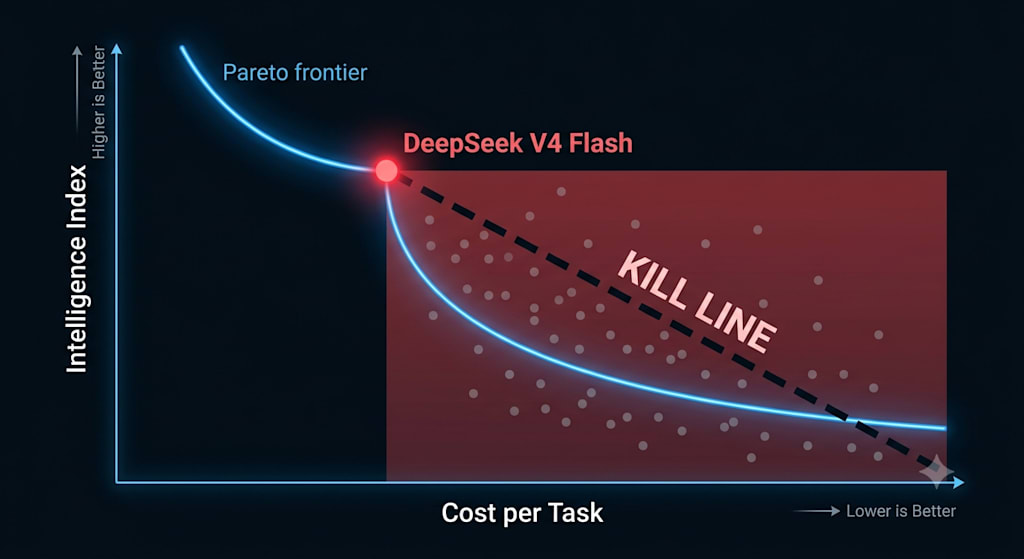
Someone pulled a chart from Artificial Analysis. Horizontal axis: Cost per Task. Vertical axis: Intelligence Index. 592 models. 130 with complete data. DeepSeek landed at (0.0271 USD, 49.93 points). That spot sat exactly on the elbow of the Pareto frontier. Draw a rectangle downward and rightward from that point.
64 active models were killed.
The internet called it the "kill line." In plain terms: any model with lower performance and a higher price has no theoretical reason to exist. Switch to DeepSeek. Cost doesn't rise. IQ doesn't drop. At least one metric improves. Textbook Pareto improvement. For businesses, that's called "being replaced."
One
The kill line isn't a line. It's a coordinate.
The horizontal axis, Cost per Task, uses a clever calculation. It doesn't look at API list price. It looks at the total token cost to complete an actual task. This separates "cheap" from "cost‑effective." Some models have rock‑bottom API prices but inefficient inference. They retry. They correct. They loop. The final bill ends up higher than bigger models. Ministral 3 is a classic case. Cheap per token, but its Cost per Task sits well above the trend.
The vertical axis, Intelligence Index, measures real cognitive scenarios: high‑school math, code generation, complex reasoning. Not a single‑leaderboard champion. Comprehensive IQ.
DeepSeek V4 Flash‑0731's coordinates: (0.0271, 49.93). It finishes a task for $0.05. Claude Fable 5 charges $3.15 for the same job. 63 times more.
Pareto optimal means no model on this frontier can improve one metric without worsening the other. DeepSeek stands at the inflection point. To its lower left: cheaper but dumber models. To its upper right: smarter but far more expensive ones. It occupies the hardest‑to‑replace position.
In this coordinate survival game, only four companies remain on the frontier: OpenAI, DeepSeek, Groq, and Anthropic. Everyone else, no matter how many billions they burned or how grand their launches, now lies in the kill zone. A dense cluster of red dots. Each has a name. Each is dominated.
Two
Models that escaped the kill line fall into two types.
First: the floor‑scrapers. GPT‑5.6 Luna dropped its price by 80%. At the low tier, its Cost per Task is $0.0216. That's 14.3% cheaper than DeepSeek. The trade‑off: IQ drops to 46.06, 3.87 points below DeepSeek. Xiaomi's MiMo‑V2.5 also sits here. Its only moat is multimodality, but coding performance lags far behind. Their survival strategy: admit defeat on performance, undercut on price. The cost: profit margins squeezed paper‑thin.
Second: the ceiling‑scrapers. Kimi K3, Fable 5, Opus 4.8, GPT‑5.6 Sol at max settings. These models score 1.3 or more IQ points higher, but their per‑task costs soar to 1.75 times DeepSeek's or more. Their reason to exist: if you need superior intelligence, you pay more. Is that extra 1 point worth a 75% premium? For 90% of everyday tasks, the answer is no. But for that remaining 10%, missions that demand precision, zero error tolerance, and high stakes, the ceiling‑scrapers remain the only choice.
Between the floor and the ceiling lies DeepSeek's kill zone. Sixty‑four "neither‑here‑nor‑there" models lie buried there. They were once the market's backbone. Now they are ghosts on the chart. No one will actively retire them, but no one will actively choose them either. In economics, that's called "dominated." In business, it's "slow death."
Three
How did DeepSeek draw this line? Its technology stack has three layers.
Layer one: architecture. 284 billion total parameters, only 13 billion activated. MoE: mixture of experts. Each inference wakes only the most relevant experts. It learns from 284 billion parameters during training, but spends only 13 billion's compute during inference. Computational cost is an order of magnitude lower than dense models.
Layer two: post‑training. This is the real moat. Through continuous post‑training iteration, V4 Flash‑0731 achieved leaps in coding, agent tasks, and complex reasoning. Not incremental improvements. Leaps. Post‑training isn't magic. It's engineered RLHF plus a continuously running data flywheel. Big parameters don't equal intelligence. Post‑training is what turns parameters into IQ. On this front, DeepSeek currently has no rival.
Layer three: versioning strategy. The naming follows last year's R1 style. Version number fixed. Date suffix for iteration. This isn't a one‑off product. It's an ever‑evolving weapon system. Every two to three months, post‑training cycles upgrade performance by another notch. Competitors don't just face today's DeepSeek kill line. They face a line that keeps moving upward.
Architecture sets the cost floor. Post‑training sets the capability ceiling. Versioning sets the cadence. Triple‑layered, rivals must chase not just today's DeepSeek, but a moving target.
Four
The ripple effects have already begun.
OpenAI slashed prices by 80%. Not a goodwill gesture. Self‑preservation. Without the cut, Luna would fall straight into the kill zone. With the cut, its low tier narrowly escapes on a razor‑thin cost advantage. But margins are 80% thinner.
Startups are swapping models en masse. What was once "GPT‑4 or nothing" is now "DeepSeek by default." The reason is brutally simple: saved costs become direct profit. High‑end model calls are shrinking, forcing providers to pivot from "selling IQ" to "selling efficiency." But that pivot isn't a flick of a switch. Efficiency is engineering. IQ is research. Research teams don't become engineering teams overnight. Organisational inertia gets in the way.
Developer habits are shifting. Where they once reached for Claude automatically for coding, they now start with DeepSeek and upgrade only if needed. Behind a habit shift lies a willingness‑to‑pay shift. When DeepSeek covers 90% of use cases, developers won't keep high‑end models as their default. They become occasional tools, not infrastructure.
The cruelest impact is on capital markets. Behind those 64 models in the kill zone are 64 funding rounds, 64 teams, 64 business plans. They aren't bad models. They are good models sentenced to death by coordinates. A little worse, a little pricier. In other industries, that's differentiated competition. In the AI market, that's "dominated."
Five
Why not push further upward? Why not slash the ceiling‑scrapers too?
The answer is plain: the current Intelligence Index caps at 100, but that's not the endpoint of human‑level intelligence. It measures high‑school math, coding, logic. Important, but far from the whole picture. If future benchmarks expand to 200 or 300 points, covering longer‑tail complexity, deeper reasoning chains, and more realistic interactions, today's frontier will reshuffle.
DeepSeek's strategy isn't to chase that ever‑rising ceiling. Its strategy is: deliver sufficiently high intelligence under the current benchmark, using as few tokens as possible. This isn't a compromise on intelligence. It's a sober reading of commercial reality. 90% of tasks don't need a flagship's full punch. DeepSeek covers that 90%. The remaining 10% is left for OpenAI and Anthropic to fight over.
This may be the smarter play. In the last AI race, everyone competed to touch the AGI threshold first. The narrative was "bigger is better." In this round, DeepSeek flips the narrative: parameters aren't the goal. Cost‑performance is. When inference cost becomes the biggest bottleneck for scaling, whoever delivers enough intelligence at the lowest cost wins.
Six
The true meaning of the kill line isn't that DeepSeek won. It's that the coordinate system itself punishes models that fall into the middle ground.
A quote that went viral online: "Codex and Claude set the ceiling; DeepSeek sets the kill line. Match it and you have no premium; fall behind and you're out."
The Pro version hasn't launched yet. Its parameter count is five times that of Flash, and performance is expected to jump another tier. When that happens, the kill line will shift upward, perhaps from today's position to the level of Opus 5 and GPT‑5.6 Sol. How many models will remain undominated in the entire coordinate system then?
The answer may be harsher than we imagine. But before that answer arrives, those 64 red dots already say enough: in front of the Pareto frontier, any "good enough" model eventually becomes a "not necessary" model.
This isn't a massacre. It's market efficiency.
About the Creator
Jin
Writer of reamstories
https://reamstories.com/jin
Enjoyed the story? Support the Creator.
Subscribe for free to receive all their stories in your feed. You could also become a paid subscriber, letting them know you appreciate their work.
Comments
There are no comments for this story
Be the first to respond and start the conversation.