
Decentralized Computing: The Race to Replace the Cloud
How blockchain, edge networks, and distributed power are reshaping the digital future.

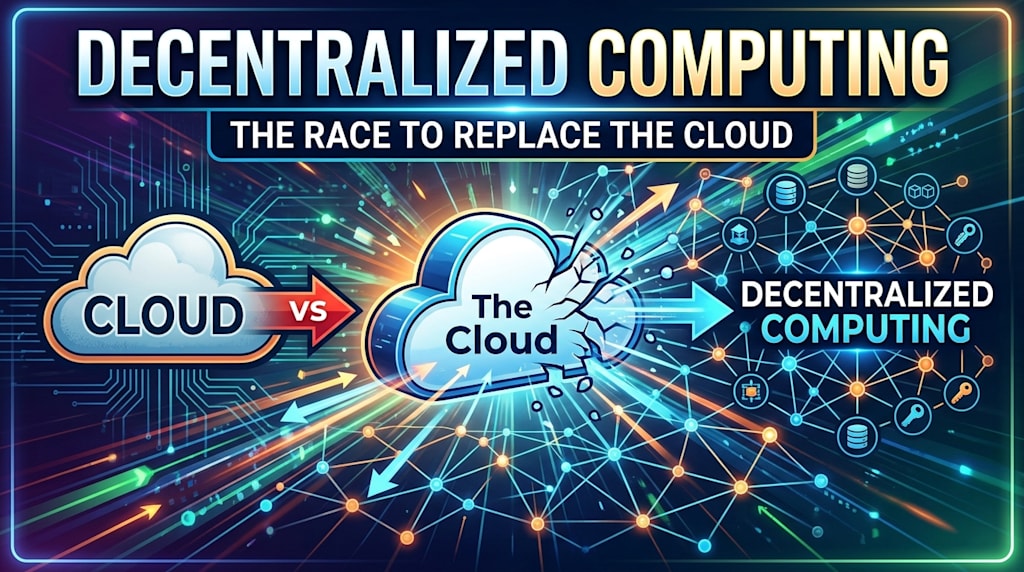
For years, the promise of Web3 was about ownership—owning your assets, your identity, your data. But an overlooked dimension of that promise is infrastructure. The majority of decentralized applications today still depend on centralized cloud providers to host their frontends, APIs, and off-chain components. This creates a quiet contradiction at the heart of the blockchain industry.
A truly decentralized internet would mean that not just the ledger, but the entire computing stack—storage, computation, and networking—runs on distributed, permissionless infrastructure. Several projects have pursued this vision with varying degrees of progress, and the space is becoming one of the more technically ambitious and contested areas in the Web3 landscape.
The appeal is straightforward: cloud dependency introduces censorship risk, single points of failure, and data sovereignty concerns. When a government pressures an infrastructure provider, even the most decentralized protocol can find its frontend taken offline. On-chain hosting and computing changes that equation entirely.
From a market perspective, decentralized compute projects face a dual challenge. They must demonstrate technical parity with commercial cloud services while also making the economics work for both developers and node operators. Storage costs, latency, developer tooling, and uptime guarantees are the table stakes in this competition.
Governance models differ widely across these platforms. Some rely on foundation-controlled roadmaps, while others vest decision-making power in token holders through on-chain voting. The alignment between governance participants and the long-term health of the network is a persistent challenge—voter apathy and plutocratic tendencies can undermine even well-designed systems.
ICP Price Prediction: Key Variables
The Internet Computer Protocol has positioned itself as one of the most ambitious attempts to build a decentralized cloud. The icp price prediction conversation among analysts often focuses on whether the network's unique consensus mechanism and canister-based smart contracts will achieve mainstream developer adoption. The icp price prediction over longer horizons will likely depend on whether enterprise and startup developers find the Internet Computer meaningfully easier or cheaper than traditional cloud alternatives—a thesis still being tested in live production environments.
As decentralized computing matures, the projects that manage to close the developer experience gap with Web2 infrastructure stand to capture significant value. The question is not whether decentralized cloud is possible—it demonstrably is—but whether it becomes the default choice for builders who care about censorship resistance without sacrificing usability.
The Economics of Decentralized Infrastructure
One of the most underexplored dimensions of decentralized computing is how its economic model compares to the hyperscale cloud providers it seeks to displace. AWS, Google Cloud, and Microsoft Azure benefit from decades of infrastructure investment, enormous economies of scale, and deeply entrenched enterprise relationships. Competing on raw price alone is not a viable strategy for decentralized alternatives—at least not in the near term.
Where decentralized compute can win on economics is in specific niches: workloads that are sensitive to censorship, applications that benefit from verifiable computation, and use cases where the cost of data sovereignty is worth paying a premium. As zero-knowledge proof generation becomes more efficient and hardware costs decline, the economic gap between centralized and decentralized compute is expected to narrow significantly over the coming years.
Node operator incentives are another critical variable. Decentralized infrastructure networks must offer compensation attractive enough to draw operators who could otherwise rent out hardware to traditional cloud customers. Token rewards, fee revenue sharing, and staking yields all factor into this equation. Networks that get the incentive balance wrong tend to suffer from either undersupply of compute—resulting in poor performance—or oversupply, which depresses rewards and leads to operator churn.
The emergence of decentralized physical infrastructure networks, often called DePIN, has added a new layer of complexity and opportunity to this space. By tokenizing the contribution of real-world hardware resources—compute, storage, bandwidth—DePIN projects attempt to crowdsource the infrastructure layer in a way that legacy cloud providers structurally cannot replicate. Whether this model proves durable at scale is one of the more consequential open questions in Web3 today.
Security, Verifiability, and Trust in Distributed Systems
Trust is the central problem that decentralized computing must solve—and solve convincingly—if it is to displace centralized alternatives. When a business runs a workload on AWS, it trusts Amazon's contractual guarantees, compliance certifications, and reputational incentives to keep data secure and services available. Decentralized compute networks must offer a different but equally credible form of assurance: mathematical verifiability.
Cryptographic techniques are advancing rapidly in this direction. Trusted execution environments allow computation to occur inside hardware-enforced secure enclaves, producing attestation proofs that a given program ran correctly without revealing the underlying data. Zero-knowledge proofs enable one party to prove the correctness of a computation to another without disclosing any inputs. These tools, increasingly integrated into decentralized infrastructure projects, move trust from institutions to mathematics—a shift with profound implications for how sensitive workloads can be handled.
Redundancy and fault tolerance are also areas where decentralized networks can theoretically outperform centralized counterparts. When data and computation are distributed across hundreds or thousands of independent nodes in geographically diverse locations, the failure of any single node or data center has minimal impact on overall availability. The challenge is coordinating this redundancy efficiently—ensuring consistency without introducing the latency penalties that would make the system impractical for real-time applications.
Audit transparency is a further advantage that decentralized systems can offer. When smart contracts govern how compute resources are allocated, priced, and verified, the rules of the system are publicly readable and cannot be changed unilaterally by a single company. This appeals not only to privacy-conscious developers but also to enterprises operating in regulated industries where auditability and immutability of records carry genuine compliance value.
Conclusion
Decentralized computing represents one of the most technically demanding and potentially transformative bets in the Web3 space. It asks a fundamental question: can open, permissionless infrastructure eventually match—or surpass—the performance, reliability, and economic efficiency of the world's most sophisticated technology companies? The honest answer today is not yet, but the trajectory is meaningful.
The projects that will define this space are not necessarily those with the most ambitious whitepapers or the largest initial token sales. They are the ones that attract serious engineers, earn the trust of real developers shipping real applications, and iterate quickly enough to close the gap with commercial cloud services. Governance, economics, security, and developer experience are all dimensions that matter—and the winners will need to execute well across all of them simultaneously.
For those tracking this space from an investment or development perspective, the key signals to watch are straightforward: Is compute actually being used, or just tokenized? Are developers building applications that would not exist on centralized infrastructure? Is the network growing its node count and geographic diversity in ways that improve resilience? These questions cut through the marketing noise and point toward the projects most likely to be running infrastructure a decade from now.
About the Creator
J. Hanry
Hanry James is an experienced analyst and content writer with over 8 years of experience. He has contributed to several leading publications in renowned tech summits such as TechWorld Expo, Global Digital Forum, and FutureTech Summit.
Enjoyed the story? Support the Creator.
Subscribe for free to receive all their stories in your feed.
Comments
There are no comments for this story
Be the first to respond and start the conversation.