
Data Center Market Surges as Cloud Computing and AI Drive the Next Digital Revolution
Rising demand for cloud services, artificial intelligence, and digital transformation is fueling unprecedented growth in global data center infrastructure.

The digital economy is expanding at a pace never seen before. Every online transaction, cloud-based application, video stream, social media interaction, and artificial intelligence query generates data that must be stored, processed, and secured. Behind this vast digital ecosystem lies a critical piece of infrastructure that often operates out of public view: the data center.
As businesses, governments, and consumers become increasingly dependent on digital technologies, the demand for advanced data center facilities is accelerating across the globe. Data centers have evolved from simple server rooms into highly sophisticated facilities capable of supporting cloud computing platforms, artificial intelligence applications, big data analytics, and real-time digital services. Today, they form the backbone of modern digital operations and play a vital role in ensuring that information remains accessible, secure, and available around the clock.
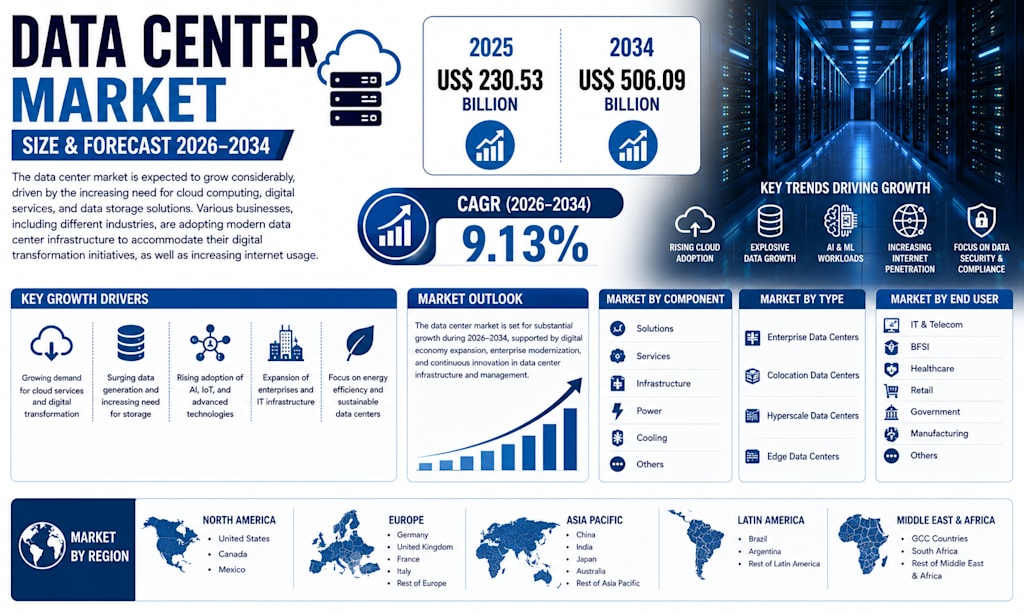
The rapid adoption of cloud services, increasing internet penetration, and the explosive growth of connected devices are creating significant opportunities for the data center industry. According to Renub Research, the global data center market is expected to grow from US$ 230.53 billion in 2025 to US$ 506.09 billion by 2034, registering a compound annual growth rate (CAGR) of 9.13% between 2026 and 2034. This remarkable growth reflects the central role data centers play in supporting the world's increasingly digital future.
Why Data Centers Have Become Essential in the Digital Age
Modern society generates an extraordinary volume of digital information every second. Businesses rely on digital platforms for customer interactions, financial transactions, communication, analytics, and operational management. Governments depend on digital infrastructure to deliver public services, while consumers increasingly use online applications for shopping, entertainment, education, and healthcare.
Data centers provide the infrastructure necessary to support these activities. They house servers, storage systems, networking equipment, power management solutions, and advanced security technologies designed to ensure uninterrupted operations. These facilities process and store enormous amounts of information while maintaining high levels of reliability and security.
Without data centers, many of the digital services people use daily would simply not function. From cloud applications and streaming platforms to online banking and e-commerce websites, data centers make modern digital life possible.
As digital transformation continues across industries, the importance of these facilities is becoming even more pronounced.
Cloud Computing Is Driving Market Expansion
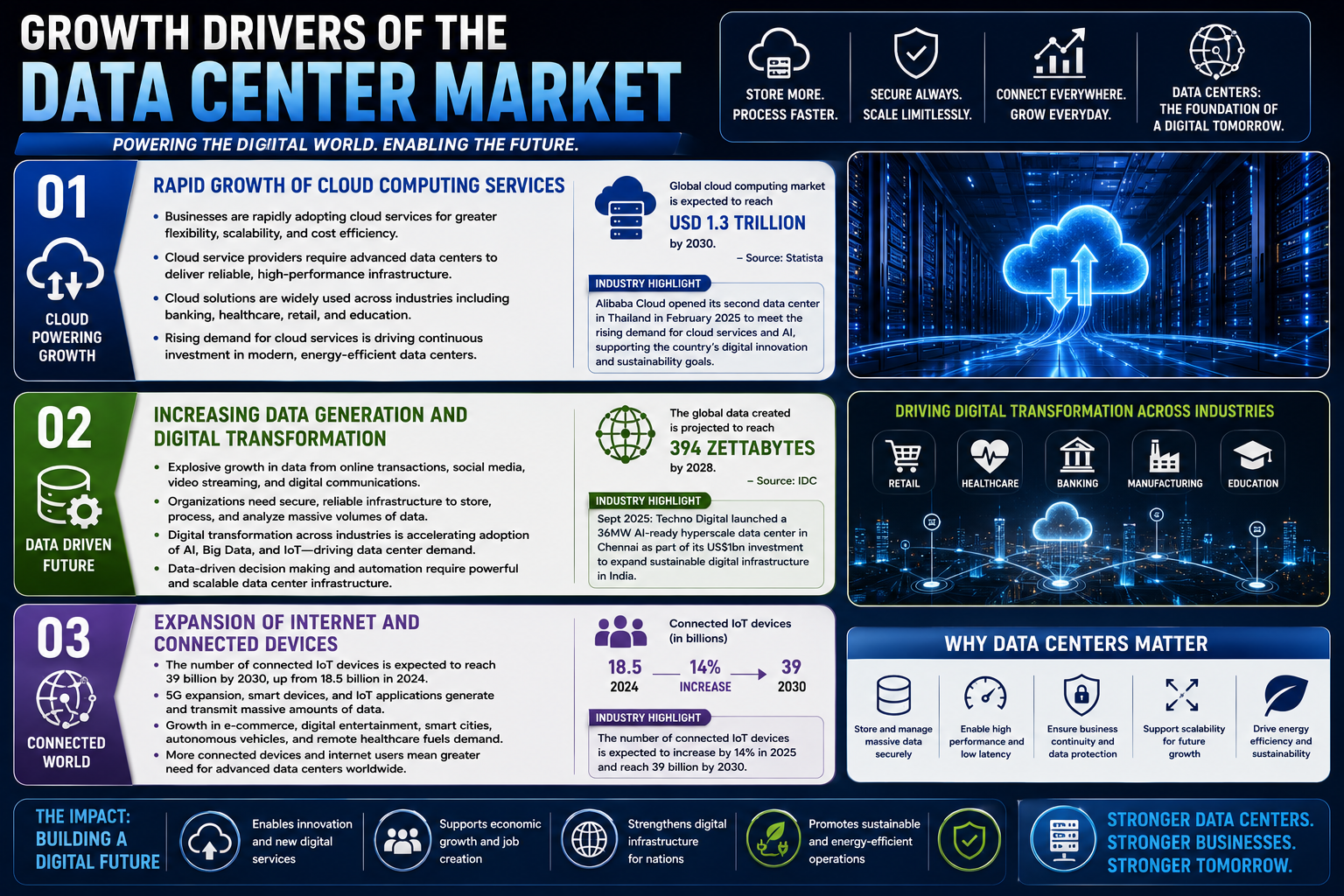
One of the most significant factors contributing to data center growth is the increasing adoption of cloud computing.
Organizations of all sizes are migrating workloads, applications, and storage systems to cloud environments in search of greater flexibility, scalability, and efficiency. Cloud computing enables businesses to access computing resources on demand without investing heavily in physical infrastructure.
This transition has created substantial demand for data center capacity. Cloud service providers require large-scale facilities capable of supporting millions of users and handling massive volumes of data traffic. Industries such as banking, healthcare, education, retail, and manufacturing increasingly rely on cloud services to manage critical business operations.
As cloud adoption continues to accelerate, providers are expanding their infrastructure footprints through the construction of new facilities and the modernization of existing ones. This trend is expected to remain one of the strongest growth drivers within the global data center market throughout the forecast period.
Digital Transformation Is Generating Unprecedented Data Volumes
The digital transformation initiatives being implemented across industries are generating enormous amounts of information that must be processed and stored efficiently.
Organizations are increasingly embracing technologies such as artificial intelligence, machine learning, big data analytics, blockchain, and the Internet of Things. These technologies produce vast quantities of structured and unstructured data that require sophisticated infrastructure for analysis and management.
Businesses are using data-driven insights to improve decision-making, optimize operations, and enhance customer experiences. As a result, reliable data storage and processing capabilities have become strategic priorities for organizations worldwide.
The growing volume of digital information is creating sustained demand for high-performance data centers capable of supporting increasingly complex workloads. Companies that once managed relatively modest data requirements are now handling terabytes and even petabytes of information, driving significant investment in advanced infrastructure.
The Internet of Things Is Expanding Infrastructure Needs
The rapid growth of connected devices is another major factor contributing to market expansion.
Smartphones, wearable devices, smart home technologies, industrial sensors, connected vehicles, and healthcare monitoring systems continuously generate and exchange data. The number of connected devices worldwide continues to rise as businesses and consumers embrace IoT-enabled technologies.
Each connected device contributes to growing data traffic that must be transmitted, processed, analyzed, and stored. This increasing connectivity is creating new requirements for data center operators and cloud service providers.
The expansion of 5G networks is further accelerating this trend. Faster network speeds and lower latency are enabling new applications such as autonomous vehicles, smart cities, industrial automation, and remote healthcare services. These innovations require robust digital infrastructure and highly capable data centers to function effectively.
As global connectivity increases, the need for scalable data center capacity is expected to grow substantially.
Hyperscale Data Centers Are Transforming the Industry
Among the fastest-growing segments of the market are hyperscale data centers.
Hyperscale facilities are massive data centers designed to support the operational requirements of major technology companies, cloud providers, social media platforms, and streaming services. These facilities contain thousands of servers and advanced networking systems capable of handling enormous workloads.
The rise of artificial intelligence has further strengthened demand for hyperscale infrastructure. AI applications require substantial computing power and data processing capabilities, making large-scale facilities increasingly important.
Major technology companies continue investing billions of dollars in hyperscale projects to support growing demand for digital services. These investments are reshaping the global data center landscape and creating opportunities across hardware, software, networking, and energy management sectors.
As cloud services and AI adoption continue to expand, hyperscale facilities are expected to remain a key growth engine for the market.
Enterprise Data Centers Continue to Play a Critical Role
While cloud computing has transformed the industry, many large organizations continue to operate their own enterprise data centers.
Multinational corporations often require dedicated infrastructure to support sensitive workloads, regulatory compliance requirements, and mission-critical business applications. Financial institutions, healthcare organizations, government agencies, and major manufacturers frequently maintain private data center facilities to ensure greater control over operations and data security.
Enterprise data centers support a wide range of functions, including financial transactions, customer relationship management systems, supply chain operations, and internal communications platforms.
Many organizations are now adopting hybrid strategies that combine private infrastructure with public cloud services. This approach allows businesses to balance flexibility, security, and cost efficiency while meeting evolving operational requirements.
Data Center Software Is Becoming Increasingly Important
The growing complexity of modern facilities has increased demand for advanced data center software solutions.
These platforms help operators monitor performance, manage workloads, optimize energy usage, automate routine processes, and strengthen security. Modern software solutions provide real-time visibility into infrastructure operations, enabling organizations to improve efficiency and reduce operational costs.
Artificial intelligence and automation technologies are also being integrated into management platforms. Predictive analytics can identify potential issues before they impact performance, helping operators maintain higher levels of reliability.
As data center environments become larger and more sophisticated, software solutions are expected to play an increasingly important role in operational management.
Regional Markets Show Strong Growth Potential
United States
The United States remains one of the world's largest and most mature data center markets. Strong cloud adoption, rapid AI development, extensive technology investment, and widespread digital transformation initiatives continue to drive growth.
United Kingdom
The United Kingdom serves as a major European hub for data center operations. Advanced telecommunications infrastructure and growing demand for cloud services are supporting market expansion across multiple industries.
India
India is emerging as one of the fastest-growing data center markets globally. Rising internet penetration, digital payment adoption, smartphone usage, and government-backed digital initiatives are creating significant demand for infrastructure investments.
Saudi Arabia
Saudi Arabia is investing heavily in digital transformation and advanced technology initiatives. The country's Vision 2030 strategy, growing cloud adoption, and smart city development projects are fueling demand for modern data center facilities.
Challenges Facing the Data Center Industry
Despite strong growth prospects, the industry faces several significant challenges.
Energy consumption remains one of the most pressing concerns. Data centers require substantial amounts of electricity to power servers, networking equipment, and cooling systems. As facilities continue to expand, balancing operational requirements with sustainability goals will become increasingly important.
Cybersecurity also represents a major challenge. Data centers store highly valuable information belonging to businesses, governments, and consumers. Protecting this data from cyberattacks, ransomware, and unauthorized access requires continuous investment in advanced security technologies.
Operators must also navigate evolving regulatory requirements while maintaining high levels of performance, reliability, and availability.
Market Forecast: Strong Growth Through 2034
According to Renub Research, the global data center market is projected to expand from US$ 230.53 billion in 2025 to US$ 506.09 billion by 2034, reflecting a CAGR of 9.13% during the forecast period from 2026 to 2034. Growth will be supported by cloud computing adoption, increasing data generation, artificial intelligence deployment, IoT expansion, and continued digital transformation across industries worldwide.
Final Thoughts
The data center market has become one of the most critical pillars of the global digital economy. As businesses and consumers generate more data than ever before, the need for secure, scalable, and efficient infrastructure continues to increase.
With Renub Research forecasting market growth from US$ 230.53 billion in 2025 to US$ 506.09 billion by 2034, the industry is positioned for substantial expansion over the next decade. Cloud computing, artificial intelligence, digital transformation, and connected technologies will continue driving demand, making data centers an indispensable part of the modern technological landscape.
As the world becomes increasingly digital, data centers will remain at the heart of innovation, enabling organizations to process information, deliver services, and support the technologies shaping the future.
About the Creator
Enjoyed the story? Support the Creator.
Subscribe for free to receive all their stories in your feed.
Comments
There are no comments for this story
Be the first to respond and start the conversation.