
Data Center Liquid Cooling Market: Size, Share and Forecast
How AI Workload Explosion, Energy Efficiency Imperatives, and Hyperscale Infrastructure Expansion Drive the Global Data Center Liquid Cooling Sector

Market Overview
Data center liquid cooling represents advanced thermal management technology utilizing liquid coolant circulation systems to absorb and dissipate heat generated by high-density computing equipment including servers, graphics processing units, central processing units, and AI accelerators within data center environments. Liquid cooling delivers dramatically superior heat transfer capability compared to conventional air cooling systems, providing up to 3,000 times greater thermal conductivity enabling effective management of rack power densities exceeding 30 kilowatts to 140 kilowatts required by next-generation artificial intelligence computing infrastructure. Direct liquid cooling solutions including cold plate systems transfer heat directly from high-power components including CPUs and GPUs to circulating liquid coolant through conductive metal plates enabling precise localized thermal management. Indirect liquid cooling solutions including rear-door heat exchangers and in-row cooling systems intercept heat from server exhaust without direct hardware contact enabling broader deployment compatibility. Immersion cooling submerges entire server hardware within thermally conductive dielectric fluid providing maximum heat dissipation for densest computing configurations. Service components including design and consulting, installation and deployment, and support and maintenance provide lifecycle support ensuring optimal system performance. Applications span banking financial services and insurance requiring transaction processing infrastructure, IT and telecommunications managing massive computational demands, media and entertainment processing video rendering workloads, healthcare managing patient data and AI diagnostic computing, government and defense maintaining mission-critical computing, retail managing e-commerce and analytics infrastructure, and research and academic institutions running simulation and modeling workloads. In the global context, liquid cooling represents essential infrastructure technology enabling the AI computing era through precise, efficient, and sustainable thermal management.
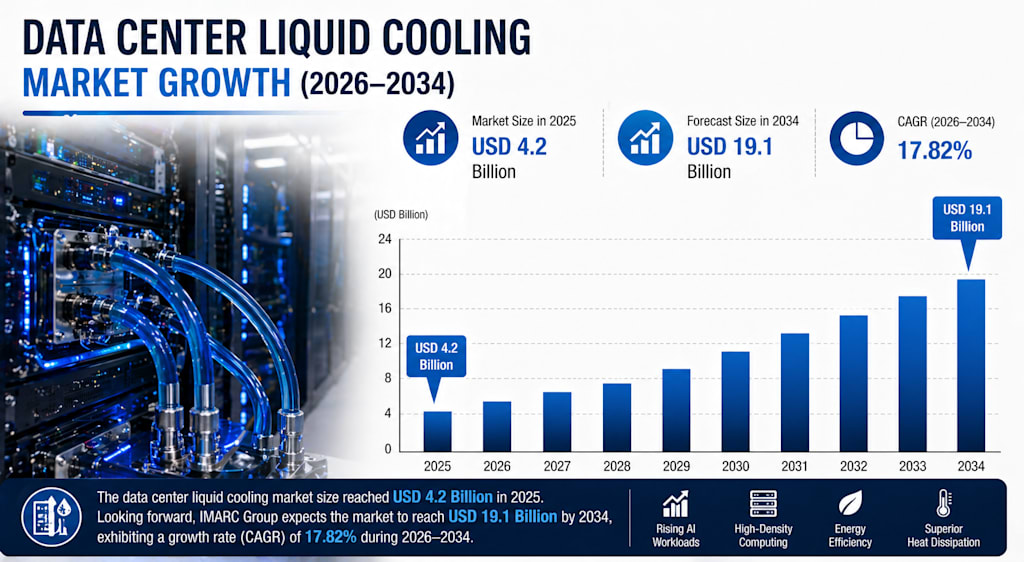
The global data center liquid cooling market size reached USD 4.2 Billion in 2025, reflecting accelerating adoption driven by explosive AI infrastructure investment and mounting thermal management challenges. Looking ahead, the market is projected to reach USD 19.1 Billion by 2034, exhibiting exceptional growth rate (CAGR) of 17.82% during 2026-2034. This extraordinary expansion is supported by rising data center rack power density driven by GPU clusters including Nvidia H100 and GB200 series routinely exceeding 700 watts per chip making air cooling physically inadequate, TrendForce estimates showing liquid cooling penetration in AI-focused data centers climbing from 14% to 33% driven by AI workloads growing over 40% annually, liquid-based cooling capturing 46% of data center cooling market as rack power densities surge beyond 40 kilowatts to 140 kilowatts for next-generation AI accelerators, AWS revealing custom liquid cooling system developed in 11 months in December 2024 supporting growing heat demands of next-generation AI chips, Microsoft announcing all data centers designed from August 2024 will use closed-loop zero-water evaporation designs launching from late 2027, Schneider Electric partnering with NVIDIA in December 2024 to launch liquid-cooled AI cluster solutions with power density up to 132 kilowatts per rack, Shell launching DLC Fluid S3 direct liquid cooling solution in June 2025 claiming up to 27% improvement in power usage effectiveness versus air-cooled environments, KDDI and HPE collaboration announced June 2025 establishing AI data center in Osaka powered by Nvidia GB200 NVL72 platform with integrated direct liquid cooling, increasing government regulatory frameworks enforcing tighter carbon emission caps and energy efficiency standards creating compliance-driven demand, and cooling systems consuming up to 40% of total data center electricity driving urgent efficiency improvement imperative.
Request PDF Sample for more detailed market insights:
Role of Innovation in Market Development
• AI-Driven Predictive Thermal Management and Real-Time Optimization
Innovation is revolutionizing liquid cooling through artificial intelligence integration. AI algorithms continuously monitor temperature sensors and coolant flow rates predicting thermal anomalies before equipment failures occur. Machine learning systems automatically adjust cooling distribution across racks achieving up to 46% reduction in mechanical energy consumption while maintaining optimal operating conditions. Intelligent fluid flow optimization in direct-to-chip systems enables machine learning models embedded in coolant distribution units to analyze sensor data from hundreds of cold plates simultaneously. Predictive thermal models enable real-time adjustment of coolant flow rates and pressure levels in high-density AI computing environments. Smart coolant distribution analyzes power consumption patterns and workload demands to dynamically optimize coolant distribution unit performance. AI-driven anomaly detection identifies thermal risk zones before hardware damage occurs. Predictive maintenance models reduce unplanned downtime preserving business continuity. AI integration transforms reactive cooling management into proactive precision thermal control.
• Direct-to-Chip and Immersion Cooling Technology Advancement
Cooling technology innovation represents transformative market development. Direct-to-chip cold plate systems deliver coolant directly to processor and GPU surfaces through precision engineered contact surfaces achieving maximum thermal transfer efficiency. Immersion cooling advancing from single-phase to two-phase dielectric fluid configurations enabling enhanced heat dissipation. Modular immersion tank architectures enabling scalable deployment across diverse facility configurations. LiquidStack unveiling GigaModular coolant distribution unit in June 2025 as scalable multi-megawatt cooling platform supporting high-density AI and hyperscale deployments. Rear-door heat exchanger technology enabling liquid cooling retrofit in existing air-cooled environments without full infrastructure replacement. Hybrid cooling architectures combining liquid and air cooling optimizing cost and performance across mixed workload environments. Engineered dielectric fluids optimized specifically for AI accelerator thermal profiles. Technology advancement enables precision cooling matching specific hardware thermal requirements.
• Sustainable Cooling Innovation and Zero-Water Technology
Sustainability-focused innovation represents critical market differentiation. Microsoft waterless cooling technology launched August 2024 for AI workloads supporting net-zero emissions goals. Closed-loop zero-water evaporation system designs eliminating freshwater consumption concerns. Heat reuse and heat recovery systems capturing waste thermal energy for building heating applications. Power usage effectiveness optimization through liquid cooling reducing facility energy intensity. Carbon-neutral cooling infrastructure aligned with corporate sustainability commitments. Renewable energy integration with cooling infrastructure reducing carbon footprint. Government subsidy and incentive programs supporting green cooling technology adoption. Regulatory compliance framework driving adoption of energy-efficient cooling alternatives. Sustainability innovation aligns cooling investment with environmental obligation and corporate responsibility.
Data Center Liquid Cooling Industry Trends and Drivers
• Artificial Intelligence and High-Performance Computing Workload Explosion
AI infrastructure expansion represents the primary and most powerful market growth driver. Generative AI model training requiring GPU clusters generating unprecedented thermal loads. Large language model inference deployment multiplying GPU-accelerated server deployments. Computer vision and recommendation engine AI systems demanding continuous high-density computing. AI-as-a-service cloud offering proliferation requiring purpose-built AI-ready facilities. GPU clusters with 60 to 100 or more kilowatts per rack for AI training workloads fundamentally requiring liquid cooling. Nvidia H100 and GB200 series GPU chips routinely exceeding 700 watts per chip overwhelming air cooling capability. AI workloads growing over 40% annually continuously intensifying thermal management demands. AI revolution creates structural and permanent shift toward liquid cooling as foundational infrastructure requirement.
• Energy Efficiency Imperatives and Sustainability Regulations
Energy efficiency and regulatory pressure represents significant market driver. Data centers consuming approximately 1% of global electricity with cooling systems consuming up to 40% of total facility electricity. Liquid cooling delivering 30 to 50% energy savings compared to air cooling at equivalent compute densities. Power usage effectiveness improvement through liquid cooling reducing operational cost burden. Government regulatory frameworks across North America Europe and Asia Pacific enforcing tighter carbon emission caps. Energy efficiency standards creating compliance-driven adoption among facilities under regulatory scrutiny. Corporate net-zero commitments requiring demonstrable infrastructure decarbonization. Tax incentives and government subsidies supporting energy-efficient cooling technology adoption. Financial and regulatory pressure ensures sustained investment in liquid cooling alternatives.
• Hyperscale and Colocation Data Center Infrastructure Expansion
Rapid hyperscale infrastructure growth drives exceptional market demand. Hyperscale facilities operated by cloud giants and major digital service providers proliferating across North America, Europe, and Asia-Pacific. Hyperscale data centers accounting for 76.4% of liquid cooling end-use segment reflecting dominant market position. Cloud providers including AWS, Microsoft Azure, Google Cloud, and Oracle constructing multi-hundred-megawatt facilities with AI-optimized specifications. Colocation providers expanding footprints accommodating enterprises seeking secure scalable infrastructure. Rack power densities at hyperscale facilities often exceeding 30 to 50 kilowatts and reaching 100 kilowatts or more requiring liquid cooling as operational necessity. Infrastructure expansion across strategic global locations ensures geographic market diversification and sustained investment flow.
Key Growth Drivers of Data Center Liquid Cooling Market
• Cloud Provider AI Infrastructure Investment
Cloud provider investment drives largest market segment. AWS, Microsoft Azure, Google Cloud, and Oracle deploying GPU clusters requiring liquid cooling as foundational infrastructure. AI training cluster deployment requiring direct-to-chip cooling for optimal performance and efficiency. Total cost of ownership optimization making liquid cooling economically compelling despite capital premiums. Cloud provider sustainability commitments accelerating zero-water and waterless cooling adoption. Hyperscale campus expansion creating multi-facility liquid cooling deployment opportunities. Cloud provider competitive advantage through energy-efficient infrastructure enabling premium service delivery. Cloud segment provides highest-volume and most consistent liquid cooling demand.
• Small and Medium Data Center Adoption and Edge Computing
SMB and edge data center segment drives fastest growth segment. Small and medium-sized data centers growing rapidly due to cost-effective space-efficient cooling technology adoption. Edge computing and localized data processing in healthcare retail and finance driving smaller data center proliferation. Space and temperature constraints of edge facilities making liquid cooling particularly attractive solution. Government incentives and green technology funding more accessible to smaller operators seeking efficiency improvement. Modular liquid cooling system deployment enabling right-sized implementation for smaller facilities. Retrofit solution compatibility enabling existing facility upgrade without full replacement investment. Edge computing growth provides distributed market expansion across geographies.
• Colocation Provider Competitive Differentiation
Colocation market drives significant liquid cooling investment. Colocation providers implementing liquid cooling to attract AI-focused enterprise clients requiring dense computing. Competitive differentiation through power usage effectiveness performance attracting sustainability-conscious enterprise tenants. High-density suite and cage offerings commanding premium colocation pricing. Liquid cooling enabling higher rack density revenue per square meter improving colocation economics. Tenant AI workload accommodation requiring direct-to-chip and immersion cooling readiness. Colocation campus liquid cooling infrastructure as competitive necessity for AI workload attraction. Colocation segment provides commercial demand supporting ongoing infrastructure investment.
Opportunities of Data Center Liquid Cooling Market
• Cooling-as-a-Service and Managed Service Models
Substantial opportunities exist in service-based cooling delivery. Cooling-as-a-Service eliminating upfront capital expenditure barriers for smaller operators. Managed liquid cooling service providing operational expertise reducing technical complexity. Subscription-based thermal management with performance guarantees. Remote monitoring and management service enabling distributed facility oversight. Predictive maintenance service reducing hardware failure risk and downtime. Thermal optimization consulting supporting facility design and retrofit planning. Service model transition enabling recurring revenue replacing one-time equipment sales. Service-oriented approach expands addressable market to capital-constrained operators.
• Retrofit and Modernization of Existing Air-Cooled Facilities
Significant opportunities exist in existing facility modernization. Rear-door heat exchanger retrofit enabling liquid cooling without full infrastructure replacement. Hybrid air-liquid cooling architecture enabling phased transition. Row-level liquid cooling addition to existing air-cooled environments. Existing data center AI workload upgrade requiring cooling infrastructure enhancement. Legacy facility competitive positioning improvement through liquid cooling retrofit. Regulatory compliance achievement through energy efficiency improvement in existing stock. Retrofit market scale substantially exceeds new construction creating large existing facility opportunity. Modernization wave provides sustained multi-year deployment opportunity.
• Asia-Pacific Market Development and Emerging Economy Expansion
Emerging opportunities exist in high-growth geographic markets. Asia-Pacific projected to grow at fastest CAGR of 32.8% during forecast period. India operating more than 150 data centers ranking 14th globally with liquid cooling adoption accelerating. China, Japan, and South Korea investing heavily in hyperscale AI infrastructure. KDDI and HPE collaboration establishing liquid-cooled AI data center in Osaka launching early 2026. China underwater data center at Lingshui adding module in February 2025 supporting high-performance workloads. 5G infrastructure expansion and AI adoption across Asia-Pacific driving regional data center investment. Government AI strategy programs across Asia-Pacific creating policy-supported demand. Emerging economy data center expansion provides highest growth rate regional opportunity.
Data Center Liquid Cooling Market Segmentation
By Component
• Solution
o Direct Liquid Cooling
Cold Plate and Direct-to-Chip Systems
Immersion Cooling (Single-Phase and Two-Phase)
Rear-Door Heat Exchangers
Hybrid Direct Liquid Cooling Systems
o Indirect Liquid Cooling
In-Row and In-Rack Cooling Units
Computer Room Air Handler Liquid-Assisted Systems
Chilled Water Distribution Systems
Economizer-Enhanced Indirect Systems
• Services
o Design and Consulting (Thermal Assessment, System Architecture, Feasibility)
o Installation and Deployment (System Integration, Commissioning, Testing)
o Support and Maintenance (Monitoring, Preventive Maintenance, Emergency Response)
By Data Center Type
• Large Data Centers
o Hyperscale Cloud Provider Facilities
o Mega Campus Multi-Building Deployments
o Purpose-Built AI Infrastructure Facilities
• Small and Medium-Sized Data Centers
o Regional and Edge Computing Facilities
o Enterprise Campus Data Centers
o Modular and Prefabricated Data Centers
• Enterprise Data Centers
o On-Premises Corporate Data Centers
o Private Cloud Infrastructure Facilities
o Hybrid Cloud Enterprise Deployments
By End Use
• Cloud Providers
o Hyperscale Public Cloud Operators (AWS, Azure, Google Cloud, Oracle)
o Regional and Specialty Cloud Providers
o AI-as-a-Service Platform Operators
• Colocation Providers
o Retail and Wholesale Colocation Facilities
o AI-Ready High-Density Colocation Campuses
o Network-Dense Interconnection Facilities
• Enterprises
o Financial Services On-Premises Infrastructure
o Healthcare and Life Sciences Data Centers
o Manufacturing and Industrial Enterprise Facilities
• Hyperscale Data Centers
o AI Training and Inference Cluster Facilities
o Content Delivery and Streaming Infrastructure
o Search and Social Platform Computing Facilities
By Application
• BFSI (Banking, Financial Services, Insurance — Transaction Processing, Risk Analytics)
• IT and Telecom (Highest CAGR — Massive Computational Demands, 5G Infrastructure)
• Media and Entertainment (Video Rendering, Content Distribution, Streaming)
• Healthcare (Medical Imaging AI, Patient Data Management, Genomics Computing)
• Government and Defense (Mission-Critical Computing, Classified Infrastructure)
• Retail (E-Commerce Computing, Recommendation Engine AI, Inventory Analytics)
• Research and Academic (High-Performance Computing, Scientific Simulation, Modeling)
• Others (Energy, Manufacturing, Transportation, Autonomous Systems)
By Region
• North America (Largest Market — 35.6% Share in 2025, Hyperscale AI Investment Concentration)
o United States (California, Texas, Virginia — Hyperscale Campus Expansion)
o Canada (Sustainability Focus, Government Incentive Support)
• Europe (Regulatory-Driven Adoption, Sustainability Leadership)
o United Kingdom, Germany, Netherlands, Ireland (Major Cloud Provider Presence)
• Asia-Pacific (Fastest Growing — 32.8% CAGR, AI Infrastructure Expansion)
o Japan (KDDI-HPE Osaka AI Data Center, Hyperscale Investment)
o China (Hyperscale Expansion, Underwater Data Center Innovation)
o India (150+ Data Centers, Liquid Cooling Adoption Acceleration)
o South Korea, Singapore, Australia (Regional Hyperscale Development)
• Middle East and Africa (Emerging Market, Sovereign AI Infrastructure)
• Latin America (Growing Digital Infrastructure Investment)
This comprehensive segmentation reflects the diverse structure of the global data center liquid cooling market, encompassing complete solution and service component coverage from direct-to-chip to immersion cooling, three primary data center type categories from hyperscale to enterprise, four end-use segments from cloud providers to enterprises, eight diverse application sectors, and geographic distribution across all major global regions aligned with AI infrastructure investment and regulatory environment.
Competitive Landscape
The global data center liquid cooling market includes established thermal management leaders including Vertiv Group Corp. holding over 11.3% market share in 2025, Schneider Electric partnering with NVIDIA for liquid-cooled AI cluster solutions, Rittal GmbH providing comprehensive data center infrastructure, Alfa Laval AB leveraging heat transfer expertise in data center applications, Asetek A/S pioneering direct liquid cooling for server applications, Fujitsu Limited contributing liquid cooling innovation for enterprise and HPC environments, CoolIT Systems providing direct liquid cooling solutions for hyperscale deployments, Green Revolution Cooling providing immersion cooling solutions, Iceotope offering precision liquid cooling technology, Asperitas developing sustainable immersion cooling, Chilldyne providing coolant distribution solutions, Lenovo Group Limited integrating liquid cooling into server hardware design, and emerging specialists including LiquidStack securing USD 20 Million Series B extension from Tiger Global in September 2024. The top five players collectively held 35% market share in 2025. Competitive positioning is influenced by thermal performance capability, solution reliability, hyperscale deployment experience, sustainability credentials, integration with leading AI hardware platforms, service and support quality, and total cost of ownership. Vertiv leads through comprehensive portfolio and global service network. Schneider Electric differentiates through NVIDIA partnership and integrated AI infrastructure solutions. Established players leverage installed base and customer relationships. Specialists differentiate through technology innovation and application expertise. Successful competitors combine hardware performance with software intelligence and service capability. Strategic partnerships between cooling technology providers and AI hardware manufacturers create integrated competitive advantages increasingly valued by hyperscale operators.
Market Outlook
The global data center liquid cooling market is expected to witness exceptional and sustained growth as AI infrastructure investment intensifies, regulatory pressure on energy efficiency increases, and liquid cooling transitions from premium option to operational necessity. Direct-to-chip cooling will achieve mainstream hyperscale deployment. Immersion cooling will transition from pilot deployments to modular scalable production. Cooling-as-a-Service models will expand market access for capital-constrained operators. AI-driven predictive thermal management will become standard operational capability. Asia-Pacific will emerge as fastest growing regional market driven by hyperscale AI investment. Retrofit and modernization of existing air-cooled facilities will create sustained deployment opportunity. Hybrid cooling architectures will enable phased transition strategies. Revenue mix will substantially shift from solutions to services as managed models proliferate. Sustainable cooling including waterless and heat recovery systems will become competitive requirements. Edge computing liquid cooling deployment will expand into distributed facilities. Engineered dielectric fluid innovation will improve immersion cooling performance and cost. Regulatory compliance frameworks will create mandatory adoption timelines in major markets. As the global AI computing era demands exponentially greater thermal management capability, liquid cooling will transition from specialized solution to universal data center infrastructure standard. Market expansion from USD 4.2 Billion in 2025 to USD 19.1 Billion by 2034 reflects exceptional growth potential driven by AI workload thermal imperatives, energy efficiency regulation, hyperscale infrastructure expansion, and sustainability commitment. Data center liquid cooling will continue serving as essential thermal infrastructure enabling the AI computing revolution through sustained technology innovation, expanding deployment scale, and comprehensive market growth.
About IMARC Group
IMARC Group is a leading market research and consulting firm providing strategy development, industry analysis, feasibility studies, and data-driven insights across global markets. The firm supports businesses, investors, and governments in making informed decisions through reliable and actionable research.
About the Creator
Yoshio
Market Research Analyst with 5+ years of experience in consumer insights and market segmentation. Skilled in data analysis and qualitative research.
Enjoyed the story? Support the Creator.
Subscribe for free to receive all their stories in your feed.
Comments
There are no comments for this story
Be the first to respond and start the conversation.