
Commercial Vehicle Market Is Powering the Future of Global Trade, Logistics, and Smart Transportation
From e-commerce delivery vans to electric heavy-duty trucks, commercial vehicles are becoming the backbone of modern economies and the driving force behind global logistics transformation.

The global economy moves on wheels, and commercial vehicles are at the center of that movement. Whether transporting construction materials, delivering online orders, moving industrial equipment, or supporting public transportation, commercial vehicles play a critical role in modern business operations and economic development.
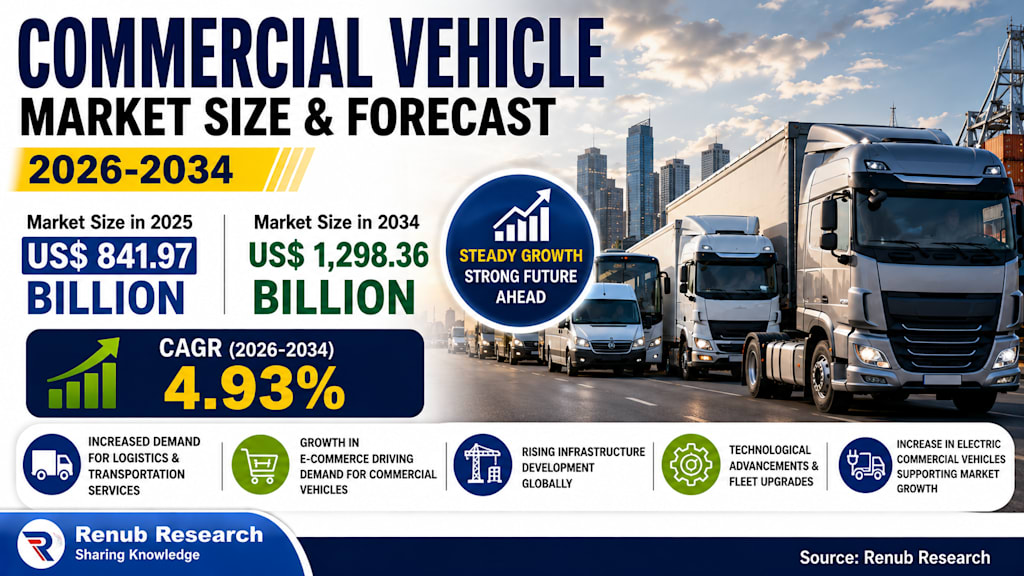
According to Renub Research, the global commercial vehicle market is projected to grow from US$ 841.97 billion in 2025 to US$ 1,298.36 billion by 2034, expanding at a compound annual growth rate (CAGR) of 4.93% between 2026 and 2034.
This steady growth reflects several powerful global trends, including the rapid expansion of e-commerce, rising infrastructure investments, increasing urbanization, growing logistics demand, and accelerating adoption of electric and technologically advanced vehicles. As businesses seek faster, safer, and more efficient transportation systems, commercial vehicles are evolving from traditional transport machines into highly connected mobility solutions.
Commercial vehicles are the backbone of modern economies
Commercial vehicles are essential to nearly every major industry. Trucks, vans, buses, trailers, and pickup vehicles support sectors such as logistics, construction, manufacturing, mining, agriculture, retail, and passenger transportation.
These vehicles are responsible for moving raw materials, finished products, construction equipment, consumer goods, and workforce populations across cities, regions, and international trade routes. Without commercial transportation networks, global commerce would slow dramatically.
The importance of commercial vehicles has increased significantly in recent years because supply chains have become more complex and customer expectations have become faster. Consumers now expect same-day or next-day delivery services, businesses require uninterrupted transportation systems, and industries rely heavily on efficient freight movement.
Commercial vehicles are therefore no longer viewed simply as transport assets. They are now considered strategic infrastructure supporting economic productivity and business competitiveness.
E-commerce growth is transforming transportation demand
One of the biggest drivers of the commercial vehicle market is the explosive rise of e-commerce and logistics services around the world.
Online shopping has fundamentally changed how goods move through economies. Retailers and logistics companies now require highly efficient transportation systems capable of handling massive delivery volumes while meeting strict delivery timelines.
Commercial vans, light trucks, and heavy-duty transport vehicles have become critical for moving goods from warehouses to fulfillment centers and ultimately to consumers.
The growth of last-mile delivery services has especially increased demand for light commercial vehicles. Delivery vans are now central to urban logistics operations because they are flexible, efficient, and capable of navigating dense city environments.
International trade expansion is also contributing to transportation demand. Businesses increasingly operate across borders, requiring reliable freight transport systems capable of supporting global supply chains.
As digital commerce continues growing worldwide, the need for advanced commercial transportation fleets is expected to rise steadily over the next decade.
Infrastructure development is creating long-term opportunity
Massive infrastructure development projects across the globe are another major growth driver for the commercial vehicle industry.
Governments are investing heavily in highways, roads, bridges, rail systems, industrial corridors, ports, and smart city projects. These developments require extensive transportation support for moving materials, machinery, and construction equipment.
Rapid urbanization is also reshaping transportation needs. Expanding cities require large-scale movement of goods, building materials, public transportation systems, and logistics services to support residential and commercial development.
Commercial vehicles play a central role in these activities. Heavy-duty trucks transport construction materials, industrial vehicles support infrastructure projects, and delivery fleets ensure supply chain continuity across urban environments.
Improved road connectivity is also helping commercial transportation businesses expand operational reach. Better highways and transportation infrastructure allow vehicles to move goods more efficiently across long distances.
As infrastructure investment continues accelerating in both developed and emerging economies, demand for commercial vehicles is expected to remain strong.
Technology is reshaping the future of commercial transportation
The commercial vehicle industry is undergoing a major technological transformation. Modern vehicles are increasingly equipped with advanced systems designed to improve efficiency, safety, route optimization, and operational management.
Fleet management systems, telematics, GPS tracking, driver assistance technologies, and predictive maintenance tools are becoming standard features in many commercial fleets.
These technologies provide businesses with real-time insights into vehicle performance, fuel usage, driver behavior, maintenance schedules, and route efficiency. As a result, companies can reduce operating costs while improving delivery performance and fleet utilization.
Automation is also becoming increasingly important. Advanced driver assistance systems are helping improve safety by reducing accident risks and supporting better vehicle control.
The rise of connected commercial fleets is transforming transportation from a manual operational activity into a data-driven business system.
For fleet operators, technology is no longer optional—it is becoming essential for maintaining competitiveness in modern logistics environments.
Electric commercial vehicles are gaining momentum
One of the most significant developments in the market is the growing adoption of electric commercial vehicles.
Governments, businesses, and transportation companies are increasingly focusing on reducing carbon emissions and improving environmental sustainability. Commercial transportation is a major contributor to greenhouse gas emissions, especially through diesel-powered fleets.
As environmental regulations become stricter, companies are accelerating investments in electric and hybrid commercial vehicles.
Electric vans and trucks offer several advantages, including reduced fuel costs, lower maintenance requirements, quieter operation, and improved sustainability performance. These benefits are especially attractive for urban delivery operations and short-distance logistics.
Battery technology improvements are also supporting broader adoption. Modern electric commercial vehicles can now achieve better driving ranges and improved reliability compared to earlier models.
Governments in many countries are providing incentives and policy support to encourage businesses to transition toward cleaner commercial transportation systems.
As electrification continues expanding globally, electric commercial vehicles are expected to become one of the most important growth segments in the industry.
Heavy-duty commercial trucks remain critical for global trade
Heavy-duty commercial trucks continue to represent one of the most important segments of the market because they are essential for long-distance freight transportation.
Industries such as construction, mining, logistics, manufacturing, and international trade rely heavily on these vehicles to move large quantities of goods efficiently.
Modern heavy-duty trucks are becoming increasingly sophisticated. Manufacturers are integrating fuel-efficient engines, telematics systems, safety technologies, and driver assistance features to improve operational performance.
The segment is also beginning to transition toward electrification and alternative fuels. Several manufacturers are developing electric and hydrogen-powered heavy-duty trucks designed to reduce environmental impact while maintaining freight performance.
As global trade continues growing, heavy-duty trucks will remain a foundational component of transportation infrastructure.
Commercial vans are becoming central to urban logistics
Commercial vans have emerged as one of the fastest-growing vehicle categories due to the rise of urban delivery services and e-commerce logistics.
These vehicles are widely used for courier services, retail deliveries, maintenance operations, and short-distance transportation tasks. Their compact design allows them to navigate city roads more efficiently than larger trucks.
Urban logistics growth is particularly benefiting this segment. As consumers increasingly expect rapid home deliveries, businesses are expanding their delivery fleets to improve last-mile service capabilities.
Electric commercial vans are also gaining popularity because they reduce fuel expenses and align with urban sustainability goals.
Because of their flexibility and operational efficiency, commercial vans are expected to remain highly important within modern transportation ecosystems.
Hybrid and plug-in commercial vehicles are supporting transition strategies
Plug-in hybrid electric commercial vehicles are becoming increasingly attractive for businesses seeking environmentally friendly transportation without sacrificing operational flexibility.
These vehicles combine internal combustion engines with electric motors and rechargeable batteries, allowing businesses to reduce fuel usage while maintaining longer driving ranges.
Hybrid commercial vehicles are especially useful for urban logistics operations where electric driving modes can be used for shorter routes while conventional engines provide extended range when needed.
Many businesses are adopting hybrid fleets as transitional solutions while electric charging infrastructure continues expanding globally.
Government incentives and sustainability goals are further supporting adoption of plug-in hybrid commercial vehicles across multiple regions.
Industrial and construction sectors remain major users
Industrial commercial vehicles continue playing a crucial role in sectors such as mining, construction, manufacturing, and infrastructure development.
These vehicles are designed for heavy-duty operations and harsh working environments. Dump trucks, concrete mixers, industrial transport vehicles, and heavy equipment carriers are essential for supporting large-scale industrial activity.
As governments and private organizations continue investing in industrialization and infrastructure projects, demand for industrial commercial vehicles remains strong.
Technological improvements are also enhancing industrial fleet performance. Automation, safety systems, and fuel-efficient engines are helping improve productivity while reducing operational costs.
The industrial segment remains one of the most stable and strategically important areas of the commercial vehicle market.
India is becoming one of the world’s fastest-growing markets
India’s commercial vehicle market is expanding rapidly due to strong economic growth, urbanization, infrastructure investment, and rising logistics demand.
The government’s focus on highways, industrial corridors, smart cities, and transportation infrastructure is significantly increasing the need for commercial transportation vehicles.
E-commerce growth and retail expansion are also driving demand for delivery vans and logistics fleets across urban and semi-urban regions.
Public transportation needs are rising as population growth increases demand for buses and mass transit solutions.
Indian manufacturers are also investing heavily in fuel-efficient and technologically advanced vehicles, including electric trucks and smart fleet solutions.
With its large consumer base and rapidly developing economy, India represents one of the most promising long-term growth opportunities in the global commercial vehicle market.
The United States remains a global leader in logistics infrastructure
The United States has one of the world’s largest and most advanced commercial vehicle markets, supported by extensive road infrastructure and highly developed logistics systems.
Commercial vehicles are essential across industries such as retail, construction, manufacturing, and online commerce.
The growth of e-commerce has significantly increased demand for delivery fleets and transportation services. Long-haul trucking also remains critical because of the country’s large geographic size and extensive interstate highway network.
American businesses are increasingly adopting telematics, driver assistance systems, and fleet optimization technologies to improve efficiency and reduce operational costs.
The shift toward sustainability is also accelerating adoption of electric and low-emission commercial vehicles across the country.
The United Kingdom is focusing on sustainable fleet transformation
The United Kingdom commercial vehicle market is benefiting from strong logistics demand and increasing emphasis on environmentally friendly transportation solutions.
The growth of online retail and last-mile delivery services is driving strong demand for light commercial vans.
Government sustainability policies are encouraging businesses to adopt low-emission and electric commercial vehicles. Fleet modernization initiatives are also accelerating investment in fuel-efficient transportation systems.
Technological innovation, telematics integration, and improved safety systems continue supporting market development across the UK.
Saudi Arabia is strengthening transportation infrastructure
Saudi Arabia’s commercial vehicle market is growing due to expanding infrastructure projects, trade activity, and logistics development.
Construction and transportation projects require significant numbers of heavy-duty trucks and industrial transport vehicles. The country’s strategic geographic location also supports regional trade and cargo movement.
The rise of retail and e-commerce sectors is increasing demand for delivery fleets and logistics vehicles.
Modern commercial vehicles with advanced safety and fuel-efficiency technologies are becoming increasingly important as businesses modernize transportation operations.
The market still faces major challenges
Despite strong long-term growth prospects, the commercial vehicle market faces several important challenges.
One of the biggest concerns is the high cost associated with purchasing and maintaining advanced commercial vehicles. Electric and technology-heavy vehicles often require significant upfront investment, which can be difficult for smaller businesses.
Fuel price fluctuations also impact profitability for logistics operators and transportation companies.
Environmental regulations represent another major challenge. Governments worldwide are introducing stricter emission standards aimed at reducing pollution and greenhouse gas emissions.
Commercial vehicle manufacturers must invest heavily in research and development to meet evolving environmental requirements while maintaining affordability and operational efficiency.
Balancing sustainability, cost efficiency, and technological advancement will remain one of the industry’s biggest long-term challenges.
Final Thoughts
The commercial vehicle market is entering a transformative period shaped by e-commerce growth, digital logistics, infrastructure expansion, and transportation electrification.
According to Renub Research, the market is projected to grow from US$ 841.97 billion in 2025 to US$ 1,298.36 billion by 2034, reflecting the critical role commercial transportation continues to play in global economic activity.
Commercial vehicles are no longer simply transport machines. They are becoming intelligent, connected, and increasingly sustainable mobility systems designed to support modern business operations and evolving supply chains.
The future of the industry will likely be defined by electrification, smart fleet technologies, automation, and sustainable transportation innovation.
About the Creator
Enjoyed the story? Support the Creator.
Subscribe for free to receive all their stories in your feed.
Comments
There are no comments for this story
Be the first to respond and start the conversation.