
Commercial Vehicle Market Accelerates as E-Commerce Growth and Infrastructure Investments Drive Global Transportation Demand
Rising logistics requirements, expanding infrastructure projects, and increasing adoption of electric commercial vehicles are fueling strong growth across the global commercial vehicle industry.

The global economy relies heavily on efficient transportation networks to move goods, services, and people across cities, countries, and continents. At the center of this vast logistics ecosystem are commercial vehicles, which play a critical role in supporting industries ranging from construction and manufacturing to retail, agriculture, and e-commerce.
As businesses continue expanding their operations and consumers increasingly demand faster delivery services, the need for reliable and technologically advanced commercial vehicles has never been greater. At the same time, innovations in fleet management, vehicle electrification, and fuel-efficient technologies are reshaping the future of commercial transportation.
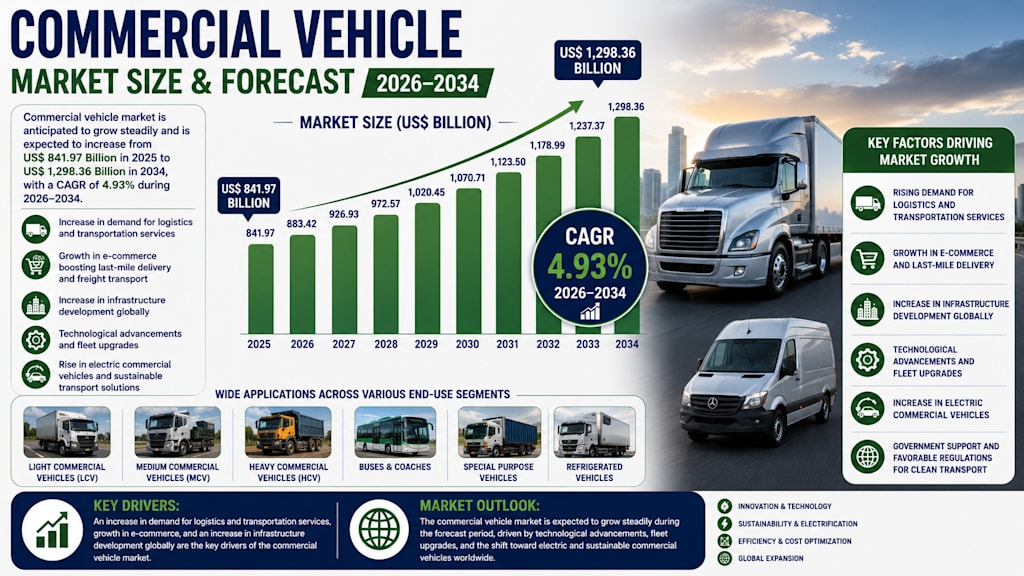
According to Renub Research, the global Commercial Vehicle Market is projected to grow from US$ 841.97 billion in 2025 to US$ 1,298.36 billion by 2034, registering a compound annual growth rate (CAGR) of 4.93% between 2026 and 2034. Growth is being driven by the rapid expansion of e-commerce, increasing infrastructure development, technological advancements, and rising investments in sustainable transportation solutions.
Commercial Vehicles Are the Backbone of Modern Economies
Commercial vehicles are motor vehicles specifically designed to transport goods, passengers, or equipment for business and commercial purposes. Unlike personal vehicles, commercial vehicles are built to handle heavy workloads, long-distance transportation, and specialized industrial tasks.
Examples of commercial vehicles include:
, Trucks
, Delivery vans
, Pickup trucks
, Buses
, Trailers
, Heavy-duty transport vehicles
These vehicles are essential for supporting supply chains, enabling trade, facilitating construction projects, and ensuring the efficient movement of products from manufacturers to consumers.
Commercial vehicles are also vital for public transportation systems, helping transport millions of people daily while supporting economic productivity.
As globalization and urbanization continue expanding, commercial vehicles remain indispensable assets across virtually every major industry.
E-Commerce Expansion Is Driving Market Growth
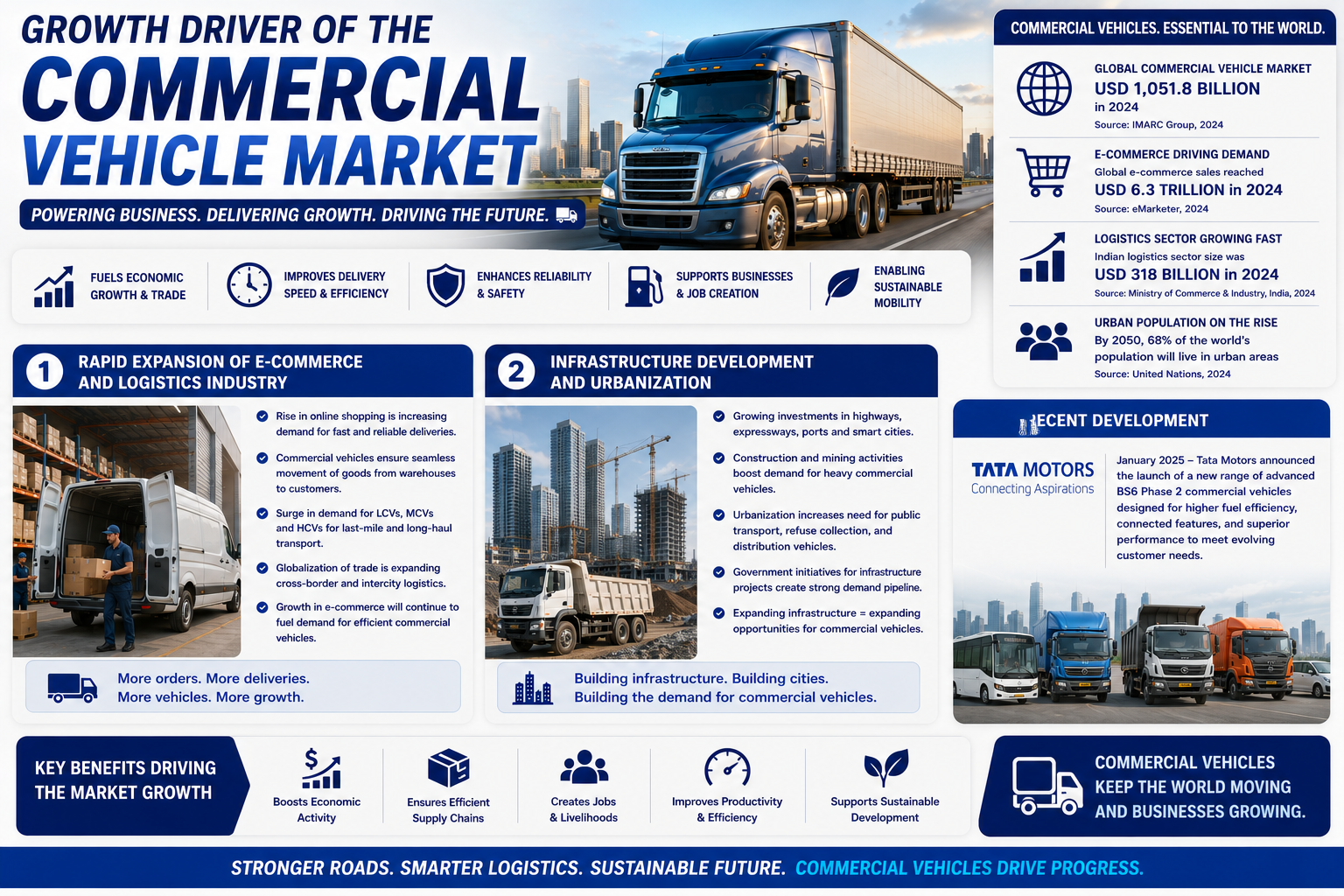
One of the strongest factors fueling the growth of the commercial vehicle market is the rapid expansion of the e-commerce industry.
Consumers increasingly expect fast, reliable, and convenient delivery services when purchasing products online. To meet these expectations, retailers, logistics providers, and delivery companies require extensive fleets of commercial vehicles capable of transporting goods efficiently.
According to data referenced in the report, India's logistics sector alone reached approximately US$ 318 billion in 2024 and is expected to continue expanding alongside the growth of digital commerce.
The growth of online shopping has significantly increased demand for:
, Delivery vans
, Light commercial vehicles
, Medium-duty trucks
, Last-mile delivery solutions
Commercial vehicles serve as the critical link between warehouses, distribution centers, retail locations, and end consumers.
As global e-commerce activity continues increasing, demand for commercial transportation solutions is expected to remain exceptionally strong.
Infrastructure Development Creates Significant Opportunities
Large-scale infrastructure development projects are another major driver of market expansion.
Governments around the world continue investing heavily in:
Highways
Roads
Bridges
Industrial corridors
Rail connectivity
Smart cities
Urban development projects
These projects require substantial transportation capacity for moving construction materials, equipment, machinery, and labor.
Rapid urbanization is further contributing to demand. As cities expand and new residential, commercial, and industrial developments emerge, commercial vehicles become essential for supporting construction activities and maintaining supply chains.
The increasing scale of infrastructure investment worldwide is creating long-term opportunities for commercial vehicle manufacturers and transportation service providers.
Technological Innovation Is Transforming Fleet Operations
Advancements in vehicle technology are significantly improving the efficiency, safety, and productivity of commercial transportation.
Modern commercial vehicles increasingly incorporate advanced technologies such as:
GPS tracking systems
Telematics platforms
Fleet management software
Driver assistance technologies
Predictive maintenance systems
Route optimization tools
These solutions help businesses monitor vehicle performance, reduce operating costs, improve fuel efficiency, and enhance driver safety.
Fleet managers can now track vehicle locations in real time, analyze operational data, and make informed decisions that improve logistics efficiency.
As transportation companies seek greater operational control and profitability, adoption of advanced vehicle technologies is expected to continue growing rapidly.
Vehicle Electrification Is Reshaping the Industry
The transition toward electric mobility is creating major opportunities within the commercial vehicle market.
Businesses increasingly seek environmentally friendly transportation solutions capable of reducing emissions and operating costs. As a result, manufacturers are investing heavily in electric commercial vehicles, including delivery vans, trucks, and buses.
Government incentives, environmental regulations, and corporate sustainability initiatives are accelerating adoption of electric transportation technologies.
Advancements in battery performance, charging infrastructure, and vehicle range are making electric commercial vehicles increasingly practical for a wide range of applications.
The continued growth of electric mobility is expected to play a central role in shaping the future of the commercial vehicle industry.
Heavy-Duty Trucks Remain Essential for Freight Transportation
Heavy-duty commercial trucks represent one of the most important segments within the market.
These vehicles are designed to transport large volumes of goods across long distances and are widely used in industries such as:
Logistics
Construction
Manufacturing
Mining
International trade
Heavy-duty trucks continue benefiting from innovations in fuel efficiency, safety systems, telematics, and driver assistance technologies.
Manufacturers are also developing electric and hybrid heavy-duty truck models to meet growing sustainability requirements.
As global trade volumes and freight transportation needs continue increasing, demand for heavy-duty commercial trucks is expected to remain strong.
Commercial Vans Benefit from Last-Mile Delivery Growth
Commercial vans have become increasingly important due to the expansion of urban delivery networks.
These vehicles are widely used by:
E-commerce companies
Courier services
Retail businesses
Maintenance providers
Logistics operators
Their compact size allows them to navigate congested urban environments more effectively than larger trucks, making them ideal for last-mile delivery operations.
The growth of same-day and next-day delivery services has significantly increased demand for flexible and efficient commercial van fleets.
As urban logistics continue evolving, commercial vans are expected to remain one of the fastest-growing vehicle categories within the market.
Plug-In Hybrid Commercial Vehicles Gain Momentum
Plug-in hybrid electric vehicles (PHEVs) are emerging as an attractive solution for businesses seeking to balance sustainability and operational flexibility.
PHEVs combine traditional internal combustion engines with electric motors and rechargeable batteries, enabling operators to switch between power sources depending on driving conditions.
These vehicles are particularly useful for urban delivery operations where electric driving can reduce emissions and fuel consumption while maintaining extended driving ranges when necessary.
Government incentives and environmental policies continue supporting the adoption of hybrid commercial vehicles across many markets.
As businesses seek cost-effective pathways toward sustainability, PHEVs are expected to play an increasingly important role within commercial transportation fleets.
Industrial Applications Continue Driving Demand
Industrial commercial vehicles represent a critical segment supporting large-scale economic activities.
Industries such as construction, mining, manufacturing, and infrastructure development depend heavily on specialized vehicles capable of operating under demanding conditions.
Examples include:
Dump trucks
Concrete mixers
Industrial transport vehicles
Heavy-duty hauling equipment
These vehicles are designed to transport heavy materials and machinery while maintaining reliability and durability in challenging environments.
The continued growth of industrial activity worldwide is expected to support strong demand for specialized commercial vehicles throughout the forecast period.
Logistics Sector Remains a Major End User
The logistics industry continues to represent one of the largest consumers of commercial vehicles globally.
Efficient transportation is essential for modern supply chains, which increasingly depend on real-time inventory management, rapid delivery services, and global trade networks.
Commercial vehicles enable businesses to move products between manufacturers, warehouses, distribution centers, retailers, and customers.
As supply chains become more sophisticated and customer expectations continue rising, logistics companies are investing heavily in fleet modernization and expansion.
These investments are expected to remain a key driver of commercial vehicle market growth.
Regional Markets Continue Expanding
United States
The United States remains one of the world's largest commercial vehicle markets. Strong transportation infrastructure, robust logistics networks, and growing e-commerce activity continue driving demand. Advanced fleet management technologies and increasing interest in electric commercial vehicles are supporting market modernization.
United Kingdom
The United Kingdom market benefits from expanding logistics operations, growing e-commerce activity, and increasing adoption of environmentally friendly transportation solutions. Demand for delivery vans and low-emission commercial vehicles continues rising.
India
India is one of the fastest-growing commercial vehicle markets globally. Rapid economic growth, expanding infrastructure development, increasing industrialization, and rising logistics requirements are fueling strong demand across multiple vehicle categories.
Saudi Arabia
Saudi Arabia's commercial vehicle market is growing steadily due to large-scale infrastructure projects, increasing trade activity, and expanding retail and logistics sectors. The country's strategic geographic location further supports demand for transportation solutions.
Challenges Facing the Industry
Despite positive growth prospects, the commercial vehicle market faces several challenges.
One major concern involves the high cost of purchasing and maintaining commercial vehicles. Advanced technologies, electrification, and fleet modernization initiatives often require significant capital investments, particularly for small and medium-sized businesses.
Fuel price volatility can also impact transportation costs and profitability, creating uncertainty for fleet operators.
Environmental regulations present additional challenges. Governments worldwide are implementing stricter emissions standards that require manufacturers and businesses to invest in cleaner vehicle technologies and compliance measures.
Balancing sustainability objectives with affordability and operational efficiency will remain a key challenge for the industry moving forward.
Market Forecast: Strong Growth Through 2034
According to Renub Research, the global Commercial Vehicle Market is expected to increase from US$ 841.97 billion in 2025 to US$ 1,298.36 billion by 2034, reflecting a CAGR of 4.93% between 2026 and 2034. Growth will be supported by expanding logistics operations, infrastructure development, technological advancements, and increasing adoption of electric commercial vehicles.
The market's outlook underscores the critical role commercial transportation continues to play in supporting global economic growth and trade.
Final Thoughts
The commercial vehicle industry is entering a new era characterized by digital transformation, sustainability initiatives, and evolving transportation demands. As businesses seek greater efficiency and consumers expect faster delivery services, commercial vehicles remain essential to modern economic activity.
With Renub Research forecasting growth from US$ 841.97 billion in 2025 to US$ 1,298.36 billion by 2034, the industry is positioned for substantial expansion. Innovations in fleet management, vehicle electrification, advanced safety systems, and logistics optimization will continue reshaping the market.
As global commerce, infrastructure development, and urbanization advance, commercial vehicles will remain at the heart of transportation networks that keep economies moving forward.
About the Creator
Enjoyed the story? Support the Creator.
Subscribe for free to receive all their stories in your feed.
Comments
There are no comments for this story
Be the first to respond and start the conversation.