
Cold Chain Packaging Market Surges as Pharma Expansion and Online Food Delivery Drive Temperature-Controlled Logistics
Rising demand for biologics, vaccines, and perishable foods is fueling the cold chain packaging market, projected to grow from US$ 31.73 billion in 2025 to US$ 75.56 billion by 2034 at a CAGR of 10.12%.

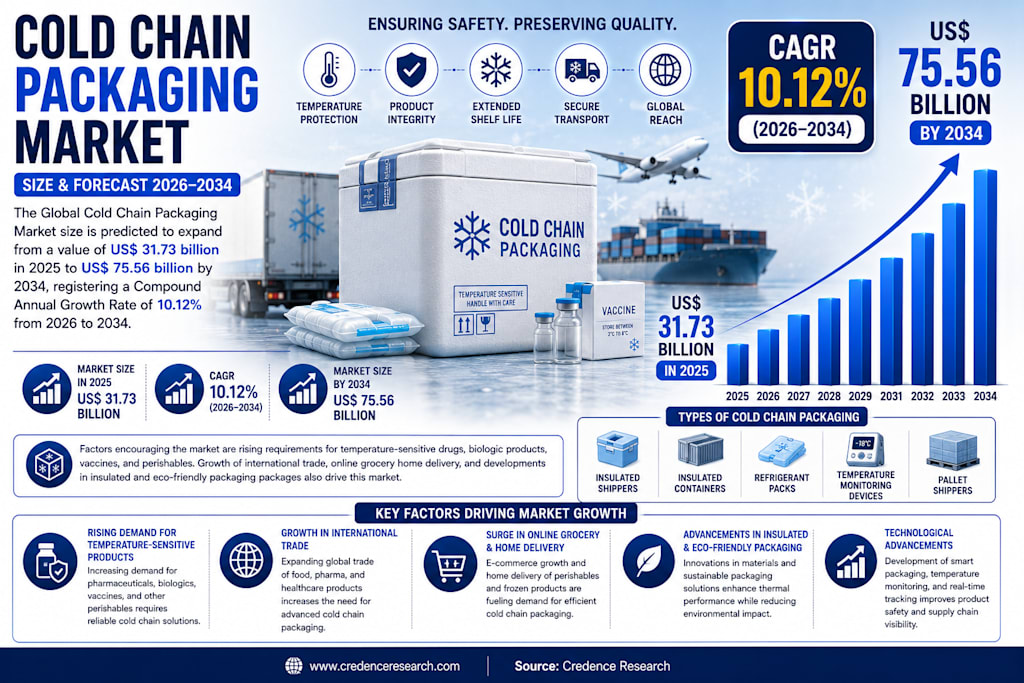
Cold Chain Packaging Market Overview
The global cold chain packaging market is experiencing strong growth as industries increasingly rely on temperature-controlled logistics to preserve product quality, safety, and efficacy. Cold chain packaging refers to specialized packaging solutions designed to maintain specific temperature ranges during storage and transportation of temperature-sensitive goods.
According to Renub Research, the market is expected to expand from US$ 31.73 billion in 2025 to US$ 75.56 billion by 2034, growing at a CAGR of 10.12% during 2026–2034.
These solutions typically include insulated containers, thermal blankets, gel packs, dry ice, and advanced temperature-monitoring systems. They are widely used in industries such as pharmaceuticals, food and beverages, chemicals, and healthcare. From vaccines and biologics to fresh food and dairy products, cold chain packaging ensures that products remain within safe temperature ranges throughout the supply chain.
The increasing globalization of trade, growth in e-commerce, and rising demand for fresh and frozen foods are significantly driving the adoption of cold chain packaging solutions worldwide.
Key Growth Drivers in the Cold Chain Packaging Market
Expanding Pharmaceutical and Biologics Distribution
One of the primary drivers of the market is the rapid expansion of pharmaceutical and biologics distribution. Products such as vaccines, insulin, monoclonal antibodies, and gene therapies require strict temperature control to maintain their efficacy and safety.
The global increase in chronic diseases, vaccination programs, and clinical trials has led to higher demand for reliable cold chain packaging solutions. Regulatory authorities also mandate strict temperature compliance, further boosting adoption.
In June 2025, Tjoapack announced the expansion of its cold chain packaging and storage capabilities in the United States and the Netherlands, reflecting growing demand for biologics and injectable drug logistics.
Rising Demand for Fresh and Frozen Food
The increasing consumption of fresh, frozen, and ready-to-eat food products is another major factor driving market growth. Urbanization, changing lifestyles, and higher disposable incomes are fueling demand for meat, seafood, dairy, and processed foods.
The growth of online grocery delivery and meal-kit services has further accelerated the need for efficient cold chain packaging, particularly for last-mile delivery.
In December 2025, Stonepeak launched Peregrine Cold Logistics, a new cold chain platform targeting Asia-Pacific and GCC markets, highlighting the growing importance of temperature-controlled logistics in global food supply chains.
Technological Advancements and Sustainable Innovations
Technological innovation is significantly enhancing the performance and sustainability of cold chain packaging solutions. Advances in insulation materials, phase-change materials, and smart packaging systems are improving temperature control and monitoring capabilities.
At the same time, sustainability is becoming a key focus area. Companies are developing eco-friendly and reusable packaging solutions to reduce environmental impact.
In December 2025, Atlas Roofing introduced ReGenX Technology, aimed at improving sustainability and innovation in insulation and cold chain packaging solutions.
Challenges in the Cold Chain Packaging Market
High Costs of Packaging and Logistics
The high cost of cold chain packaging solutions is a significant barrier to market growth. Advanced insulation materials, refrigerants, and monitoring systems increase packaging and transportation expenses compared to conventional methods.
These costs can be particularly challenging for small and medium-sized enterprises, especially in price-sensitive markets. Balancing performance, compliance, and affordability remains a key challenge for industry players.
Infrastructure Gaps and Operational Complexity
The effectiveness of cold chain packaging depends heavily on supporting infrastructure, including cold storage facilities, reliable transportation networks, and trained personnel.
In many emerging markets, infrastructure gaps and inconsistent electricity supply can disrupt temperature-controlled logistics. Additionally, varying regulatory standards across countries add complexity to global operations.
Segment Insights in the Cold Chain Packaging Market
Expanded Polystyrene (EPS) Packaging
EPS-based packaging is widely used due to its excellent insulation properties, lightweight design, and cost-effectiveness. It is commonly used for transporting pharmaceuticals, seafood, and dairy products over short to medium distances.
Paper & Paperboard Packaging
Paper-based cold chain packaging is gaining popularity due to its sustainability and recyclability. It is often used in combination with insulation liners for improved thermal performance, especially in food delivery applications.
Insulated Containers
Insulated containers are essential for long-distance transportation of temperature-sensitive goods. Advanced materials such as vacuum insulation panels and phase-change materials provide high-performance temperature control.
Pharmaceutical Applications
The pharmaceutical segment is one of the fastest-growing areas, driven by the increasing distribution of vaccines, biologics, and specialty drugs. Strict regulatory requirements ensure consistent demand for reliable cold chain solutions.
Dairy Products Packaging
Cold chain packaging plays a crucial role in maintaining the quality and safety of dairy products such as milk, cheese, and ice cream. Rising demand for packaged dairy products is driving growth in this segment.
Regional Insights in the Cold Chain Packaging Market
United States
The United States is a leading market, supported by strong demand from pharmaceutical and food industries. Advanced logistics infrastructure and strict regulatory standards drive adoption of high-quality cold chain solutions.
United Kingdom
The UK market is growing steadily, driven by pharmaceutical distribution and online grocery delivery. Sustainability initiatives and regulatory compliance play a significant role in shaping the market.
India
India is emerging as a fast-growing market due to increasing pharmaceutical production, vaccine distribution, and demand for fresh and frozen foods. Government initiatives to improve cold chain infrastructure are supporting market growth.
Saudi Arabia
Saudi Arabia’s market is driven by high demand for imported food and pharmaceuticals. Investments in healthcare and logistics infrastructure are boosting the adoption of cold chain packaging solutions.
Market Segmentation
The cold chain packaging market is segmented by material, product, application, and geography. Materials include expanded polystyrene, polyurethane foam, and paper-based solutions.
Products include insulated pallet shippers, containers, gel packs, and vacuum insulation panels. Applications span pharmaceuticals, food products, dairy, seafood, and processed foods across multiple regions.
Key Companies in the Cold Chain Packaging Market
Leading companies in the market include Cascades Inc., Sonoco Products Company, Pelican BioThermal LLC, Cold Chain Technologies Inc., Cryopak Industries Inc., Sofrigam Company, and Intelsius. These companies are focusing on innovation, sustainability, and global expansion to strengthen their market position.
Final Thoughts
The cold chain packaging market is becoming increasingly vital as global supply chains evolve to support temperature-sensitive products. From life-saving pharmaceuticals to everyday food items, maintaining product integrity is critical across industries.
With strong growth projections, technological advancements, and rising global demand, the market is well positioned for sustained expansion. As sustainability and efficiency become key priorities, cold chain packaging will continue to play a central role in shaping the future of global logistics.
About the Creator
Enjoyed the story? Support the Creator.
Subscribe for free to receive all their stories in your feed.
Comments
There are no comments for this story
Be the first to respond and start the conversation.