
Cloud Computing Market to Surpass USD 3.34 Trillion by 2033 as AI, Digital Transformation, and Hybrid Work Accelerate Global Adoption
Businesses Worldwide Turn to Cloud Infrastructure to Unlock Scalability, Innovation, and Operational Efficiency

The global cloud computing industry has entered a transformative era. Once viewed primarily as a cost-saving technology, cloud computing has evolved into the backbone of modern digital business operations. Organizations across industries now rely on cloud platforms to support innovation, manage data, deploy artificial intelligence applications, and enable flexible work environments.
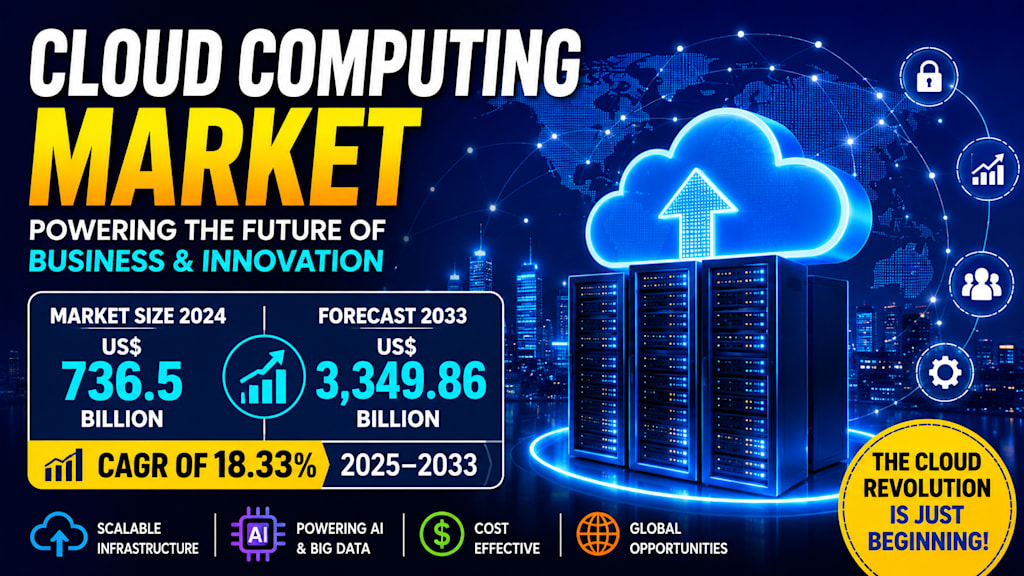
According to Renub Research, the global Cloud Computing Market is projected to grow from US$ 736.5 billion in 2024 to US$ 3,349.86 billion by 2033, expanding at an impressive CAGR of 18.33% during 2025–2033. This remarkable growth reflects the increasing dependence of enterprises, governments, and consumers on cloud-based technologies.
As businesses continue to modernize their operations, cloud computing has become more than a technological upgrade—it has become a strategic necessity.
Understanding Cloud Computing in the Digital Age
Cloud computing refers to the delivery of computing resources such as servers, storage, networking, databases, software, and analytics over the internet. Rather than investing heavily in physical infrastructure, organizations can access these resources on demand and pay only for what they use.
This model provides unparalleled flexibility and scalability. Businesses can quickly adapt to changing market conditions, launch new services faster, and reduce operational complexity. Cloud platforms also enable real-time collaboration, secure remote access, and seamless integration of emerging technologies.
The three primary service models driving the market include:
Software as a Service (SaaS)
Infrastructure as a Service (IaaS)
Platform as a Service (PaaS)
Together, these solutions form the foundation of today's digital economy.
Why Digital Transformation Is Fueling Cloud Growth
Digital transformation initiatives are reshaping industries worldwide. Organizations are investing heavily in technologies that improve efficiency, customer experiences, and business agility.
Cloud computing plays a central role in this transformation. It provides the infrastructure needed to deploy digital services rapidly while reducing the burden of managing physical hardware.
From manufacturing and healthcare to retail and finance, businesses are migrating applications and workloads to the cloud to improve performance and remain competitive.
A notable example emerged in June 2024 when Oracle and Google Cloud announced an expanded strategic partnership. The collaboration enables organizations to combine Oracle Cloud Infrastructure with Google Cloud capabilities, simplifying application modernization and cross-cloud deployments.
Such partnerships highlight how cloud providers are creating interconnected ecosystems that support enterprise innovation on a global scale.
The Rising Dominance of SaaS Solutions
Software as a Service has become one of the most influential segments within the cloud computing market.
Organizations increasingly prefer SaaS applications because they eliminate the need for complex installations, ongoing maintenance, and expensive infrastructure investments. Instead, businesses can access software through a web browser and pay through subscription-based models.
Popular SaaS solutions include:
Customer Relationship Management (CRM) software
Enterprise Resource Planning (ERP) systems
Collaboration tools
Human resource management platforms
Marketing automation software
The flexibility and affordability of SaaS have made it particularly attractive for small and medium-sized enterprises. Larger organizations also benefit from rapid deployment and automatic updates, allowing them to focus on strategic initiatives rather than IT maintenance.
As remote work continues to influence workplace structures, SaaS adoption is expected to accelerate even further.
Artificial Intelligence and Big Data Are Creating New Opportunities
Artificial intelligence and data analytics have emerged as major catalysts for cloud adoption.
Modern businesses generate enormous volumes of data every day. Processing, storing, and analyzing this information requires powerful computing resources that traditional infrastructure often cannot provide efficiently.
Cloud platforms offer scalable environments capable of supporting advanced AI workloads, machine learning models, and real-time analytics applications.
Organizations leverage cloud-based AI solutions to:
Automate routine processes
Improve customer experiences
Predict market trends
Detect fraud
Optimize supply chains
Enhance decision-making
In February 2024, Akamai Technologies expanded its cloud strategy through its Generalized Edge Compute initiative. The program enhances edge computing capabilities by bringing workloads closer to users and devices, reducing latency and improving performance for AI-driven applications.
This evolution demonstrates how cloud computing is increasingly intertwined with next-generation technologies.
Hybrid and Multi-Cloud Strategies Gain Momentum
Businesses today rarely depend on a single cloud provider.
Instead, many organizations are adopting hybrid and multi-cloud approaches that combine public cloud, private cloud, and on-premises infrastructure.
These strategies provide several advantages:
Greater operational flexibility
Reduced vendor dependency
Enhanced security controls
Improved disaster recovery
Optimized workload management
Hybrid cloud environments enable companies to maintain sensitive workloads within private infrastructure while utilizing public cloud resources for scalability and innovation.
As organizations seek greater control over their digital ecosystems, hybrid and multi-cloud adoption is expected to remain a key market trend throughout the forecast period.
Remote Work Continues to Strengthen Cloud Adoption
The global shift toward remote and hybrid work has significantly accelerated cloud computing demand.
Cloud-based collaboration tools enable employees to work from virtually any location while maintaining productivity and connectivity.
Applications such as video conferencing platforms, file-sharing services, project management tools, and virtual desktops rely heavily on cloud infrastructure.
Businesses have realized that cloud technologies not only support remote operations but also enhance workforce flexibility and employee satisfaction.
As remote work becomes a permanent component of many organizations' strategies, investment in cloud-based workplace solutions will continue to expand.
Security and Compliance Drive Cloud Investments
Cybersecurity has become one of the most important considerations for organizations adopting cloud technologies.
With increasing cyber threats, businesses require secure platforms capable of protecting sensitive information while complying with regulatory requirements.
Cloud providers continue to invest heavily in:
Data encryption
Identity management
Threat detection
Compliance frameworks
Security monitoring systems
Modern cloud platforms often provide stronger security capabilities than traditional on-premises environments, making them attractive options for organizations seeking to reduce cybersecurity risks.
The growing emphasis on data protection and compliance is expected to create additional opportunities for cloud service providers worldwide.
Challenges Facing the Cloud Computing Industry
Despite its significant growth potential, the cloud computing market faces several challenges.
Data Privacy and Security Concerns
Organizations remain cautious about storing sensitive information in third-party environments.
Concerns regarding data breaches, unauthorized access, and regulatory compliance continue to influence purchasing decisions.
Although cloud providers have strengthened security frameworks, enterprises must carefully evaluate risks and establish robust governance policies.
Service Reliability and Downtime Risks
Cloud outages can disrupt critical business operations and impact customer experiences.
Even leading cloud providers occasionally experience service interruptions that affect applications and data availability.
To address these concerns, organizations increasingly invest in redundancy strategies, disaster recovery solutions, and multi-cloud architectures.
Integration with Legacy Systems
Many enterprises still operate outdated IT systems that were not designed for cloud environments.
Migrating these systems often involves complex integration processes, compatibility issues, and significant investments.
Successfully modernizing legacy infrastructure remains one of the most challenging aspects of digital transformation initiatives.
United States Leads Global Cloud Innovation
The United States remains the largest and most influential cloud computing market.
American enterprises continue to invest aggressively in cloud technologies to enhance innovation, scalability, and operational efficiency.
Industries such as healthcare, finance, retail, and government are increasingly embracing cloud-based solutions.
A significant milestone occurred when Google Cloud partnered with EPAM Systems to expand AI-first cloud solutions. The collaboration focuses on leveraging Google Cloud's advanced artificial intelligence capabilities, including Vertex AI and Generative AI technologies.
Such initiatives reinforce the United States' leadership position in global cloud innovation.
India's Cloud Computing Market Experiences Rapid Expansion
India has emerged as one of the fastest-growing cloud computing markets globally.
Several factors are driving this growth:
Expanding digital economy
Government digital initiatives
Growing startup ecosystem
Rising internet penetration
Increased enterprise modernization
A major development occurred in January 2024 when Microsoft announced a US$ 3 billion investment aimed at strengthening cloud and artificial intelligence infrastructure across India.
The initiative also includes plans to train millions of individuals in AI-related skills, supporting the country's growing digital workforce.
India's cloud adoption journey is expected to play a critical role in shaping the future of the global technology landscape.
United Kingdom Strengthens Cloud Infrastructure Investments
The United Kingdom continues to witness strong cloud adoption across both public and private sectors.
Government agencies, financial institutions, healthcare providers, and retailers increasingly depend on cloud technologies to improve efficiency and innovation.
Amazon Web Services announced plans to invest approximately £8 billion in the United Kingdom over the coming decade. The investment will support new data centers, expanded infrastructure, and enhanced cloud services.
Such commitments demonstrate the long-term confidence major technology providers have in the UK cloud market.
Saudi Arabia Emerges as a Regional Cloud Hub
Saudi Arabia is rapidly becoming a leading cloud computing destination in the Middle East.
Government initiatives such as Vision 2030 are accelerating digital transformation efforts across multiple sectors.
The country's Cloud First Policy encourages organizations to adopt cloud solutions while promoting investment in local data centers.
Global technology leaders including AWS, Microsoft, Oracle, and Google continue expanding their presence within Saudi Arabia, helping establish the nation as a regional cloud computing powerhouse.
Top 10 Recent Developments in the Cloud Computing Industry
1. Oracle and Google Cloud Expand Strategic Partnership (2024)
Oracle and Google Cloud expanded their collaboration to simplify enterprise cloud migration and modernization.
2. Microsoft Announces US$3 Billion Investment in India (2024)
Microsoft revealed plans to strengthen AI and cloud infrastructure while supporting digital skill development.
3. AWS Commits £8 Billion to UK Expansion (2024)
Amazon Web Services announced a decade-long infrastructure investment across the United Kingdom.
4. Akamai Launches Generalized Edge Compute Initiative (2024)
Akamai expanded edge cloud capabilities to improve AI and analytics performance.
5. Google Cloud and EPAM Strengthen AI Collaboration
The partnership focuses on developing AI-first enterprise cloud solutions.
6. Microsoft Expands Azure AI Services
Microsoft continues integrating advanced generative AI capabilities into Azure offerings.
7. Oracle Enhances Multi-Cloud Connectivity
Oracle expanded interoperability between Oracle Cloud Infrastructure and partner platforms.
8. AWS Increases Global Data Center Investments
AWS continues expanding regional infrastructure to meet growing cloud demand.
9. Salesforce Advances AI-Powered Cloud Services
Salesforce introduced new AI features across customer engagement platforms.
10. IBM Accelerates Hybrid Cloud Solutions
IBM expanded hybrid cloud offerings designed to support enterprise digital transformation initiatives.
Competitive Landscape
The cloud computing market remains highly competitive, with leading providers continuously investing in innovation, infrastructure expansion, and artificial intelligence integration.
Major market participants include:
Amazon Web Services (AWS)
Google Cloud
Microsoft Corporation
Alibaba Cloud
Salesforce Inc.
Adobe
Oracle Corporation
IBM Corporation
These companies continue to shape the future of cloud computing through strategic partnerships, acquisitions, and technological advancements.
Final Thoughts
Cloud computing has evolved into the foundation of modern business innovation. From supporting artificial intelligence and big data analytics to enabling remote work and digital transformation, cloud technologies are reshaping how organizations operate across every industry.
With the global Cloud Computing Market projected to grow from US$ 736.5 billion in 2024 to US$ 3,349.86 billion by 2033, the sector presents enormous opportunities for technology providers, enterprises, and investors alike.
As businesses increasingly prioritize agility, scalability, and innovation, cloud computing will remain one of the most influential technologies driving the global digital economy throughout the next decade.
About the Creator
Enjoyed the story? Support the Creator.
Subscribe for free to receive all their stories in your feed.
Comments
There are no comments for this story
Be the first to respond and start the conversation.