
Cleaning Robot Market to Reach US$27.71 Billion by 2033 as AI-Powered Automation Reshapes Global Cleaning Industry
Smart Homes, Rising Hygiene Awareness, Labor Shortages, and Advanced Robotics Drive Rapid Growth in Residential and Commercial Cleaning Applications

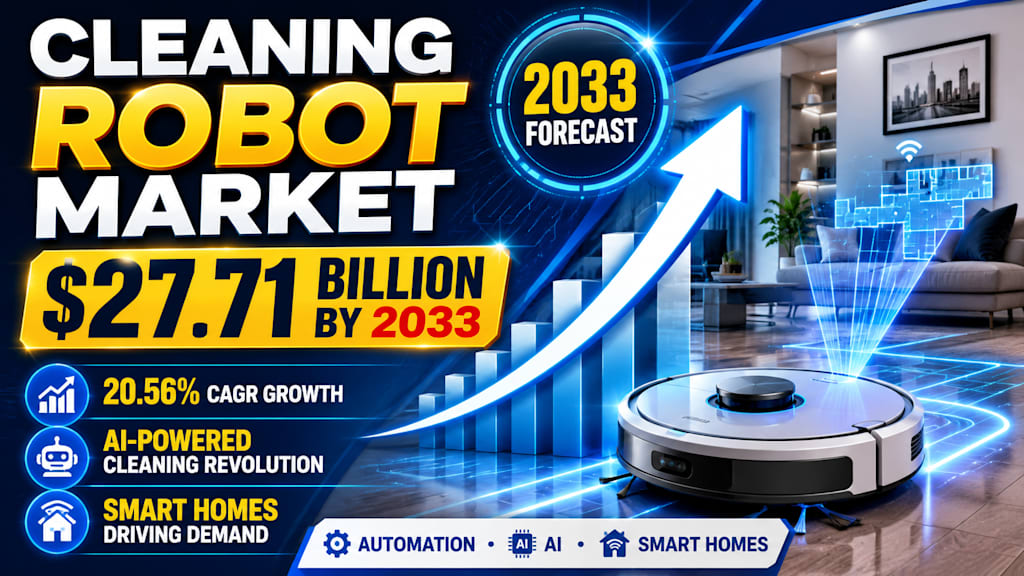
Cleaning Robot Market Outlook 2025–2033
The global cleaning robot market is entering a transformative growth phase as consumers and businesses increasingly embrace automation, convenience, and intelligent cleaning solutions. From robotic vacuum cleaners navigating living rooms autonomously to industrial floor-cleaning robots maintaining large facilities, robotic cleaning technologies are becoming an essential part of modern life.
According to Renub Research, the Cleaning Robot Market is projected to grow from US$ 5.15 billion in 2024 to US$ 27.71 billion by 2033, expanding at an impressive CAGR of 20.56% during 2025–2033.
The remarkable growth trajectory is being driven by rapid technological advancements, increasing health consciousness, labor shortages, aging populations, and growing adoption of smart home ecosystems. As artificial intelligence (AI), machine learning, sensors, and Internet of Things (IoT) technologies continue to evolve, cleaning robots are becoming more intelligent, efficient, and affordable.
Today, robotic cleaners are no longer luxury gadgets. They are emerging as practical household and commercial tools capable of improving hygiene standards while reducing manual effort.
Understanding the Cleaning Robot Market
The cleaning robot market encompasses automated machines designed to perform cleaning tasks in residential, commercial, and industrial environments. These include:
Robotic vacuum cleaners
Robotic mops
Window-cleaning robots
Pool-cleaning robots
Industrial floor-cleaning robots
Autonomous commercial cleaning systems
Modern cleaning robots use advanced technologies such as AI-powered navigation, laser mapping, computer vision, obstacle detection, and cloud connectivity to perform cleaning tasks with minimal human intervention.
Many models now integrate with smart home platforms, allowing users to control devices through smartphones, voice assistants, or automated schedules.
As technology advances, these machines are becoming increasingly capable of handling complex environments while delivering superior cleaning performance.
Why Cleaning Robots Are Becoming Mainstream
The growing popularity of cleaning robots reflects a broader shift toward automation in everyday life.
Consumers are increasingly seeking solutions that save time and reduce repetitive household chores. Busy lifestyles, dual-income households, and expanding urban populations have significantly increased demand for automated cleaning systems.
At the same time, businesses are under pressure to maintain higher hygiene standards while managing labor shortages and rising operational costs.
Cleaning robots address both challenges by offering:
Consistent cleaning performance
Reduced labor dependency
Scheduled autonomous operation
Improved hygiene management
Long-term operational savings
As a result, adoption rates are rising across both consumer and commercial sectors worldwide.
Growing Demand for Automation and Convenience
One of the most significant growth drivers is the global demand for convenience.
Modern consumers increasingly value products that simplify daily routines. Robotic cleaners allow users to maintain clean homes without investing time and effort in manual cleaning.
Through mobile applications, users can:
Schedule cleaning sessions
Monitor cleaning progress
Create cleaning zones
Receive maintenance alerts
Control robots remotely
For working professionals, elderly individuals, and busy families, these capabilities offer substantial lifestyle benefits.
The integration of voice assistants such as Amazon Alexa and Google Assistant has further enhanced convenience, making robotic cleaners a seamless component of smart home ecosystems.
Artificial Intelligence Is Revolutionizing Cleaning Performance
Artificial intelligence is fundamentally transforming the cleaning robot industry.
Earlier robotic cleaners often followed random movement patterns, resulting in inefficient cleaning. Today's AI-powered robots use advanced algorithms to map spaces accurately and optimize cleaning routes.
Modern systems can:
Identify obstacles in real time
Recognize furniture layouts
Detect dirt concentrations
Learn user preferences
Adapt to changing environments
Machine learning capabilities enable robots to improve performance over time, delivering more personalized cleaning experiences.
AI-driven navigation systems also reduce missed areas and improve battery efficiency, making robotic cleaners significantly more effective than previous generations.
As AI technology continues to advance, the capabilities of cleaning robots are expected to expand dramatically.
Hygiene Awareness Continues to Strengthen Market Demand
Global awareness regarding cleanliness and sanitation has increased substantially in recent years.
The COVID-19 pandemic fundamentally changed consumer attitudes toward hygiene, leading many households and businesses to prioritize regular cleaning practices.
Cleaning robots support these efforts by providing:
Frequent automated cleaning
Reduced human contact
Consistent sanitation routines
Improved indoor cleanliness
Many robotic vacuum cleaners now include HEPA filtration systems capable of capturing allergens, dust particles, and pet dander.
This feature has become particularly attractive for families with children, pet owners, and individuals suffering from allergies or respiratory conditions.
Healthcare facilities, hotels, offices, and retail establishments are also investing in robotic cleaning technologies to maintain higher hygiene standards while improving operational efficiency.
Smart Homes Are Creating New Growth Opportunities
The rapid expansion of smart home technology is creating favorable conditions for cleaning robot adoption.
Connected homes increasingly feature integrated ecosystems that include:
Smart lighting
Smart security systems
Smart thermostats
Smart appliances
Robotic cleaning devices
Consumers now expect household technologies to communicate seamlessly with one another.
Cleaning robots equipped with Wi-Fi connectivity and cloud-based control systems fit naturally within these environments.
Manufacturers are focusing on developing products that support broader smart home integration, creating enhanced user experiences and strengthening market growth potential.
Commercial and Industrial Adoption Accelerates
While residential applications remain the largest segment, commercial and industrial sectors are becoming increasingly important contributors to market growth.
Large facilities often face challenges related to labor availability, cleaning consistency, and operational costs.
Autonomous cleaning robots offer attractive solutions across:
Healthcare Facilities
Hospitals require continuous cleaning and sanitation to reduce infection risks and maintain patient safety.
Retail Spaces
Retailers use robotic cleaners to maintain clean shopping environments while minimizing labor expenses.
Hospitality Industry
Hotels are adopting robotic cleaning technologies to improve efficiency and enhance guest experiences.
Manufacturing Facilities
Industrial cleaning robots help maintain operational safety and cleanliness in large production environments.
As businesses pursue automation strategies, demand for professional cleaning robots is expected to grow significantly.
Challenges Limiting Wider Adoption
Despite strong growth prospects, several challenges continue to affect market expansion.
High Product Costs
Advanced robotic cleaners equipped with AI navigation, self-emptying systems, and premium sensors often carry high price tags.
Although entry-level models are becoming more affordable, many consumers in emerging markets still view robotic cleaners as expensive investments.
Maintenance expenses, including battery replacements and component repairs, further increase ownership costs.
Performance Limitations
Complex home layouts can still present challenges for robotic cleaning systems.
Robots may struggle with:
Staircases
Narrow spaces
Cluttered rooms
Uneven surfaces
Complex floor transitions
While navigation technology continues to improve, performance limitations remain an important consideration for potential buyers.
Manufacturers are actively investing in advanced sensors and improved mapping systems to address these issues.
Regional Market Insights
United States
The United States represents one of the world's most mature cleaning robot markets.
High disposable incomes, widespread technology adoption, and strong smart home penetration continue to support robust demand.
Consumers increasingly prioritize convenience, indoor air quality, and automation, making robotic cleaners a popular household investment.
Commercial adoption is also expanding rapidly across healthcare, retail, and office environments.
United Kingdom
The UK market continues to grow steadily as urbanization and smart home adoption increase.
Compact living spaces and busy lifestyles make robotic cleaning solutions particularly attractive for British consumers.
Commercial sectors such as hospitality and healthcare are also contributing to rising demand.
India
India is emerging as a promising growth market.
Rapid urbanization, rising disposable incomes, and increasing awareness of smart home technologies are encouraging adoption among middle-class consumers.
While price sensitivity remains a challenge, growing availability through e-commerce platforms is expanding market accessibility.
Long-term growth prospects remain highly favorable.
United Arab Emirates
The UAE is witnessing strong growth due to high consumer purchasing power and widespread acceptance of innovative technologies.
Frequent dust accumulation and strong demand for premium smart home products are driving robotic cleaner adoption.
Government initiatives promoting smart cities and digital transformation are further supporting market expansion.
Sustainability Becomes a Competitive Differentiator
Environmental sustainability is becoming an increasingly important factor in purchasing decisions.
Manufacturers are responding by developing:
Energy-efficient motors
Longer-lasting batteries
Recyclable materials
Reduced power consumption systems
Consumers are showing greater interest in products that align with environmental goals without compromising performance.
As sustainability regulations strengthen globally, eco-friendly innovation is expected to become a major competitive advantage.
10 Recent Developments Shaping the Cleaning Robot Industry
1. Nilfisk Launches Next-Generation Vacuum Solutions (2025)
Nilfisk introduced the VP300, VP400, and VU200 cordless vacuum systems featuring improved filtration, maneuverability, and professional-grade performance.
2. Ecovacs Unveils DEEBOT X8 PRO OMNI (2025)
Ecovacs launched the DEEBOT X8 PRO OMNI featuring advanced self-washing mopping technology and enhanced autonomous cleaning capabilities.
3. Ecovacs Introduces GOAT A3000 Robotic Lawn Mower
The company expanded beyond indoor cleaning with a LiDAR-powered robotic lawn maintenance solution.
4. Samsung Enhances AI-Based Cleaning Technologies
Samsung continues integrating advanced AI algorithms into robotic cleaning systems for smarter navigation and obstacle avoidance.
5. iRobot Expands Smart Mapping Features
iRobot has upgraded room recognition and personalized cleaning functions across several Roomba product lines.
6. LG Electronics Improves Home Automation Integration
LG strengthened connectivity between robotic cleaners and broader smart home ecosystems.
7. Kärcher Advances Commercial Cleaning Automation
Kärcher expanded autonomous cleaning offerings targeting industrial and commercial facilities.
8. Panasonic Focuses on Sensor-Based Navigation
Panasonic continues investing in intelligent navigation systems designed to improve cleaning efficiency and coverage.
9. Pentair Develops Advanced Pool Cleaning Technologies
Pentair expanded its robotic pool cleaner portfolio with enhanced automation and energy efficiency features.
10. Cecotec Expands Affordable Smart Cleaning Solutions
Cecotec has broadened its product lineup with competitively priced robotic cleaners targeting value-conscious consumers.
Competitive Landscape
The cleaning robot market remains highly competitive, with leading companies focusing on AI innovation, smart connectivity, automation, and user experience enhancements.
Major market participants include:
Alfred Kärcher SE & Co. KG
Cecotec Innovaciones SL
Ecovacs Robotics Inc.
iRobot Corporation
LG Electronics Inc.
Neato Robotics Inc.
Nilfisk A/S
Panasonic Corporation
Pentair Plc
Samsung Electronics Co. Ltd.
Companies are increasingly investing in research and development to differentiate products through intelligent navigation, autonomous maintenance capabilities, and advanced cleaning performance.
Final Thoughts
The global cleaning robot market is transitioning from a niche consumer electronics segment into a mainstream automation industry. Growing awareness of hygiene, rising demand for convenience, labor shortages, and rapid advancements in artificial intelligence are accelerating adoption worldwide.
With the market expected to surge from US$ 5.15 billion in 2024 to US$ 27.71 billion by 2033, the industry is poised for extraordinary expansion. Smart homes, connected ecosystems, and AI-powered innovation will continue to redefine cleaning experiences across residential, commercial, and industrial environments.
As robotic technologies become smarter, more affordable, and increasingly integrated into daily life, cleaning robots are set to become indispensable tools for maintaining cleaner, healthier, and more efficient living and working spaces around the globe.
About the Creator
Enjoyed the story? Support the Creator.
Subscribe for free to receive all their stories in your feed.
Comments
There are no comments for this story
Be the first to respond and start the conversation.