
Claude Fable 5.2 Just Did Something No Benchmark Can Measure
I tested it against Gemini 4 Carbon, then watched it paint 700,000 strokes. The gap wasn’t specs. It was taste.
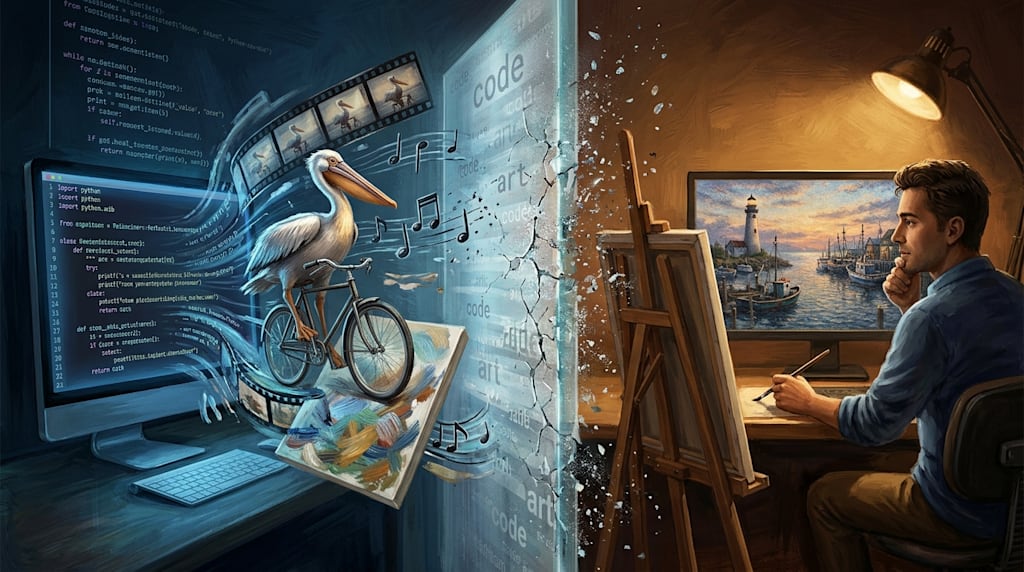
Claude Fable 5.2 has been out for a day, and my X timeline is flooded. Social media is playing with it. Communities are going crazy over it. Even accounts that usually post only funding news are reposting the pelican on a bike. Gemini 4 Carbon launched early this morning too. I ran several cases, and it improved, especially over the previous generation. But when I put the outputs side by side, I sighed. What was missing wasn’t instruction following, resolution, frame rate, or even likeness. It was something no benchmark captures but anyone can feel at a glance: taste.
Two comparisons. Yesterday I used Fable 5.2 to make a birthday video for ChatGPT’s fourth anniversary. At 00:58, the rhythm is solid. The visuals follow the main visual language of each OpenAI model generation that I put in the prompt. The GPT-4o frame is beautiful. Here is the Gemini 4 Carbon high version from Antigravity at 00:52. Compare them directly. Is it much worse? Alone, it’s fine. After the Fable 5.2 version, it gives you a “forget it” feeling. I also tested a lighthouse fishing-port Three.js page with Claude Fable 5.2. I captured static frames. The comparison is even clearer. This is only the start.
The community has made stranger things. The pelican on a bike, already a meme, became a 3D version by @Tech Friend AJ with Fable 5.2: 4,800 lines of Python, Blender API calls, no graphical interface, full scene creation, animation, and rendering. 00:18. I can’t describe it better than strange. My previous career was design. Around 2018, C4D was popular, and I did 3D design for a long time. Looking at the modeling, feather detail, rigging, car animation, lighting, overall light and shadow, and storyboard proportion, this is comparable to a full-pipeline designer with more than five years of experience and strong taste. Full-pipeline matters. Strong taste matters. This is technology plus taste, not one skill.
Another case: @Jeremy Berman used Fable 5.2 to write Python that controls Blender, with no Computer Use, and made a video through code alone. 00:18. I thought he had taken someone else’s video as a joke. It is not only 3D modeling videos. Someone spent eight hours hand-coding a design game from scratch. The result: 01:12. Sometimes I feel ashamed. I look at what other people make with the model, then at my own work. The gap between people is still large. @camperaigg used Three.js, 2,000 lines of code, and 83 minutes to make an animated video. 00:30. The character action performance has strong taste. Claude Fable 5.2’s fight scene looks like this. 00:15. It also uses code to devour music. Who says a large model cannot compose directly? Right now it cannot beat Suno. What about a year from now? 00:45.
The most extreme part is drawing. Claude Fable 5.2 writes code to draw. This made me dizzy. It is not calling an image model. It does not use an image model. It does not pre-render or trace an underlying image. Every painting is a Python program, about one or two thousand lines. The program has a simulated paint engine with different bristles. Every stroke goes through the engine before it lands on the canvas. It is code simulating a brush. These images are not the most extreme. This one is. An image as close as possible to reality. Claude Fable 5.2 painted it with 700,000 strokes. This is not a photograph. Fable 5.2 used code to paint 700,000 strokes. Zoom in, and you can see the brushstroke details. I looked at it for a long time. When shock reaches a certain level, words disappear.
Painting on paper, stroke by stroke, has seemed exclusive to humans. Image-generation models are popular, but the craftsmanship of a brushstroke feels different from direct generation. Many people say an image from an image model cannot be called a painting. Philosophically, I partly agree. But when a model paints stroke by stroke on its canvas and produces a work, can that work be called a work? A few years ago, when I was a designer, if I had told colleagues that we could use code to do visual identity, paint, and render video, they would have thought I was an idiot. Now that is what is happening. Large models use code to devour the virtual world. They have reached places that seem unrelated to code: the taste that belongs to art.
For a long time, people had a default division. Code is science and engineering, a programmer’s job. Art is inspiration, feeling, things that cannot be explained. In high school, my first big choice was liberal arts or sciences. Science meant math, physics, chemistry. Liberal arts meant politics, history, geography. I was an art student on the art exam track. From our teens, we were sorted into categories. People assume technology and art are opposed.
Looking back, that division is industrial-age inertia. Human energy is limited. Learning a skill costs too much. So we divide labor. You write code. I draw. He animates. Someone else composes. Each person masters a small piece, and collaboration assembles a complete work. This system raised production efficiency over hundreds of years. The core question is whether we need fine division because these abilities belong to different domains, or because learning them costs too much.
After Claude Fable 5.2, the answer is obvious.
For a computer, many things we think are worlds apart can become one thing: code. Code is the closest thing to a universal language in the digital world. Code has a terrifying advantage. It can run repeatedly, change infinitely, be controlled precisely, and adjust itself from results. Ask a designer to move 10,000 feathers, and he may think you are crazy. For code, 10,000 feathers and 100,000 feathers are a difference in computation. The premise is knowing how to arrange 100,000 feathers so they look good. That was what AI lacked: taste.
Large models led by Claude Fable 5.2 are not perfect in taste. Many works still need human guidance. But no one will question whether AI has taste. Once a large model has taste, it can devour everything with code. Images, videos, music. Do you think code cannot make them? In the digital world, they are code. They are formats. Underneath, everything is code. If something can be expressed, executed, and fed back inside a computer, AI can potentially do it. Things that can be created will almost inevitably be devoured by AI.
Last year, large models struggled to draw an SVG. The pelican on a bike looked like this. We may be watching AI devour things humans thought could not be computed. Including beauty.
I don’t know whether this is AGI. If AGI appears, we may look back and find its first form was not mysterious. It may be a model opening a terminal, writing code, and creating worlds.
I want to be sober about this. Taste being engineered does not mean taste is exhausted. Benchmarks cannot measure flavor. They also cannot measure intention, trade-offs, curation, responsibility, or why someone makes a thing. Programmatic brushstrokes can simulate craftsmanship. Human painting has physicality, contingency, materiality, and the moment when a person decides where the next stroke lands. Those are not the same. Fable 5.2 does not change whether AI will replace artists. It compresses the intermediate skill stack between intention and finished product. A team once crossed the technical-artistic cost gap. Now one person who can write prompts and judge quality may cross it with a model.
The victory belongs less to a model than to a loosening of the division of labor. We thought technology and art were opposed because humans could not afford to learn two languages. The computer says it can afford both. Then it uses code to connect them.
That is what makes people sigh. It does not paint better than you. It makes you rethink how many “different domains” were only walls built from learning costs.
About the Creator
Jin
Writer of reamstories
https://reamstories.com/jin
Enjoyed the story? Support the Creator.
Subscribe for free to receive all their stories in your feed. You could also become a paid subscriber, letting them know you appreciate their work.
Comments
There are no comments for this story
Be the first to respond and start the conversation.