
China Ultrasound Devices Market Outlook 2026–2034: How Advanced Diagnostic Imaging Is Transforming Healthcare
Growing healthcare investments, rising chronic disease prevalence, and rapid technological innovation are driving strong growth in China's ultrasound devices industry.

China's healthcare sector is undergoing a remarkable transformation driven by increasing healthcare investments, technological innovation, and growing demand for advanced diagnostic services. As the country's population ages and chronic diseases become more prevalent, healthcare providers are placing greater emphasis on early diagnosis, preventive care, and efficient patient management.
Among the many technologies supporting this healthcare evolution, ultrasound imaging has emerged as one of the most important diagnostic tools. Ultrasound systems provide real-time imaging, are non-invasive, cost-effective, and do not expose patients to harmful radiation. These advantages have made ultrasound technology a cornerstone of modern medical diagnostics across hospitals, clinics, maternity centers, and diagnostic facilities throughout China.
From monitoring pregnancies and diagnosing cardiovascular diseases to evaluating abdominal organs and guiding treatment decisions, ultrasound devices have become indispensable in everyday medical practice.
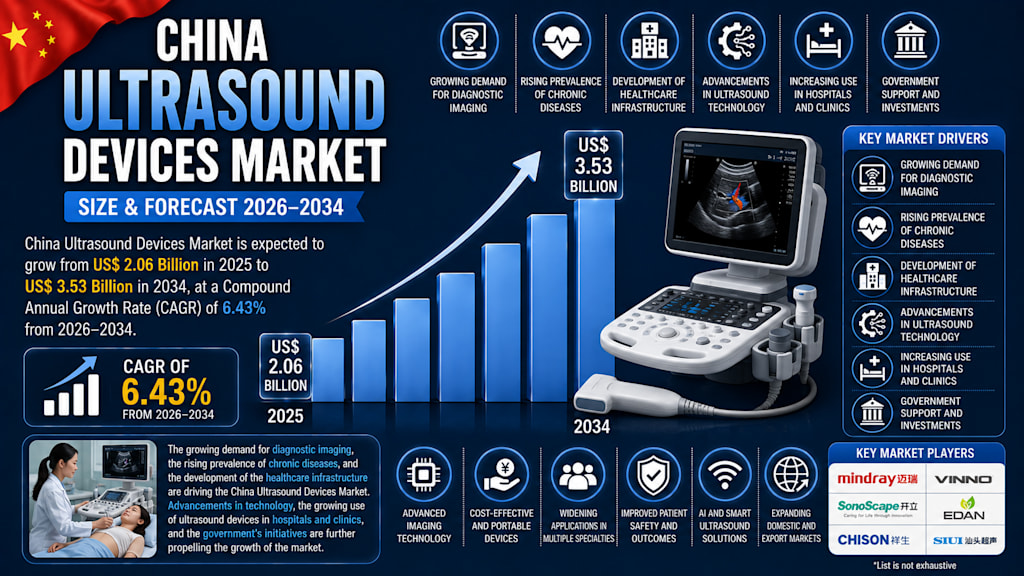
According to Renub Research, the China Ultrasound Devices Market is projected to grow from US$ 2.06 billion in 2025 to US$ 3.53 billion by 2034, registering a compound annual growth rate (CAGR) of 6.43% between 2026 and 2034. Expanding healthcare infrastructure, increasing prevalence of chronic diseases, technological advancements, and rising adoption of portable imaging systems are among the key factors driving market growth.
As healthcare modernization continues accelerating across China, ultrasound devices are expected to play an increasingly important role in supporting accurate diagnosis, preventive healthcare, and improved patient outcomes.
Understanding Ultrasound Technology
Ultrasound devices are medical imaging systems that use high-frequency sound waves to generate real-time images of internal organs, tissues, blood vessels, and physiological structures.
The technology operates through a transducer that emits sound waves into the body and captures returning echoes. These echoes are processed by specialized software to create detailed visual images displayed on a monitor.
Unlike many other imaging modalities, ultrasound does not use ionizing radiation, making it a safer option for frequent examinations and sensitive patient groups such as pregnant women.
Ultrasound imaging is widely used across numerous medical specialties, including cardiology, obstetrics, gynecology, radiology, oncology, vascular medicine, and emergency care.
Its combination of safety, affordability, portability, and diagnostic effectiveness has contributed significantly to its widespread adoption throughout China's healthcare system.
As healthcare providers increasingly prioritize efficient and patient-friendly diagnostic solutions, ultrasound technology continues gaining importance across both urban and rural healthcare settings.
Expanding Healthcare Infrastructure Is Driving Demand
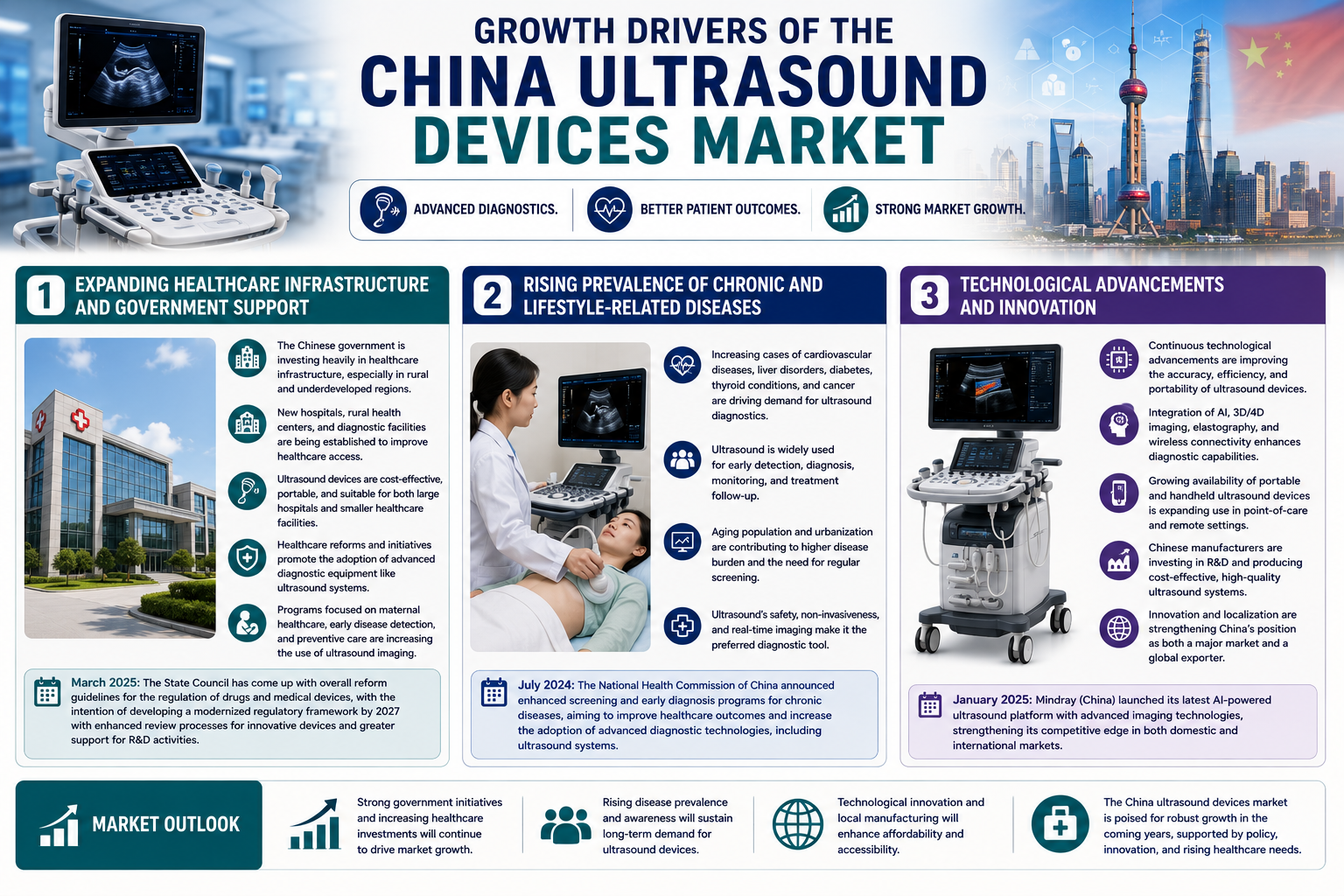
One of the most important factors supporting growth in China's ultrasound devices market is the ongoing expansion of healthcare infrastructure.
The Chinese government continues investing heavily in hospitals, community healthcare centers, rural medical facilities, and diagnostic institutions to improve access to healthcare services nationwide.
Healthcare reforms designed to strengthen medical services and expand healthcare accessibility are creating strong demand for cost-effective diagnostic technologies such as ultrasound imaging.
Ultrasound devices are particularly attractive because they can be deployed in both advanced hospitals and smaller community healthcare facilities.
Government initiatives supporting maternal healthcare, chronic disease management, preventive care, and rural healthcare development have further accelerated adoption.
In March 2025, China's State Council introduced comprehensive reforms aimed at modernizing medical device regulation, improving review processes for innovative technologies, and supporting research and development activities within the healthcare sector.
As healthcare infrastructure continues expanding, demand for diagnostic imaging equipment is expected to remain strong.
Rising Chronic Disease Burden Is Fueling Market Growth
China's growing burden of chronic diseases is creating substantial demand for diagnostic imaging technologies.
Conditions such as cardiovascular disease, cancer, liver disorders, kidney disease, and diabetes require ongoing monitoring, early detection, and accurate diagnosis.
Ultrasound imaging has become an essential diagnostic tool because it provides real-time visualization of organs, tissues, and blood flow without exposing patients to radiation.
Healthcare providers increasingly rely on ultrasound examinations to detect abnormalities, monitor disease progression, and guide treatment decisions.
Growing awareness regarding preventive healthcare is also encouraging individuals to undergo regular health screenings and diagnostic evaluations.
As chronic disease prevalence continues rising, ultrasound systems are expected to remain among the most frequently utilized imaging technologies within China's healthcare system.
Aging Population Creates Long-Term Opportunities
China's aging population represents another major driver of ultrasound device demand.
Older adults are more likely to experience chronic illnesses, cardiovascular disorders, cancer, and other age-related health conditions that require regular diagnostic monitoring.
According to demographic projections referenced in the report, China's population aged 65 years and older is expected to reach approximately 400 million by 2050, creating substantial long-term demand for diagnostic imaging services.
Healthcare providers increasingly use ultrasound technology to evaluate organ function, monitor disease progression, and support treatment planning for elderly patients.
The aging population also strengthens demand for cardiology imaging, oncology diagnostics, vascular examinations, and chronic disease management programs.
As demographic changes continue reshaping healthcare needs, ultrasound technology is expected to become even more critical in supporting geriatric healthcare services throughout China.
Technological Innovation Is Transforming Ultrasound Imaging
Rapid technological advancements are significantly enhancing the capabilities of modern ultrasound systems.
Manufacturers continue developing devices that offer higher image resolution, improved diagnostic accuracy, enhanced workflow efficiency, and greater portability.
Innovations such as three-dimensional (3D) imaging, four-dimensional (4D) imaging, artificial intelligence integration, wireless connectivity, and automated image analysis are transforming diagnostic capabilities.
Artificial intelligence is becoming particularly valuable because it assists healthcare professionals in image interpretation, anomaly detection, workflow optimization, and clinical decision-making.
Modern ultrasound systems also feature improved software platforms that enable more detailed visualization of anatomical structures and physiological processes.
In October 2024, GE Healthcare signed a cooperation agreement to establish its Greater China Ultrasound Headquarters in Wuxi New District, strengthening innovation, research capabilities, and customer engagement across the ultrasound ecosystem.
As innovation continues advancing, ultrasound technology is becoming increasingly powerful and accessible.
Portable and Handheld Devices Are Expanding Access
One of the most significant trends within the market is the growing adoption of portable and handheld ultrasound devices.
These systems offer substantial advantages in terms of mobility, flexibility, and accessibility.
Portable devices enable healthcare professionals to perform diagnostic examinations in emergency departments, ambulances, rural clinics, community healthcare centers, and remote locations where traditional imaging infrastructure may be limited.
The ability to conduct point-of-care imaging improves clinical efficiency and accelerates diagnosis in time-sensitive situations.
Healthcare providers increasingly value portable ultrasound systems because they support decentralized healthcare delivery while reducing patient travel requirements.
As healthcare accessibility becomes a national priority, portable ultrasound technology is expected to play a growing role in expanding diagnostic services throughout China.
Trolley-Based Ultrasound Systems Continue Dominating Hospitals
Despite the rise of portable devices, trolley and cart-based ultrasound systems continue to dominate many hospital environments.
These systems offer advanced imaging performance, greater processing power, and more sophisticated diagnostic capabilities than many portable alternatives.
Trolley-based systems are widely used across cardiology, radiology, gynecology, abdominal imaging, and specialized diagnostic procedures.
Hospitals and large diagnostic centers rely on these systems because they support advanced modalities such as Doppler imaging, 3D visualization, and 4D imaging.
Their versatility and diagnostic precision make them particularly valuable for complex examinations requiring detailed image analysis.
As Chinese hospitals continue modernizing facilities and expanding clinical capabilities, demand for advanced trolley-based ultrasound systems is expected to remain strong.
Cardiology Applications Are Growing Rapidly
The cardiology ultrasound segment represents one of the most important areas of market growth.
Cardiovascular diseases remain a major public health concern in China, creating substantial demand for diagnostic tools capable of evaluating heart structure and function.
Echocardiography, a specialized ultrasound application, enables healthcare professionals to assess cardiac performance, blood flow, valve function, and structural abnormalities.
The growing prevalence of hypertension, heart failure, coronary artery disease, and other cardiovascular conditions is driving increased utilization of cardiology ultrasound systems.
Advancements in imaging technology have further enhanced diagnostic accuracy, enabling earlier detection and more effective management of cardiovascular diseases.
As awareness regarding heart health continues increasing, cardiology applications are expected to remain a key growth driver for the ultrasound market.
Gynecology and Prenatal Care Remain Essential Applications
Gynecology and obstetrics continue representing major application areas for ultrasound imaging.
Ultrasound technology plays a critical role in prenatal care by enabling healthcare providers to monitor fetal development, assess pregnancy health, and detect potential complications.
The technology is also widely used to diagnose gynecological conditions such as ovarian cysts, uterine abnormalities, and reproductive health disorders.
Government initiatives supporting maternal and child healthcare have further strengthened demand for ultrasound services.
Advancements in 3D and 4D imaging have improved visualization capabilities, providing more detailed insights into fetal development and maternal health.
As women's healthcare remains a national healthcare priority, demand for gynecology ultrasound systems is expected to continue growing steadily.
Diagnostic Centers Are Becoming Important End Users
Diagnostic centers have emerged as major users of ultrasound technology across China.
These facilities offer specialized imaging services and often provide faster access to diagnostic examinations than large hospitals.
Growing awareness regarding preventive healthcare and routine health screenings is encouraging more individuals to utilize diagnostic center services.
Private imaging centers are expanding rapidly, increasing accessibility to ultrasound examinations across urban and suburban markets.
Technological improvements have enhanced diagnostic efficiency, allowing centers to perform a broader range of imaging procedures while maintaining high-quality standards.
As demand for preventive healthcare services continues growing, diagnostic centers are expected to remain a significant contributor to market expansion.
Challenges Facing the Market
Despite strong growth prospects, the ultrasound devices market faces several challenges.
One of the most significant obstacles is the high cost associated with advanced ultrasound systems.
Modern devices incorporating artificial intelligence, portable capabilities, and advanced imaging features often require substantial investment, making them difficult for smaller healthcare facilities to acquire.
Maintenance expenses, software updates, and operator training requirements can further increase ownership costs.
Budget limitations remain particularly challenging for healthcare providers operating in rural or underserved areas.
Manufacturers continue working to develop cost-effective solutions that improve accessibility without compromising diagnostic performance.
Workforce Training Remains a Critical Need
Another important challenge involves the availability of skilled healthcare professionals capable of operating ultrasound systems effectively.
Ultrasound examinations require specialized training and expertise to ensure accurate image acquisition and interpretation.
Some rural and developing regions continue experiencing shortages of trained technicians, sonographers, and radiologists.
Ongoing education and professional development programs are necessary to help healthcare personnel stay current with evolving technologies and imaging techniques.
Without adequate training, healthcare facilities may struggle to fully realize the benefits of advanced ultrasound systems.
Addressing workforce development challenges will remain essential for supporting long-term market growth and maximizing diagnostic effectiveness.
Regional Market Insights
Beijing remains one of China's most advanced healthcare markets, supported by leading hospitals, research institutions, and extensive government healthcare investment. Growing emphasis on preventive medicine and advanced diagnostics continues driving demand for high-performance ultrasound systems.
Shanghai continues serving as a major center for healthcare innovation and medical technology adoption. Strong healthcare spending, advanced medical facilities, and active research ecosystems support widespread utilization of ultrasound imaging technologies.
Tianjin is experiencing increasing demand as healthcare infrastructure expands and hospitals invest in modern diagnostic equipment. Growing awareness regarding preventive healthcare is further supporting market growth.
Guangdong benefits from its large population, rapidly expanding healthcare system, and strong economic development. Hospitals and clinics throughout the province increasingly rely on advanced ultrasound systems to improve diagnostic accuracy and patient care.
Competitive Landscape
Competition within China's ultrasound devices market remains intense as global and domestic manufacturers invest heavily in innovation, artificial intelligence, imaging quality, and portability.
Major industry participants include Canon Medical Systems Corporation, Koninklijke Philips NV, Siemens AG, Samsung Electronics Co. Ltd., Hologic Inc., Fujifilm Holdings Corporation, GE Healthcare, and Shenzhen Mindray Bio-Medical Electronics Co., Ltd.
These companies continue developing advanced ultrasound solutions designed to improve diagnostic precision, workflow efficiency, and healthcare accessibility.
Strategic investments in research, development, and localized innovation are expected to remain key competitive priorities throughout the forecast period.
Final Thoughts
China's ultrasound devices market is entering a period of sustained expansion driven by healthcare modernization, demographic changes, technological innovation, and increasing demand for diagnostic services. Ultrasound imaging has become one of the most versatile and widely utilized medical technologies, supporting applications ranging from cardiology and oncology to prenatal care and preventive health screening.
Advancements in artificial intelligence, portable imaging, and high-resolution visualization are making ultrasound systems more effective, accessible, and valuable than ever before. At the same time, government investment in healthcare infrastructure continues creating opportunities for broader adoption across hospitals, clinics, and diagnostic centers.
With the market projected to grow from US$ 2.06 billion in 2025 to US$ 3.53 billion by 2034, ultrasound technology is expected to remain a critical component of China's healthcare system and an essential tool for improving patient outcomes in the years ahead.
About the Creator
Enjoyed the story? Support the Creator.
Subscribe for free to receive all their stories in your feed.
Comments
There are no comments for this story
Be the first to respond and start the conversation.