
China’s Biopsy Devices Industry Is Advancing Cancer Diagnosis Through Precision and Early Detection
Rising Cancer Cases, Healthcare Modernization, and Minimally Invasive Technologies Are Driving Growth in China’s Biopsy Devices Market

Cancer remains one of the most significant public health challenges worldwide, and China is no exception. As the country experiences rapid urbanization, demographic changes, and lifestyle shifts, the demand for advanced diagnostic tools capable of detecting diseases at an early stage continues to grow. Among these technologies, biopsy devices have become essential instruments in modern healthcare, enabling physicians to diagnose cancer and other serious medical conditions with greater accuracy and confidence.
The increasing emphasis on preventive healthcare, combined with advancements in minimally invasive procedures and expanding healthcare infrastructure, is transforming China's biopsy devices market. Hospitals and diagnostic centers across the country are investing heavily in advanced technologies designed to improve patient outcomes while supporting earlier and more accurate disease detection.
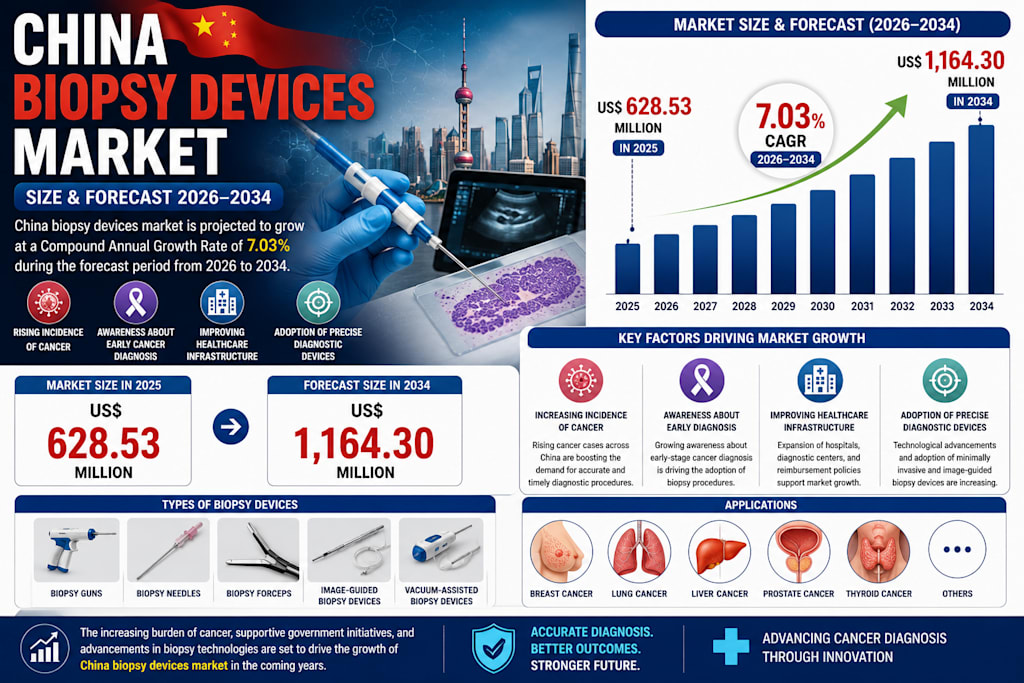
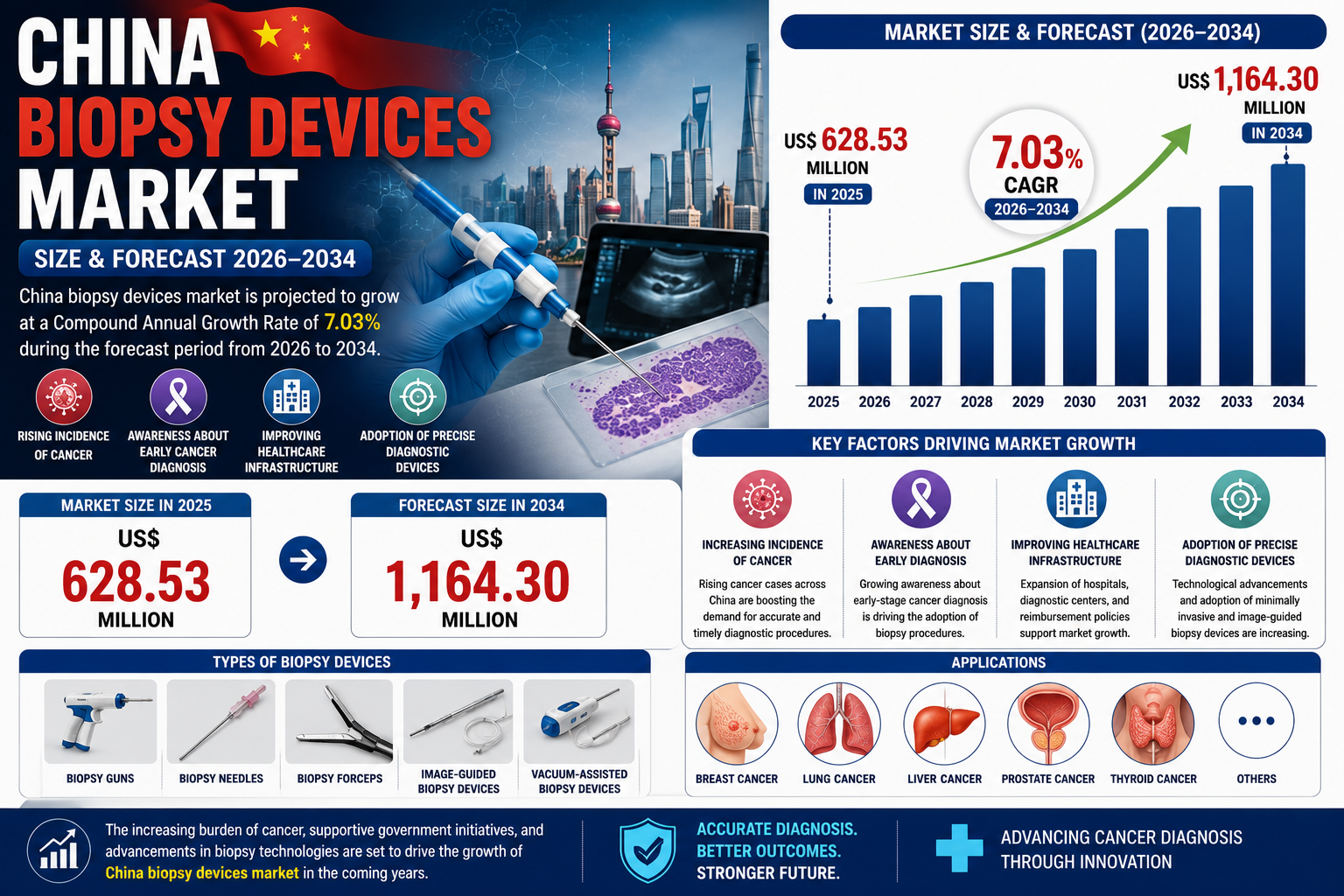
According to Renub Research, the China Biopsy Devices Market is expected to grow from US$ 628.53 million in 2025 to US$ 1,164.30 million by 2034, registering a compound annual growth rate (CAGR) of 7.03% between 2026 and 2034. Rising cancer incidence, increased awareness of early diagnosis, healthcare modernization initiatives, and growing adoption of precision diagnostic technologies are key factors driving market growth.
As China continues strengthening its healthcare system, biopsy devices are becoming increasingly important tools in the fight against cancer and other chronic diseases.
Understanding the Role of Biopsy Devices
Biopsy devices are specialized medical instruments used to collect tissue or cell samples from the body for laboratory examination.
The collected samples help physicians diagnose diseases such as:
Cancer
Infections
Inflammatory disorders
Autoimmune conditions
Organ abnormalities
Common biopsy devices include:
Biopsy needles
Needle-based biopsy guns
Forceps
Vacuum-assisted biopsy systems
Image-guided biopsy technologies
These devices are often used in conjunction with imaging systems such as ultrasound, computed tomography (CT), and magnetic resonance imaging (MRI) to ensure accurate sample collection.
Biopsies remain one of the most reliable diagnostic methods for confirming disease presence and determining appropriate treatment strategies.
Rising Cancer Incidence Is Fueling Demand
One of the strongest growth drivers for China's biopsy devices market is the increasing prevalence of cancer.
Rapid industrialization, environmental pollution, smoking, dietary changes, and aging populations have all contributed to rising cancer rates across the country.
Early diagnosis plays a critical role in improving survival outcomes, making biopsy procedures an essential component of modern cancer care.
Lung cancer, breast cancer, liver cancer, and prostate cancer are among the most common malignancies requiring biopsy-based diagnosis.
Data highlighted in the report indicate that China recorded approximately 364,800 new liver cancer cases and nearly 318,800 liver cancer deaths in 2014. Although incidence and mortality rates have gradually declined, liver cancer remains a major healthcare concern.
As awareness regarding cancer screening continues increasing, demand for biopsy procedures is expected to grow steadily.
Early Detection Is Becoming a National Healthcare Priority
China's healthcare system increasingly emphasizes preventive medicine and early disease detection.
Government-led awareness campaigns and screening programs are encouraging individuals to undergo regular health examinations and cancer screenings.
Healthcare providers recognize that early diagnosis often leads to:
Better treatment outcomes
Lower healthcare costs
Improved survival rates
Reduced disease burden
Biopsy procedures provide definitive diagnostic information that guides treatment decisions and personalized care plans.
As preventive healthcare gains greater importance nationwide, biopsy devices are becoming indispensable tools within diagnostic pathways.
Minimally Invasive Technologies Are Transforming Procedures
Technological innovation is significantly improving biopsy procedures across China.
Modern biopsy devices are designed to maximize accuracy while minimizing patient discomfort.
Minimally invasive techniques offer numerous advantages compared with traditional surgical biopsies, including:
Reduced pain
Faster recovery times
Lower complication risks
Shorter hospital stays
Improved patient satisfaction
Image-guided technologies have become particularly important.
Advanced ultrasound, CT, and MRI systems allow physicians to target abnormal tissue with exceptional precision.
As healthcare providers increasingly prioritize patient-centered care, minimally invasive biopsy procedures continue gaining popularity.
Medical Robotics and Smart Technologies Are Accelerating Innovation
China's medical technology sector is rapidly embracing robotics, automation, and intelligent healthcare solutions.
A notable milestone occurred in March 2025 when MicroPort MedBot's Toumai SP Laparoscopic Surgical Robot received approval from China's National Medical Products Administration (NMPA) for applications across urology, general surgery, and gynecology.
Although primarily designed for surgical procedures, such advancements highlight China's broader commitment to precision medicine and medical technology innovation.
The integration of robotics, artificial intelligence, and image-guided systems is expected to enhance future biopsy procedures by improving accuracy and workflow efficiency.
As these technologies mature, they will likely play a growing role in diagnostic medicine.
Healthcare Infrastructure Expansion Is Supporting Growth
China has invested heavily in healthcare modernization over the past decade.
Government initiatives aimed at improving hospital infrastructure, expanding cancer treatment capabilities, and increasing access to advanced diagnostic services are strengthening the healthcare system nationwide.
Investments have focused on:
New hospitals
Diagnostic centers
Cancer treatment facilities
Medical equipment upgrades
Healthcare workforce development
Healthcare expansion is not limited to major metropolitan areas.
Programs targeting rural and underserved regions are helping improve access to advanced medical technologies.
As healthcare infrastructure continues improving, demand for biopsy devices is expected to increase substantially.
Foreign Investment Policies Are Encouraging Innovation
Government policy reforms are also supporting market development.
In September 2024, China's Ministry of Commerce introduced new measures permitting fully foreign-owned hospitals in major cities such as Beijing and Shanghai while relaxing restrictions on foreign direct investment in healthcare institutions.
These policy changes are expected to encourage:
- Technology transfer
- International partnerships
- Medical innovation
- Increased healthcare investment
The resulting improvements in healthcare quality and diagnostic capabilities will likely benefit the biopsy devices market significantly.
Needle-Based Biopsy Guns Lead Product Demand
Needle-based biopsy guns represent one of the most important product segments within China's biopsy devices market.
These devices are widely used for core needle biopsies, allowing physicians to obtain high-quality tissue samples efficiently.
Their advantages include:
- Accurate tissue collection
- Fast procedure times
- Ease of use
- Reduced patient discomfort
Automated and semi-automated systems further improve procedural consistency and diagnostic reliability.
As healthcare providers increasingly prioritize minimally invasive techniques, needle-based biopsy guns are expected to maintain strong demand.
Biopsy Needles Remain Essential Diagnostic Tools
Biopsy needles continue to represent a critical component of diagnostic medicine.
These devices are used across numerous biopsy procedures, including:
Fine needle aspiration biopsies
Core needle biopsies
Organ-specific sampling procedures
Their affordability and versatility make them accessible across a wide range of healthcare settings.
Manufacturers continue improving needle designs to enhance:
Precision
Safety
Patient comfort
Sample quality
Growing demand for diagnostic services is expected to support continued expansion of this segment.
Lung Biopsy Devices Are Experiencing Strong Growth
China's lung biopsy devices segment is growing rapidly due to the high prevalence of lung cancer.
Lung cancer remains one of the leading causes of cancer-related mortality in the country.
Biopsy procedures are essential for:
- Confirming diagnoses
- Determining cancer type
- Guiding treatment selection
- Monitoring disease progression
Advancements in image-guided technologies are improving the safety and accuracy of lung biopsies.
As awareness regarding lung health continues increasing, demand for lung biopsy devices is expected to remain strong.
CT-Guided Biopsies Are Enhancing Diagnostic Precision
CT-guided biopsy procedures have become increasingly important within modern diagnostic medicine.
These technologies enable physicians to access lesions located in difficult-to-reach anatomical areas such as:
- Lungs
- Liver
- Abdomen
- Deep soft tissues
CT imaging provides detailed visualization, helping improve sample collection accuracy while reducing complications.
Large hospitals and specialized diagnostic centers are among the primary adopters of CT-guided biopsy technologies.
As imaging capabilities continue improving, this segment is expected to experience sustained growth.
Hospitals Continue to Dominate End-User Demand
Hospitals remain the largest end-user segment within China's biopsy devices market.
They serve as primary centers for:
- Cancer diagnosis
- Advanced imaging
- Specialized pathology services
- Surgical interventions
Large hospitals possess the infrastructure, expertise, and equipment necessary to perform complex biopsy procedures safely and effectively.
Government investments in hospital modernization are further strengthening this segment's market position.
As healthcare demand continues increasing, hospitals are expected to remain the primary consumers of biopsy devices.
Regional Markets Driving Expansion
Beijing
Beijing remains a leading market due to its concentration of top-tier hospitals, research institutions, and advanced healthcare infrastructure. The city's emphasis on medical innovation and early disease detection supports strong biopsy device adoption.
Shanghai
Shanghai benefits from a highly developed healthcare system, strong private-sector participation, and high healthcare expenditure. Advanced hospitals and diagnostic centers continue driving demand for cutting-edge biopsy technologies.
Tianjin
Tianjin's expanding healthcare infrastructure and growing chronic disease burden are supporting increased adoption of advanced diagnostic devices, including biopsy systems.
Chongqing
As western China's healthcare sector develops, Chongqing is emerging as an important market for biopsy technologies. Government investments in healthcare modernization are improving access to advanced diagnostic services.
Challenges Facing the Market
High Costs of Advanced Technologies
Advanced biopsy systems incorporating sophisticated imaging and automation technologies can be expensive.
Smaller healthcare facilities may face budget constraints that limit adoption.
Procedure costs can also present financial challenges for certain patient populations.
Urban-Rural Healthcare Disparities
Access to advanced diagnostic services remains uneven across China.
Urban centers generally possess superior healthcare infrastructure compared with rural regions.
Patients in remote areas may encounter difficulties accessing specialized biopsy procedures and experienced medical professionals.
Final Thoughts
China's biopsy devices market is entering a period of strong growth driven by rising cancer incidence, healthcare modernization, technological innovation, and increasing awareness of early disease detection.
According to Renub Research, the China Biopsy Devices Market is projected to grow from US$ 628.53 million in 2025 to US$ 1,164.30 million by 2034, reflecting expanding demand for accurate and minimally invasive diagnostic solutions.
As healthcare providers continue investing in precision medicine, advanced imaging technologies, and patient-centered care, biopsy devices will remain essential tools in modern diagnostics.
The future of disease detection in China will increasingly depend on technologies that enable earlier diagnosis, greater accuracy, and more effective treatment planning—making biopsy devices a cornerstone of next-generation healthcare.
About the Creator
Enjoyed the story? Support the Creator.
Subscribe for free to receive all their stories in your feed.
Comments
There are no comments for this story
Be the first to respond and start the conversation.