
China’s Autonomous Vehicle Revolution: How Self-Driving Technology Is Reshaping the Future of Transportation
Backed by Government Support, Artificial Intelligence, and Smart Infrastructure, China Is Racing Toward an Autonomous Mobility Future

The future of transportation is no longer a distant concept reserved for science fiction. Across China, autonomous vehicles are moving from experimental technology to real-world deployment, transforming how people and goods travel through cities and across regions. From self-driving taxis navigating busy urban streets to autonomous delivery vehicles transporting packages, the country is rapidly becoming one of the world's most important centers for autonomous mobility innovation.
China's commitment to technological advancement, combined with strong government support and significant investments in artificial intelligence, has created a favorable environment for the development of self-driving transportation systems. Technology companies, automakers, and research institutions are collaborating to accelerate innovation, while pilot programs continue to demonstrate the practical benefits of autonomous driving technologies.
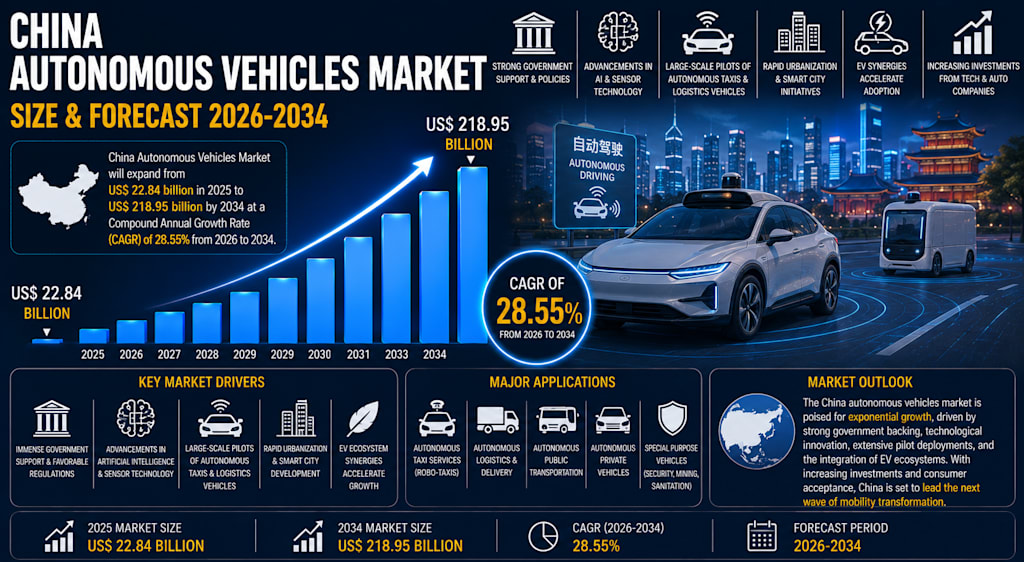
According to Renub Research, the China Autonomous Vehicles Market is projected to grow from US$ 22.84 billion in 2025 to an impressive US$ 218.95 billion by 2034, representing a remarkable compound annual growth rate (CAGR) of 28.55% between 2026 and 2034. This extraordinary growth highlights the increasing importance of autonomous mobility within China's transportation ecosystem and reflects the country's ambition to lead the global autonomous vehicle industry.
Understanding the Autonomous Vehicle Revolution
Autonomous vehicles are equipped with advanced technologies that enable them to perceive their surroundings, analyze environmental conditions, make driving decisions, and navigate with limited or no human intervention. These vehicles rely on a combination of sophisticated hardware and software systems, including cameras, radar, lidar, GPS, ultrasonic sensors, artificial intelligence, machine learning algorithms, and high-performance computing platforms.
Together, these technologies allow vehicles to interpret road conditions, recognize obstacles, detect pedestrians, monitor traffic patterns, and make real-time decisions that enhance safety and efficiency.
The primary objective of autonomous vehicles is to reduce human error, improve road safety, optimize traffic flow, and create more efficient transportation networks. As technology continues to advance, autonomous systems are becoming increasingly capable of handling complex driving scenarios that were once considered impossible for machines to manage independently.
Government Support Is Accelerating Innovation
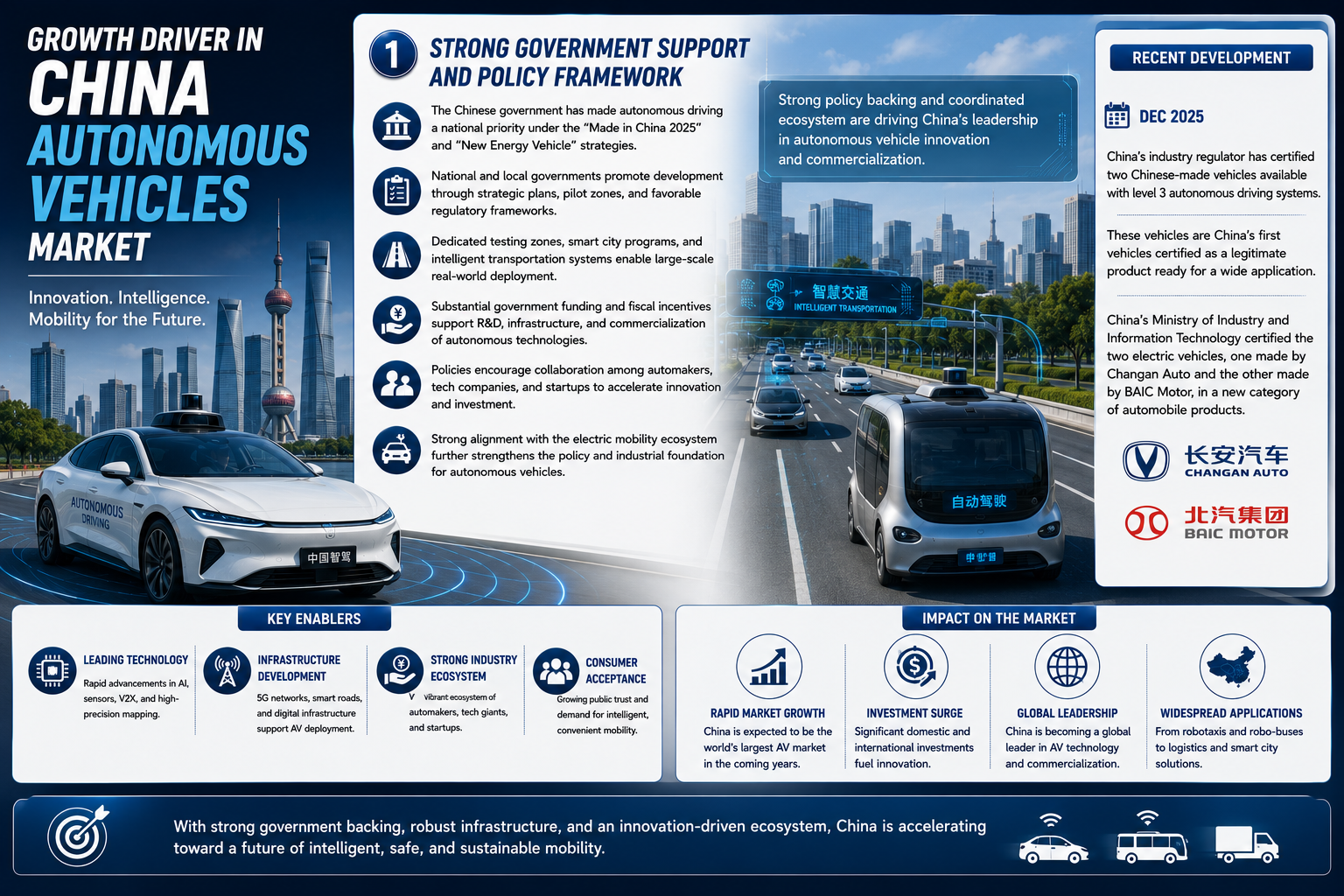
One of the most significant factors driving China's autonomous vehicle market is the strong support provided by both national and local governments. Policymakers recognize the transformative potential of autonomous transportation and have introduced strategic initiatives designed to accelerate development and commercialization.
Dedicated testing zones, smart city programs, favorable regulations, infrastructure investments, and research funding have created an environment where innovation can flourish. Government-backed pilot projects allow companies to test autonomous systems under real-world conditions while gathering valuable operational data.
The Chinese government's long-term transportation strategy aligns autonomous driving with broader objectives related to digital transformation, smart infrastructure, and electric mobility. This coordinated approach has encouraged automakers, technology firms, and startups to invest heavily in autonomous vehicle development.
A major milestone occurred in December 2025 when China's industry regulator certified two Chinese-made vehicles equipped with Level 3 autonomous driving systems. These vehicles became the country's first officially certified Level 3 autonomous products, marking an important step toward broader commercial adoption.
Artificial Intelligence Is Powering Autonomous Progress
Artificial intelligence lies at the heart of autonomous vehicle technology. Without advanced AI capabilities, self-driving systems would be unable to process the enormous amount of information generated by sensors and cameras.
China's leadership in artificial intelligence development has become a major competitive advantage in the autonomous vehicle market. AI algorithms enable vehicles to identify objects, predict movement patterns, recognize road signs, and make split-second driving decisions.
The widespread deployment of 5G networks further enhances autonomous vehicle performance by enabling real-time communication between vehicles, infrastructure, and cloud-based computing systems. This connectivity improves navigation accuracy, traffic management, and overall system reliability.
Partnerships between technology companies and automakers continue to accelerate innovation. In October 2025, Baidu formed an alliance with a major Chinese automaker to develop next-generation autonomous vehicles. The collaboration combines Baidu's expertise in artificial intelligence with the manufacturing and distribution capabilities of the automotive industry, creating new opportunities for large-scale commercialization.
Urbanization Is Creating Demand for Smarter Mobility
China's rapid urbanization has created unique transportation challenges. Large metropolitan areas face increasing traffic congestion, growing environmental concerns, and rising demand for efficient mobility solutions.
Autonomous vehicles offer a potential solution to many of these issues. Self-driving taxis, autonomous shuttles, and intelligent delivery vehicles can improve transportation efficiency while reducing operational costs and emissions.
As more people move into urban centers, transportation networks must evolve to accommodate changing mobility needs. Autonomous systems have the potential to optimize traffic flow, reduce accidents, and enhance accessibility for individuals who may face challenges with traditional transportation options.
The growing popularity of ride-sharing and shared mobility services also supports the expansion of autonomous transportation. Consumers are becoming increasingly comfortable with technology-enabled transportation models, creating favorable conditions for self-driving services.
In September 2025, Pony.ai launched a pilot project for autonomous ride-hailing services in Beijing. The initiative demonstrates how autonomous technology can be integrated into everyday transportation while providing valuable operational insights for future expansion.
Autonomous Taxis Are Leading Commercial Adoption
Among the various applications of autonomous technology, self-driving taxi services have emerged as one of the most visible and commercially promising sectors.
Major Chinese cities are already testing autonomous passenger transportation services within designated operational areas. These pilot programs allow companies to refine technologies while introducing consumers to autonomous mobility experiences.
Robo-taxis offer several advantages, including lower operating costs, improved vehicle utilization, and increased transportation accessibility. As autonomous systems become more reliable, ride-hailing services may undergo significant transformation.
Consumer acceptance is also improving as people gain direct experience with autonomous transportation technologies. Positive user experiences are helping build public confidence and encouraging broader adoption.
China's combination of dense urban populations, advanced digital infrastructure, and strong government support makes it an ideal environment for autonomous passenger vehicle deployment.
Electric Vehicles and Autonomous Driving Form a Powerful Partnership
One of the unique characteristics of China's autonomous vehicle market is its close relationship with electric vehicle development.
Most next-generation autonomous vehicles are being designed alongside electric propulsion systems. Electric vehicles provide a suitable platform for autonomous technologies because they already incorporate advanced electronics, software integration, and digital control systems.
China's global leadership in electric vehicle production and battery manufacturing creates additional advantages for autonomous mobility development. High-capacity batteries power not only vehicle movement but also the sensors, processors, and communication systems required for autonomous operation.
Continuous advancements in battery technology, including improvements in energy density, charging speed, and operational safety, are supporting the growth of autonomous vehicle fleets throughout the country.
The Importance of Sensors and Human-Machine Interfaces
Autonomous vehicles depend heavily on sophisticated sensor technologies that allow them to understand their surroundings.
Ultrasonic sensors, cameras, radar systems, and lidar technologies work together to create a detailed understanding of the environment around the vehicle. These systems support functions such as parking assistance, obstacle detection, blind-spot monitoring, and autonomous navigation.
China's strong manufacturing capabilities enable large-scale production of these critical components, helping reduce costs and accelerate adoption. The increasing popularity of Level 2 and Level 2+ autonomous systems has further expanded demand for sensor technologies.
Human-machine interface (HMI) technologies also play an essential role. Digital displays, voice assistants, touchscreens, head-up displays, and haptic feedback systems help passengers understand vehicle status and interact with autonomous functions.
Chinese consumers have shown strong interest in advanced digital experiences, encouraging automakers to invest heavily in intuitive and engaging HMI solutions. These interfaces are crucial for building consumer confidence and improving user experience.
Challenges Still Need to Be Addressed
Despite remarkable progress, several challenges remain before autonomous vehicles achieve widespread adoption.
Safety and reliability continue to be among the most significant concerns. Autonomous systems must operate effectively under diverse road conditions, varying weather environments, and unpredictable human behavior. Any high-profile incidents involving autonomous vehicles can influence public perception and slow adoption.
Regulatory complexity also presents challenges. Although government support remains strong, differences in regional regulations, testing requirements, and deployment approvals can create operational hurdles for companies seeking to scale autonomous services nationwide.
Data security and privacy concerns represent another important consideration. Autonomous vehicles generate enormous amounts of data related to navigation, passenger behavior, and operational performance. Ensuring secure data management while complying with evolving regulations will be essential for long-term success.
Regional Innovation Hubs Are Driving Growth
Several regions across China have emerged as leaders in autonomous vehicle innovation.
Beijing is widely recognized as one of the country's most advanced autonomous driving centers. The city benefits from extensive pilot programs, strong research capabilities, smart transportation initiatives, and the presence of leading technology companies. Autonomous taxis, logistics vehicles, and public transportation solutions are increasingly common throughout designated testing areas.
Shanghai has established itself as another major hub, leveraging its strengths in automotive manufacturing, smart city development, and advanced infrastructure. The city's commitment to autonomous driving pilots and electric mobility initiatives continues to attract investment and innovation.
Zhejiang Province is gaining attention for its digital economy and expertise in artificial intelligence, cloud computing, and data analytics. Cities such as Hangzhou are actively supporting autonomous taxi services, smart logistics platforms, and intelligent transportation systems.
Tianjin is also expanding its role in autonomous transportation, particularly in logistics, port operations, and industrial applications where autonomous trucks and delivery vehicles can generate significant efficiency improvements.
Looking Ahead
The future of autonomous vehicles in China appears exceptionally promising. Continued advancements in artificial intelligence, sensor technologies, battery systems, connectivity infrastructure, and smart city development are expected to create new opportunities throughout the transportation sector.
Companies such as AutoX, Baidu Apollo, Didi Chuxing, Pony.ai, TuSimple, and WeRide continue to invest heavily in autonomous mobility solutions, reflecting confidence in the market's long-term growth potential.
As autonomous vehicles become increasingly reliable and commercially viable, they have the potential to transform passenger transportation, logistics operations, public transit systems, and urban mobility services across China.
Final Thoughts
China's autonomous vehicle market represents one of the most exciting technological transformations of the modern era. Supported by government initiatives, artificial intelligence innovation, advanced infrastructure, and growing consumer acceptance, the country is rapidly moving toward a future where self-driving transportation becomes part of everyday life.
With the market expected to reach nearly US$ 219 billion by 2034, autonomous vehicles are poised to reshape transportation, improve safety, enhance efficiency, and redefine mobility for millions of people. While challenges remain, the pace of innovation suggests that China will continue playing a leading role in the global autonomous vehicle revolution for years to come.
About the Creator
Enjoyed the story? Support the Creator.
Subscribe for free to receive all their stories in your feed.
Comments
There are no comments for this story
Be the first to respond and start the conversation.