
China Built an Internet People Love. That’s Exactly Why AI Agents Can’t Work There.
WeChat, Meituan, and Taobao turned daily life into a smooth closed loop. Now every AI assistant dies at the login screen.
As of September 26, Muse was still climbing in North America. The consumer AI product had passed two million prompts in a week. It sat at the top of the free charts in both the United States and Canada, ahead of ChatGPT. Its mobile app launch was beating ChatGPT’s early mobile numbers.
In China, the reaction was less awe than confusion. Domestic consumer agents had already shipped email handling, shopping help, travel assistants. Those features were standard. None produced the same shock. Americans might seem easier to impress. The real difference is the ground the agents run on.
The Chinese PC web is nearly empty. Meituan’s website is a corporate page and an app download link. Taobao’s PC site has goods and can complete a purchase, but it is thinner than the mobile app. Alibaba’s 1688 site is fuller, because foreign buyers still use browsers.
History explains this. Taobao grew out of the internet 1.0 era. Meituan was born in the mobile era. In 2012, Wang Xing told the company to go all in on mobile. After that, Meituan stopped adapting content for PC browsers. Another trend ran alongside mobile growth: network sinking. Many people in lower-tier cities, older users, and young users first went online through a phone. They never needed a browser. Over a decade, content moved into mobile apps. The PC web hollowed out. Only companies from the older internet era, like Taobao, still had users who wanted web shopping, so only they kept some parity between web and app.
AI agents work best in the web world.
A browser is a cross-company operating system. Muse’s real workplace is its own cloud computer and browser. It runs inside a Secure VM. Meta trained a browser agent to complete multi-step tasks: open a page, read it, log in, fill a form, click, go back. The agent gets a mouse. It does not need every app to build an API. It only needs the browser. One browser, and it can reach every website. The web is public, observable, and verifiable. The agent can see the page, understand a button, follow a step, and check whether the task finished.
The US internet looks more like Taobao. It developed early. Most sites existed before mobile took over. Many services still run through apps, but companies treat the website as a real service entrance. They keep full content and cross-device functions. Alibaba’s 1688 site is the fullest because foreigners still need the browser.
That is the first reason Muse creates shock. It uses infrastructure that has been mature for thirty years and almost unchanged for twenty. The agent does not need every software company to cooperate. It just needs the open web.
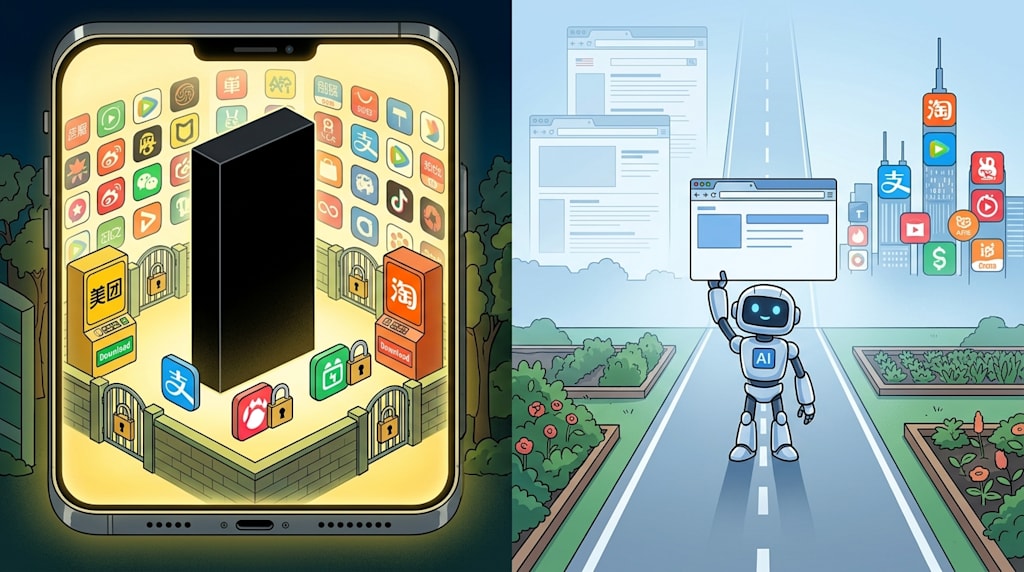
China’s consumer agents often demo well and fail in practice for the opposite reason. The high-frequency services are not on public web pages. They live inside apps. Each app has its own account system and risk-control system. Each has mini-programs. Each asks for different device permissions. They use face scans, SMS codes, sliders, app jumps. An agent stalls at the door.
WeChat is the extreme case. It holds chat, payments, life services, official accounts, mini-programs, and search content. It is half the mobile internet. Every agent must go through it. No agent can enter it. It is a black box.
Muse hit this wall too. One tester found that Google login for email failed on mobile. The reporter switched to a computer and connected. Meituan has no desktop content at all. Most apps do not.
From this angle, Muse’s North American success shows a certain late-mover advantage. Calling the US internet a late mover sounds strange. That is why the word must be “certain.”
The email killer app
According to recent App Store reviews, the most common use for Muse in the US is email. One person processed 12,000 backlogged emails in a few days. The agent found services to unsubscribe from. It organized calendars, set reminders, handled a long-delayed car maintenance appointment, and contacted the repair shop to book it.
Chinese users do not use email much. That is why the killer app does not land here. Email is central in American life. Important matters arrive by email. A critical message sits between spam. Cleaning the inbox should be daily work. Skip a few days, and it becomes a pile.
Muse’s first killer need is simple: do the things I have been avoiding. It is the same reason robot vacuums sell. People pay to avoid tasks they hate but must do.
This also explains Muse’s reception. American life has more friction. Many services still depend on phone support and manual processes. China’s mobile internet infrastructure is smoother. Even if an agent could complete the flow, the experience would not improve much.
That is late-mover advantage in another form.
The term used to describe China catching up with advanced technology and engineer dividends is late-mover advantage. New technology brings a new system. It clashes with old habits. A “backward” country without a complete old system adapts faster.
Mobile payments are an example. China led the US partly because the old payment infrastructure was weak. Credit card culture was thin. Cash ruled many daily scenes. Mobile internet coverage was broad.
China’s mobile internet era built strong app development. That strength rested on a weak PC past. Many lower-tier and rural users never formed stubborn PC habits. They met the internet through a phone.
Now the wheel turns. The US has late-mover advantage in AI experience. China’s mobile internet is too strong. Interest groups are too large. Habits are too stubborn. That makes consumer AI agents harder to spread.
Mobile internet packaged everything into apps for user experience. Packaging is friendly to people. It is hostile to AI.
AI needs a different user experience.
People need pretty icons, clear hierarchy, moderate information density. AI needs observability. It needs to know its location, available actions, and the meaning of each element. People tolerate ambiguity. They use experience to guess the next step. AI can guess too, but ambiguity raises error rates and burns tokens. AI-friendly software should map one action to one clear meaning. People like all-in-one closed environments. AI likes single-purpose tools it can combine step by step. People judge a task done by feel. AI needs verifiable completion. Most important: people need safety. AI needs openness. It does not want captchas, dynamic rendering, face recognition, or data hidden inside. It wants every device to work, open APIs, third-party calls.
But mobile internet has formed interest groups. They do not want an AI-friendly world. Even API openness is limited. Doubao’s phone was blocked by WeChat and Taobao when it tried cross-app operations. The second generation connected only a few third-party apps, including Cao Cao Mobility. Platforms have no reason to hand the user entrance to an agent.
Muse’s limits
Muse looks like the future. For Americans, it creates the feeling that things can be handed to a machine. That is the same psychological shock ChatGPT created when people could talk to a machine normally.
But Muse’s praise comes mostly from one-time hauls: 12,000 emails, hundreds saved on car insurance, broadband bills, thousands on flight cancellations. The numbers are clear. Users want to post them. That drove early virality. These cases are stock, not flow. Once mined, they are gone.
History has social products that burn hot and vanish. Muse needs recurring high-frequency scenes. The next test is which tasks users hand over repeatedly and which tasks they stop doing themselves. Continued use depends on reliable completion.
Apps are not empty in the US. Penetration is high. Practical limits appear. Reviewers found Muse stalls on complex family matters, third-party apps, and multi-factor authentication. When tasks cross websites and apps, Muse fails more often.
One tester wanted a summary of school and extracurricular information. The content sat in email, ParentSquare, Google Forms, and WhatsApp. Muse could read email. It could not gather everything.
In a Girl Scouts annual membership renewal, Muse almost finished. The payment page timed out. The tester took over and paid.
Then the tester tried to book an annual physical. Muse got date of birth and the last four digits of a Social Security number. It failed at the insurance update. The AI suggested calling the clinic.
Muse still faces the awkward arc: amazing at first, more problems later.
China’s internet is fragmented, but it has giants that cross domains. That could produce three consumer agent systems different from the US.
The first and most likely path is an agent inside a super app. WeChat is the best candidate. WeChat covers daily life. Mini-programs already created a first layer of API-like access to outside content. That is an easier environment for a consumer agent than Muse’s.
The second is an agent inside a tech giant’s platform. Alibaba’s Qwen is the example. It can connect many life-service apps. This is closer to Muse, but it lacks social distribution.
The third is phone makers. ByteDance’s AI phone. Xiaomi’s AIoT platform with broad device reach.
System matters for AI. It provides user context. Context improves consumer agent experience.
US tech giants sit in separate yards. Chinese giants overlap and fight. That gives Chinese agents a chance to expand through AI. A WeChat agent could hold social, mini-programs, content, and payment in one loop. A US independent agent must connect every app itself. Miss one, and the chain breaks.
So China’s consumer agent may be hard at the start and better later.
Entry points and interests decide the fight. If every giant builds its own agent, users get a crowd of walled agents, not one general assistant. APIs will be limited, selective, and commercial. An agent that cancels subscriptions, compares prices, or migrates users across platforms hurts ads and subscription revenue. Platforms have reasons to block it.
The key questions are: Who controls the entrance? How is revenue split? Who holds identity and payment permissions? How do risk control and compliance work? Who defines the agent calling standard?
China’s agent problem is system politics. Its opportunity is system concentration.
China’s agent market will likely take a mixed shape: OS agents, super-app agents, giant platform agents, and vertical agents. The breakthrough belongs to whoever connects identity, payment, mini-program APIs, and device permissions.
The US will grow independent, open, cross-platform general agents from the old web world. China will grow closed, controllable, in-system butler agents from super apps and phones.
China’s greatest internet success, super apps, closed loops, mobile first, is the biggest problem for general AI agents. The same walls that block agents also define where Chinese agents can win.
People like gardens. AI needs roads.
For twenty years, China put the world into apps and locked AI outside. In the next ten, whoever balances the garden and the road will define the next entrance.
A phone screen glows in a dark room. The agent opens a browser tab. It can read the page. It cannot open the app. It waits.
About the Creator
Jin
Writer of reamstories
https://reamstories.com/jin
Enjoyed the story? Support the Creator.
Subscribe for free to receive all their stories in your feed. You could also become a paid subscriber, letting them know you appreciate their work.
Comments
There are no comments for this story
Be the first to respond and start the conversation.