
China Agriculture Equipment Market Accelerates Growth as Mechanization and Smart Farming Transform Rural Productivity
Government incentives, rising labor costs, and rapid adoption of precision agriculture technologies are driving strong expansion in China’s agricultural equipment industry.

China’s agricultural sector is undergoing one of the most significant transformations in its history. As the nation balances food security objectives, urbanization pressures, labor shortages, and sustainability goals, the role of modern agricultural machinery has become increasingly important. Traditional labor-intensive farming methods are steadily giving way to mechanized and technology-driven solutions designed to improve productivity, efficiency, and profitability.
Agricultural equipment is now at the center of China’s modernization strategy. From tractors and seed drills to advanced combine harvesters and drone-based spraying systems, farmers are investing in machinery that helps them cultivate larger areas, reduce labor dependence, and improve crop yields.
As government support continues and smart farming technologies gain momentum, China’s agricultural equipment market is poised for substantial growth over the coming decade.
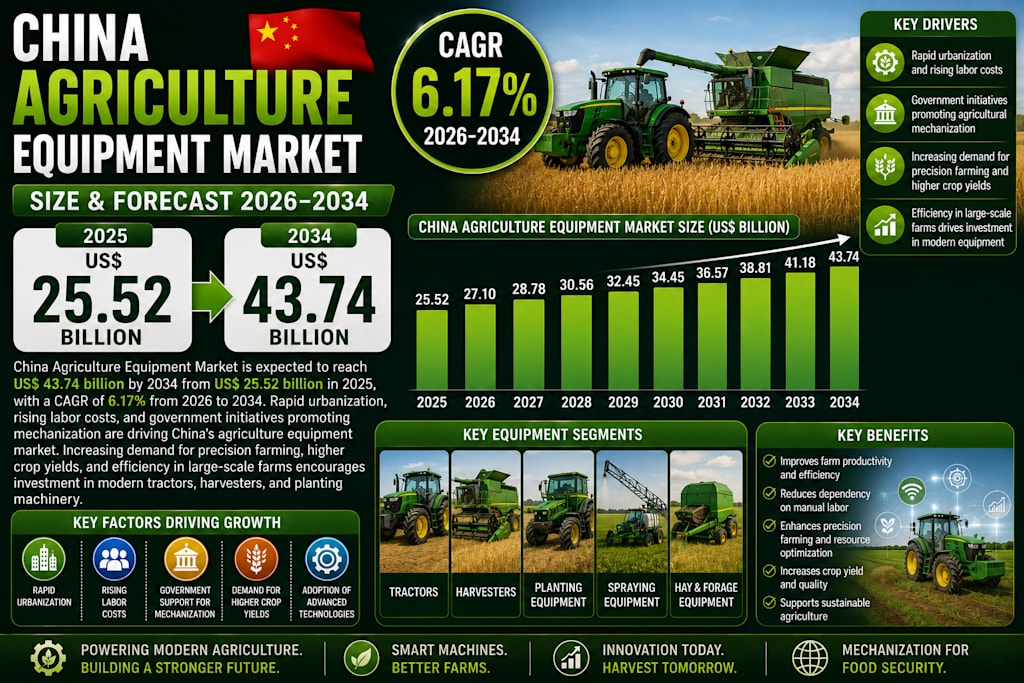
According to Renub Research, the China Agriculture Equipment Market is projected to grow from US$25.52 billion in 2025 to US$43.74 billion by 2034, registering a compound annual growth rate (CAGR) of 6.17% between 2026 and 2034. Rising mechanization, increasing demand for precision farming, labor shortages, and supportive government policies are expected to fuel market expansion.
Agricultural Mechanization Is Becoming Essential
China has long been one of the world's largest agricultural producers, but the sector faces growing challenges.
Rapid urbanization has reduced the availability of rural labor, while increasing wages have made traditional farming practices more expensive. At the same time, the need to feed a large population continues placing pressure on agricultural productivity.
Mechanization offers a practical solution to these challenges.
Modern agricultural equipment enables farmers to complete planting, spraying, harvesting, and soil preparation tasks more efficiently and accurately than manual methods. Machinery also allows farms to scale operations while maintaining productivity and reducing labor requirements.
As agricultural modernization becomes a national priority, equipment adoption continues accelerating across the country.
Government Support Drives Industry Expansion
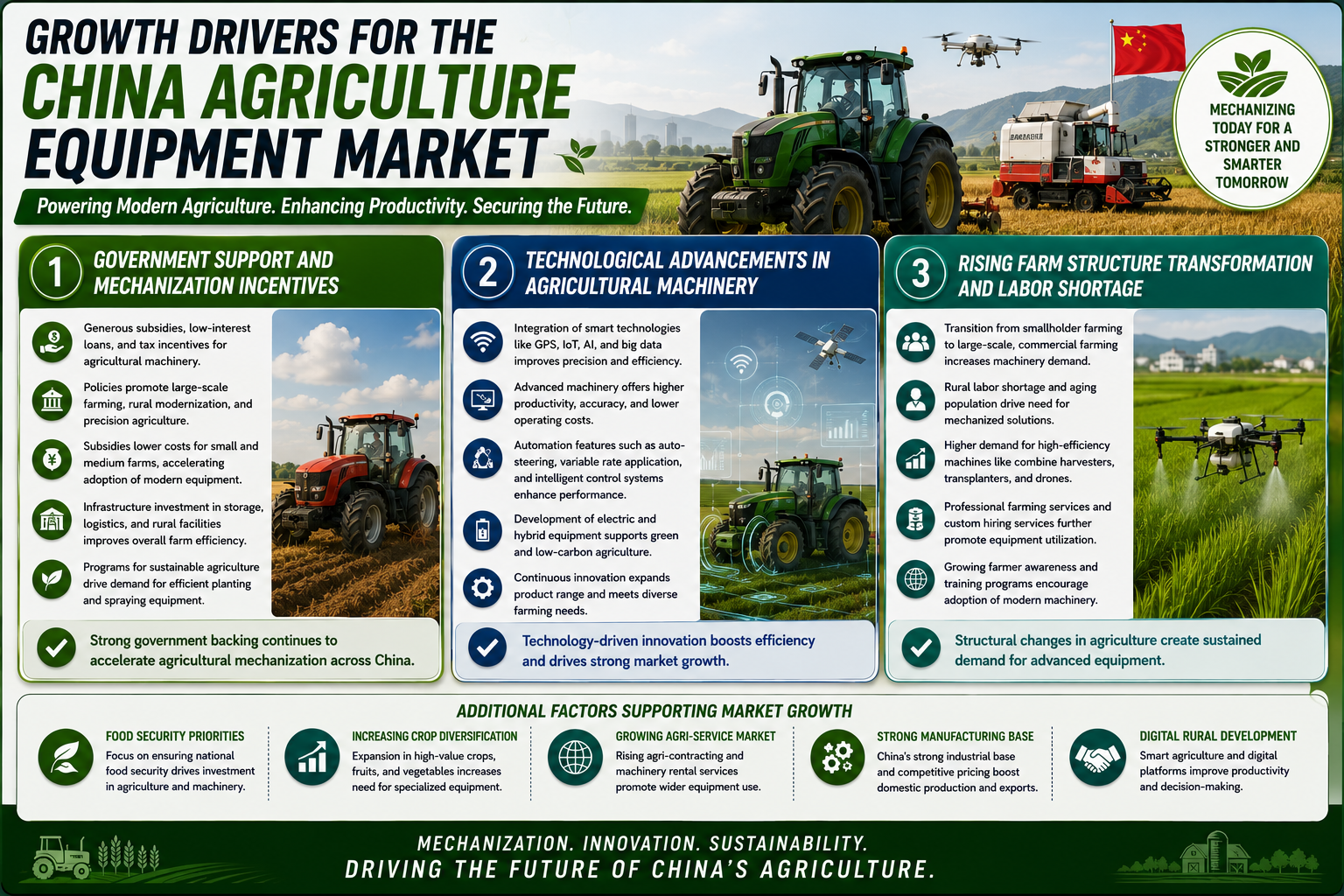
One of the strongest growth drivers for China's agricultural equipment market is government support.
The Chinese government has implemented a variety of programs aimed at encouraging mechanization and modern farming practices. Subsidies, low-interest financing, equipment purchase incentives, and rural modernization initiatives help reduce financial barriers for farmers.
These policies are particularly important for small and medium-sized agricultural operations that may otherwise struggle to invest in advanced machinery.
Government efforts also promote precision agriculture, sustainable farming practices, and efficient resource utilization.
Infrastructure investments, including logistics facilities, storage systems, and rural transportation networks, further support equipment adoption.
As policymakers continue prioritizing agricultural modernization and food security, demand for machinery is expected to remain strong.
Rising Labor Costs Encourage Automation
China's labor market is changing rapidly.
Many rural workers are migrating to urban areas in search of higher-paying employment opportunities, reducing the agricultural workforce and increasing labor costs.
For farmers, this creates significant operational challenges, particularly during labor-intensive periods such as planting and harvesting seasons.
Agricultural machinery helps address these issues by reducing dependence on manual labor while improving operational efficiency.
Equipment such as tractors, harvesters, planters, and sprayers allows farmers to complete critical tasks quickly and consistently, even with limited workforce availability.
As labor shortages continue affecting rural communities, mechanization is becoming less of an option and more of a necessity.
Precision Agriculture Is Transforming Farming Practices
Precision agriculture has emerged as one of the most important trends shaping China's agricultural equipment market.
Modern farming increasingly relies on data-driven decision-making to optimize yields, reduce waste, and improve sustainability.
Precision farming technologies integrate GPS systems, sensors, artificial intelligence, drones, and automated machinery to provide real-time insights into crop performance and field conditions.
These tools help farmers apply fertilizers, pesticides, and water more accurately, reducing costs while improving environmental outcomes.
Agricultural equipment manufacturers are increasingly incorporating precision technologies into their products, making advanced farming practices more accessible.
As awareness of precision agriculture benefits grows, demand for smart equipment is expected to increase significantly.
Smart Farming Technologies Gain Momentum
The integration of digital technologies is reshaping agricultural equipment capabilities.
Smart machinery equipped with connectivity features can collect, analyze, and transmit data related to soil conditions, weather patterns, machinery performance, and crop health.
Internet of Things (IoT) technologies allow farmers to monitor operations remotely and make informed decisions based on real-time information.
Artificial intelligence systems can help optimize planting schedules, predict maintenance requirements, and identify potential production issues before they become serious problems.
These innovations improve efficiency while supporting long-term sustainability goals.
As China continues investing in digital transformation, smart agriculture equipment is expected to play an increasingly important role.
Demand for Higher Crop Yields Supports Equipment Adoption
Food security remains a critical concern for China.
The country must continue increasing agricultural productivity to meet the needs of its large population while managing limited arable land resources.
Agricultural machinery helps farmers maximize output by ensuring timely planting, precise input application, and efficient harvesting.
Modern equipment reduces operational delays, minimizes crop losses, and improves overall farm performance.
Mechanized solutions also support consistent production quality, which is increasingly important for both domestic consumption and export markets.
As demand for agricultural output continues growing, investment in advanced equipment is expected to remain a strategic priority.
Tractors Remain the Backbone of Agricultural Mechanization
Among all categories of agricultural machinery, tractors continue to play the most fundamental role.
Tractors serve as versatile platforms capable of supporting a wide range of farming operations, including plowing, planting, spraying, hauling, and harvesting support.
Manufacturers now offer tractors in multiple horsepower categories to meet the needs of diverse farm sizes and applications.
Smaller tractors remain popular among family-operated farms, while larger commercial operations increasingly invest in high-horsepower models capable of handling extensive acreage.
Technological enhancements such as GPS guidance, autonomous steering, and fuel-efficient engines are further increasing tractor productivity.
As mechanization expands, tractors will continue serving as essential tools within China's agricultural sector.
Planting Equipment Experiences Strong Growth
The planting equipment segment is experiencing substantial growth as farmers adopt mechanized sowing methods.
Seed drills, precision planters, and automated planting systems improve seed placement accuracy, reduce waste, and support uniform crop emergence.
These benefits directly contribute to higher yields and more efficient resource utilization.
Modern planting equipment often incorporates GPS guidance, variable-rate seeding technologies, and soil monitoring capabilities.
Such features help optimize planting operations while supporting broader precision agriculture objectives.
Government support programs and increasing awareness of productivity benefits continue encouraging adoption throughout the country.
Spraying Equipment Supports Sustainable Farming
China's spraying equipment market is expanding rapidly due to growing emphasis on crop protection and sustainable resource management.
Modern sprayers allow farmers to apply pesticides, herbicides, and fertilizers with greater precision and efficiency.
Technologies such as GPS guidance and automated application controls help reduce chemical waste while improving effectiveness.
Agricultural drones have emerged as particularly important tools for spraying operations, enabling precise treatment of fields while reducing labor requirements.
As environmental concerns and regulatory expectations increase, precision spraying technologies are becoming increasingly valuable.
This segment is expected to remain one of the fastest-growing areas within the broader equipment market.
Combine Harvesters Improve Operational Efficiency
Combine harvesters represent another critical component of agricultural mechanization.
These machines integrate multiple harvesting functions, including reaping, threshing, and cleaning, into a single operation.
By significantly reducing labor requirements and improving harvesting efficiency, combine harvesters help farmers maximize productivity during critical harvest periods.
Technological advancements have further enhanced performance through features such as GPS navigation, yield monitoring, and automated adjustments.
Large-scale grain producers increasingly rely on advanced harvesters to manage crops such as rice, wheat, and corn efficiently.
As commercial farming operations expand, demand for combine harvesters is expected to continue growing.
Seed Drills Advance Precision Planting
Seed drills continue gaining popularity as farmers recognize the importance of accurate planting practices.
Unlike traditional broadcasting methods, seed drills place seeds at consistent depths and spacing, improving germination rates and crop uniformity.
Modern systems support various crop types and can be integrated with digital farming technologies.
Their ability to improve efficiency and reduce seed wastage makes them particularly attractive within precision agriculture programs.
Growing demand for cereals, vegetables, and cash crops further supports investment in advanced planting equipment.
Regional Markets Reflect Different Priorities
China's agricultural equipment market varies significantly across regions.
Shanghai
Shanghai serves primarily as a distribution and technology hub rather than a major farming center.
Demand focuses on smart agriculture solutions, greenhouse automation, hydroponic systems, and compact machinery suitable for urban and peri-urban farming.
Technology-driven products often find strong acceptance due to the city's advanced infrastructure and innovation ecosystem.
Beijing
Beijing plays an important role in agricultural research, policy development, and technology testing.
Demand centers on advanced machinery capable of supporting large-scale farming operations and sustainable agricultural practices.
Intelligent tractors, automated planting systems, and digital farm management tools are particularly important within this market.
Shenzhen
Shenzhen's agricultural equipment market reflects its status as a leading technology center.
The city is heavily involved in the development of agricultural robotics, drones, sensors, artificial intelligence applications, and precision farming technologies.
Innovation-driven companies continue introducing cutting-edge solutions that support smart agriculture initiatives across China and international markets.
High Equipment Costs Remain a Challenge
Despite strong growth prospects, equipment affordability remains a significant challenge.
Advanced tractors, harvesters, precision planters, and smart farming systems require substantial capital investment.
Although government subsidies help offset costs, many smaller farmers still face financial barriers when considering equipment purchases.
Maintenance, repair, and replacement expenses further increase ownership costs.
Manufacturers and policymakers must continue exploring financing solutions that make advanced technologies more accessible to smaller agricultural operations.
Infrastructure and Skills Gaps Limit Adoption
Another important challenge involves infrastructure and workforce readiness.
Modern agricultural equipment often requires reliable transportation networks, service centers, spare parts availability, and technical support systems.
In some rural areas, infrastructure limitations can reduce machinery efficiency and increase operating costs.
Additionally, farmers need training to operate increasingly sophisticated equipment effectively.
GPS-enabled machinery, automated systems, and precision technologies require specialized knowledge that may not be widely available.
Addressing these skill gaps through training programs and extension services will be essential for maximizing the benefits of mechanization.
Innovation Continues to Shape the Future
Recent developments highlight the industry's ongoing commitment to innovation.
In October 2024, ComNav Technology showcased advanced autosteering systems designed to improve field efficiency and reduce labor requirements. These technologies support large-scale precision agriculture initiatives and reflect growing investment in automation.
In May 2024, LiuGong introduced the S935TA sugarcane harvester, featuring precision harvesting capabilities designed to improve productivity while minimizing crop losses.
Also in May 2024, Ricardo plc and Wuzheng Group announced a strategic partnership focused on developing electric and hybrid agricultural machinery, including intelligent tractors designed to support sustainable farming practices.
These developments demonstrate how innovation continues driving market evolution.
Final Thoughts
China's agricultural equipment market is entering a period of significant transformation driven by mechanization, digitalization, and sustainability.
As labor shortages intensify, food security priorities grow, and precision agriculture technologies become more accessible, demand for advanced machinery is expected to increase steadily.
With the market projected to grow from US$25.52 billion in 2025 to US$43.74 billion by 2034, substantial opportunities exist for equipment manufacturers, technology providers, investors, and agricultural enterprises.
While challenges related to affordability, infrastructure, and technical skills remain, continued government support and technological innovation provide strong foundations for future growth.
As China continues modernizing its agricultural sector, advanced equipment will play a critical role in improving productivity, supporting rural development, and ensuring long-term food security for one of the world's largest populations.
About the Creator
Enjoyed the story? Support the Creator.
Subscribe for free to receive all their stories in your feed.
Comments
There are no comments for this story
Be the first to respond and start the conversation.