
Cell Therapy Manufacturing Is Hitting a Scalability Wall And Most Companies Are Unprepared
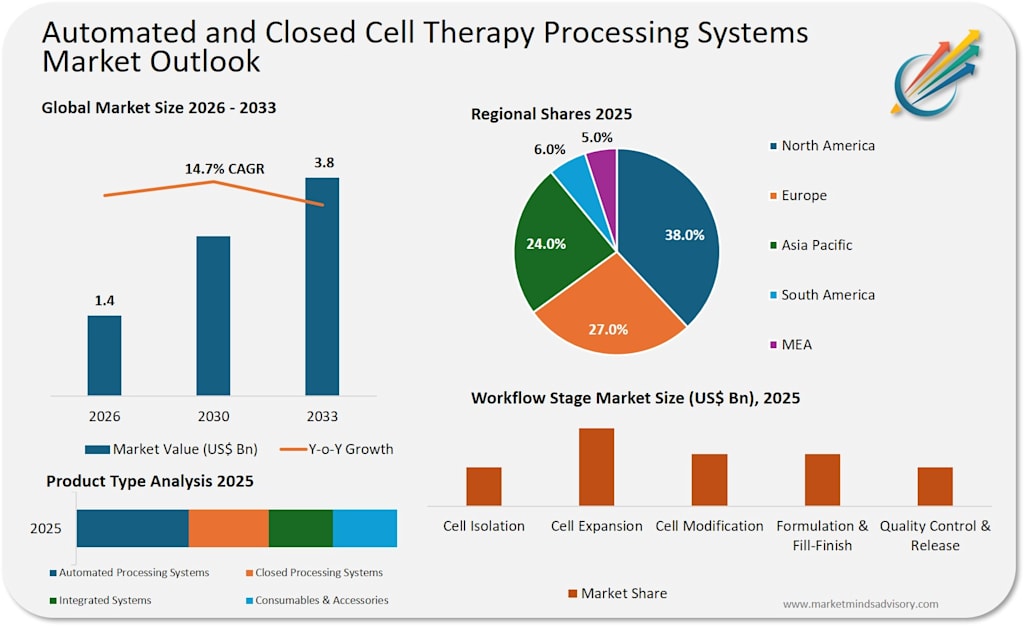
In 2026, the global market size is projected to reach USD 1.42 billion, with a forecasted compound annual growth rate (CAGR) of 14.7% from 2026 to 2033. By 2033, the market is expected to attain a value of USD 3.84 billion.

The promise of personalized medicine is colliding with industrial reality. As CAR-T therapies and regenerative treatments move from clinical trials to commercial scale, manufacturers are discovering that manual processing methods cannot support the volume, consistency, or economics required for mass adoption.
Why Manual Processing Is No Longer Viable
Cell therapy manufacturing today resembles artisan production in an industry demanding automotive-scale precision. Each batch requires specialized cleanroom environments, highly trained personnel, and weeks of processing time. The result is a bottleneck that limits patient access, inflates costs to unsustainable levels, and introduces variability that regulators increasingly view as unacceptable.
The economics are stark. Manual CAR-T production can cost upwards of $400,000 per patient, with labor representing nearly 40% of total manufacturing expenses. Contamination rates in open systems range between 2-5%, and each failure means not just financial loss but delayed treatment for critically ill patients. As approval pipelines expand beyond oncology into autoimmune disorders, neurological conditions, and genetic diseases, the gap between therapeutic potential and manufacturing capacity is widening dangerously.
Companies that continue relying on legacy processing methods face a compounding risk: they are building commercial strategies on infrastructure that cannot scale. The question is no longer whether automation will dominate cell therapy manufacturing, but how quickly laggards will be priced out of the market.
Structural Shifts Driving the Market
Regulatory Pressure Is Forcing Standardization
Global health authorities are tightening manufacturing standards as cell therapies transition from experimental treatments to mainstream medicine. The FDA’s recent guidance on Chemistry, Manufacturing, and Controls (CMC) for cellular therapies explicitly favors closed, automated systems that minimize human intervention. European regulators are following suit, creating a compliance environment where manual processing increasingly represents regulatory risk rather than flexibility.
This shift is not merely procedural. Regulators are demanding reproducibility data that open systems struggle to provide. Automated platforms generate digital audit trails, real-time monitoring, and batch-to-batch consistency that manual processes cannot match. For companies seeking approval in multiple jurisdictions, closed systems are becoming the only viable path to global commercialization.
Economic Realities Are Reshaping Investment Priorities
The cell therapy sector attracted over $18 billion in investment capital last year, but investors are becoming more discriminating about manufacturing strategies. Due diligence now routinely includes assessments of production scalability, cost-per-dose trajectories, and automation roadmaps. Companies without credible plans to reduce manufacturing costs by 60-70% over the next five years are facing valuation discounts or outright funding rejections.
Payers are equally focused on economics. Insurance providers and national health systems are signaling that reimbursement models will not support current pricing indefinitely. The UK’s National Institute for Health and Care Excellence (NICE) has already rejected several cell therapies on cost-effectiveness grounds. Automated processing is not just an operational improvement but a market access requirement.
Technology Convergence Is Enabling True Closed-Loop Manufacturing
Recent advances in bioreactor design, AI-driven process control, and single-use technologies are finally making fully automated cell therapy production technically feasible. Systems can now handle the entire workflow from apheresis to formulation without breaking sterile barriers. Machine learning algorithms optimize culture conditions in real-time, adapting to patient-specific cell characteristics that previously required expert intervention.
The integration of these technologies is creating a new competitive dynamic. Early adopters are achieving 10-15 day reductions in vein-to-vein time, 80%+ decreases in contamination risk, and manufacturing costs approaching $100,000 per dose. These improvements are not incremental; they represent a fundamental shift in what is economically and operationally possible.
Where the Real Opportunity Lies
The highest-value opportunities are concentrated in three areas. Allogeneic therapy platforms represent the most compelling use case for automation because they require industrial-scale production from healthy donor cells. Companies developing off-the-shelf products need systems capable of producing thousands of doses per batch with pharmaceutical-grade consistency. The economics only work with full automation.
Autologous therapies for solid tumors present a different but equally urgent opportunity. Unlike hematological cancers where CAR-T has proven successful, solid tumor applications require more complex cell engineering and shorter processing windows. Automated systems that can handle multi-step genetic modifications while maintaining cell viability are becoming essential as next-generation therapies enter clinical development.
Contract development and manufacturing organizations (CDMOs) face existential pressure to automate. As therapy developers increasingly outsource production, CDMOs must demonstrate they can handle multiple product types, maintain segregated workflows, and scale rapidly. Manual operations cannot meet these requirements. CDMOs investing in modular, automated platforms are capturing disproportionate market share while those relying on traditional infrastructure are losing clients to more capable competitors.
The Competitive Landscape Is Fragmenting
The market is splitting into two distinct tiers. Integrated platform providers offering end-to-end automation are commanding premium positioning and long-term partnerships with major therapy developers. These systems, while requiring significant capital investment, provide the scalability and regulatory confidence that commercial-stage companies demand.
Point solution providers focusing on specific process steps face commoditization pressure. As integrated platforms mature, the value of standalone automation for individual unit operations is declining. Companies in this segment must either move up the value chain by developing broader capabilities or accept margin compression as their products become interchangeable components in larger systems.
The risk extends beyond technology providers. Therapy developers that have built internal manufacturing around manual or semi-automated processes face a strategic dilemma. Retrofitting existing facilities is often more expensive than building new automated capacity, but abandoning sunk investments is politically and financially difficult. This hesitation is creating a two-speed market where automated manufacturers are pulling ahead in cost structure and production capacity while traditional players struggle to compete.
The Cost of Delayed Action
Companies that postpone automation investments face compounding disadvantages:
Regulatory vulnerability: As standards tighten, manual processes will require increasingly expensive validation and monitoring to maintain compliance, eventually becoming unapprovable for new indications.
Talent scarcity: The specialized workforce required for manual cell therapy manufacturing is not scaling with demand. Labor costs are rising 15-20% annually in key markets, and turnover rates exceed 30% in some facilities.
Competitive displacement: Early movers in automation are establishing cost structures that will be impossible for manual manufacturers to match, effectively pricing them out of competitive bids and partnership opportunities.
Stranded assets: Facilities designed around manual processing are becoming obsolete faster than their depreciation schedules, creating balance sheet write-downs and limiting strategic flexibility.
The window for orderly transition is narrowing. Companies that wait for automation technology to fully mature will find themselves too far behind to catch up.
About the Creator
Sanjay Vane
At Market Minds Advisory, we’re more than just consultants—we’re partners in your journey to growth and success.
Enjoyed the story? Support the Creator.
Subscribe for free to receive all their stories in your feed.
Comments
There are no comments for this story
Be the first to respond and start the conversation.