
Ceiling Tiles Are No Longer Just Overhead: They’re Becoming Strategic Infrastructure Assets
In 2026, the market is estimated to be valued at USD 8.2 billion, with projections indicating a rise to USD 13.7 billion by 2033, reflecting a CAGR of 7.5% during the forecast period.

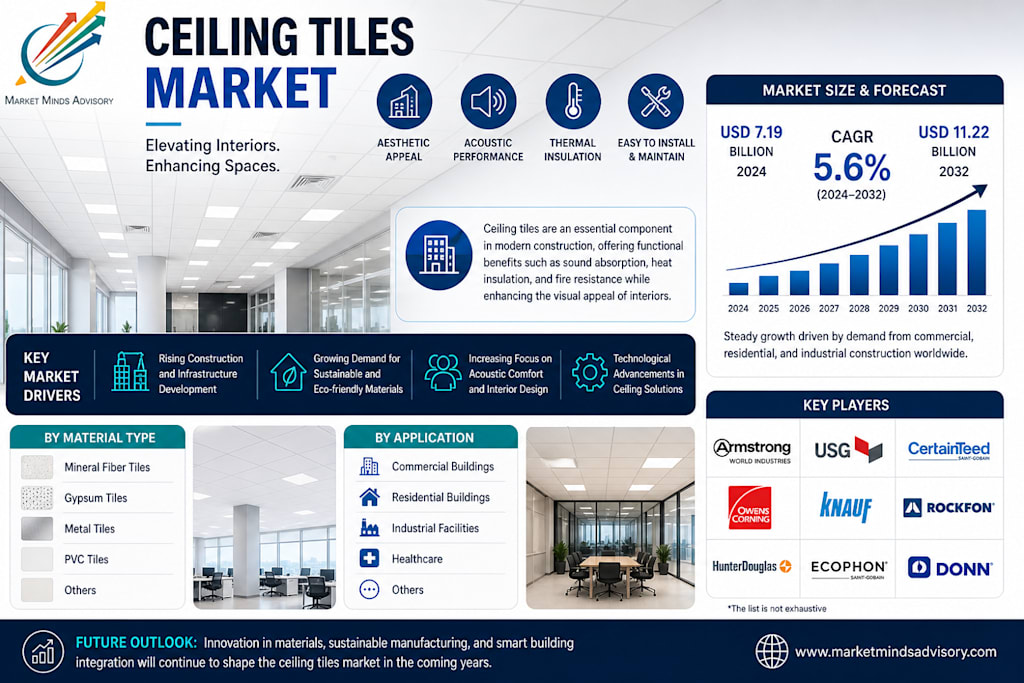
The commercial real estate sector is quietly undergoing a fundamental shift in how it values interior infrastructure, and ceiling systems are emerging as a critical battleground for sustainability compliance, indoor air quality mandates, and operational cost reduction.
The global ceiling tiles market is experiencing a structural transformation that extends far beyond aesthetic preferences or basic functionality. What was once a commoditized building material category is now intersecting with regulatory pressure on embodied carbon, workplace wellness standards, and the urgent need to retrofit aging commercial stock. Companies that continue treating ceiling procurement as a low-value purchasing decision are exposing themselves to compliance risks, missed energy savings, and competitive disadvantage in attracting tenants and talent.
Why This Market Shift Matters Now
Three converging forces are elevating ceiling systems from background infrastructure to strategic decision points. First, building codes in major markets are tightening restrictions on volatile organic compound emissions and fire safety standards, forcing property owners to accelerate replacement cycles. Second, the post-pandemic focus on indoor air quality has made acoustic and ventilation performance non-negotiable features rather than premium options. Third, corporate sustainability commitments are pushing procurement teams to scrutinize the embodied carbon in every building component, including the estimated 2 billion square feet of ceiling tiles replaced annually in commercial buildings.
The financial implications are substantial. A typical commercial office building spends 15-20% of its interior renovation budget on ceiling systems, yet most organizations lack visibility into how material choices impact long-term operational costs, insurance premiums, and asset valuations. Early movers are discovering that strategic ceiling system upgrades can reduce HVAC loads by 8-12%, improve acoustic performance that correlates with 5-7% productivity gains, and qualify properties for green building certifications that command rental premiums.
Structural Shifts Driving the Market
Regulatory Tightening Is Accelerating Replacement Demand
Building safety regulations are evolving faster than typical replacement cycles. The European Union’s updated Construction Products Regulation and similar frameworks in North America are imposing stricter limits on flame spread ratings and smoke development. Properties using legacy ceiling materials face potential non-compliance within 3-5 years in many jurisdictions. This isn’t a gradual transition but a hard deadline that will compress replacement demand into a narrow window, creating supply constraints and price volatility for those who delay action.
Simultaneously, indoor air quality standards are moving from voluntary guidelines to enforceable requirements. ASHRAE Standard 241 and similar protocols now specify minimum ventilation effectiveness that older ceiling systems cannot support without costly HVAC modifications. The alternative is ceiling tiles engineered with integrated air distribution and filtration capabilities, but these advanced systems require lead times of 12-16 weeks and specialized installation expertise that is already in short supply.
Material Science Innovation Is Fragmenting the Competitive Landscape
The traditional dominance of mineral fiber is being challenged by bio-based composites, recycled content materials, and hybrid systems that integrate lighting, sensors, and air purification. These alternatives aren’t just environmental gestures but they deliver measurable performance advantages. Bio-based ceiling tiles can achieve comparable or superior acoustic ratings while reducing embodied carbon by 40-60%. Recycled content options are closing the cost gap with conventional materials while offering supply chain resilience advantages as virgin material costs fluctuate.
However, this proliferation of options creates decision complexity. Procurement teams accustomed to simple price-per-square-foot comparisons now face total cost of ownership calculations that must account for installation labor differences, maintenance requirements, end-of-life disposal costs, and performance attributes that impact other building systems. Organizations without sophisticated evaluation frameworks are either paralyzed by choice or defaulting to familiar options that may no longer represent optimal value.
The Retrofit Economy Is Overtaking New Construction as the Primary Growth Driver
New commercial construction has plateaued in many developed markets, but the retrofit opportunity is expanding rapidly. An estimated 60% of commercial building stock in North America and Europe was constructed before modern energy codes and will require substantial upgrades to meet 2030 climate targets. Ceiling systems are often the most cost-effective intervention point because replacement can be executed without major tenant disruption and delivers immediate improvements in multiple performance dimensions.
The economics of retrofit are becoming increasingly compelling. Energy-efficient ceiling tiles with high light reflectance can reduce lighting energy consumption by 10-15% while improving workspace illumination quality. When combined with integrated LED fixtures and occupancy sensors, the payback period can compress to under three years. Yet most building owners are still approaching ceiling replacement reactively, waiting for visible damage rather than proactively capturing these operational savings.
Where the Real Opportunity Lies
The highest-value opportunities are concentrated in three specific use cases. Healthcare facilities face the most stringent requirements for infection control, acoustic performance, and cleanability, creating demand for premium antimicrobial and washable ceiling systems that command 30-50% price premiums. Educational institutions are prioritizing acoustic performance to support learning outcomes, with research demonstrating that proper ceiling specification can improve speech intelligibility scores by 20-25 points. Data centers and industrial facilities are discovering that ceiling systems engineered for thermal management can reduce cooling costs by 8-12% while improving equipment reliability.
Geographic concentration matters significantly. Markets with aggressive carbon reduction mandates, such as California, the Nordic countries, and parts of Asia-Pacific, are seeing 2-3 times faster adoption of low-embodied-carbon ceiling materials. Companies with significant property portfolios in these regions face near-term compliance pressure that will require coordinated procurement strategies and potentially new supplier relationships.
Competitive or Strategic Shift
The competitive landscape is bifurcating between scale players optimizing manufacturing efficiency for commodity segments and specialized providers developing high-performance systems for demanding applications. The middle ground is eroding rapidly. Manufacturers competing primarily on price are facing margin compression as raw material costs rise and customers become more sophisticated about total cost of ownership. Meanwhile, premium providers are capturing disproportionate value by bundling ceiling tiles with integrated systems, installation services, and performance guarantees.
Distribution channels are also consolidating. Large construction supply distributors are leveraging purchasing power to extract concessions from manufacturers, while direct-to-owner sales models are gaining traction for major retrofit projects where customization and technical support justify bypassing traditional channels. This creates strategic risk for manufacturers overly dependent on any single route to market.
The Cost of Delayed Action
Organizations that defer strategic ceiling system decisions face multiple compounding risks:
Regulatory non-compliance penalties that can reach $10,000-$50,000 per violation in some jurisdictions, plus potential building use restrictions
Stranded asset risk as properties with outdated systems face valuation discounts of 5-15% compared to comparable buildings with modern, sustainable infrastructure
Talent attraction disadvantage as workplace quality becomes a competitive differentiator, with 68% of knowledge workers citing environmental quality as important to employer choice
Operational cost escalation from missed energy savings that compound annually, potentially totaling $0.50-$1.20 per square foot over a typical 10-year period
Supply chain disruption exposure as demand compression creates capacity constraints and extends lead times from weeks to months
The window for proactive planning is narrowing. Organizations that wait until compliance deadlines are imminent will face premium pricing, limited material selection, and installation capacity shortages.
About the Creator
Sanjay Vane
At Market Minds Advisory, we’re more than just consultants—we’re partners in your journey to growth and success.
Enjoyed the story? Support the Creator.
Subscribe for free to receive all their stories in your feed.
Comments
There are no comments for this story
Be the first to respond and start the conversation.