
Can India’s Gas Genset Market Reach USD 420.61 Million by 2034 as Clean Energy Adoption and Gas Infrastructure Expand?
Growing natural gas availability, stricter environmental regulations, rising industrial demand, and government support for cleaner energy are accelerating India’s gas genset market growth.

India's energy landscape is undergoing a major transformation as industries, businesses, and government agencies increasingly seek cleaner and more efficient power generation solutions. While diesel generators have traditionally dominated the backup power market, growing environmental concerns and expanding natural gas infrastructure are encouraging a shift toward gas-powered generator sets.
Gas gensets, which operate using natural gas, LPG, biogas, or other gaseous fuels, are emerging as an attractive alternative due to their lower emissions, quieter operation, and reduced operating costs in areas with reliable gas availability. As India accelerates its transition toward cleaner energy sources, gas gensets are becoming an increasingly important component of the country's power generation ecosystem.
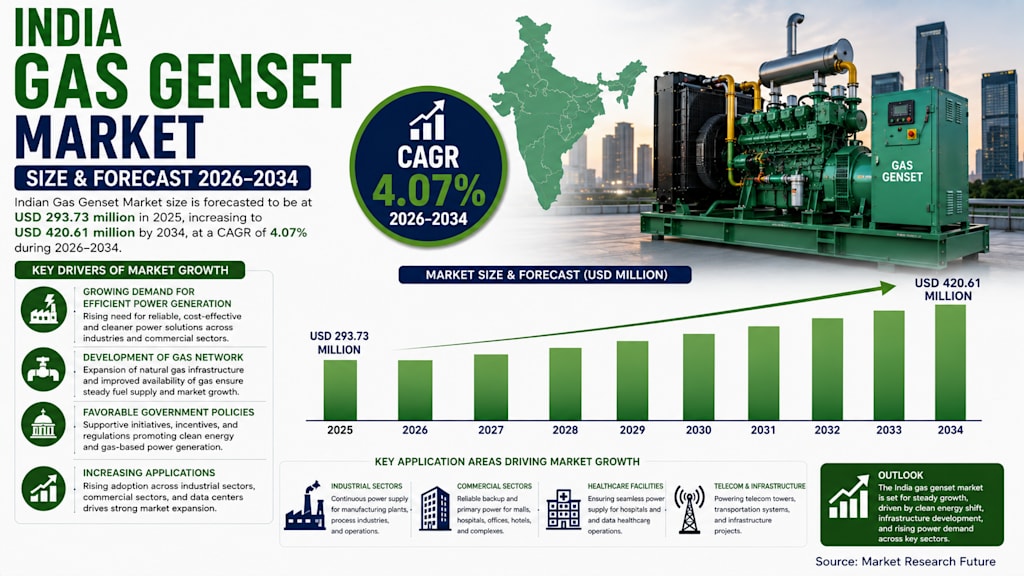
According to Renub Research, the India Gas Genset Market is projected to grow from USD 293.73 million in 2025 to USD 420.61 million by 2034, expanding at a CAGR of 4.07% during 2026–2034. Growth is being driven by the expansion of gas infrastructure, rising demand for uninterrupted power supply, increasing industrialization, and favorable government policies promoting cleaner fuels.
Understanding the Growing Importance of Gas Gensets
Gas gensets combine a gas-powered internal combustion engine with an alternator to generate electricity. These systems can operate using natural gas, compressed natural gas (CNG), piped natural gas (PNG), liquefied petroleum gas (LPG), or biogas depending on availability and application requirements.
Compared with diesel generators, gas gensets produce significantly lower emissions of nitrogen oxides, sulfur dioxide, and particulate matter. They also generate less noise and often provide lower operating costs when connected to established gas distribution networks.
The growing focus on sustainability and cleaner energy sources has positioned gas gensets as a preferred choice for businesses seeking reliable backup power while complying with environmental regulations.
Industries, hospitals, hotels, IT parks, commercial complexes, and educational institutions increasingly view gas gensets as a practical solution that balances reliability with environmental responsibility.
Expansion of Natural Gas Infrastructure Drives Market Growth
One of the most significant factors supporting market expansion is the rapid development of India's natural gas infrastructure.
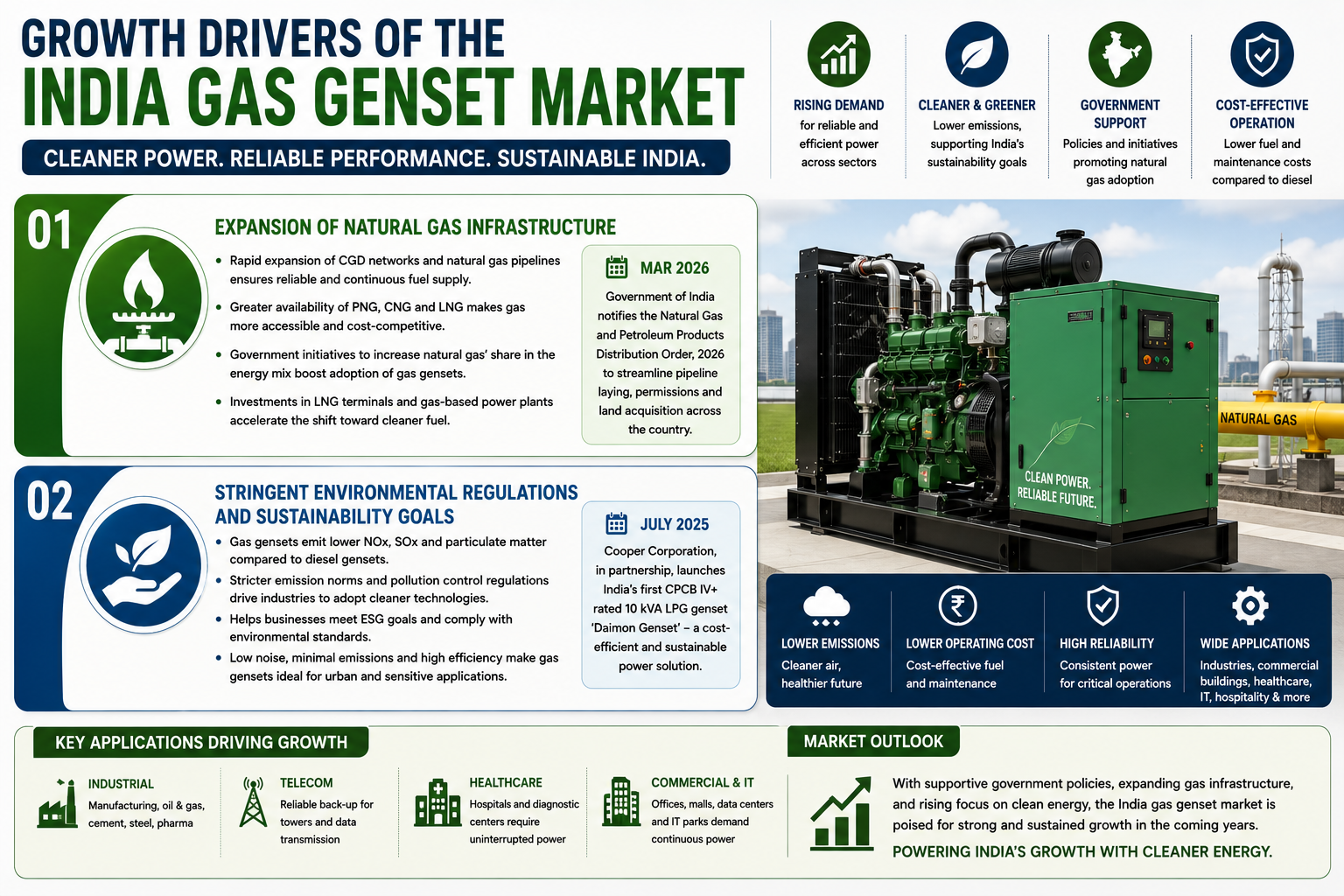
The Indian government has been actively promoting natural gas as a key component of the country's future energy mix. Investments in city gas distribution networks, interstate pipelines, LNG terminals, and related infrastructure are significantly improving access to natural gas across multiple regions.
The increasing availability of PNG and CNG is making gas gensets more practical and economically attractive for businesses.
As fuel accessibility improves, companies are becoming more confident in adopting gas-based power generation technologies for both primary and backup applications.
In March 2026, the Government of India introduced the Natural Gas and Petroleum Products Distribution Order, 2026, aimed at streamlining pipeline development and accelerating gas infrastructure expansion across the country. Such initiatives are expected to strengthen long-term market growth.
Environmental Regulations Encourage Cleaner Power Solutions
India's commitment to reducing carbon emissions and improving air quality has become a major catalyst for gas genset adoption.
Environmental regulations targeting industrial emissions are becoming increasingly stringent, particularly in urban and industrialized regions. Organizations are under growing pressure to adopt cleaner technologies that align with sustainability goals and regulatory requirements.
Gas gensets offer a significant advantage because they emit fewer pollutants compared with diesel generators.
Businesses can maintain reliable power generation capabilities while reducing their environmental footprint and meeting compliance obligations.
Corporate sustainability initiatives and Environmental, Social, and Governance (ESG) commitments are also encouraging companies to invest in cleaner backup power solutions.
As environmental awareness continues to rise, gas gensets are expected to gain broader acceptance across multiple sectors.
Industrial Growth Is Creating Strong Demand
Industrial expansion remains one of the strongest drivers of the India gas genset market.
Manufacturing facilities require dependable power supplies to maintain production schedules and prevent costly operational disruptions. Industries such as chemicals, pharmaceuticals, textiles, food processing, automotive manufacturing, and cement production increasingly rely on gas gensets for reliable energy support.
Many industrial facilities are also adopting combined heat and power (CHP) systems that utilize gas gensets to generate both electricity and useful thermal energy.
This dual-purpose capability significantly improves energy efficiency and helps reduce operating costs.
As India's manufacturing sector continues to expand under initiatives such as Make in India, demand for efficient and environmentally friendly power solutions is expected to grow steadily.
Commercial Sector Adoption Continues to Accelerate
Commercial establishments are becoming major adopters of gas genset technology.
Hotels, shopping malls, hospitals, office complexes, educational institutions, entertainment venues, and retail centers require uninterrupted power to support daily operations and maintain customer satisfaction.
Gas gensets provide reliable backup electricity while offering quieter operation compared with traditional diesel systems.
This advantage is particularly valuable in densely populated urban environments where noise restrictions and environmental regulations are becoming increasingly important.
The expansion of commercial real estate projects and organized retail infrastructure across India is creating new opportunities for gas genset manufacturers.
As businesses prioritize operational continuity and sustainability, commercial demand is expected to remain strong.
Data Centers and IT Infrastructure Support Market Expansion
India's rapidly expanding digital economy is generating substantial demand for reliable backup power systems.
The growth of cloud computing, digital payments, artificial intelligence, e-commerce platforms, and data storage facilities has increased the importance of uninterrupted electricity supply.
Data centers require continuous power availability to protect critical information and ensure operational reliability.
Gas gensets are increasingly being considered for these facilities due to their environmental advantages and dependable performance.
Similarly, IT parks and technology campuses are adopting cleaner energy solutions to align with corporate sustainability objectives.
As India's digital infrastructure continues to expand, demand for advanced gas-powered generation systems is expected to rise significantly.
Low KVA Gas Gensets Gain Popularity in Urban Areas
Low-capacity gas gensets, typically up to 75 kVA, are becoming increasingly popular across urban markets.
These systems are commonly used by small businesses, retail establishments, educational institutions, healthcare clinics, restaurants, banks, and office spaces.
Their compact design, low emissions, and quiet operation make them particularly suitable for urban environments where environmental regulations are stricter.
The expansion of city gas distribution networks has improved fuel accessibility, encouraging greater adoption among small and medium-sized enterprises.
As urbanization continues and awareness of cleaner energy solutions grows, demand within the low KVA segment is expected to increase steadily.
High KVA Gas Gensets Support Critical Infrastructure
High-capacity gas gensets exceeding 75 kVA are essential for facilities with substantial power requirements.
Hospitals, airports, data centers, industrial complexes, IT parks, manufacturing facilities, and large commercial buildings depend on these systems for reliable electricity generation.
High KVA gas gensets offer the ability to handle significant electrical loads while maintaining environmental compliance.
Their compatibility with combined heat and power systems further enhances their value by improving overall energy efficiency.
Government support for cleaner fuels and ongoing investments in gas infrastructure are expected to strengthen growth within this segment.
Rising Adoption of CHP Systems Improves Market Prospects
Combined Heat and Power technology is creating additional opportunities for gas genset deployment.
CHP systems simultaneously generate electricity and useful thermal energy from a single fuel source, significantly improving overall energy utilization.
Industries with substantial heating requirements can benefit from reduced fuel consumption and lower operating costs through CHP implementation.
Gas gensets are particularly well suited for CHP applications due to their efficiency and environmental performance.
As businesses seek ways to optimize energy use and reduce carbon emissions, CHP adoption is expected to support future market growth.
Limited Gas Availability Remains a Challenge
Despite substantial progress in infrastructure development, natural gas availability remains uneven across India.
Gas pipeline networks and city gas distribution systems are concentrated primarily in urban and industrial regions, leaving many rural and remote areas with limited access.
This infrastructure gap restricts gas genset adoption in several parts of the country.
Companies operating in areas without reliable gas supply often continue relying on diesel generators or other alternatives.
Expanding gas infrastructure nationwide will require significant investment and long-term planning.
Until broader coverage is achieved, availability constraints will remain a challenge for market expansion.
High Initial Costs Impact Adoption Rates
Another obstacle facing the market is the relatively high initial investment associated with gas genset systems.
Installation often requires specialized engines, gas pipelines, storage facilities, safety systems, and additional infrastructure.
For small and medium-sized enterprises, these upfront costs can be a significant barrier.
Fluctuations in natural gas and LNG prices also introduce uncertainty regarding long-term operating expenses.
Although gas gensets often provide economic benefits over time through lower fuel and maintenance costs, the higher initial investment may discourage some potential buyers.
Maharashtra Leads the Regional Market
Maharashtra represents one of India's most important gas genset markets.
Cities such as Mumbai, Pune, and Nagpur benefit from extensive industrial activity, advanced infrastructure, and expanding city gas distribution networks.
Industries including pharmaceuticals, automotive manufacturing, chemicals, information technology, and healthcare are increasingly adopting gas-based power solutions.
Commercial establishments such as hotels, hospitals, shopping centers, and data centers further contribute to demand.
The state's focus on environmental sustainability and emission reduction is expected to continue supporting market growth.
Gujarat Emerges as a Gas Genset Powerhouse
Gujarat's advanced gas infrastructure and industrial strength make it one of the leading markets for gas gensets in India.
The state possesses extensive pipeline networks and widespread city gas distribution systems, ensuring reliable fuel availability.
Major industrial sectors including petrochemicals, chemicals, engineering, textiles, ceramics, and manufacturing rely heavily on dependable power solutions.
Cities such as Ahmedabad, Surat, Vadodara, and Rajkot continue driving adoption through strong industrial and commercial activity.
Gujarat's commitment to sustainable industrial development further enhances growth opportunities for gas genset providers.
Uttar Pradesh and Andhra Pradesh Show Strong Potential
Uttar Pradesh is experiencing rapid growth due to expanding gas infrastructure, urbanization, industrial development, and smart city initiatives.
Cities including Noida, Ghaziabad, Kanpur, and Lucknow are increasingly embracing cleaner energy solutions.
Meanwhile, Andhra Pradesh benefits from strong industrial activity, coastal LNG access, special economic zones, and expanding commercial development.
Cities such as Visakhapatnam, Vijayawada, and Tirupati are creating new opportunities for gas genset deployment across multiple sectors.
Both states are expected to play important roles in the future expansion of India's gas genset market.
Final Thoughts
India's Gas Genset Market is steadily evolving as businesses seek cleaner, more efficient, and environmentally responsible power generation solutions.
Government support for natural gas infrastructure, stricter environmental regulations, industrial expansion, and increasing commercial demand are creating favorable conditions for long-term growth.
Although challenges related to gas availability and initial investment costs remain, the benefits of lower emissions, quieter operation, and improved sustainability continue driving adoption.
With the market projected to grow from USD 293.73 million in 2025 to USD 420.61 million by 2034, gas gensets are expected to become an increasingly important part of India's energy transition strategy, helping businesses balance reliability, efficiency, and environmental responsibility.
About the Creator
Enjoyed the story? Support the Creator.
Subscribe for free to receive all their stories in your feed.
Comments
There are no comments for this story
Be the first to respond and start the conversation.