
Building Management System Market Surges as Smart Buildings and Sustainability Goals Transform Global Infrastructure
Growing demand for energy-efficient buildings, smart city development, and advanced automation technologies is driving rapid expansion in the Building Management System industry.

Modern buildings are becoming increasingly intelligent. What was once a collection of independent systems for lighting, heating, ventilation, security, and power management is now evolving into an interconnected digital ecosystem capable of optimizing performance, reducing costs, and enhancing occupant comfort. At the center of this transformation is the Building Management System (BMS), a technology that is rapidly becoming indispensable in modern infrastructure.
As organizations seek to improve energy efficiency, strengthen security, and support sustainability objectives, Building Management Systems are emerging as critical tools for managing complex facilities. These systems enable building owners and facility managers to monitor and control multiple building functions through a centralized platform, helping reduce operational expenses while improving overall performance.
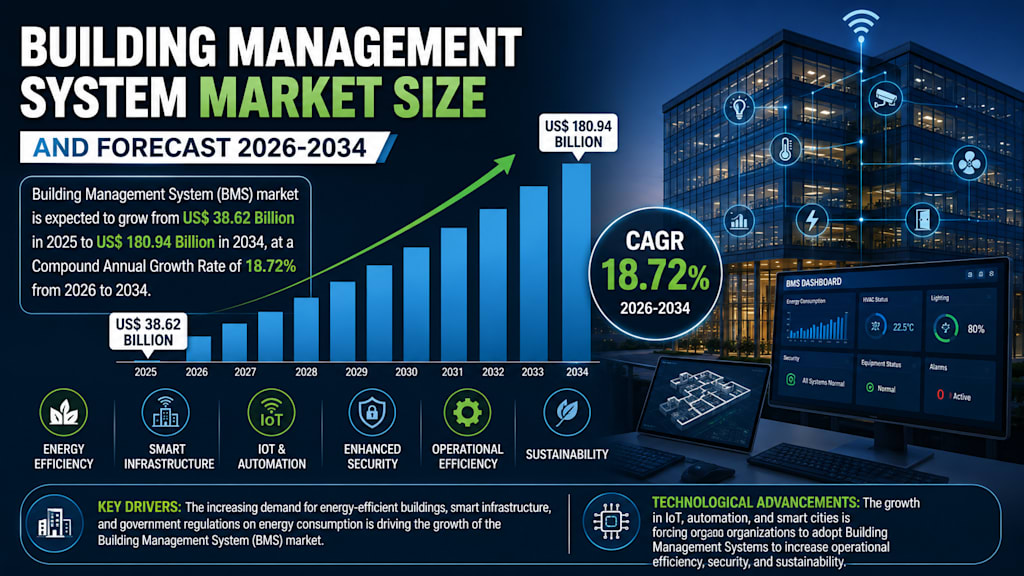
The increasing adoption of smart buildings, the rise of smart city initiatives, and growing environmental regulations are creating significant opportunities for the industry. According to Renub Research, the global Building Management System Market is projected to grow from US$ 38.62 billion in 2025 to US$ 180.94 billion by 2034, registering an impressive compound annual growth rate (CAGR) of 18.72% during the forecast period from 2026 to 2034. This remarkable growth reflects the increasing importance of intelligent infrastructure in the global economy.
Understanding the Role of Building Management Systems
A Building Management System, often referred to as a Building Automation System (BAS), is an integrated platform that monitors, controls, and optimizes various building operations. These systems typically manage heating, ventilation, and air conditioning (HVAC), lighting, power distribution, security systems, fire safety infrastructure, and other essential building functions.
By collecting information from sensors, controllers, and connected devices throughout a facility, a Building Management System enables real-time monitoring and automated decision-making. Facility managers can view operational data, identify inefficiencies, and make adjustments through a centralized interface.
This centralized approach offers substantial advantages compared to managing individual systems independently. Building operators gain better visibility into building performance while improving operational efficiency and reducing maintenance requirements.
As buildings become more technologically sophisticated, Building Management Systems are increasingly viewed as essential infrastructure rather than optional upgrades.
Energy Efficiency Is Driving Market Growth
One of the most significant factors fueling demand for Building Management Systems is the growing focus on energy efficiency.
Buildings account for a substantial share of global energy consumption and carbon emissions. Governments, businesses, and environmental organizations are under increasing pressure to reduce energy waste and improve sustainability. Building Management Systems help address these challenges by optimizing the use of resources such as electricity, heating, cooling, and lighting.
Advanced automation capabilities enable systems to adjust building operations based on occupancy levels, environmental conditions, and real-time energy demands. This minimizes unnecessary consumption while maintaining occupant comfort.
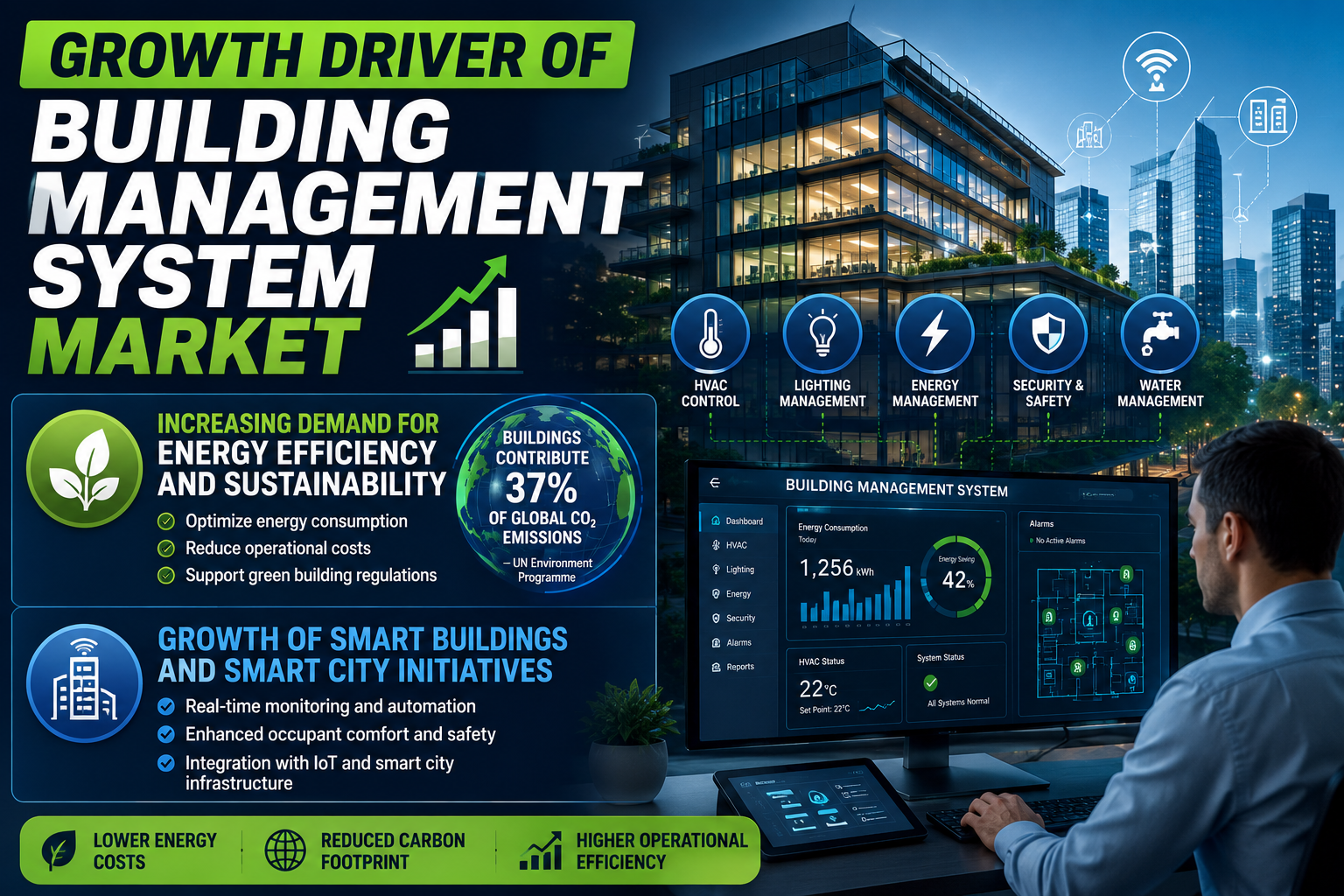
According to information highlighted in the market report, buildings contribute approximately 37% of global carbon dioxide emissions, increasing the urgency for energy optimization solutions. Advanced building management technologies are helping organizations significantly reduce operational carbon emissions and improve sustainability outcomes.
As environmental regulations become more stringent, investment in energy-efficient building technologies is expected to continue accelerating.
Smart Buildings Are Transforming Infrastructure
The rise of smart buildings is creating enormous opportunities for the Building Management System market.
Smart buildings utilize connected technologies to automate and optimize building operations. Through the integration of sensors, communication networks, artificial intelligence, and cloud-based platforms, these facilities can adapt dynamically to changing conditions and user requirements.
Building Management Systems serve as the operational backbone of smart buildings by coordinating multiple building functions and ensuring efficient performance. They enable systems to communicate with one another, share data, and respond intelligently to environmental changes.
For example, lighting systems can automatically adjust based on occupancy and natural daylight availability, while HVAC systems can optimize temperature settings according to real-time usage patterns.
The growing popularity of smart buildings across commercial, residential, healthcare, and industrial sectors is expected to remain a major driver of market expansion.
Smart City Development Is Accelerating Adoption
Governments around the world are investing heavily in smart city initiatives designed to improve urban efficiency, sustainability, and quality of life.
These projects involve the integration of intelligent transportation systems, digital infrastructure, smart utilities, and advanced building technologies. Building Management Systems play a critical role in these environments by helping optimize resource utilization and improve operational performance.
Smart city developments require buildings that can communicate with broader urban networks while minimizing energy consumption and environmental impact. Building Management Systems provide the necessary technological foundation to support these objectives.
The incorporation of Internet of Things (IoT) sensors, cloud computing, and artificial intelligence is enhancing the capabilities of modern building management platforms, making them increasingly valuable within smart city ecosystems.
As urbanization continues globally, the demand for intelligent building solutions is expected to grow substantially.
Organizations Seek Better Facility Management
Modern facilities are becoming increasingly complex, creating a need for more sophisticated management solutions.
Large commercial buildings, hospitals, airports, hotels, educational institutions, and industrial facilities rely on multiple interconnected systems that require continuous monitoring and maintenance. Managing these systems manually can be costly, inefficient, and prone to human error.
Building Management Systems simplify facility management by providing centralized oversight of critical infrastructure. Facility managers can monitor performance, identify maintenance needs, and respond to issues more quickly.
Predictive maintenance capabilities are particularly valuable because they help identify potential equipment failures before they occur. This reduces downtime, extends equipment lifespan, and lowers maintenance costs.
Organizations are increasingly adopting Building Management Systems as part of broader efforts to improve operational efficiency and maximize asset performance.
HVAC Systems Represent a Major Application Area
Heating, ventilation, and air conditioning systems represent one of the most important applications for Building Management Systems.
HVAC systems are often among the largest consumers of energy within commercial and residential buildings. Optimizing their performance can generate significant cost savings and environmental benefits.
Building Management Systems enable centralized control of HVAC operations by monitoring temperature, humidity, airflow, and occupancy levels. Advanced analytics help ensure that systems operate efficiently while maintaining comfortable indoor environments.
Real-time monitoring capabilities allow facility managers to identify inefficiencies and make adjustments that improve performance. Predictive maintenance features can also detect equipment issues before they result in costly failures.
As organizations prioritize energy conservation and occupant comfort, HVAC-focused building management solutions continue to experience strong demand.
Security and Access Control Are Becoming More Advanced
Security has become an increasingly important aspect of modern building management.
Building Management Systems now integrate surveillance cameras, access control systems, biometric authentication technologies, alarm systems, and other security solutions into unified platforms. This integration allows organizations to monitor security operations more effectively and respond rapidly to potential threats.
Advanced access control capabilities enable building managers to restrict access to sensitive areas and ensure that only authorized personnel can enter specific locations. Real-time monitoring enhances situational awareness and improves overall security management.
Cloud-based platforms and mobile applications are making security management even more accessible, allowing authorized users to monitor facilities remotely.
As concerns regarding physical security continue to increase, integrated security management systems are expected to remain a key growth area within the market.
Fire and Safety Integration Enhances Protection
Fire safety represents another critical component of Building Management Systems.
Modern platforms integrate smoke detectors, fire alarms, sprinkler systems, emergency lighting, and evacuation systems into comprehensive safety networks. These systems can automatically detect emergencies, activate protective measures, and notify emergency responders when necessary.
Automated coordination between fire safety systems and other building functions helps improve emergency response effectiveness and reduce potential damage.
Compliance with increasingly strict building safety regulations is encouraging organizations to invest in advanced fire and safety management solutions.
The ability to enhance occupant protection while meeting regulatory requirements continues to drive adoption across commercial and institutional facilities.
Hardware Innovation Supports Industry Growth
The Building Management System hardware segment remains a vital part of market development.
Sensors, controllers, communication devices, actuators, and monitoring equipment form the foundation of modern building automation systems. Advances in hardware technology are improving performance while reducing energy consumption and installation complexity.
Manufacturers are increasingly developing compact, wireless, and IoT-enabled components capable of supporting sophisticated automation capabilities. These innovations enhance system flexibility and simplify deployment across a variety of building types.
The growing adoption of smart building technologies is driving continued demand for advanced hardware solutions.
As digital infrastructure becomes more prevalent, hardware innovation will remain essential to the evolution of Building Management Systems.
Commercial Buildings Lead Adoption
Commercial buildings represent the largest segment of the Building Management System market.
Office buildings, shopping malls, hotels, airports, hospitals, and educational institutions require sophisticated infrastructure management solutions capable of supporting complex operational requirements. Building Management Systems help these organizations improve efficiency, reduce costs, and enhance occupant experiences.
Commercial property owners increasingly view intelligent building technologies as strategic investments that improve sustainability and operational performance.
As smart building adoption continues to accelerate, the commercial segment is expected to remain a major contributor to market growth.
Regional Markets Offer Significant Opportunities
United States
The United States remains one of the most advanced Building Management System markets globally. Strong adoption of smart building technologies, stringent energy efficiency standards, and significant investments in sustainable infrastructure continue to support growth. Advanced technologies such as artificial intelligence, cloud computing, and IoT are increasingly integrated into building operations.
United Kingdom
The United Kingdom is experiencing steady growth driven by sustainability initiatives, energy-efficiency regulations, and modernization of existing building infrastructure. Smart building adoption continues to increase across commercial and public-sector facilities.
India
India represents a rapidly expanding market fueled by urbanization, infrastructure development, and government-backed smart city initiatives. Growing awareness of energy conservation and operational efficiency is encouraging widespread adoption.
Saudi Arabia
Saudi Arabia's ambitious infrastructure projects, smart city investments, and modernization efforts are creating substantial opportunities for Building Management System providers. The country's focus on intelligent infrastructure continues to drive demand for advanced building technologies.
Challenges Facing the Industry
Despite its strong growth outlook, the Building Management System market faces several challenges.
High implementation costs remain a significant barrier, particularly for small and medium-sized organizations. Building Management Systems often require substantial investments in hardware, software, sensors, and networking infrastructure.
Integration complexity also presents challenges. Modern buildings frequently contain multiple systems that utilize different technologies and communication protocols. Successfully integrating these systems into a unified platform can be technically demanding.
Cybersecurity risks represent another growing concern. As Building Management Systems become increasingly connected to the internet, protecting sensitive data and preventing unauthorized access becomes essential.
Addressing these challenges will be critical for sustaining long-term industry growth.
Market Forecast: Exceptional Growth Through 2034
According to Renub Research, the global Building Management System Market is projected to increase from US$ 38.62 billion in 2025 to US$ 180.94 billion by 2034, reflecting a CAGR of 18.72% between 2026 and 2034. Growth will be driven by increasing demand for energy-efficient buildings, expanding smart city initiatives, rising adoption of automation technologies, and greater emphasis on sustainability and operational efficiency.
The market's impressive forecast highlights the growing importance of intelligent infrastructure in the future of urban development.
Final Thoughts
The Building Management System market is transforming how buildings are operated, maintained, and optimized. As organizations seek to reduce energy consumption, improve operational efficiency, enhance security, and support sustainability goals, Building Management Systems are becoming indispensable tools for modern infrastructure management.
With Renub Research forecasting growth from US$ 38.62 billion in 2025 to US$ 180.94 billion by 2034, the industry is positioned for remarkable expansion. Advances in artificial intelligence, IoT, cloud computing, and automation technologies will continue enhancing system capabilities while expanding adoption across residential, commercial, and industrial sectors.
As smart buildings and smart cities become increasingly common worldwide, Building Management Systems will play a central role in creating more efficient, sustainable, and connected environments for future generations.
About the Creator
Enjoyed the story? Support the Creator.
Subscribe for free to receive all their stories in your feed.
Comments
There are no comments for this story
Be the first to respond and start the conversation.