
Biodiesel Market Outlook 2026–2034: How Renewable Fuels Are Accelerating the Global Energy Transition
Growing demand for sustainable energy, supportive government policies, and increasing adoption across transportation and industrial sectors are driving strong growth in the global biodiesel market.

The global energy sector is undergoing a significant transformation as governments, businesses, and consumers increasingly seek cleaner and more sustainable alternatives to fossil fuels. Concerns about climate change, greenhouse gas emissions, energy security, and environmental sustainability are pushing industries toward renewable energy solutions capable of supporting long-term economic growth while reducing environmental impact.
Among the various renewable fuel options available today, biodiesel has emerged as one of the most practical and widely adopted alternatives to conventional diesel. Produced from renewable resources such as vegetable oils, animal fats, and used cooking oils, biodiesel offers a cleaner-burning fuel solution that can be used in existing diesel engines with little or no modification.
Its compatibility with current transportation and industrial infrastructure has made biodiesel a valuable component of global efforts to reduce carbon emissions and accelerate the transition toward sustainable energy systems.
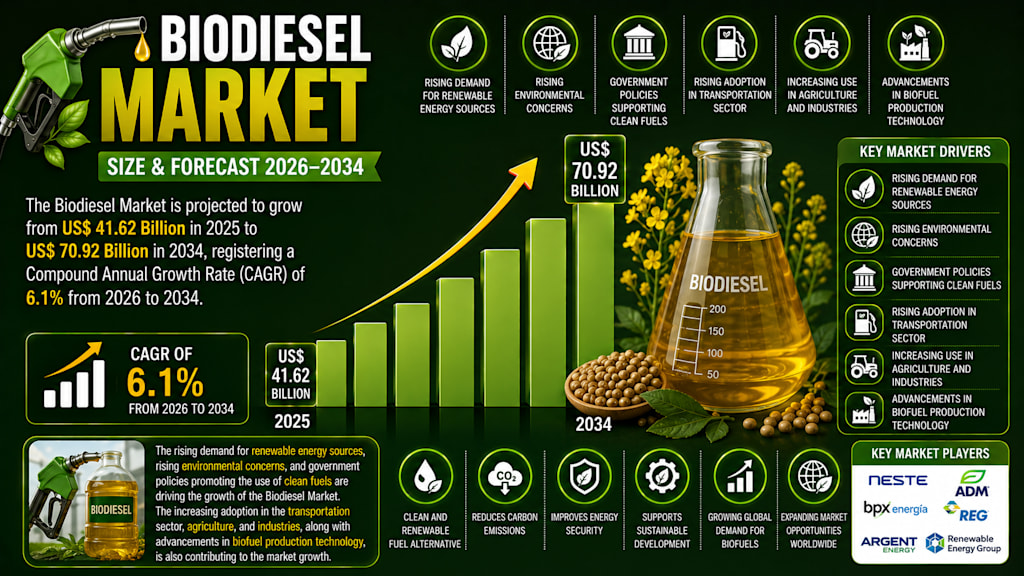
According to Renub Research, the global Biodiesel Market is projected to grow from US$ 41.62 billion in 2025 to US$ 70.92 billion by 2034, registering a compound annual growth rate (CAGR) of 6.1% between 2026 and 2034. Rising demand for renewable energy sources, increasing environmental awareness, government incentives, and expanding adoption across transportation, agriculture, and industrial sectors are among the primary factors driving market growth.
As countries continue pursuing ambitious sustainability goals, biodiesel is expected to play an increasingly important role in the global energy landscape.

Understanding Biodiesel and Its Importance
Biodiesel is a renewable and biodegradable fuel produced from natural feedstocks such as vegetable oils, animal fats, and recycled cooking oils.
The fuel is manufactured through a chemical process known as transesterification, which converts oils and fats into fatty acid methyl esters suitable for use in diesel engines.
One of biodiesel's greatest advantages is its compatibility with conventional diesel engines. It can be used either as a standalone fuel or blended with petroleum diesel without requiring significant engine modifications.
Compared to traditional fossil fuels, biodiesel generates lower greenhouse gas emissions and produces fewer harmful pollutants. It is also biodegradable and less toxic, reducing environmental risks associated with spills and fuel handling.
Because of these characteristics, biodiesel has become an attractive solution for governments and industries seeking to reduce dependence on fossil fuels while improving environmental performance.
Today, biodiesel is widely used across transportation, agriculture, logistics, manufacturing, and power generation sectors worldwide.
Rising Demand for Renewable Energy Is Driving Growth
One of the most significant factors supporting biodiesel market expansion is the growing global demand for renewable and sustainable energy sources.
As concerns regarding climate change continue intensifying, governments and corporations are under increasing pressure to reduce carbon emissions and transition toward cleaner energy systems.
Biodiesel offers a practical solution because it can significantly reduce greenhouse gas emissions compared to conventional diesel fuel. It also supports circular economy principles by utilizing renewable and waste-based feedstocks.
Industries are increasingly adopting biodiesel to meet sustainability targets, improve environmental performance, and comply with regulatory requirements.
Transportation companies, agricultural operators, logistics providers, and industrial organizations are among the leading adopters of biodiesel fuel.
In November 2024, Repsol introduced Nexa 100% Renewable Diesel, a renewable diesel product designed to maximize engine performance while reducing environmental impact. The launch reflects growing industry commitment to sustainable fuel alternatives.
As investments in renewable energy continue expanding globally, biodiesel demand is expected to increase steadily throughout the forecast period.
Government Policies and Incentives Are Supporting Adoption
Government support remains one of the most important catalysts for biodiesel market growth.
Many countries have introduced blending mandates that require fuel suppliers to incorporate specified percentages of biodiesel into conventional diesel fuel. These mandates help create stable demand while supporting national environmental objectives.
Governments also provide subsidies, tax incentives, grants, and funding programs designed to encourage biodiesel production and consumption.
Renewable fuel standards and greenhouse gas reduction policies have further strengthened market development by creating favorable regulatory environments for biofuel adoption.
Public-private partnerships are supporting investments in production facilities, distribution networks, and research initiatives focused on improving biodiesel technology.
In December 2025, Germany approved draft legislation allowing the continued use of food and animal feed products as biofuel additives to help achieve greenhouse gas reduction targets through biodiesel and bioethanol blending programs.
As governments continue prioritizing decarbonization strategies, policy support is expected to remain a major growth driver for the biodiesel industry.
Transportation Sector Continues Leading Demand
The transportation industry represents the largest application area for biodiesel worldwide.
Commercial trucks, buses, delivery fleets, agricultural machinery, construction equipment, and other diesel-powered vehicles increasingly utilize biodiesel blends to reduce emissions and improve sustainability.
One of biodiesel's key advantages is that it can often be used within existing diesel engines without extensive modifications. This allows fleet operators to transition toward cleaner fuel solutions without major infrastructure investments.
Transportation companies are adopting biodiesel to comply with emissions regulations, enhance corporate sustainability initiatives, and reduce environmental footprints.
The agricultural sector also relies heavily on biodiesel-powered equipment due to the fuel's environmental benefits and compatibility with existing machinery.
According to data referenced by the International Energy Agency, road transportation accounted for nearly all liquid biofuel demand in 2022 and is expected to remain the dominant application through 2030.
As global transportation activity continues increasing, biodiesel consumption within this sector is expected to remain strong.
Industrial and Power Generation Applications Are Expanding
Beyond transportation, biodiesel is gaining traction within industrial and power generation applications.
Many businesses use biodiesel-powered generators as backup or primary electricity sources, particularly in remote areas where access to conventional energy infrastructure may be limited.
Power generation facilities increasingly incorporate biodiesel as part of broader renewable energy strategies aimed at reducing emissions and improving sustainability.
Industrial operators also use biodiesel in heavy equipment, machinery, and manufacturing processes that rely on diesel fuel.
The ability to integrate biodiesel into existing systems without significant modifications makes it an attractive option for organizations seeking to improve environmental performance while maintaining operational efficiency.
As demand for renewable electricity and cleaner industrial energy solutions continues growing, biodiesel's role within these sectors is expected to expand further.
Vegetable Oil Feedstocks Continue Dominating Production
Vegetable oils remain the most widely used feedstocks for biodiesel production.
Common sources include soybean oil, palm oil, rapeseed oil, and sunflower oil, all of which provide favorable characteristics for biodiesel manufacturing.
Many countries promote domestic biodiesel production using locally available agricultural resources as a means of enhancing energy security and reducing dependence on imported fossil fuels.
The agricultural sector benefits from increased demand for feedstock crops, creating additional economic opportunities for farmers and rural communities.
Government initiatives supporting renewable fuels often encourage cultivation of biodiesel feedstock crops, further strengthening supply chains.
Because vegetable oils offer reliable availability and proven performance characteristics, they are expected to remain the dominant feedstock category throughout the forecast period.
Animal Fat Biodiesel Is Gaining Momentum
Animal fat-based biodiesel is emerging as an increasingly important segment within the market.
Produced from waste materials such as tallow, poultry fat, and other animal by-products, this type of biodiesel supports sustainability by converting waste streams into valuable energy resources.
Animal fat biodiesel offers environmental benefits by reducing waste disposal requirements while decreasing reliance on food-based agricultural feedstocks.
Technological advancements have significantly improved processing efficiency and fuel quality, making animal fat biodiesel more competitive with traditional alternatives.
Many organizations view waste-based biodiesel production as an important strategy for promoting circular economy principles and improving resource utilization.
As industries continue exploring sustainable fuel solutions, demand for animal fat biodiesel is expected to grow steadily.
Fuel Biodiesel Segment Remains the Largest Market
The fuel biodiesel segment continues to dominate overall market demand.
Biodiesel's ability to function as a direct replacement or supplement for conventional diesel makes it particularly attractive for transportation and logistics applications.
Key benefits include lower carbon emissions, reduced air pollutants, improved engine lubrication, and enhanced energy security.
Governments and private-sector organizations increasingly view biodiesel as a practical transitional fuel capable of supporting emissions reductions while broader electrification initiatives continue developing.
Growing demand for sustainable transportation solutions is expected to reinforce the dominance of fuel biodiesel applications in the years ahead.
High Production Costs Remain a Challenge
Despite strong growth prospects, the biodiesel industry faces several challenges.
One of the most significant obstacles involves production costs.
Feedstocks such as vegetable oils, animal fats, and recycled oils can experience substantial price fluctuations influenced by agricultural conditions, supply chain disruptions, and global commodity markets.
Higher raw material costs can reduce biodiesel's competitiveness relative to conventional petroleum diesel.
Production facilities also require specialized infrastructure, processing equipment, and technological expertise, creating additional financial barriers.
Smaller producers may face particular difficulties maintaining profitability during periods of feedstock price volatility.
Improving operational efficiency and developing alternative feedstock sources will be essential for addressing these challenges.
Feedstock Availability and Land Use Concerns
Another important challenge involves ensuring sustainable feedstock availability.
Large-scale biodiesel production depends heavily on agricultural resources, raising concerns regarding land use, food security, and environmental sustainability.
In some regions, increased demand for feedstock crops may create competition between fuel production and food production.
Environmental groups have also raised concerns regarding deforestation and habitat loss associated with expansion of certain agricultural feedstocks.
To address these issues, researchers and industry participants are exploring alternative sources such as algae, agricultural residues, waste oils, and other non-food feedstocks.
Developing sustainable feedstock strategies will be critical for supporting long-term market growth while minimizing environmental impacts.
Regional Market Insights
The United States remains one of the world's largest biodiesel markets, supported by strong government policies, abundant feedstock availability, and advanced production infrastructure. Renewable Fuel Standard requirements continue driving biodiesel adoption across transportation and agricultural sectors. In May 2025, Argus expanded its Argus Open Markets electronic price discovery service to include biodiesel trading in New York Harbor, highlighting growing market sophistication.
The United Kingdom continues expanding biodiesel adoption through renewable energy initiatives and waste-based feedstock programs. In January 2026, Corteva and bp announced the launch of Etlas, a joint venture focused on developing crops optimized for sustainable aviation fuel and renewable diesel production.
India is experiencing rapid growth driven by rising energy demand, government support for renewable fuels, and efforts to reduce fossil fuel imports. In August 2024, M11 Industries inaugurated a 450 TPD biodiesel production facility, demonstrating increasing investment in domestic biodiesel infrastructure.
Saudi Arabia is gradually expanding biodiesel development as part of broader economic diversification and renewable energy strategies. In March 2023, the country's first biofuel production facility opened in Al Jubail, marking an important milestone for the local renewable energy sector.
Competitive Landscape
Competition within the global biodiesel market continues intensifying as companies invest in production capacity, feedstock diversification, and technological innovation.
Major industry participants include Archer Daniels Midland Company, FutureFuel, Renewable Energy Group Inc., Bunge Global SA, Wilmar International, and Shell.
These organizations focus on improving production efficiency, expanding feedstock sourcing capabilities, strengthening distribution networks, and developing next-generation renewable fuel technologies.
Strategic partnerships, acquisitions, and investments in sustainable production methods are expected to remain key competitive strategies throughout the forecast period.
Final Thoughts
The global biodiesel market is becoming an increasingly important component of the worldwide transition toward cleaner and more sustainable energy systems. Rising environmental awareness, supportive government policies, and growing demand for renewable transportation fuels continue creating strong opportunities across the industry.
While challenges related to feedstock availability, production costs, and sustainability remain, ongoing technological advancements and regulatory support are helping strengthen biodiesel's position within the global energy mix.
With the market projected to grow from US$ 41.62 billion in 2025 to US$ 70.92 billion by 2034, biodiesel is poised to play a vital role in reducing greenhouse gas emissions, improving energy security, and supporting long-term sustainability objectives around the world.
About the Creator
Enjoyed the story? Support the Creator.
Subscribe for free to receive all their stories in your feed.
Comments
There are no comments for this story
Be the first to respond and start the conversation.