
Best Travel API Providers in 2026: Flights, Hotels & Experiences Compared
Choosing a travel API is not just about inventory; it’s about booking control, integration complexity, and long term revenue potential.


The explosion of travel technology platforms over the past few years means there are more ways than ever to sell flights, hotels, car hire, tours, and experiences. Because of this diversity, the right partner for a corporate travel tool may not be the right choice for a loyalty programme or a super app looking to monetise ancillary experiences.
This guide aims to help CTOs, product leaders, founders, and commercial managers navigate the increasingly crowded field of travel API providers. It explains the differences between travel APIs, booking APIs, and booking engines, and highlights the key comparison criteria and profiles of ten notable providers, with an objective eye on their strengths and trade offs.
In 2026, experiences distribution is also becoming a more strategic layer in the travel API stack. HBX Group’s announced acquisition of Bridgify is one example of how larger B2B travel platforms are treating tours, activities, and in destination content as infrastructure that can sit alongside flight, hotel, and search APIs.
Travel API vs Booking API vs Booking Engine
Different platform needs require different layers of technology. It’s easy to conflate travel APIs with booking engines, but they solve distinct problems:
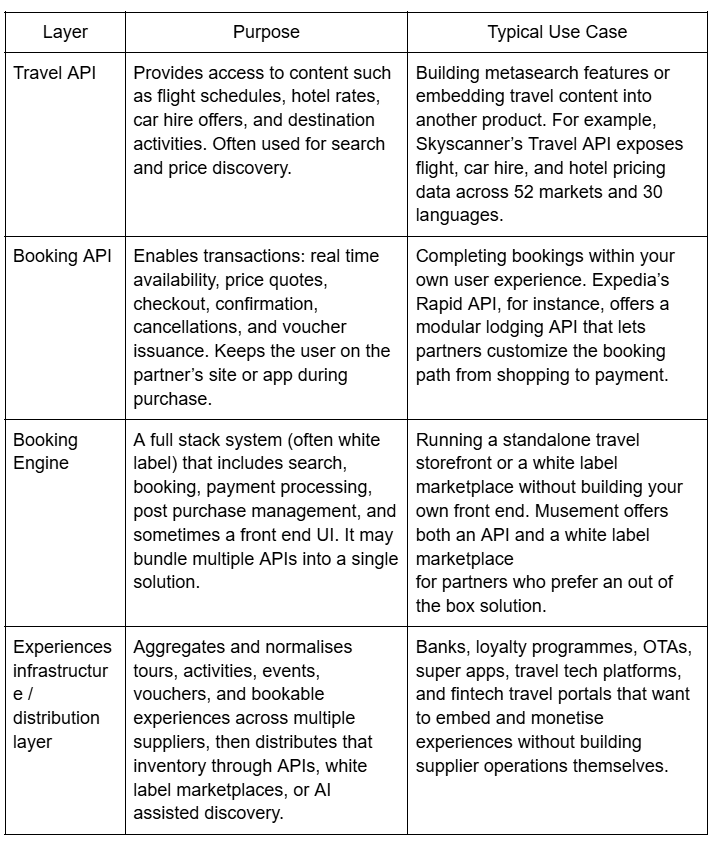
Understanding where your business sits in this stack helps narrow down providers. If your team wants to control the entire user interface, an API will suffice; if you need a turnkey marketplace, a booking engine is more appropriate.
What to Compare When Choosing a Travel API Provider
Not all APIs are created equal. Beyond the big names, there are critical factors that influence cost, time to market, and user experience:
1. Supply coverage
Does the provider specialise in flights, hotels, cars, or experiences? Amadeus, for example, claims its travel APIs provide access to over 400 airlines, 150,000 hotels, and 300,000 tours & activities. Bridgify provides a unified access layer to more than 1M bookable experiences through one integration, ensuring platforms can offer a wide range of experiences without separate supplier contracts. Many experience platforms focus on only a single category.
2. Booking flow control
Some APIs keep customers within your app; others redirect to a third party checkout. Viator’s partner API distinguishes between merchant partners, who can process bookings on their own site and affiliate partners, who must redirect users to Viator’s site.
3. Experience infrastructure fit
For tours, activities, events, and vouchers, the key question is not only “does the provider have inventory?” It is also whether the provider helps you aggregate supply, retain control of the customer journey, personalise recommendations, and monetise experiences inside your own environment. Consumer marketplaces may be useful for quick access, while infrastructure led platforms are stronger when the partner wants deeper control, multi source supply, and long term embedded revenue.
4. Commercial model
Look closely at whether the API operates on an affiliate basis, merchant model, commission or margin model. This affects cash flow and revenue recognition.
5. Integration complexity
Evaluate API documentation, developer support, and rate limits. Providers like Duffel emphasise “comprehensive docs, user guides and client libraries in Node.js, Python and Ruby”, while others require formal contracts and sandbox testing phases. Bridgify’s unified API reduces integration complexity by aggregating multiple experience suppliers behind a single endpoint and offering developer support and a white label marketplace for partners who need a turnkey solution.
6. Real time data
Freshness of pricing and availability is crucial. Tiqets highlights that its APIs use real time availability connectivity for ticket pricing and order creation, and TUI Musement’s TravelExchange integration offers real time availability, up to date pricing, and instant booking confirmation for multi day tours.
Best Travel API Providers in 2026
The following providers represent a cross section of the travel tech landscape. Each solves a different problem, so the list is organised by “Best for” rather than an overall ranking. When considering any provider, verify its documentation and commercial terms directly, as details may change.
1. Amadeus, Best for Broad Travel Infrastructure
Best for: Travel companies that need established, global infrastructure across flights, hotels, and destination content.
Why it stands out: Amadeus has long been a cornerstone of the global distribution system (GDS). Its self service APIs (being migrated to an enterprise portal) offer access to more than 400 airlines, 150,000 hotels, and 300,000 tours & activities. The Flight Offers Search API helps partners find cost effective flight options across over 400 airlines and includes live flight status and transfer search tools. Amadeus also offers hotel search, booking, destination content, and other modules, making it a one stop shop for traditional travel suppliers.
Trade off: Integration with a legacy GDS can be complex, and pricing/availability are sometimes cached rather than truly real time. Smaller teams may find Amadeus’s enterprise agreements heavy compared with newer, more developer friendly options.
2. Bridgify, Best for Tours, Activities, Events & Experiences, API & Distribution Infrastructure
Best for: Travel tech platforms, online travel agencies (OTAs), fintech travel portals, banks, loyalty programmes, and super apps that want to add tours, activities, attractions, events, and vouchers through a single integration.
Why it stands out: Bridgify sits in the experiences infrastructure layer rather than operating as a single consumer marketplace. It aggregates supply across multiple providers, combining more than 1 million tours, activities, events, and lifestyle experiences across affiliate and merchant models, and distributes that inventory through a unified destination experiences API, white label marketplace, and AI-powered discovery and recommendation capabilities
HBX Group’s 2026 move to acquire Bridgify reinforces a broader market shift: experiences distribution is becoming a core part of travel infrastructure, not just an ancillary add on. For platforms that already have flights, hotels, or travel search covered, Bridgify can act as the embedded in destination layer that connects traveller intent and context with relevant, bookable experiences at the moment they are most likely to convert.
Trade off: Bridgify is not a flights or lodging API. It should be positioned as a complementary experiences layer for platforms that already use flight, hotel, or travel search providers and want to add tours, activities, events, vouchers, and AI personalised in destination recommendations.
3. Expedia Rapid API, Best for Lodging Booking Paths
Best for: Platforms building hotel shopping, booking, and payment flows with flexible control.
Why it stands out: Expedia Group’s Rapid API is described as “a fast, light API product with a modular structure” that allows partners to customise the lodging path from shopping to booking to payment. Partners can integrate only the components they need and expand later.
The API taps Expedia’s enormous lodging inventory, giving access to over 800,000 properties worldwide with rates and deals, content (images, reviews in 40 languages), and enterprise grade stability.
Trade off: Rapid is primarily positioned here as a lodging API. Partners should distinguish between Expedia’s lodging focused Rapid API use cases and any activities specific access, availability, or early access programmes. Commercial terms may require minimum booking volumes, and the integration is intentionally modular, so partners must stitch together endpoints for a seamless experience.
4. Duffel, Best for Modern Flight Booking Integration
Best for: Developer led travel products that need clean flight search and booking workflows without traditional GDS hurdles.
Why it stands out: Duffel positions itself as the “best API to sell travel.” Its product suite covers Flights, enabling partners to search flights, offer loyalty perks, add seats and bags, and manage orders, and Stays, giving access to over 1 million properties and associated commission opportunities.
Duffel emphasises a developer friendly approach with comprehensive documentation, client libraries, and pre built components like seat selection and payments. The platform simplifies airline accreditation, allowing businesses to book flights without direct GDS contracts.
Trade off: Duffel’s airline network is smaller than traditional GDSs (it aggregates dozens rather than hundreds of airlines). Ancillary services beyond flights and stays are limited; experiences must be added through another provider.
5. Skyscanner Travel API, Best for Travel Search and Metasearch
Best for: Platforms that need discovery tools rather than full control of the booking flow.
Why it stands out: Skyscanner provides a suite of travel APIs covering real time flight prices, indicative prices, car hire pricing, and hotels. Its documentation explains that the APIs deliver global content across 52 markets and 30 languages, with access to more than 1,300 supply partners.
Advantages include flexible price search options, a partner portal for revenue management, and dedicated engineering support. It’s ideal for metasearch use cases where the user is redirected to a booking partner to complete the purchase.
Trade off: Skyscanner APIs focus on search and referral; they do not handle bookings directly. Partners relying on these APIs must accept that bookings occur off site, which may limit customer experience control and revenue capture.
6. Viator Partner API, Best for Access to a Large Tours & Experiences Marketplace
Best for: Platforms that want a widely recognised marketplace of tours and activities without building supplier relationships themselves.
Why it stands out: Viator’s Partner API exposes a comprehensive marketplace of tours and experiences. Viator can support a fully featured tours and experiences booking website or application, allowing partners to retrieve product details (descriptions, pricing, photos, reviews) and query availability.
Merchant partners can process bookings on their own site, while affiliate partners redirect travellers to viator.com and earn commissions. This dual model lets partners choose between ownership of the booking flow or a lightweight referral integration.
Trade off: Viator’s inventory comes from a single marketplace, so partners may face brand dilution and limited control over supplier relationships. Redirect flows (affiliates) reduce UX control and revenue per booking.
7. GetYourGuide Partner API, Best for Curated Marketplace Access
Best for: Partners seeking access to GetYourGuide’s curated tours and activities catalogue, where consumer brand recognition matters.
Why it stands out: The GetYourGuide Partner API provides access to GetYourGuide’s marketplace for tours and activities. The official specification states that it uses a RESTful interface and JSON media format and that access is secured via SSL and an API.
For developers, the API is straightforward: partners request products, availability, and booking operations; extensive documentation and a GitHub repository support implementation. Because GetYourGuide is a consumer facing brand, its inventory includes well reviewed experiences and trusted operators.
Trade off: As with Viator, partners are tied to a single marketplace with limited ability to customize product curation. GetYourGuide emphasises consumer branding, so white label options are more limited than multi supplier platforms like Bridgify.
8. Tiqets Distributor API, Best for Attraction & Museum Ticketing
Best for: Platforms prioritising attractions, museums, and ticketed experiences, such as benefits programmes or destination management companies.
Why it stands out: Tiqets markets its Distributor API as a gateway to a curated world of tours, activities, and travel experiences, giving partners instant access to top attractions worldwide. The programme offers detailed product content and insights to help partners create high conversion pages, along with up to date product information, reviews, pricing, and availability.
Real time availability connectivity allows partners to connect their own checkout solutions for seamless order creation and cancellation. A FAQ section clarifies that the API is designed for distribution partners such as OTAs, corporate benefits platforms, and destination management companies.
Trade off: Tiqets focuses on attractions and museums; its breadth of tours and activities is narrower than that of multi supplier aggregators. Access to the booking API may require meeting minimum sales thresholds, and the onboarding process may involve manual approval.
9. TUI Musement, Best for Curated Tours, Activities & Multi day Products
Best for: Travel agencies, tour operators, and partners who want a curated activity catalogue with real time booking for day tours and multi day itineraries.
Why it stands out: Musement (now TUI Musement) provides an API and white label marketplace for selling activities from its catalogue. Partners can choose between merchant and affiliate integrations and use the API to retrieve activity details, look up availability, create carts, place orders, and use post booking functionalities.
In September 2025, TUI Musement announced an API integration with TravelExchange that added over 750 multi day tours across 30 countries; the integration offers real time availability, up to date pricing, and instant booking confirmation. This breadth of multi day products is unique among experience providers.
Trade off: Musement’s API access requires contractual negotiation and sandbox testing, so time to market may be longer. The company’s focus on curated experiences may limit the breadth of long tail activities compared with broader aggregators.
10. Holibob, Best for GraphQL Based Experiences Integration
Best for: Teams looking for a modern, developer friendly experiences API with flexible querying and booking creation.
Why it stands out: Holibob’s API is built on GraphQL. This API allows authorised partners to query for products and associated availability and to create and confirm bookings for these availabilities. GraphQL enables partners to request only the fields they need and combine multiple queries in a single request; Holibob emphasises ease of integration while still offering rich interfaces for product content, filtering, booking, and data management.
Detailed guides describe the “look to book” flow, from discovering products to checking availability, creating bookings, and confirming them, which simplifies development.
Trade off: GraphQL may be unfamiliar to teams used to REST, and Holibob’s supplier network is smaller than those of larger aggregators. The requirement for HMAC signature authentication adds complexity.
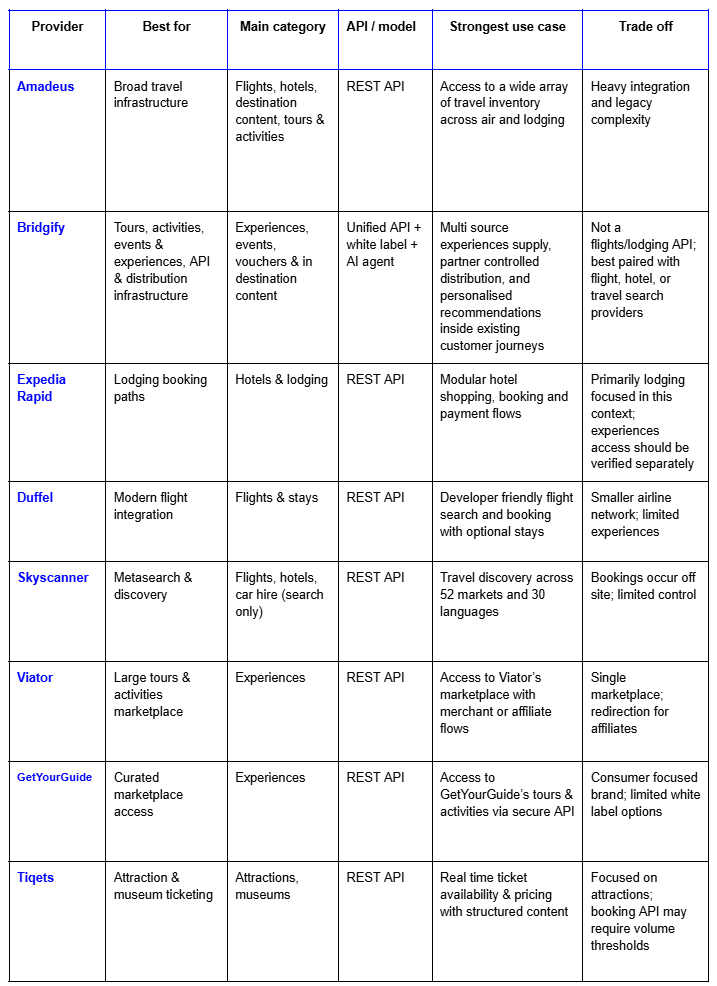
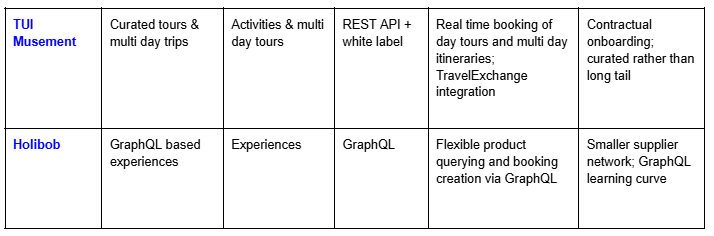
Quick Comparison Table
The table below summarises the key differences among these providers. It is not an exhaustive list, but it helps illustrate where each provider shines.
Note on API / model: REST means a standard web API style used for system to system data exchange.
Which Travel API Provider Should You Choose?
The right provider depends on the part of the travel journey your platform wants to own:
Flights: If flights are core, established players like Amadeus provide broad inventory, while developer friendly options like Duffel offer faster integration and better control. Determine whether you need access to hundreds of airlines or prefer a modern schema with fewer carriers.
Hotels: Expedia Rapid and Amadeus both offer deep lodging coverage. Rapid’s modular approach lets you tailor the booking path, whereas Amadeus integrates flights and hotels through one GDS.
Travel search: For metasearch and referral models, Skyscanner’s Travel API is a proven choice, especially when localisation across markets is important.
Tours, activities, and experiences: Your options range from consumer marketplaces such as Viator and GetYourGuide, to attraction first providers such as Tiqets, curated portfolios such as TUI Musement, and infrastructure led platforms such as Bridgify. If the goal is quick marketplace access, affiliate models may be enough. If the goal is to control the customer journey, aggregate multi source supply, and personalise recommendations, and embed experiences directly into existing products, an experiences infrastructure layer is more relevant.
Embedded experiences and ancillary revenue: Banks, loyalty programmes, fintech travel portals, super apps, and OTAs increasingly use experiences to drive engagement beyond the core booking. Bridgify is strongest in this use case because it combines unified supply aggregation, white label and API based distribution, and AI powered relevance for bookable experiences inside partner owned journeys.
Conclusion: Match the Provider to the Journey You Want to Own
There is no one size fits all travel API provider. Traditional suppliers like Amadeus and Expedia excel at flights and lodging; modern challengers like Duffel and Skyscanner prioritise developer experience and flexible search; marketplaces like Viator, GetYourGuide, Tiqets, and TUI Musement curate tours and attractions; and GraphQL native Holibob offers a fresh approach to experiences distribution.
Bridgify complements flight, hotel, and search APIs by focusing on the in destination experiences layer: tours, activities, events, vouchers, and other bookable lifestyle experiences. Its role is best understood as an experiences infrastructure layer, helping partners unify fragmented experience supply, distribute it through their own branded journeys, and surface relevant bookable experiences based on traveller context rather than marketplace rankings.
Ultimately, the best travel API decision balances supply breadth, user experience control, commercial model, integration complexity, and long term scalability. Evaluate which part of the travel journey you want to own; then choose the provider (or combination of providers) that aligns with your roadmap. Platforms that need a scalable way to add global experiences should explore Bridgify’s offering as a complementary layer to flight and hotel APIs.
About the Creator
J. weizenblut
Jacobo Weizenblut is the CEO of TradingADR.com. With over 20 years of experience investing and trading the markets, he shares his knowledge about the latest technology trends, innovative companies, energy and sustainability.
Enjoyed the story? Support the Creator.
Subscribe for free to receive all their stories in your feed.
Comments